
The notary appointment is in eleven days. The agent has the draft deed ready, the bank has approved the mortgage, and then someone in the chain asks the question you haven't prepared for: what's your NIE? You don't have one. You're not sure whether to book a police station in Spain, fly back to a consulate, or hand the whole file to a gestor and hope.
The confusing part of a NIE application in Spain isn't the form. It's that the same form leads to three different procedures depending on where you're standing, which passport you hold and why you want the number. Choose the wrong route and you lose weeks you don't have.
Table of Contents
- Who Needs an NIE and Why It Matters
- Choose Your NIE Route First
- Documents and Fee to Prepare Before You Book
- How to Apply for Your NIE Step by Step
- Processing Times and Pitfalls That Delay Applications
Who Needs an NIE and Why It Matters
The NIE is a number, not a permission. Spain's Foreigner Identity Number (Número de Identidad de Extranjero) is a personal, unique and exclusive identifier assigned to non-Spanish nationals who have economic, professional or social links with the country, as Spanish Tax Agency guidance on foreigner identification sets out. It isn't a visa and it isn't a residence permit. It's the identifier that tells the Spanish administration which foreigner it's dealing with, across tax, banking, employment and property records.
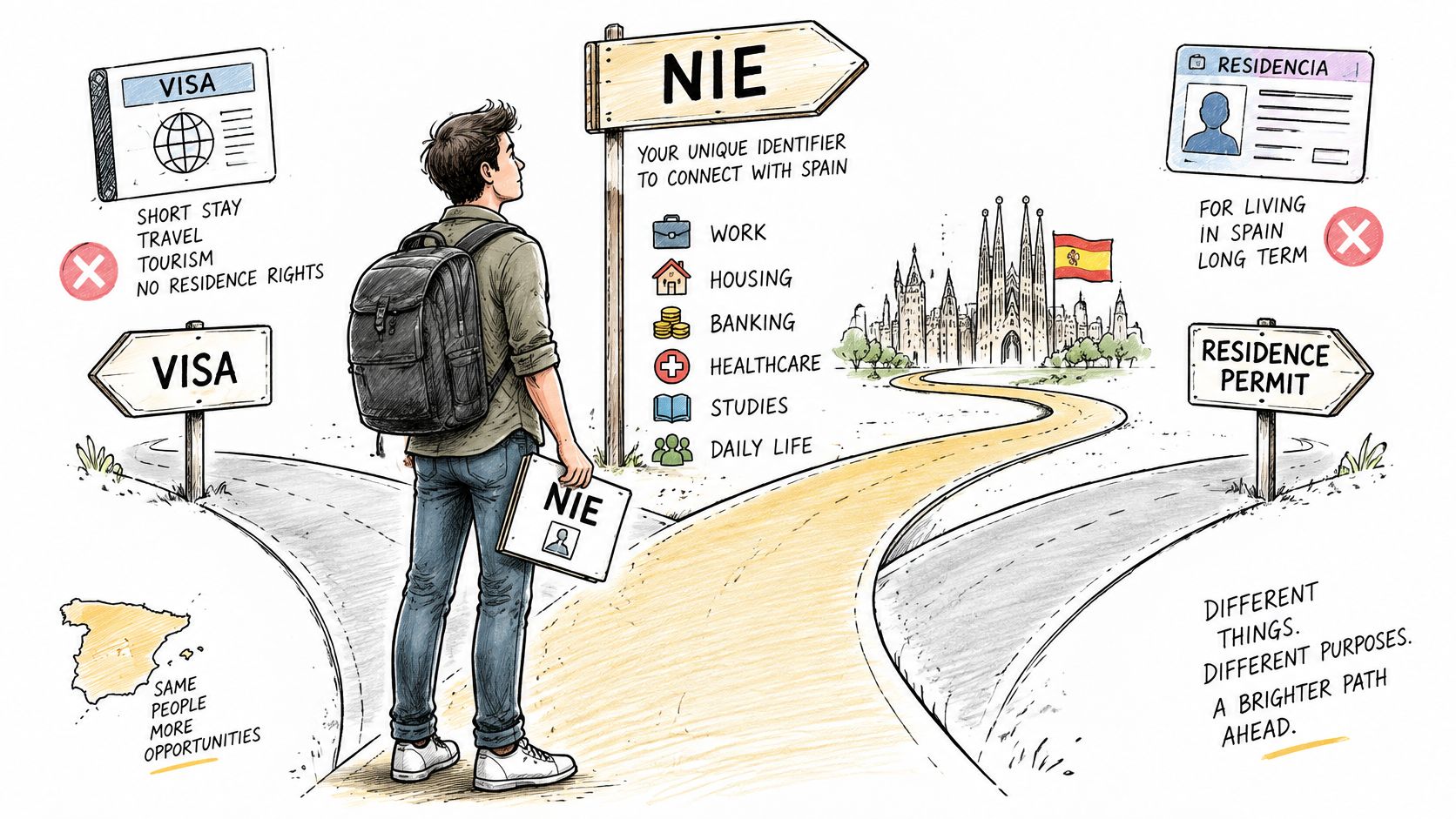
That guidance lists three situations in which the number is assigned: when a foreigner receives a document authorising them to remain in Spain other than a visa, when immigration proceedings are started, and when the person has economic, professional or social interests in the country. The third category is the one independent applicants use, and it carries two conditions. You generally need to be in a regular situation in Spain, and you must explain the reason you're asking.
Where the number shows up in practice
- Property: you can't sign a deed, pay transfer tax or register a purchase without it, which is why buyers need it before they make an offer rather than at the notary's desk.
- Banking and utilities: opening an account, arranging a mortgage, taking a phone contract.
- Work and business: signing an employment contract, registering with Social Security, incorporating a company.
- Tax and inheritance: filing returns, dealing with a Spanish estate, receiving a bequest.
The number is tied to you rather than to a document, so it survives a new passport, a new visa and a move between provinces. Keep the certificate with your residence papers and quote the number on every later form.
A retired couple buying a flat near Alicante shows why the stated reason matters. Neither of them will work in Spain, so an employment contract is irrelevant to their file. Their purpose is the property purchase and the bank account that goes with it, and the evidence is the purchase paperwork and the bank's own correspondence. Same form, different attachments.
Choose Your NIE Route First
Say you have a flat under offer in Málaga and you're still in London, with a notary asking for a date. Do you book the Foreigners' Office or the consulate? Both routes produce a number, and they are not interchangeable. Your row in the table below decides the office, the evidence and the wait.
| Situation | Where to apply | Fee | Typical timing |
|---|---|---|---|
| Non-EU applicant already in Spain | Foreigners' Office or National Police station, appointment required | €9.84 on Modelo 790, Código 012 | Set by appointment availability in your province, so book before you have a signing date |
| Applicant living abroad | Spanish consulate or diplomatic office in your country of residence | €9.84 on Modelo 790, Código 012 | Usually around two weeks, extendable for administrative reasons |
| EU/EEA/Swiss citizen registering residence | Foreigners' Office or designated police station | Not listed as a separate NIE charge, since the number comes with the registration file | Register within three months of entering Spain |
Three questions before you book
- Are you in Spain or abroad? In Spain you book with the province where you live, not the province where the property is, and not the one with the shortest queue.
- Which passport are you applying on? A UK, US or Australian passport puts you on the non-EU route. An Irish or German passport puts you on the EU registration route, and the number arrives as part of a different process.
- Does your evidence exist yet? If the answer is no, wait. A planned purchase with no signed contract, or a company that isn't incorporated, gives you nothing to attach and a reason the officer can't verify.
For EU, EEA and Swiss citizens, the number is normally issued as part of residence registration, which must be completed within three months of entering Spain according to Spanish government guidance on registering as an EU resident. That guidance also sets the bar for economically inactive applicants: sufficient resources plus public or private health insurance providing full cover in Spain, equivalent in scope to the national healthcare system. Insurance wording and territorial validity get checked, which is where Bsure Health Brokers comes in for readers working through a residency-based NIE, since we help people who need health cover for a visa or NIE, and all of our advice and support is available in English.
Pick your row, print the checklist for that route, and book the appointment for that specific office.
Documents and Fee to Prepare Before You Book
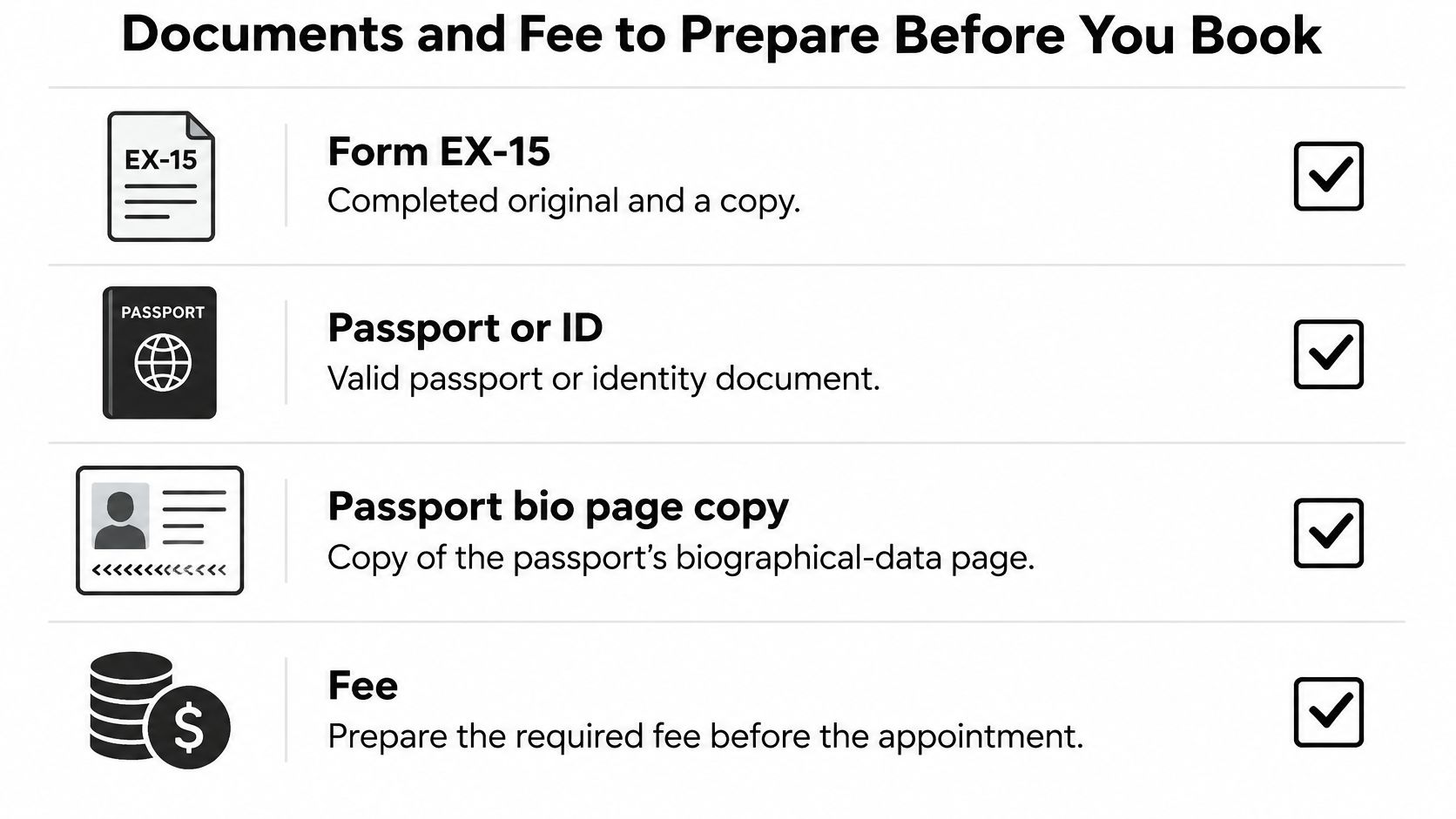
The core file is smaller than people expect, and that's exactly what makes the gaps expensive. According to Spanish consular guidance on NIE applications, you complete Form EX-15 and submit the original plus a copy, present a valid passport or identity document with a copy of the biographical-data page, and state the economic, professional or social reason for your request.
Here's the package laid out before you commit to a date.
The reason section is where files stall. The officer needs to see a genuine Spain-related purpose, and supporting evidence may be requested. Match the words on the form to the paperwork in the folder.
| Stated reason | Evidence to attach |
|---|---|
| Property purchase | Signed purchase contract or property deed |
| Company formation | Company incorporation documents |
| Tax declaration | Copy of the tax return filed |
| Banking transaction | Bank account opening or transaction record |
| Inheritance | Inheritance or estate documents |
| Employment | Job offer or employment contract |
The fee itself is modest: the same consular guidance lists the NIE-assignment fee at €9.84, paid on Modelo 790, Código 012. Pay it before the appointment and keep the stamped receipt, because some offices want to see the original receipt rather than a photocopy. Applications filed in Spain follow the same document set, with an immigration appointment and an in-person visit to a Foreigners' Office or Police Station to submit it.
If the evidence doesn't exist yet, the appointment shouldn't either.
What a consulate adds
Consular files can require something extra: proof that you live within that consulate's jurisdiction, an appointment in its own booking system, and in some cases acceptance of an application through an authorised representative. Check your consulate's page rather than assuming the Madrid rules apply.
My checklist for the day, in order:
- Originals and copies of every page, not just the ones you think matter.
- Printed appointment confirmation, since a reference on your phone may not be enough.
- The stamped fee receipt, in the same folder.
- Evidence that matches your stated reason, with a translation lined up if the office asks for one.
- A scanned set kept in the cloud, so a lost folder doesn't cost you another month. If you're photographing pages on a kitchen table, how to scan papers into PDF covers getting clean, legible files.
One folder per applicant. Couples who share a folder spend ten minutes at the window separating documents while the queue waits. And if the NIE sits at the end of a visa application, the FBI background check for a Spanish visa is often the document that sets your calendar, so start it early.
How to Apply for Your NIE Step by Step
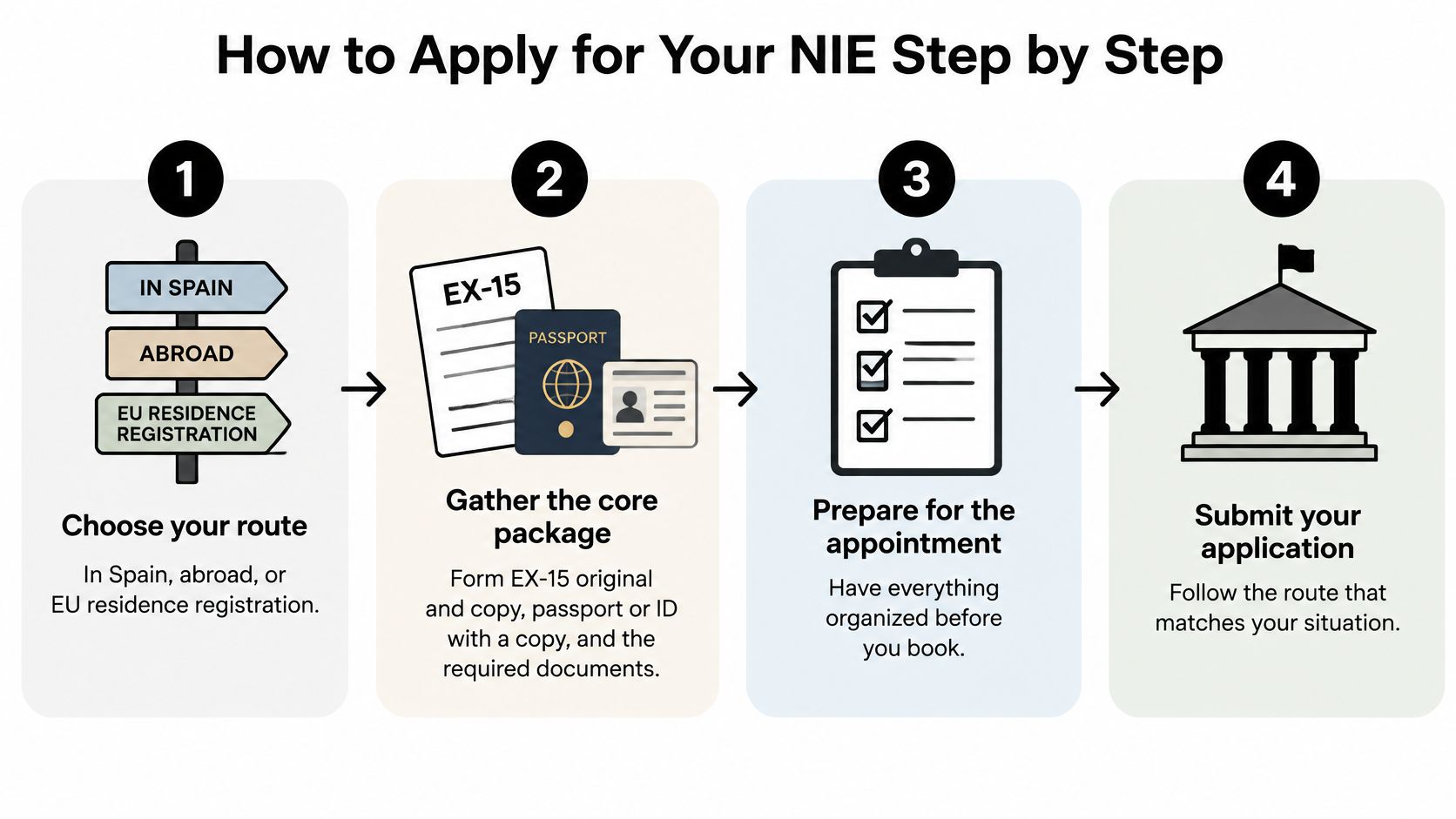
The core sequence works for every route, but steps 1, 3, 4 and 5 vary by where you apply and which passport you hold.
- Choose your route and the office that handles it. In Spain, apply through the Foreigners' Office or National Police station serving your province. Abroad, contact the Spanish consulate or diplomatic office responsible for your country of residence. EU citizens obtain their NIE through residence registration.
- Prepare the application package. Bring Form EX-15, your passport or national ID, a copy of the passport's biographical-data page, and evidence for your stated reason. Check the relevant office's requirements for originals and copies.
- Check whether a separate fee applies. For a standalone NIE request, use Modelo 790, Código 012, and keep the stamped receipt. EU citizens receive the NIE through residence registration, rather than paying a separate NIE fee.
- Book the appointment and keep its confirmation. Choose the appointment system for your route. For an application in Spain, the NIE and TIE appointment booking guide explains how to use the online booking screens. Follow the confirmation instructions for your office or consulate.
- Submit your application through the correct channel. In Spain, attend the appointment with the documents required by your office. Consulates set their own submission procedures, including whether applications are accepted in person or through a representative.
- Check the details recorded on your application. Make sure your name, nationality and stated purpose match your documents and Form EX-15. Ask about any error before leaving, if the office allows corrections on the day.
- Keep the NIE record with your other important documents. The NIE identifies you for administrative and financial procedures. It does not, by itself, prove residence status.
Where the routes split
For a consular application, check the consulate's instructions before booking. It may ask for proof that you live within its jurisdiction, use its own appointment system, or allow an application through a representative with power of attorney. Do not assume the requirements match those of an office in Spain.
EU citizens who need to live in Spain register as residents rather than applying for a standalone NIE. Depending on their circumstances, they may need to provide employment or self-employment evidence, or proof of resources and full health cover if they are not working. The registration certificate records the NIE and residence details, so keep it with your other identity and residence documents.
Processing Times and Pitfalls That Delay Applications
Plan around the calendar, not the best case. The published consular estimate is a fortnight or so and can stretch for administrative reasons, but in Spain the binding constraint is the appointment queue in your province. That queue has nothing to do with how urgent your purchase is. If a completion date, a job start or a car purchase depends on the number, begin the process before you have those dates rather than after.
The failures below are the ones that cost people a second appointment, and they're all avoidable with five minutes of checking.
| Pitfall | What Happens | How to Avoid It |
|---|---|---|
| Going to the wrong office | Application refused or delayed | Check the office for your province before booking |
| Missing copies or appointment confirmation | Officer cannot process the file on the day | Bring originals, copies and the printed confirmation |
| Vague reason for the NIE | Request rejected for lacking a clear economic, professional or social link | State one concrete purpose and attach evidence such as a property deed |
| Treating the NIE as proof of residence | Confusion over immigration status | Keep the NIE and residence documents separate in your file |
| Paying with the wrong fee form | Application cannot proceed | Use Modelo 790, Código 012 and keep the receipt |
| Assuming EU citizens get a standalone number | Missed residence registration deadline | Register within three months of entering Spain |
Two of those deserve more than a table cell. The wrong-office mistake is the most common and the most annoying, because the fix is reading your province name on the booking page instead of picking the office a friend recommended in a different region.
The translation question
Ask before you go, not at the desk. English-language documents are sometimes accepted as they are and sometimes refused, so call or email the office handling your file and ask whether a sworn translation will be needed. Bring whatever they specify, and bring a copy of it too.
Ask the office, not the forum. The answer that matters is the one from the province processing your file this month.
The wider lesson is that the NIE rewards preparation over speed. People who arrive with a coherent file, a receipt and a reason they can point to walk out with a number. People who arrive with a passport and a hope usually leave with a new appointment date and a longer wait. Once the number is in hand, keep it with your residence paperwork, use it consistently, and it stops being a problem for good.
Once your NIE is in place, the next paperwork question for most new residents is health cover that satisfies the residency file, and that's where Bsure Health Brokers does the fiddly part for you. We compare Spanish and international policies, check that the wording and cover meet what the office expects, and handle the application, renewals and updates afterwards, all in English from our Marbella office. Visit Bsure Health Brokers to tell us whether you need cover for a visa or NIE, are already resident and want a new policy, or have cover and want to switch, and we'll come back to you with options.