
What if doing the ten Spain move tasks in the wrong order costs you more time than the visa form?
Buy a policy too late and the application stalls. Request an apostille too early and it can expire before you file. Leave the NIE until after you land and a bank account, a rental contract, and insurance direct debits can fail together.
This moving abroad checklist is built as a timeline. 3 to 6 months before departure, secure the legal route and cover that satisfies residency rules. Before the flight, arrange banking, medical records, and shipping. In the first months in Spain, complete the padrón, public healthcare registration, housing, and tax steps.
If you are leaving a flat, an international relocation guide for apartment dwellers helps you decide what to store and what to ship before the quote is locked in.
Around 281 million people lived outside their country of birth, according to United Nations estimates summarised in the International Organization for Migration's 2026 World Migration Report. Rules at the destination stay specific. I recommend working the steps in order, keeping proof of every application, and not assuming a paper one consulate accepted will satisfy another office in Spain.
Table of Contents
- 1. Confirm Visa and Entry Requirements
- 2. Apply for Your NIE (Foreigner Identity Number)
- 3. Arrange Private Health Insurance Before Arrival
- 4. Register on the Padrón (Empadronamiento)
- 5. Access Public Healthcare Through the SNS
- 6. Transfer Medical Records, Prescriptions, and Medication
- 7. Open a Spanish Bank Account
- 8. Obtain a Spanish Tax Number and Understand Tax Residency
- 9. Secure Housing and Set Up Utilities
- 10. Plan the Shipment of Belongings and Official Documents
- 10-Step Spain Moving Checklist at a Glance
- Your Next Move: Ticking Off the Checklist with Expert Help
1. Confirm Visa and Entry Requirements
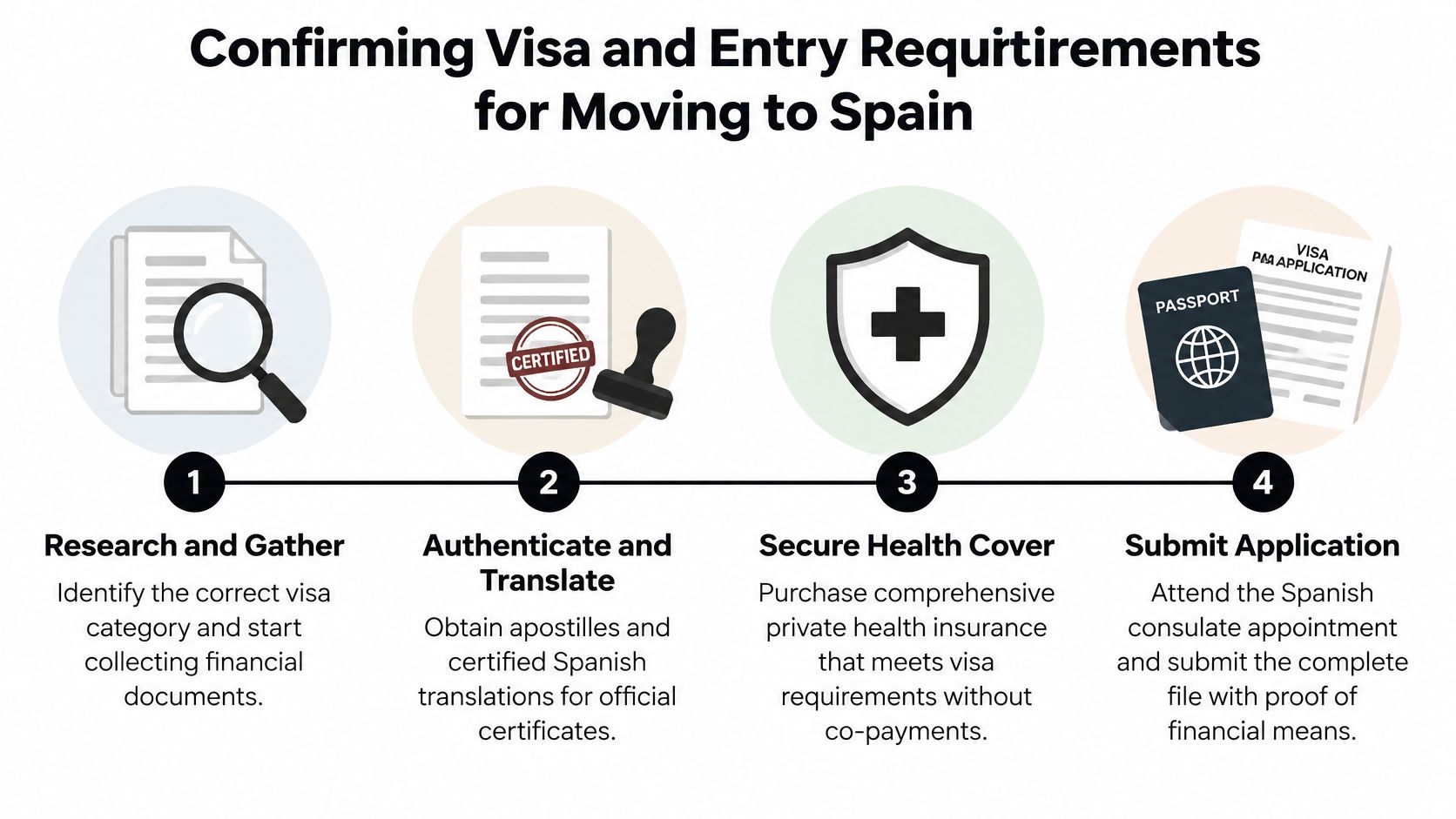
Start with the route, not the flight. A Non-Lucrative visa, a Digital Nomad visa, a work visa, and a study visa ask for different proof, and filing under the wrong category wastes months. Check the current requirements on the Spanish consulate website for your country of residence, because consulates interpret evidence differently.
Say you're a retiree applying for a Non-Lucrative visa. You'll typically submit bank statements, a pension certificate, and private health insurance confirming full cover in Spain. A remote worker on the Digital Nomad route instead proves remote employment and income. In both cases, insurance isn't an afterthought. It's part of the application pack.
Use this order before you apply:
- Confirm financial means early: Gather statements and income proof in the format your consulate requests, not a generic printout.
- Match insurance wording: We confirm a policy meets your visa's health insurance wording before you buy, because a cheap travel policy won't do.
- Apostille in sequence: Order apostilles for birth, marriage, and criminal record certificates early, but check validity windows so they don't lapse.
- Allow 3 to 6 months: Document gathering, translations, and appointment waits rarely compress into a few weeks.
2. Apply for Your NIE (Foreigner Identity Number)
Your NIE (Número de Identidad de Extranjero) opens the door to almost everything else. Banks, landlords, utility companies, the tax agency, and many insurers ask for it. Without it, routine tasks become workarounds, and some contracts won't proceed.
You can often apply at a Spanish consulate before you move, or in Spain after arrival. The trade-off is clear. Applying beforehand takes effort while you're still packing, but it removes a bottleneck during the busiest first weeks. Say a family obtains NIEs at their consulate in advance. They can open accounts and sign a rental contract immediately, instead of paying for temporary accommodation while they wait for appointments.
A property buyer faces the same logic. The NIE obtained for the purchase is later used for utilities, tax registration, and insurance paperwork, so accuracy matters from the first form.
Practical rule: Treat your NIE like a passport number. Photograph the certificate, store a digital copy securely, and quote the number exactly as printed on every form.
Bring originals and copies to appointments, even if the booking page only mentions originals. Offices regularly keep copies, and rebooking because you lacked a photocopy is a common, avoidable delay. Keep the certificate safe after issue. You'll be asked for it far more often than you expect.
3. Arrange Private Health Insurance Before Arrival
Don't confuse having insurance with being covered for what you'll need. A visa-compliant policy must satisfy residence wording, but it also needs to work when you need a specialist, a scan, or follow-up care. Compare Spanish and international plans on exclusions, waiting periods, and pre-existing condition terms, not just premium.
Spain's aggregate results look strong, yet newcomers can still struggle. Spain's 2025 health profile reports unmet medical need of 2.6% in 2024, below the EU average of 3.6% according to the European Commission's 2025 Spain health profile, but that national figure doesn't remove language, registration, or continuity problems for a new arrival.
Say you're a retiree with diabetes. You need to know whether the condition is covered, excluded, or subject to a waiting period before you commit. A family of four has a different audit: maternity, paediatrics, and renewal increases as children age.
Our guidance on getting health insurance in place quickly for a Spanish application explains the documentation insurers issue for consulates. Disclose your full medical history accurately, confirm emergency assistance and repatriation, and check age-related renewal increases now, not at the first renewal.
4. Register on the Padrón (Empadronamiento)
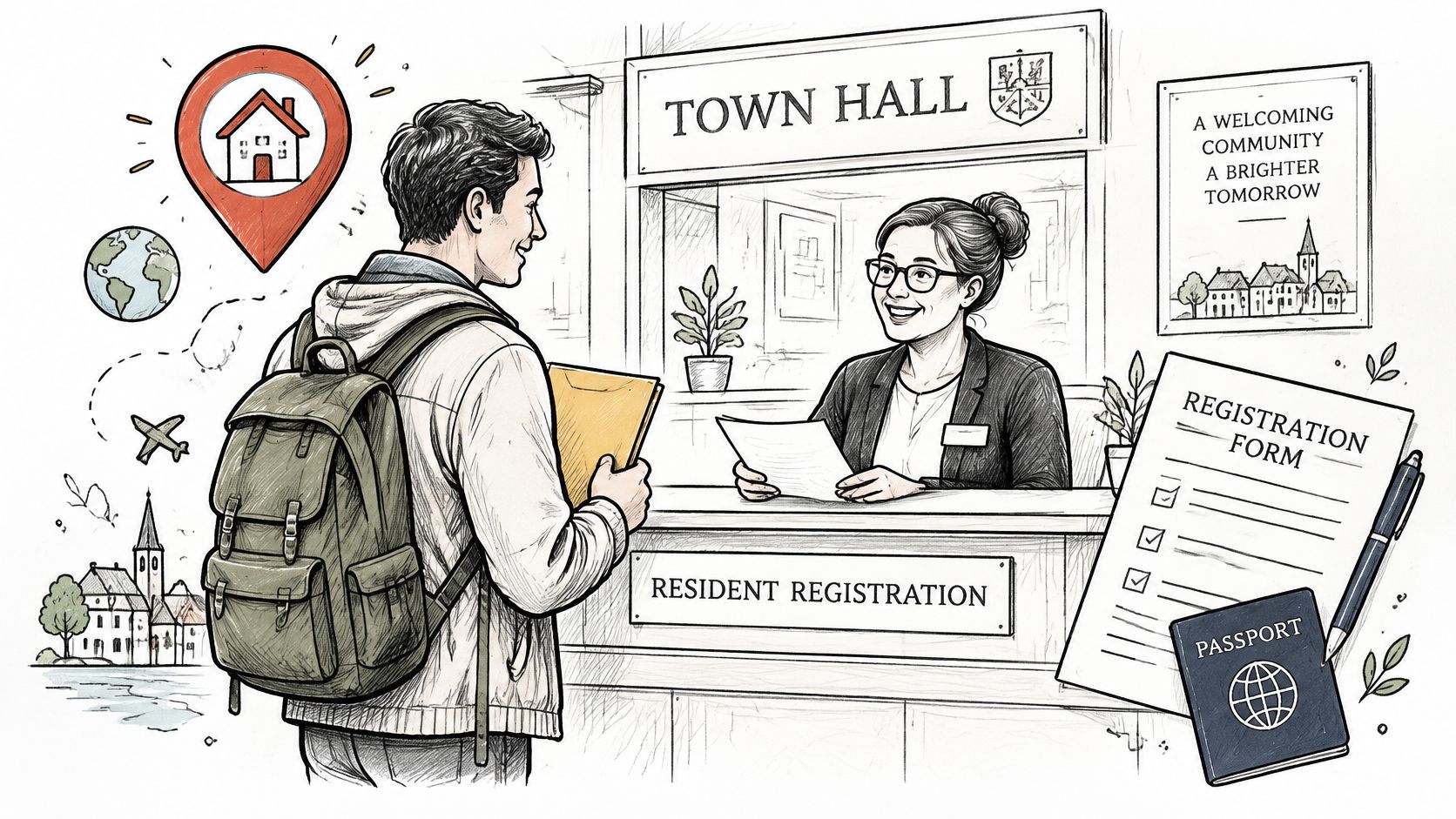
Once you have an address, register it. The padrón is your town hall's municipal register of residents, and your certificate proves where you live. Schools, health centres, and other administrative procedures rely on it, so this belongs in your first weeks, not your first year.
Registration is usually done in person at the ayuntamiento. Say you've just signed a rental contract. You attend with your passport or NIE and the contract, receive your certificate, and then use it to apply for a public health card. A family follows the same path before enrolling children in local schools, which is why housing delays quickly become schooling delays.
Book online if your town hall offers appointments, and go prepared:
- Proof of address: Bring your rental contract or property deed, plus a recent utility bill if you have one.
- Identity documents: Carry passports or NIEs for everyone you're registering, including children.
- Extra certificates: Request multiple copies so you don't queue again for the next office.
- Address changes: Update your registration promptly when you move, because an old padrón undermines later applications.
Don't treat this as optional local admin. It's the document that connects your residence status to everyday services.
5. Access Public Healthcare Through the SNS
Spain's public system, the Sistema Nacional de Salud (SNS), is tax-funded and broad, but eligibility isn't automatic on arrival. It depends on your legal residence status, padrón registration, and whether you're contributing to or covered by Social Security. Confirm your position with your regional health service before you cancel any private cover.
EU movers face a specific distinction. An EHIC is for medically necessary treatment during a temporary stay, while a Portable Document S1 is the mechanism for healthcare access after a residence move when another country remains responsible, according to the European Commission's guidance on moving and working in Europe. Using the wrong document creates a gap that only appears when you try to register.
Say you're an employee who registers at a local health centre and receives a health card. You can then book GP appointments through the regional service. Many expats still keep private insurance alongside the SNS for faster specialist access and wider provider choice.
Our overview of how Spain's healthcare system works for residents sets out the public and private routes side by side. Keep private cover active during any eligibility wait, ask about English-speaking staff locally, and save 112 for emergencies.
6. Transfer Medical Records, Prescriptions, and Medication
Do a continuity-of-care audit before you leave. That means more than packing a repeat prescription. Request a medical summary, key test results, imaging reports, vaccination records, and current prescriptions from your doctor, then have essential documents translated into Spanish.
This matters most when treatment can't pause. Say you're moving after cancer treatment. You gather oncology reports and treatment summaries, translate them, and share them with a new specialist near Marbella so follow-up doesn't restart from zero. Say you manage diabetes. You check that your insulin is available in Spain, confirm how a Spanish prescription will be issued, and carry enough supply for the first weeks.
Medications can be restricted, renamed, or prescription-only under different rules, so check with your pharmacist or doctor before you travel. Don't assume a familiar brand name means the same formulation or availability.
Your records are only useful if a Spanish clinician can read, trust, and act on them quickly.
Keep digital and physical copies, and carry medication in hand luggage with prescriptions to hand. If you're changing insurer or provider as part of the move, our guide to changing healthcare providers without losing continuity helps you time the switch around waiting periods and active treatment.
7. Open a Spanish Bank Account
You'll need a Spanish account sooner than you think. Landlords, utility companies, insurers, and tax authorities prefer local direct debits, and some won't accept foreign accounts smoothly. Open the account once you have an NIE where possible, although some banks start the process with a passport.
Money movement is a core part of relocation, not an admin extra. International remittances rose from approximately USD 128 billion to USD 831 billion between 2000 and 2022 according to the OECD International Migration Outlook 2024, which underlines how many movers must keep funds flowing between countries. Test transfers before departure and understand fees and exchange-rate spreads.
Say you're a retiree moving pension income monthly. A poor exchange rate repeated every month costs more than a slightly higher account fee. Say you're a newcomer setting up rent and insurance payments. You need direct debits working before the first premium date, not after a failed payment notice.
Compare account fees, transfer costs, online banking quality, and English-language support. Bring your NIE, passport, and proof of address, and ask directly whether the bank handles insurance premium direct debits. Keep an emergency reserve accessible from your home account until local banking is fully working, because arrival costs rarely wait for account approval.
8. Obtain a Spanish Tax Number and Understand Tax Residency
Tax residency follows days and ties, not intentions. Spending more than 183 days in Spain in a calendar year generally makes you tax resident, and that changes how income is taxed and reported. Register for your NIF (Número de Identificación Fiscal) with the Agencia Tributaria early, often alongside your NIE process.
Say you're a retiree with pensions from another country. You need advice on which pension is taxed in Spain under the relevant double taxation agreement before you file, not after an assessment arrives. Say you hold overseas accounts or investments. You may face the Modelo 720 declaration for foreign assets above reporting thresholds, with deadlines that carry penalties if missed.
We recommend recording these items from day one:
- Days in each country: Keep travel dates, boarding passes, and entry records in one file.
- Income sources: List pensions, rent, dividends, and remote work income by country of origin.
- Foreign assets: Note accounts, property, and investments that could trigger reporting.
- Professional advice: Consult a Spanish asesor fiscal if income comes from multiple countries.
Wealth tax also varies by region, so where you settle affects what you pay. Getting advice before your first filing season is cheaper than correcting returns later, and far less stressful.
9. Secure Housing and Set Up Utilities
Rent first if you don't know the area well. Buying quickly feels decisive, but neighbourhood noise, winter damp, school routes, and healthcare access only reveal themselves over time. A year renting while you assess districts is usually money well spent.
Spanish rentals typically require an NIE or passport, proof of income, and a deposit, and some landlords request guarantors. Read the contract carefully and ask for an English translation if your Spanish isn't strong enough to catch notice periods, deposit terms, and who pays for repairs. Confirm which utilities are included, because headline rent can exclude electricity, water, gas, internet, and community fees.
Say a couple signs a townhouse lease and sets up electricity and internet the same week. They also photograph the property, agree an inventory with the landlord, and register the address on the padrón immediately. That sequence prevents disputes about damage and unblocks school and healthcare registration.

Budget for duplicated costs if completion slips. Temporary accommodation overlapping with a deposit and first month's rent is common, and it's easier to absorb when you've planned for it.
10. Plan the Shipment of Belongings and Official Documents
Shipping is where paperwork meets physics. Household goods, vehicles, and pets all move under customs rules, and a missing inventory or proof of residence can hold a container while storage charges accumulate. Non-EU movers may benefit from exemptions for personal effects, but you'll usually need an itemised inventory and evidence supporting the move.
Say a family ships household goods in a sea container. They list items with values, photograph high-value pieces, and keep the inventory consistent with customs forms. If you need to explore cross-border freight solutions, compare written quotes that specify customs handling, insurance, delivery access, and storage, not just transport.
Documents need the same discipline. Birth and marriage certificates, degrees, and driving licences may require an apostille and certified translation for use in Spain. Say you're applying for jobs. An apostilled, translated degree obtained before departure saves weeks compared with requesting it from abroad.
Check pet vaccination and microchipping requirements early, and confirm whether your driving licence can be exchanged or requires re-testing. Pack essentials, medication, chargers, and key documents to travel with you. Your shipment may arrive later than you do, and your first fortnight shouldn't depend on a container schedule.
10-Step Spain Moving Checklist at a Glance
| Checklist Item | Best Timing | Key Requirement | Difficulty |
|---|---|---|---|
| Confirm Visa and Entry Requirements | 3–6 months before moving | Select the correct visa and prepare required financial, insurance, and certified documents | High |
| Apply for Your NIE (Foreigner Identity Number) | Before moving, if possible | Apply with identification and supporting documents explaining why you need an NIE | Moderate |
| Arrange Private Health Insurance Before Arrival | Before applying for a visa or travelling | Choose cover that meets visa rules and accounts for exclusions and waiting periods | Moderate |
| Register on the Padrón (Empadronamiento) | Soon after securing an address | Register with the town hall using proof of identity and address | Low |
| Access Public Healthcare Through the SNS | After establishing residence and checking eligibility | Confirm eligibility and apply for a regional health card | Moderate |
| Transfer Medical Records, Prescriptions, and Medication | Before departure | Gather medical records and confirm medication availability and prescription requirements | Moderate |
| Open a Spanish Bank Account | After obtaining an NIE or establishing an address | Provide identification and proof of address; check fees and direct-debit options | Moderate |
| Obtain a Spanish Tax Number and Understand Tax Residency | Early after arrival, before tax obligations arise | Obtain a NIF and assess tax residency, reporting, and filing requirements | High |
| Secure Housing and Set Up Utilities | Before or soon after arrival | Arrange accommodation and required documents, then set up utilities | Moderate |
| Plan the Shipment of Belongings and Official Documents | Several months before moving | Check customs and import rules, prepare an inventory, and arrange required apostilles and translations | High |
Your Next Move: Ticking Off the Checklist with Expert Help
Work through these ten steps in order and relocation becomes a sequence of manageable tasks. Visa and NIE first. Health insurance before you apply, not after a consulate rejects incomplete paperwork. Then padrón, banking, housing, utilities, and tax registration in your first months, with medical records and shipping arranged so they don't collide with arrival admin.
Plan for friction anyway. Bureaucratic delay isn't just an inconvenience. It's a financial and healthcare risk when access to services depends on a registration that hasn't completed. In Spain, 55% of respondents disagreed that local paperwork and authorities are easy to deal with according to InterNations Expat Insider 2025 for Spain, even though most respondents rated medical care positively once they could access it. That gap is exactly where a timed moving abroad checklist earns its keep.
Build your own first-90-days contingency into every step. Keep proof of applications and appointments. Carry translated civil and medical documents. Retain valid cover from your departure country where you're permitted to do so, and hold enough accessible cash for temporary accommodation, consultations, or a second set of fees. If one office asks for a certificate you requested weeks earlier, you'll be glad you asked for duplicates.
Where Specialist Help Actually Helps
Health insurance is the step that causes the most sequencing errors because it serves two masters. It has to satisfy a consulate or residence application on paper, and it has to give you usable treatment after arrival. A policy can meet the first test and fail the second if exclusions, waiting periods, or provider networks don't match your health history, age, or region.
That's where we can step in if you want support. We're Bsure Health Brokers, based in Marbella and serving expats across Spain since 1989. We're a DGSFP-registered brokerage, and our English-speaking team compares Spanish and international insurers for visa- and NIE-compliant cover, including family plans, retiree policies, and options that consider serious pre-existing conditions. We ask key questions about your circumstances before recommending a company, and we consider family discounts, international cover, waiting times, and the cover required for residency in Spain.
Our help covers people who need cover for a visa or NIE, residents taking out a new policy, and residents switching provider. All advice and support are available in English, with documentation in Spanish and available in English as well. We handle setup, paperwork, renewals, and ongoing support end to end, so you're not decoding policy wording alone while also chasing a padrón appointment.
Start with step 1 this week, even if your move is months away. Confirm your visa route with your consulate, list every document you'll need, and date each one. Then work forward in order, checking off each item only when you hold the evidence in hand. A move to Spain rewards people who respect sequence, and it penalises people who assume paperwork will sort itself out after landing.
If your visa or NIE application depends on compliant private health cover, we at Bsure Health Brokers will compare Spanish and international policies for your age, health history, and residence route, then handle the paperwork and renewals for you. Tell us whether you need cover for a visa or NIE, a new policy as a resident, or a switch from an existing provider, and we'll help you tick the insurance step off your checklist before you apply.