
You and your partner have the house valued and a sunny coast circled in a magazine. Then the consulate writes back. The residency file will not move until you show private health cover with no co-payments and no waiting periods. The policy you had never priced is now the thing that stalls the move.
That gap is common, and the interest behind it is large. A 2025 Harris Poll, reported by Investopedia, found that 44% of Americans had seriously considered retiring abroad, while 14% were actively planning or contemplating an overseas move within the following two years. Wanting the move is not the same as clearing the file.
The best places to retire abroad are the ones that accept your pension or other passive income, tell you what cover you need on day one, and still insure you if you already have cancer, diabetes, or heart disease. Lifestyle comes after those gates. If you are also checking what treatment a clinic may legally offer once you land, the Dream Body Clinic guide to treatment rules is a reminder that local law, not a brochure, decides what you can buy.
Rank a country on four questions. Does a residency route take your income type? Is private cover required before you arrive? How are pre-existing conditions and age loadings handled? What does the specific town cost once rent, drugs, and tax are in? The ten stops below are judged in that order.
Table of Contents
- 1. Spain (Costa del Sol and Marbella)
- 2. Portugal (Algarve, Lisbon and Porto)
- 3. Malta
- 4. Cyprus (Paphos, Limassol and Larnaca)
- 5. Greece (Athens, Crete and the Islands)
- 6. Mexico (Lake Chapala, San Miguel de Allende and Mérida)
- 7. Costa Rica
- 8. Panama (Panama City, Boquete and Coronado)
- 9. Thailand (Chiang Mai, Bangkok and Phuket)
- 10. Malaysia (Penang, Kuala Lumpur and Johor Bahru)
- How the top retirement destinations compare on residency, healthcare and expat base
- Build Your Shortlist Around Visa and Cover, Then Test Daily Life
1. Spain (Costa del Sol and Marbella)
Ask a consulate what stalls a Spanish retirement file and the answer is usually insurance, not income. That gate, more than the climate, explains why so many British and Northern European retirees end up in Marbella, Mijas, Estepona, and Nerja.
In InterNations' 2025 Quality of Life Index, Spain ranked first overall, and 83% of surveyed expats viewed healthcare as affordable, against 59% globally. The same reporting cites an OECD benchmark: Spain covers the whole population for a core set of services, and only 1.7% of residents reported unmet healthcare needs, against an OECD average of 3.4%.
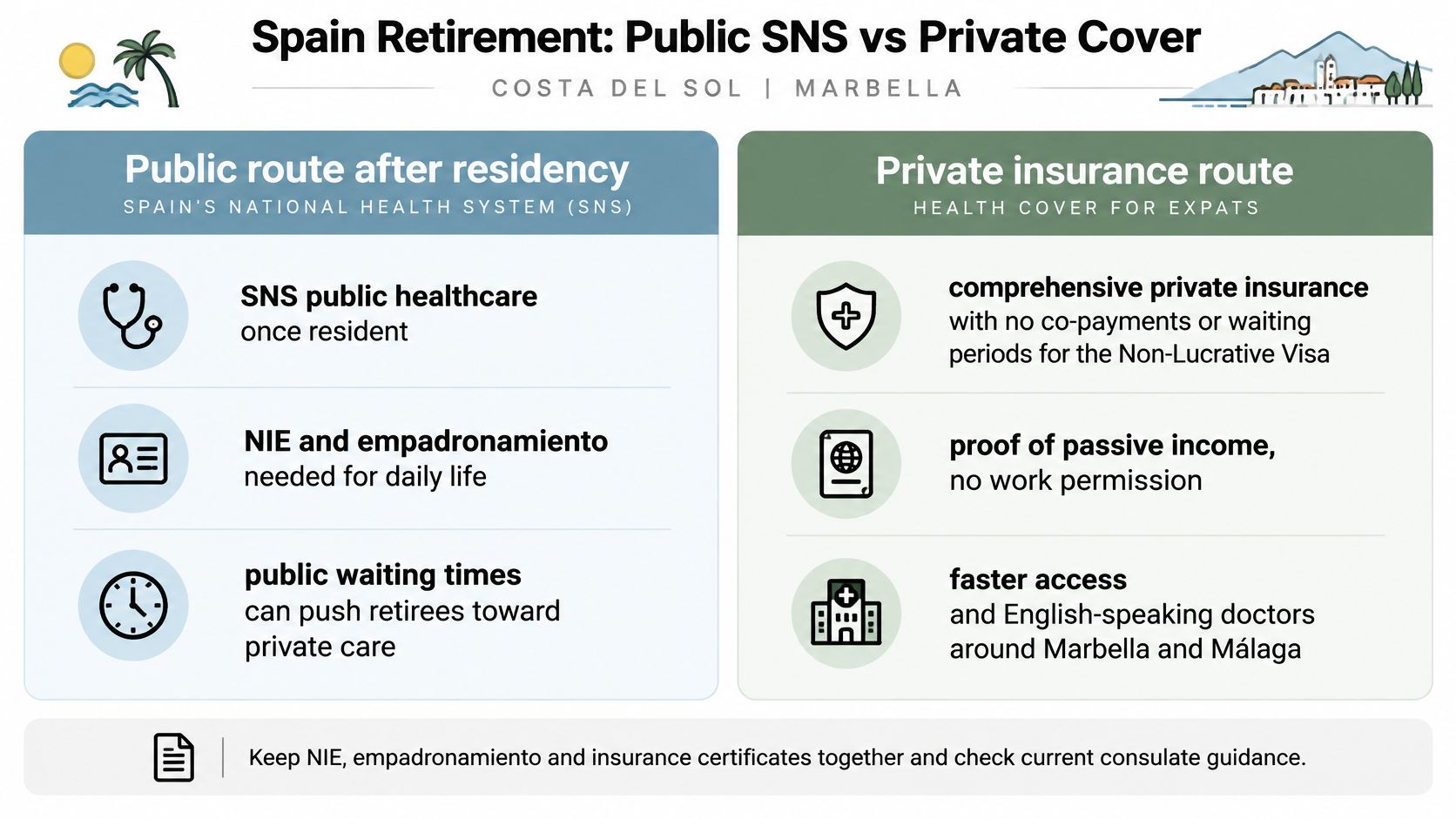
Non-EU retirees generally apply through a passive-income residence route, most often the Non-Lucrative Visa. Consulates typically ask for proof of income together with a private health policy taken out in Spain before they approve the file, so the policy has to exist before the residency does. Registration for the public system comes after residency is granted, which means private cover carries the early months. Many people with cancer or diabetes keep a Spanish private policy even after registering, because specialist slots and English-speaking doctors are easier to reach that way.
What to fix before you pay a premium
- Match the visa wording: A travel plan with an excess will not satisfy a consulate asking for full cover.
- Read the age steps: Ask what the premium does after 65 and again after 75, not only the first-year price.
- Keep one folder: NIE, padrón certificate, and the insurance certificate belong together at every renewal.
Bsure Health Brokers, a brokerage based in Marbella and operating across Spain, compares Spanish and international policies for people who need health insurance for retirees under 65 as well as older applicants, including cover that meets residency rules and plans that can consider serious pre-existing conditions. A couple heading to Estepona should get the hospital list in writing before they sign.
2. Portugal (Algarve, Lisbon and Porto)
Portugal's gate is the D7 passive-income visa. A steady pension or investment income is the usual proof. Tax treatment for new residents has shifted more than once, so get current advice before you treat an old forum post as the rule.
Legal residents can use the public SNS. Expats in Lagos, Tavira, Lisbon, and Porto still keep private cover, often at CUF or Lusíadas, because specialist access is faster and repatriation is easier to arrange. Say you arrive on a UK pension, register at the local centro de saúde once you have a NIF and residence card, and keep the private policy until you know the public waiting time for your own condition.

Coastal rents in the Algarve are not the bargain the country-level averages suggest. Price the town, not the country.
Practical rule: Buy a policy that names repatriation and your chronic condition before you book the D7 appointment. Public registration does not replace that document.
3. Malta
Malta works when you want English as an official language and a small British community, not when you want a cheap large-country hospital network. Non-EU pensioners look at the Malta Retirement Programme. It is an income-and-property route. Thresholds, qualifying pension rules, and fees change, so read the current criteria with a licensed adviser before you reserve a flat in Sliema or St Julian's.
Public hospitals are modern. Specialist waits can still be long. Private clinics fill that gap, and you should have the policy in force before you apply, not after a GP visit goes badly. Gozo is quieter and often cheaper. It is also farther from the main private capacity, so test the ferry and the clinic list in person.
How insurers treat the island
Ask three questions in writing. Does the plan accept your pre-existing condition on Malta? Does it renew after 70 without a new medical? Which private hospitals in Malta, not "Europe", are in network? A pensioner who only checks the public emergency department will be fine for a fracture and stuck for a planned cardiology review.
4. Cyprus (Paphos, Limassol and Larnaca)
British retirees cluster in Paphos and around Limassol because English goes far and the winter is mild. Non-EU applicants use pension-based residence schemes. The income floor and the document list are not stable year to year. Confirm them with a licensed adviser before you transfer a deposit.
The public system is GESY. Rollout for residents is real, and so is the private hospital network in Limassol, Nicosia, and Paphos. The move that fails is dropping private cover the week GESY registration is approved. You want a policy that still pays private specialists while the public file is opening, and you want renewal terms that do not explode because you turned 75.
Visit in winter, not in a June fortnight. Summer crowds hide slow buses, shut clinics, and rents that only look fair in August.
5. Greece (Athens, Crete and the Islands)
Greece takes non-EU retirees on a national visa built around passive income, including pensions. The minimum is set in the rules for that route. Do not budget from a blog that quotes last year's figure.
Legal residents can use EOPYY. Private hospitals in Athens and Thessaloniki, and solid clinics on Crete, are where expats book specialists. Island living in Corfu or Rhodes is the lifestyle. It is a poor plan if your cardiologist is only in Athens and your policy will not pay the flight or the mainland admission.
What breaks island retirements
- Language at the counter: Basic Greek gets a residence stamp moving. English does not run every clinic outside Athens.
- Paper expiry: A lapsed permit or a lapsed policy can block both public registration and a private admission.
- Geography: Choose cover that pays specialists on the mainland and includes repatriation, not a plan limited to one island clinic.
Go in November. August will not show you the closed pharmacy or the winter ferry.
6. Mexico (Lake Chapala, San Miguel de Allende and Mérida)
Mexico is the close option for Americans and Canadians who want a lower daily cost and a large retiree town. Temporary or permanent residence is built on pension or investment income. Use a licensed immigration adviser. A tourist stamp is not a retirement plan.
Medicare does not generally cover care received outside the United States, which is why American retirees have to arrange local insurance or a host-country system before they rely on a hospital in Guadalajara or Mérida, a point set out in TheStreet's look at affordable retirement abroad. Nearly half of U.S. adults worry about affording medication or healthcare, and 38% of surveyed American expatriates cited cheaper or better healthcare as a reason they considered leaving. That motive only helps if the policy pays in Mexico.
Public IMSS can be joined voluntarily in some cases, with age and health limits you must check. Expats in San Miguel de Allende, Lake Chapala, and Mérida mostly use private hospitals. Quality drops fast once you leave those hubs.

Keep the policy, the hospital list, and your records in English and Spanish. Add repatriation if you want a U.S. or Canadian bed for a major event. Check security street by street, not by country brand.
7. Costa Rica
The pensionado category is a lifetime-pension route, with tax exemptions on some income once you qualify. Confirm the current pension proof and the document list before you sell anything. A licensed local attorney should file it. Forum screenshots go stale.
Residents can join the public CCSS (often called the CAJA). Many North Americans in Escazú, Atenas, and the Central Valley still hold private insurance because specialist slots in San José move faster. That mix fails when the private plan excludes the condition you already have, or when the CAJA will not take you on the timetable you assumed.
A country with a strong public system is a poor fit if you cannot join it, or if your specialist only works in a private hospital the policy will not pay.
We compare international health insurance for people whose move is not only a Spanish visa, including plans that have to travel with a chronic condition. Spend a month in the town in the rainy season before you call it home. Coastal expat strips cost more, and a specialist visit can mean a drive to San José.
8. Panama (Panama City, Boquete and Coronado)
Panama is built around retirees in a way most "sunny" lists are not. InterNations' 2025 Expat Insider survey, in the Expat Insider 2025 report, found that 35% of respondents in Panama were already retired, against 11% globally, and the country ranked third in the survey's overall index after 16th in 2024. The healthcare subcategory ranked 36th. Only 45% rated healthcare quality positively, against 67% globally.
That split is the decision. Pensionado status can bring discounts on some medical services, utilities, and travel, and the U.S. dollar is the official currency, which simplifies a dollar pension. Private hospitals in Panama City are the serious option. Clinics in Boquete and Coronado cover routine care. They are not a full substitute if you need frequent specialist work.
Use a registered local attorney for the pensionado file, and confirm the current pension proof and discount rules yourself. Pick the town for hospital distance first, climate second. A policy should pay in Panama and should say what repatriation costs when Panama City is not enough.
9. Thailand (Chiang Mai, Bangkok and Phuket)
Thailand is a hospital destination with a visa attached, not a beach with a clinic nearby. The usual route is the Non-Immigrant O-A, tied to age plus income or a bank deposit, with extensions if you still qualify. Check the current figures with a Thai embassy. Old baht amounts circulate for years after they change.
Bumrungrad and Bangkok Hospital are the names expats use for serious care. Chiang Mai and Phuket have large communities and good private hospitals. Complex work still often means Bangkok. Private bills are not "cheap" once you need a long admission, and many policies exclude the condition you already have or cap cancer drugs.
Before you fund a Thai bank account
- Hospitalisation in Thailand: The certificate should name inpatient cover in Thai private hospitals, not a home-country network only.
- Pre-existing terms: Get the exclusion, the waiting period, and the annual limit in one email.
- Records: Carry English copies. A new consultant will not wait for your old GP to fax.
Family visits need a health plan of their own. The mosquito guidance for families visiting Thailand covers a risk residents stop noticing. For the retiree policy itself, compare international health insurance for Thailand against evacuation, co-payments, and whether the plan still renews after a claim.
10. Malaysia (Penang, Kuala Lumpur and Johor Bahru)

Malaysia clears the first retiree gates better than many low-cost options: English is widely usable, private hospitals in Kuala Lumpur and Penang are strong, and daily costs undercut Western Europe. The hard gate is Malaysia My Second Home, revised with higher financial deposits and income tests than older guides quote. Treat pension evidence, fixed deposits and renewal terms as one file, and use only the current official criteria.
The health gate is narrower. Public care is cheaper for residents, but a retiree who wants a named specialist still needs private cover that pays those hospitals, states any pre-existing exclusion in plain language and says how premiums rise with age. Tax residency is separate from the visa; plan before 183 days in the country makes the question real.
Penang suits food, a walkable centre and lower rents than central Kuala Lumpur. Johor Bahru is for Singapore access and a different hospital map.
Spend one week with a clinic appointment in the city you would use before the MM2H deposit goes in.
How the top retirement destinations compare on residency, healthcare and expat base
| Item | Main residency route | Healthcare access | Typical expat base |
|---|---|---|---|
| Spain (Costa del Sol and Marbella) | Non-Lucrative Visa based on passive income | Public SNS for residents; private cover often used | Marbella, Mijas, Estepona, Nerja |
| Portugal (Algarve, Lisbon and Porto) | D7 visa based on passive income | Public SNS for legal residents; private hospitals also used | Algarve, Lisbon, Porto |
| Malta | Malta Retirement Programme | Public hospitals and private clinics; private cover often used | St Julian's, Sliema, Gozo |
| Cyprus (Paphos, Limassol and Larnaca) | Pension-based residence schemes for non-EU retirees | GESY public system and private hospitals | Paphos, Limassol, Larnaca |
| Greece (Athens, Crete and the Islands) | Residence based on passive income | Public EOPYY system; private care in major cities | Athens, Crete, Corfu, Rhodes |
| Mexico (Lake Chapala, San Miguel de Allende and Mérida) | Temporary or permanent residency based on pension or income | IMSS public coverage and private hospitals | Lake Chapala, San Miguel de Allende, Mérida |
| Costa Rica | Pensionado residency based on a qualifying lifetime pension | CCSS public system and private facilities | Escazú, Atenas, Central Valley |
| Panama (Panama City, Boquete and Coronado) | Pensionado visa based on qualifying pension income | Public care for residents and modern private hospitals | Panama City, Boquete, Coronado |
| Thailand (Chiang Mai, Bangkok and Phuket) | Non-Immigrant O-A retirement visa | Private hospitals; insurance is important | Chiang Mai, Bangkok, Phuket |
| Malaysia (Penang, Kuala Lumpur and Johor Bahru) | Malaysia My Second Home programme | Public care and well-regarded private hospitals | Penang, Kuala Lumpur, Johor Bahru |
Build Your Shortlist Around Visa and Cover, Then Test Daily Life
Cut ten countries to three before you compare beaches. Work in a fixed order, and drop a place as soon as one gate fails.
Income first. Your pension, annuity, or other passive income has to match that country's residency route. A salary you no longer earn, or a house you plan to sell later, often does not count. Write the evidence the consulate wants, then check the figure against this year's rule, not a saved PDF.
Policy shape second. If the visa wants private cover with no co-payments and no waiting periods, a cheap travel plan fails the file. We look for plans that meet residency-visa rules, including insurance for residence, and we set that requirement beside family discounts, international cover, and low wait times before we recommend a contract.
Your medical history third. Age loadings after 65, and again later, change the budget more than a cheaper rent. Pre-existing cancer or diabetes can mean a decline, a loading, or a permanent exclusion. We support those complex cases and compare quotes for serious preconditions, including national plans, family plans, cover for people over 65 and over 70, and international plans. Bsure Health Brokers has done this work from Marbella since 1989, as a DGSFP-registered brokerage, because too many people moving to Spain were sold policies that did not meet the visa or the care they needed.
The town fourth. Country averages hide the rent in Marbella, Lagos, or Penang. Price a specific flat, a specific GP, and a specific pharmacy.
Then stay at least two weeks outside peak season. Walk to a clinic. Price a month of groceries. Call home the way you would call every Sunday. The best ways to call family abroad are part of the actual monthly bill, not a tech extra. If Spain is on the shortlist, an independent broker such as Bsure Health Brokers can compare Spanish and international policies against the visa wording before you commit, at no cost to you. People moving for a visa or NIE, and residents who already need a new policy or a switch, can start from those three situations. We have seen files succeed when the policy was chosen for the consulate and the condition, and stall when the sunshine was chosen first.
Bsure Health Brokers compares Spanish and international health plans for retirees and expats, including visa and NIE cover, policies for people over 65, and options that take serious pre-existing conditions into account. If Spain is on your list, that comparison is the practical next step before you pay a premium or book a flight. Visit Bsure Health Brokers and tell us whether you need cover for a visa, a new resident policy, or a switch.