
You're on the phone with a Spanish insurer, a landlord, or a courier, and the conversation stalls on one simple detail. You know the address matters, but you don't have it, or you need to say that you don't have someone else's. That tiny gap can turn into a very awkward pause in Spain, especially when the person on the other end expects paperwork to match exactly.
If you searched for i don't have your address in spanish, you probably need more than a literal translation. You need the version that sounds natural, polite, and safe to use in real admin moments, not just in a textbook exercise. In Spain, that usually means knowing when to use tu or su, when dirección is enough, and when the paperwork is really asking for domicilio. For visa-related paperwork, even the details around identity and documents can get specific fast, which is why resources like this guide to FBI background checks for a Spanish visa can be useful when the address question is part of a bigger application.
Table of Contents
- Why This Phrase Matters More Than You Think
- The Core Translation and the Grammar Behind It
- Formal and Informal Variants You Should Know
- Pronunciation You Can Use Right Now
- Real Dialogues and Email Templates for Expats
- Common Mistakes and How to Avoid Them
- Quick-Reference Cheat Sheet and Final Tips
Why This Phrase Matters More Than You Think
A courier rings your bell and asks for the address again. Your insurer wants the address on file before they issue documents. A visa form asks for domicilio, and the receptionist wants to know whether that's your home address, your correspondence address, or the place where you can receive mail. These are not classroom moments. They're the kind of tiny language decisions that decide whether something gets delivered, processed, or delayed.
In Spanish, address is not just a word you translate once and forget. The same core noun, dirección, can point to a street address, a work address, or even a web or email address, so the word is broad enough to create confusion in admin settings. That's why a sentence as simple as No tengo tu dirección can matter in insurance calls, logistics, and healthcare paperwork. It's also why getting the tone right is part of the job, not a bonus.
A lot of learners only want the direct phrase, but the core need is more practical. You're trying to say the right thing to the right person in a way that fits Spanish expectations in Spain, where formal and informal speech still shape how people handle forms, deliveries, and official communication. If you're dealing with health insurance or admin documents, the paperwork often depends on exact details, not a loose paraphrase, so getting the wording right helps you avoid another round of emails.
Practical rule: when the issue is missing an address, think about the relationship first, then the noun. The grammar comes after the social context.
The Core Translation and the Grammar Behind It
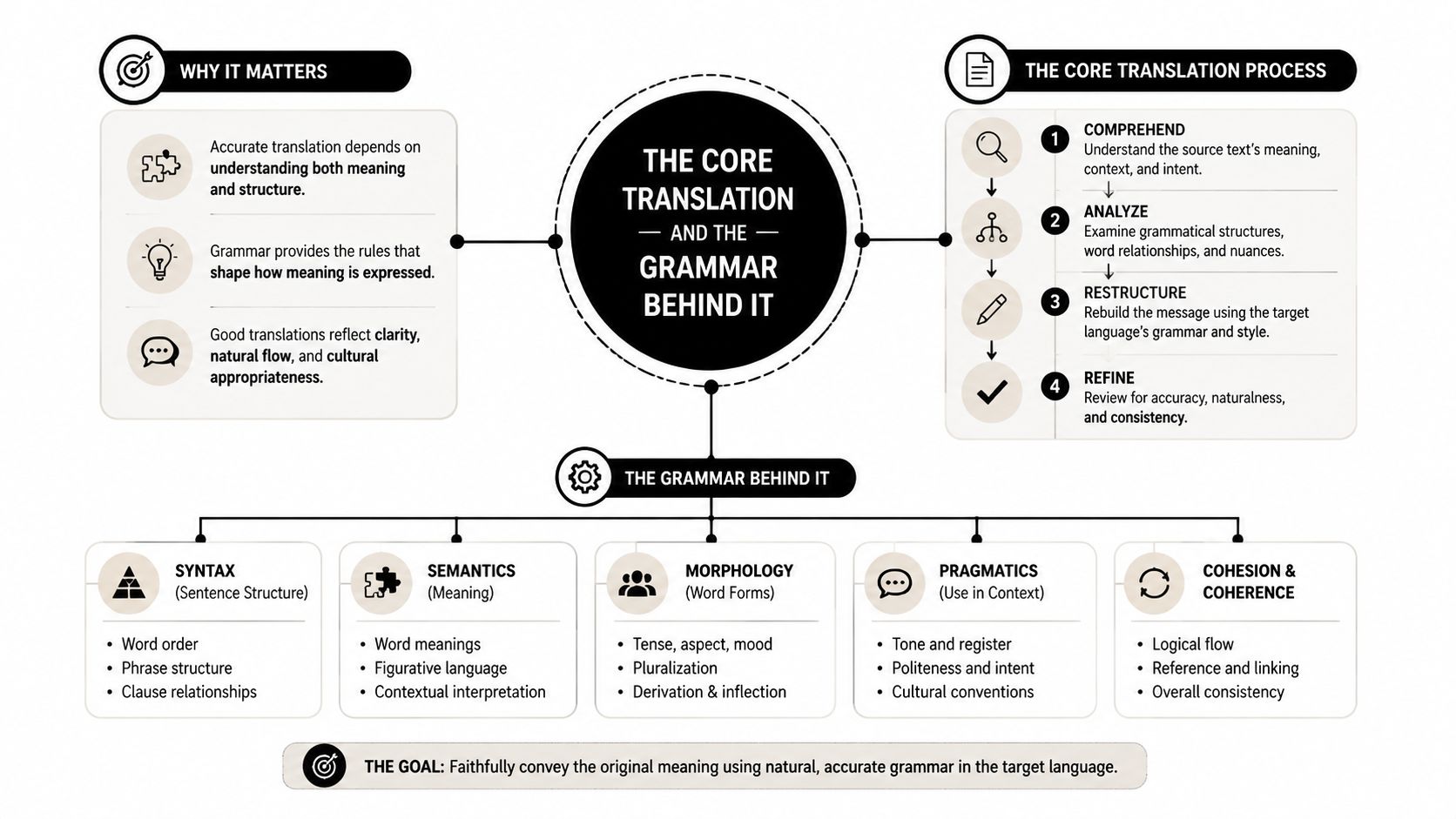
The direct translation of “I don't have your address” is No tengo tu dirección in informal Spanish, or No tengo su dirección in a more formal setting, as reflected in major Spanish dictionary guidance on dirección as the standard word for address in both postal and digital contexts (Cambridge English-Spanish dictionary entry for address). The verb tener means to have, and no tengo means I don't have. Spanish usually leaves out the subject pronoun yo, because the verb ending already makes the subject clear.
What dirección covers in everyday Spanish
Dirección is doing a lot of work here. It can mean the place where someone lives or works, and it's also the normal term for a web address or email address in Spanish dictionaries such as Cambridge and Collins. That wide range is exactly why the same word appears in housing forms, customer service messages, and digital contact fields.
If you're translating by instinct, that breadth can be confusing. But in practice, the sentence structure is simple:
- No tengo means I don't have
- tu means your in informal speech
- su means your in formal speech
- dirección means address
So the sentence doesn't need extra decoration. It needs the right relationship marker. That's the part many learners skip.
Why the pronoun changes the tone
Spanish uses tú and usted to signal whether the exchange is relaxed or respectful. In a text to a friend, No tengo tu dirección feels normal and direct. In an email to a clinic, an insurer, or a landlord, No tengo su dirección sounds more appropriate because it keeps the tone polite.
For readers who think in communication systems rather than grammar terms, this is a good place to understand what language localization is. A literal translation can be correct and still feel wrong if it ignores context, register, and the social setting of the conversation.
Formal and Informal Variants You Should Know
A real address exchange in Spain often starts with tone, not vocabulary. In a text to a friend, No tengo tu dirección sounds natural and plain. In an email to a clinic, an insurer, a landlord, or a front desk agent, No tengo su dirección fits better because Spanish politeness usually runs through usted, not just through softer wording.
The question form changes for the same reason. If someone asks whether you have their address, the informal reply is ¿No tienes mi dirección?, while the formal reply is ¿No tiene mi dirección?. If you need to ask for the address back, the common forms are ¿Cuál es tu dirección? and ¿Cuál es su dirección?. That distinction is easy to miss in basic vocabulary lists, even though it shows up constantly in paperwork, customer service calls, and registration forms. For a wider guide to address words in Spanish, see Spanish Learning Lab on home and email address in Spanish.
| Choosing the Right Form of “I Don't Have Your Address” | |||
|---|---|---|---|
| Phrase | Formality | Use With | Common Context |
| No tengo tu dirección | Informal | Friends, family, peers | Texts, casual calls, everyday conversation |
| No tengo su dirección | Formal | Officials, clients, doctors, strangers | Email, front desk, insurance, paperwork |
| ¿Cuál es tu dirección? | Informal | Someone you know well | Asking for a delivery or home address |
| ¿Cuál es su dirección? | Formal | Someone you do not know well | Office, hospital, bank, service desk |
Dirección versus domicilio in paperwork
Learners often pause at dirección and domicilio because the two words are not always interchangeable. Dirección is the broad, everyday word, while domicilio appears more often in formal paperwork and usually points to a registered or habitual address. If a form asks for domicilio, treat it as a field about official residence or correspondence, not just any place where mail could be sent.
That difference matters in visas, health insurance enrollment, and other administrative situations where the person reading the form needs to know exactly which address you mean. It also explains why a sentence can be grammatically correct and still feel off if the register is wrong. For a practical reference on address vocabulary, including the kinds of places and fields where the word appears, the ParrotApp vocabulary guide on address in Spanish is useful.
If you need to refuse a request or set a boundary while staying polite, the same formal and informal split applies, which is also why learners benefit from related guidance such as how to say no confidently in Spanish. The sentence choice does the social work for you, the same way a clear subject line helps a Spanish email feel appropriately framed before anyone even reads the details.
Use this test: if the message sounds like paperwork, lean formal. If it sounds like a friend helping you sort a delivery, informal is fine.
Pronunciation You Can Use Right Now
If you are standing at a front desk, on a phone call, or filling out a form and need to say you do not have someone's address, the safest move is to keep the sentence simple and let the stress do the work. No tengo tu dirección sounds like noh TEHN-goh too dee-rehk-SYOHN, and No tengo su dirección sounds like noh TEHN-goh soo dee-rehk-SYOHN. If you are asking for the address instead of stating the problem, ¿Cuál es tu dirección? sounds like kwal ehs too dee-rehk-SYOHN?
The part that usually feels odd to English speakers
Dirección carries the stress on the final syllable, -ción, so that ending needs the strongest push in the word. In parts of Spain, the c before i or e can come out with a soft th-like sound, so the pronunciation may shift a little depending on where you are. That is normal, and it will not usually block understanding.
What matters most is the shape of the sentence. Spanish listeners are used to hearing slightly different accents, especially in admin settings where people are just trying to exchange an address, confirm contact details, or finish a form. A clear sentence with the right stress is better than a perfect accent with the wrong rhythm.
If you need a real-world listening aid for calls and voice notes, a Spanish transcription guide can help you catch how addresses are said in spoken Spanish. If you are dealing with appointment requests, the wording can also come up in a clinic or front-desk context, so having a clear way to ask for the address can save you from awkward back-and-forth. A practical example is the kind of message you might send while arranging paperwork through a TIE appointment guide, where the address exchange has to sound polite and direct.
Keep the rhythm calm, and do not overthink the accent. Native speakers usually understand rough pronunciation more easily than words with the stress placed in the wrong place.
Real Dialogues and Email Templates for Expats
When you're handling visas, insurance, account setup, or front-desk admin, the phrase has to fit a real exchange. People asking for this wording often need it for visas, insurance enrollment, or account setup, not just casual conversation. That's why generic address guides often fall short, since they may explain address formats without really answering how to request the missing address politely or what to do when only an email, domicilio, or temporary correspondence address is available (ParrotApp vocabulary guide on address in Spanish). For speech-heavy situations, a Spanish transcription guide can also help you slow down and notice the exact wording people use on calls.

Delivery or courier call
Spanish:
No tengo tu dirección. ¿Me la puedes enviar por mensaje, por favor?
English:
I don't have your address. Can you send it to me by message, please?
That version feels natural in a delivery context because it's short and practical. If the person is a courier or a business contact, switch to su if you need more distance: No tengo su dirección. ¿Me la puede enviar por mensaje, por favor?
Health insurance or appointment admin
If you're updating records for a provider, use the formal version.
Spanish:
No tengo su dirección en el sistema. ¿Me la puede confirmar, por favor?
English:
I don't have your address in the system. Could you confirm it, please?
If you're dealing with appointment logistics, the same language works well for confirming contact details tied to medical admin, including coordination around a TIE appointment. The tone stays respectful, but the request still sounds human.
Email template you can copy
Asunto: Confirmación de dirección
Estimado/a [nombre],
No tengo su dirección. ¿Podría enviármela, por favor?
Necesito confirmarla para actualizar los datos.
Muchas gracias.
Un saludo,
[Tu nombre]
That email is useful because it doesn't over-explain. It tells the recipient what you need, why you need it, and how to reply. In Spanish admin culture, that kind of clarity saves back-and-forth.
Common Mistakes and How to Avoid Them
The most common errors here are small, but they sound off to a native speaker. The first is mixing tu and su inside the same message. The second is assuming dirección only means a postal address, when it can also cover digital addresses. The third is reaching for the wrong verb because English uses “address” in a broader way than Spanish does.
Google's location tools are a useful reminder that address data has to be handled carefully, because browser permission, the blue dot, and map errors all affect whether a location is correct. Google notes that if location details seem wrong, reloading the browser, checking permissions, or restarting the computer can help, and Spanish guidance on home location also points users toward verifying the map pin and, when needed, the official cadastre because map data can contain errors (Google Maps help on location and map errors).
The fix is usually simple:
- Match the pronoun to the relationship: use tu for familiar situations and su for formal ones.
- Use dirección broadly: don't limit it to just one kind of address.
- Use domicilio when the form or institution asks for it: that usually signals a more official address field.
- Don't force an English-style literal translation: Spanish already has its own way to ask and confirm.
- Drop the subject pronoun unless you really need emphasis: tengo already tells the listener who the subject is.
For visa and health-insurance paperwork, the details can get especially annoying, so a checklist like this one on common Spanish visa health insurance mistakes can keep you from missing a form requirement while you focus on the language itself.
Quick-Reference Cheat Sheet and Final Tips
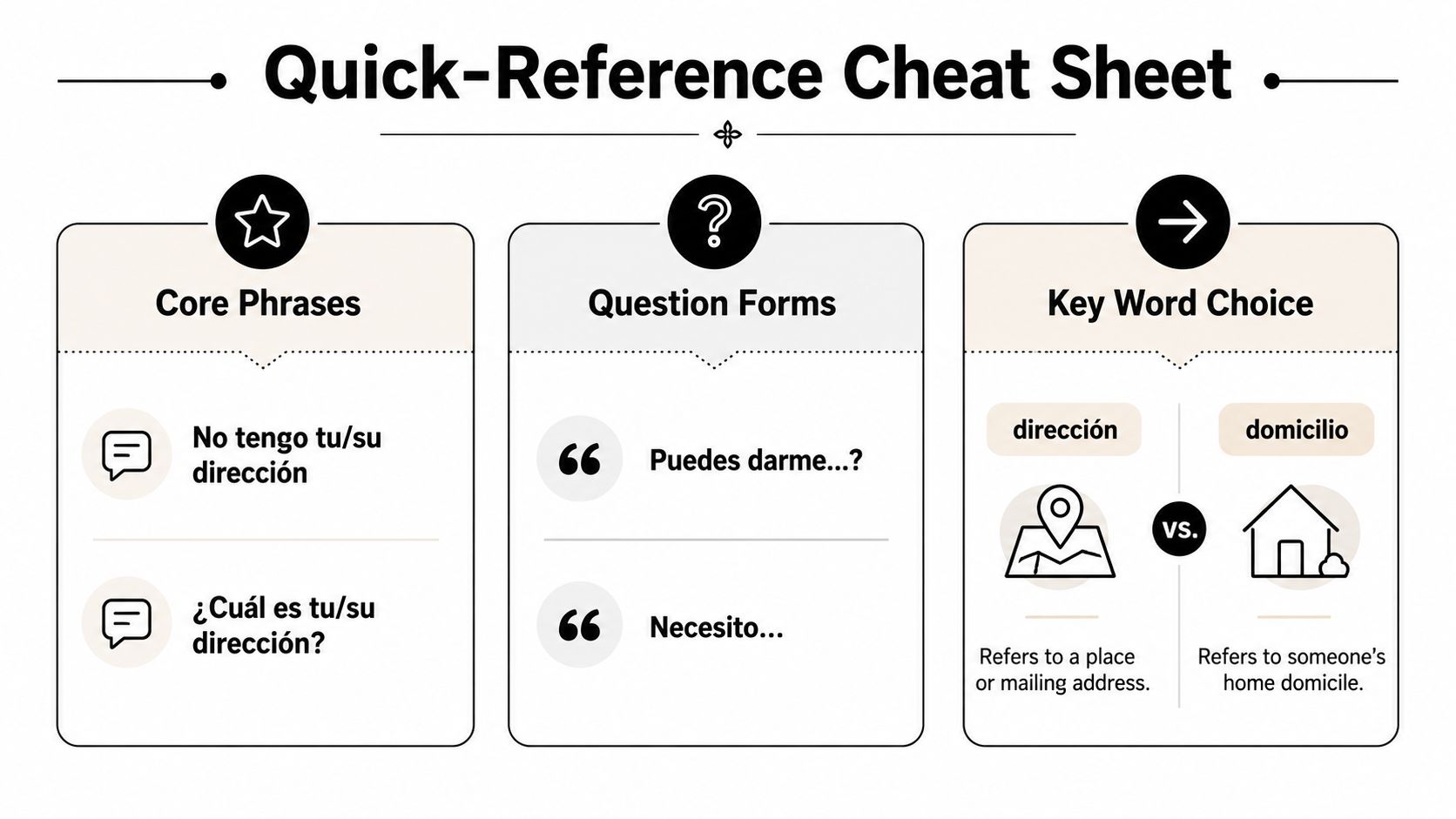
Core phrase: No tengo tu dirección.
Formal version: No tengo su dirección.
Question form: ¿Cuál es tu dirección? or ¿Cuál es su dirección?
Paperwork word: domicilio when the form wants an official or habitual address.
Think of address in Spain as identity data, not just a sentence. It shows up on invoices, prescriptions, visa files, and policy documents, so getting it right matters more than it seems at first glance. My best advice is simple. Ask for the address in writing, confirm the postal code, and check your own address against official records before you send anything out.
If you're sorting health cover, visa paperwork, or expat admin in Spain, Bsure Health Brokers can help make the process feel less opaque. Visit Bsure Health Brokers if you want clear guidance on Spanish health insurance and the documents that usually come with it.