
You're staring at a better policy, a cleaner hospital network, maybe a lower monthly premium, and the old plan still has you boxed in. If you live in Spain on a visa or residency permit, the implications are higher than price alone. A bad switch can mean paperwork headaches, treatment delays, or a non-compliant policy that puts your legal status at risk.
Table of Contents
- Why Switching Health Insurance in Spain Is Different
- Your Eligibility and Timing for a Switch
- The Hidden Risks of Switching Insurers
- The Correct Switching Process Step by Step
- Maintaining Visa and NIE Compliance When You Switch
- Your Pre-Switch Checklist and Action Plan
- When to Use a Broker for a Stress-Free Switch
Why Switching Health Insurance in Spain Is Different
If you're an expat in Spain, you already know the worst part of insurance isn't choosing a plan. It's deciding whether you can safely leave the one you've got. In the U.S. individual market, mid-year switching is usually limited to a Special Enrollment Period after a qualifying life event, and the typical enrollment window is 60 days, with many years using December 15 as the deadline for coverage starting January 1, according to Healthcare.gov's enrollment guidance. That framework exists to control timing. Spain works differently, because private medical cover is usually built around annual contracts, renewal dates, and insurer-specific rules.
That difference matters. A U.S.-style answer like “wait for a qualifying event” doesn't solve your actual problem if your Spanish policy renews automatically, your visa depends on compliant cover, or your new plan looks better but starts waiting periods again. National switching patterns also show that people often change plans because life circumstances change, not because they suddenly feel like shopping. A U.S. study found 12.8% of nonelderly Americans with employer coverage switched health plans in 2010, down from 17.2% in 2003, and about 5% switched because of a job change (NIHCR research brief). The point is simple, switching is usually forced by real-world logistics.
Practical rule: in Spain, treat health insurance like a contract first and a product second. If you don't know the renewal date, the cancellation notice requirement, and the visa rules, don't cancel anything yet.
For expats, the core issue is not just “Can I switch?” It's “Can I switch without losing continuity, breaking my residence requirements, or creating a gap that costs me more later?” That's why the Spanish process needs its own playbook, not recycled generic advice. If you also need to understand how public coverage fits into the picture, start with Social Security in Spain.
Your Eligibility and Timing for a Switch
Your first question is not which insurer looks cheapest. It's whether your current policy is inside its cancellation window. Most Spanish private health plans run on annual contracts, and the practical rule is straightforward, if you miss the cancellation notice period, the policy often renews for another year. That's why people feel trapped. They aren't imagining it, they're dealing with contract mechanics.
Know the notice date before you do anything
Do not assume you can cancel whenever you want. Check the policy conditions and look for the renewal date, the automatic renewal clause, and the notice period. If your contract requires written cancellation before renewal, send that notice early enough that there's no argument about timing. Late notice is where people get stuck paying for another year they didn't want.
If the insurer can say your notice arrived too late, they usually will.
The serious mistake is cancelling first and shopping later. You want the new policy approved, confirmed, and dated before the old one ends. That sequence protects you from being uninsured for even a day, which matters for both medical access and residency paperwork.
Understand the exceptions, but don't count on them
Mid-year exits are possible in limited situations, but they're the exception, not the plan. If your insurer changes the terms, if underwriting produces a different result than expected, or if a policy is not suitable for your residency status, you need to review the actual wording, not internet folklore. For the medical side of the process, what underwriting means in Spanish health insurance is the right place to clarify why one application is approved cleanly while another comes back with conditions.
A clean switch starts with timing discipline. If you're within the allowed cancellation window, act. If you're not, stop and reassess before sending anything.
The Hidden Risks of Switching Insurers
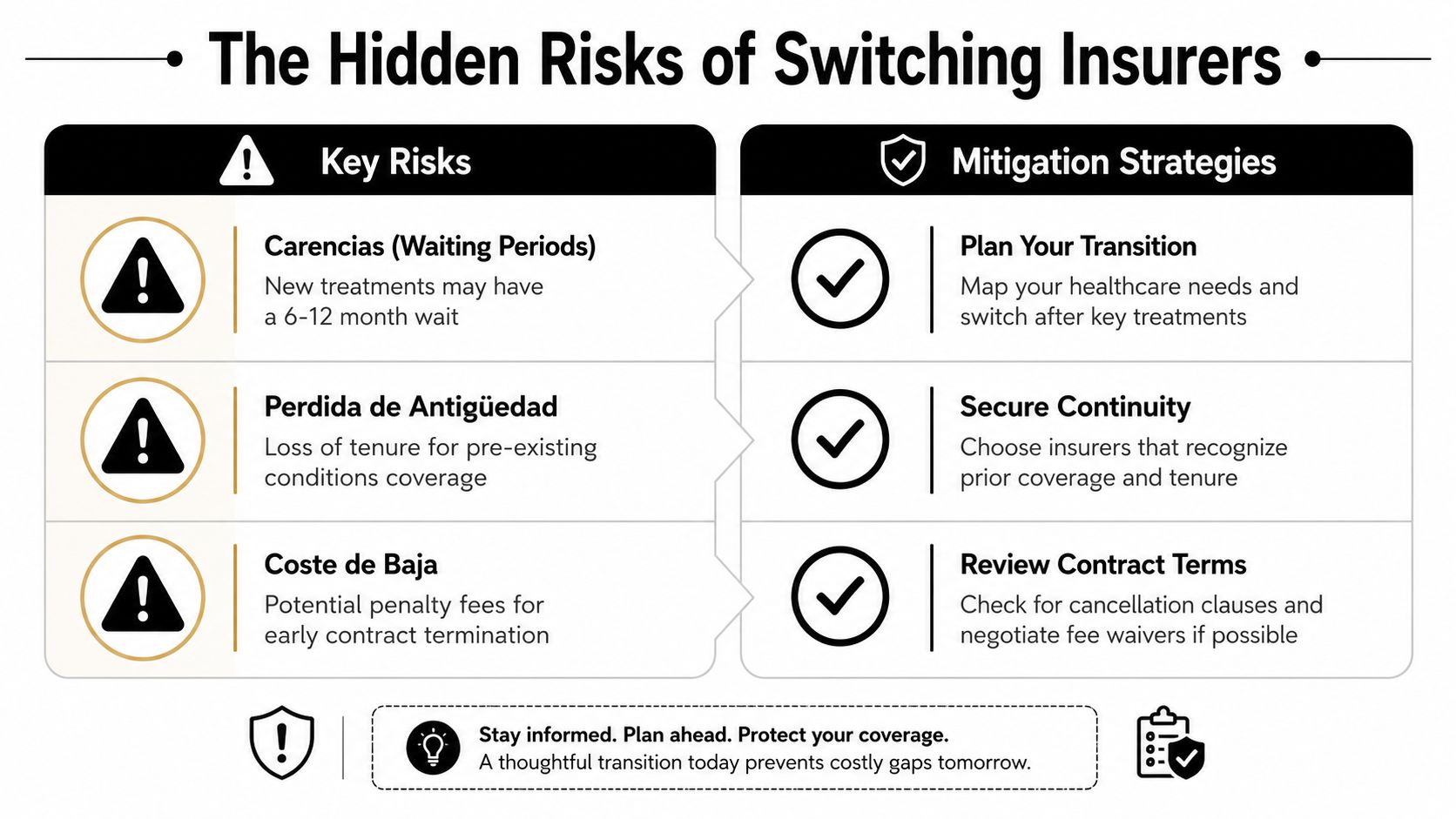
The cheapest new premium can be a false win. What matters is what happens to care already in progress, and what gets reset when the new policy starts. That's the part most online explainers skip, and it's exactly where expats get burned.
Waiting periods can restart
Many policies impose waiting periods, known in Spain as carencias. If you switch to a new insurer, those waiting periods can apply again to certain treatments or procedures. That means a policy that looks better on paper may not cover the service you thought you were buying right away. If you're planning surgery, specialist treatment, dental work, or anything already in motion, ask the insurer what happens on day one, not what the brochure promises in general terms. For a deeper look at treatment delays and policy timing, see medical insurance waiting periods.
The coverage reset trap is real
Your deductible and out-of-pocket progress usually do not follow you to a new plan. They restart. That means a policy with a lower monthly premium can still cost more if you've already paid a large share of your current deductible and you're about to need more care. This is the classic coverage reset trap. The right question is not “What's the cheaper premium?” It's “How much value am I giving up by abandoning the progress I've already made under this policy?”
Pre-existing conditions need written approval
Do not rely on a phone call, a sales email, or a friendly verbal promise. Get the insurer's position in writing if you have ongoing treatment, a chronic condition, or a history that might affect acceptance. Expats with diabetes, cancer history, cardiac issues, or similar needs should assume underwriting matters until proven otherwise. A switch can be perfectly fine, but only if the new insurer has clearly accepted the risk profile and you know exactly what's covered from the start.
The Correct Switching Process Step by Step
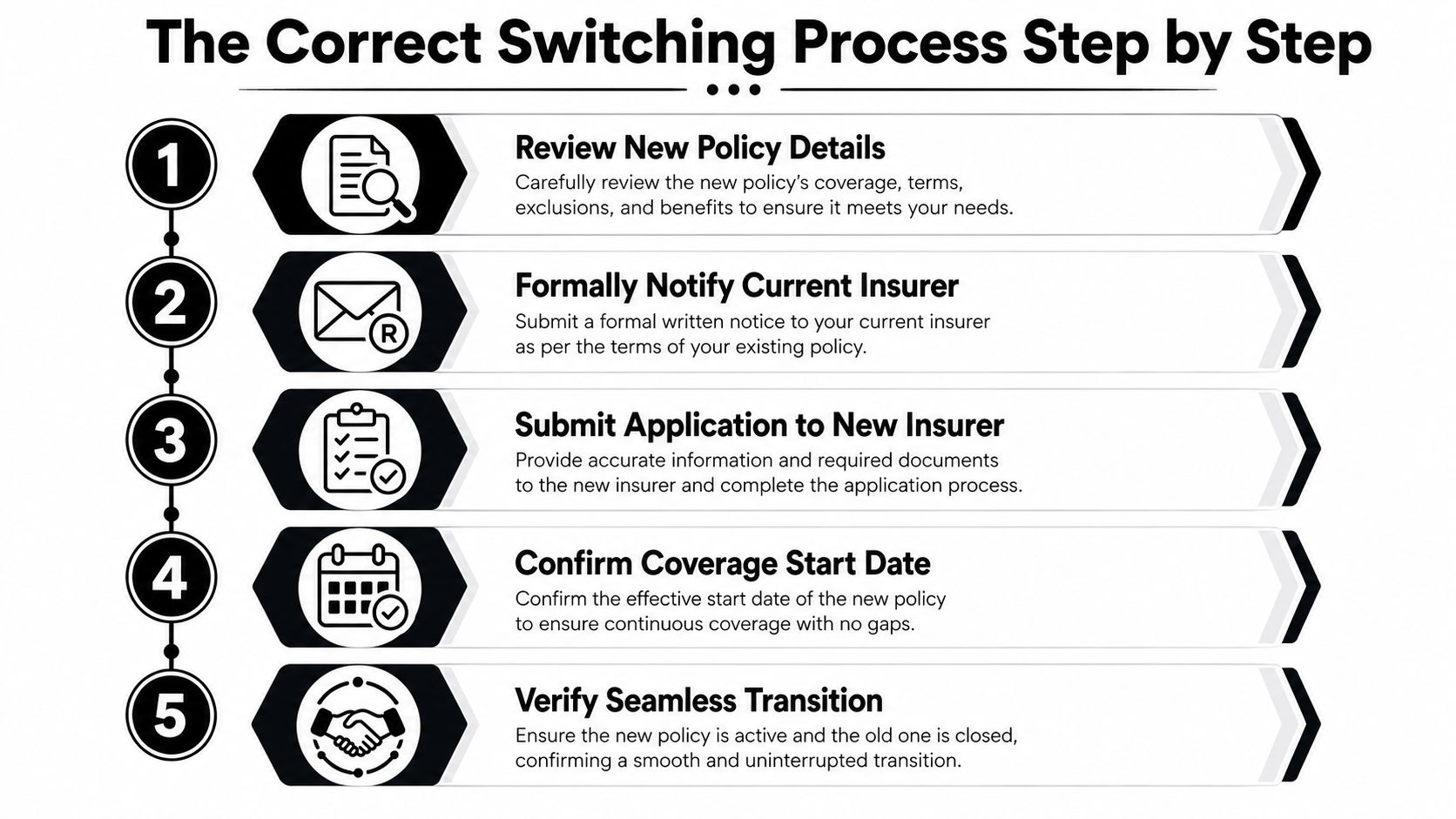
The right order matters. If you do this backwards, you create gaps, disputes, and unnecessary stress. A proper switch is a document-first process, not a hopeful phone call followed by cancellation.
Step 1, secure the new policy first
Apply to the new insurer before you cancel anything. Get the proposal reviewed, complete any medical questionnaire carefully, and wait for acceptance in writing. If the insurer asks for extra information, answer it fully and keep copies of everything you send. The wrong move is to assume approval is automatic because the premium looks attractive.
Step 2, check the effective date
Once the new policy is approved, confirm the exact start date. You want to know the first day you're covered, the date any waiting periods begin, and whether any specific benefits are delayed. If the new insurer won't cover an ongoing treatment immediately, you need to know that before you give notice to the old one.
Step 3, cancel the current policy formally
Use a legally recognized method. In Spain, that usually means a written cancellation request sent in a way you can prove, often by burofax or another traceable method accepted by the insurer. Keep the receipt, the date, and a copy of the letter. A cancellation that can't be proven is a cancellation you may have to fight about later.
A simple cancellation request can say:
Solicitud de baja de póliza
Por la presente, solicito la baja de mi póliza de seguro de salud número [number], con efecto al vencimiento correspondiente, conforme al plazo de preaviso establecido en las condiciones de la póliza.
Atentamente, [full name], [ID or passport], [date].
Step 4, overlap the dates if needed
Never create an uninsured gap just to make the paperwork feel neat. If the old policy ends on one date and the new one starts later, you've made a bad trade. The cleanest switch is the one where the old coverage ends only when the new coverage is already live.
Step 5, confirm everything after the handover
After the switch, verify that your policy documents, membership card, and any required certificates for visa or residency use match the promised terms. If you'll need to show proof quickly for immigration or a private clinic, don't wait until there's a deadline.
Maintaining Visa and NIE Compliance When You Switch
For expats, the stakes jump. A cheaper plan is useless if it doesn't satisfy the conditions tied to your visa, residency renewal, or NIE-related paperwork. Spanish authorities and consulates care about compliance, not your preference for a lower premium.
Don't downgrade into a non-compliant policy
If your residence route requires private health insurance, choose a policy that fits those rules. In practice, that means confirming the cover is valid in Spain, has the right structure for your permit, and doesn't leave obvious gaps that would make the file vulnerable. If you switch into a plan that saves money but fails the residency test, you may create a bigger problem than the savings were worth.
That risk is especially sharp for people who are newly arrived, renewing visas, or moving between private and public coverage. Retirees over 65 should be even stricter, because they often face narrower options and more insurer scrutiny. The safest strategy is not to guess. It's to verify the policy against the paperwork you will have to present.
Treat compliance as a document check, not a sales promise
Sales language is cheap. Document compliance is what matters. Before you sign, make sure you can produce the insurer certificate, policy conditions, and any other paperwork your lawyer, gestor, or consulate may ask for. If the policy has exclusions, co-payments, or structural features that clash with your permit requirements, don't rationalize it away.
Bottom line: if the policy can't support your residence paperwork, it's the wrong policy, even if the premium is attractive.
The right move for an expat is to protect continuity first, then price, then convenience. If those three don't line up, keep looking.
Your Pre-Switch Checklist and Action Plan
Don't start with the brochure. Start with the facts on your current plan and the paperwork the new insurer will issue. If you skip that order, you'll miss something important.
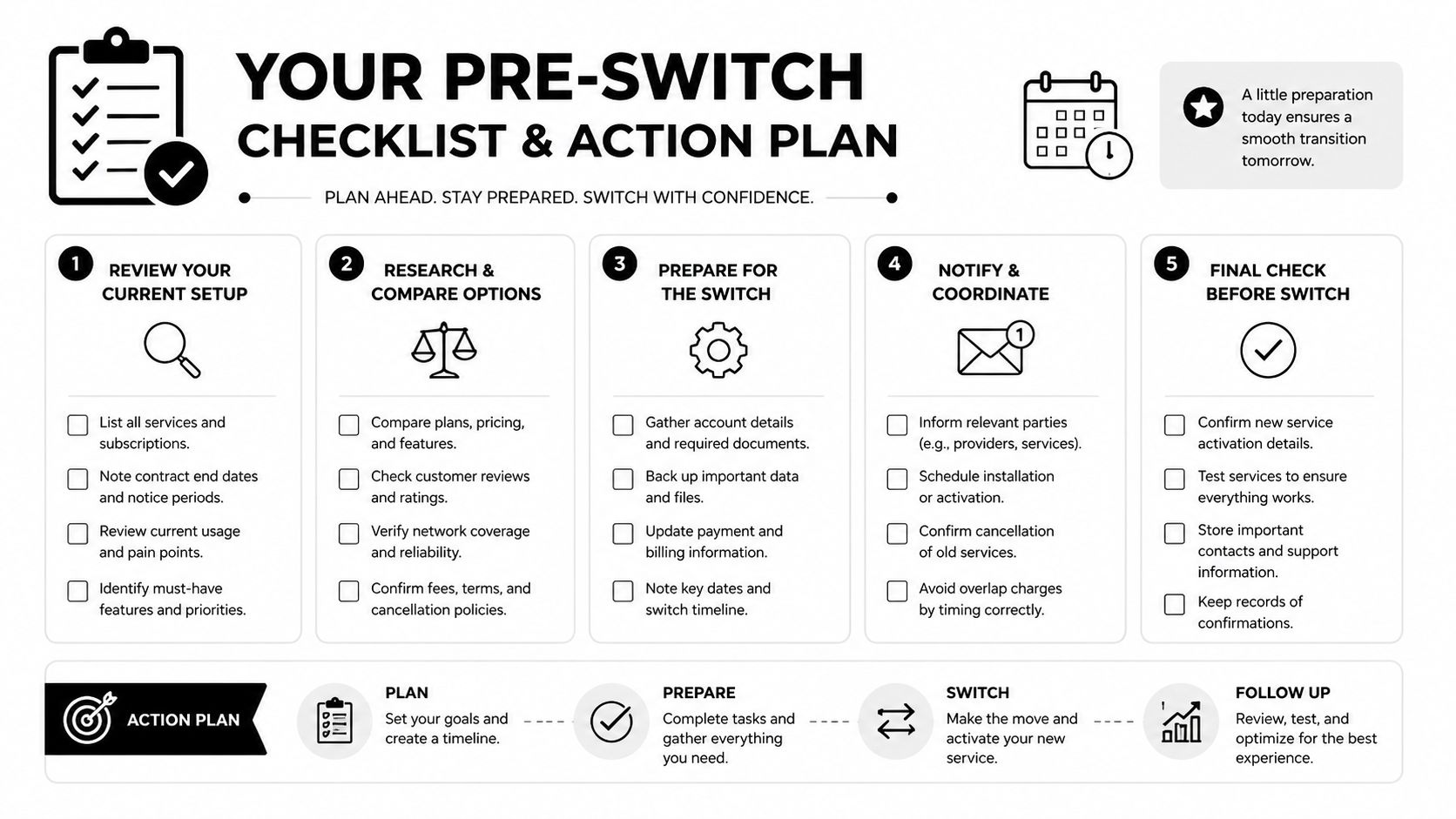
- Check the renewal date: Confirm when your current policy renews and how much notice you need to cancel it.
- Verify the new acceptance: Make sure the new insurer has accepted your application in writing, not just verbally.
- Review ongoing care: List every specialist, medication, test, or treatment you can't afford to interrupt.
- Ask about waiting periods: Confirm whether any benefits reset and when they become available.
- Match the visa file: Make sure the new policy supports your residence, NIE, or visa requirement before you sign.
If you're reading U.S. advice about qualifying life events, ignore it. That logic doesn't solve a Spanish contract problem. In Spain, the key issues are notice, acceptance, continuity, and compliance.
When to Use a Broker for a Stress-Free Switch
Use a broker when the switch touches more than price. That includes visa compliance, pre-existing conditions, family cover, renewals, and any case where you can't afford to get the sequence wrong. The DIY route works only if you have the time and confidence to compare wording, underwriting, and cancellation rules line by line.
A good independent broker removes the guesswork. They compare policies across insurers, flag non-compliant options, manage the paperwork, and help you avoid a gap between policies. For expats who need to organise documents efficiently, even a simple task like compress PDFs on Mac without quality loss can be useful when you're sending certificates, IDs, and policy files to multiple parties.
The value isn't mystery, it's execution. A broker is the right call if you want a clean switch without being trapped by the coverage reset trap, a bad underwriting outcome, or a cancellation error. If you're not fully sure your next policy fits your visa, your health history, and your timeline, don't gamble with it.
Bsure Health Brokers helps English-speaking residents in Spain compare compliant health plans, handle the paperwork, and avoid coverage gaps when switching gets complicated. If you want straight answers on visa-safe cover, pre-existing conditions, and the best timing for a move, visit Bsure Health Brokers and get the switch done properly.