
You've registered as self-employed in Spain, your first invoices are going out, and the monthly autónomo paperwork is already taking more time than you expected. Then the health insurance question lands on your desk. You're paying into Social Security, but does that fully solve healthcare? If you're applying for residency, will the policy you found be accepted? If you buy private cover, is it just another cost, or is it something you can use strategically for your visa, your taxes, and your working life?
That mix of uncertainty is normal, especially for expats. Spain has a strong public system, but the practical answer for a self-employed person isn't just “public or private.” It's usually a combination of legal access, administrative timing, and choosing the right private policy for your specific situation.
The people who handle this best don't treat health cover as a side issue. They treat it as part of setting up properly in Spain. That means understanding what your cuota gives you, where private insurance becomes essential, and how to avoid the common mistakes that create delays, rejected applications, or tax headaches later.
Table of Contents
- Navigating Your Health Options as a New Autónomo
- Public Versus Private Healthcare for the Self-Employed
- Meeting Mandatory Insurance Rules for Visas and Residency
- The Financial Case for Your Health Insurance Policy
- How to Choose the Right Type of Insurance Plan
- Your Step-by-Step Guide to Getting Covered
- Conclusion Your Health Is Your Most Valuable Business Asset
Navigating Your Health Options as a New Autónomo
A typical new autónomo often starts with the same assumption. Register, pay the monthly contribution, get access to healthcare, done. Then the actual questions start. Can you see specialists easily? What happens if you need paperwork for a visa file? Will a private insurer accept your medical history? And if you already have public access, are you wasting money by adding private cover?
Those doubts get sharper when you're not Spanish and you're dealing with the system in a second language. A missed document doesn't just slow down healthcare. It can affect your residency timeline, your tax planning, and your ability to keep working without disruption.
I've seen the same pattern many times with expats who are otherwise organised. They sort their NIE, register with a gestor, open a bank account, and still leave health insurance until the final stage. That's usually when bureaucracy becomes expensive. People buy a cheap policy online, only to discover it doesn't meet visa conditions, has co-payments they didn't notice, or doesn't match the billing setup needed for tax purposes.
The stress usually comes from three separate questions
- Legal access: You want to know what cover you already have through your self-employed registration.
- Residency compliance: You need to know whether private insurance is required for your visa or permit, and what wording matters.
- Business practicality: You need cover that helps you get treatment without losing working days or battling admin each time you need care.
Practical rule: Don't choose a policy by price alone. In Spain, the right policy has to match your residency status, your medical profile, and how you actually work.
The good news is that this becomes much simpler once you separate those issues. Public healthcare, private healthcare, visa rules, and tax treatment each follow their own logic. When you line them up properly, the decision becomes much clearer.
For most self-employed people in Spain, the smart approach isn't to ask, “Do I need health insurance?” It's to ask, “What type of cover solves the exact problem I have right now?”
Public Versus Private Healthcare for the Self-Employed
Spain gives self-employed workers a strong starting point. But a strong starting point isn't always the same thing as the best working setup for someone who depends on their own time, availability, and ability to stay productive.
What your autónomo contributions actually unlock
Self-employed workers in Spain gain full access to the public healthcare system by paying monthly Social Security contributions. As of 2026, the minimum monthly cuota de autónomo ranges between €200 and €600 depending on real income, and new workers can use the Tarifa Plana of around €80 per month for the first year, according to Caser's guide to Social Security for autónomos in Spain.
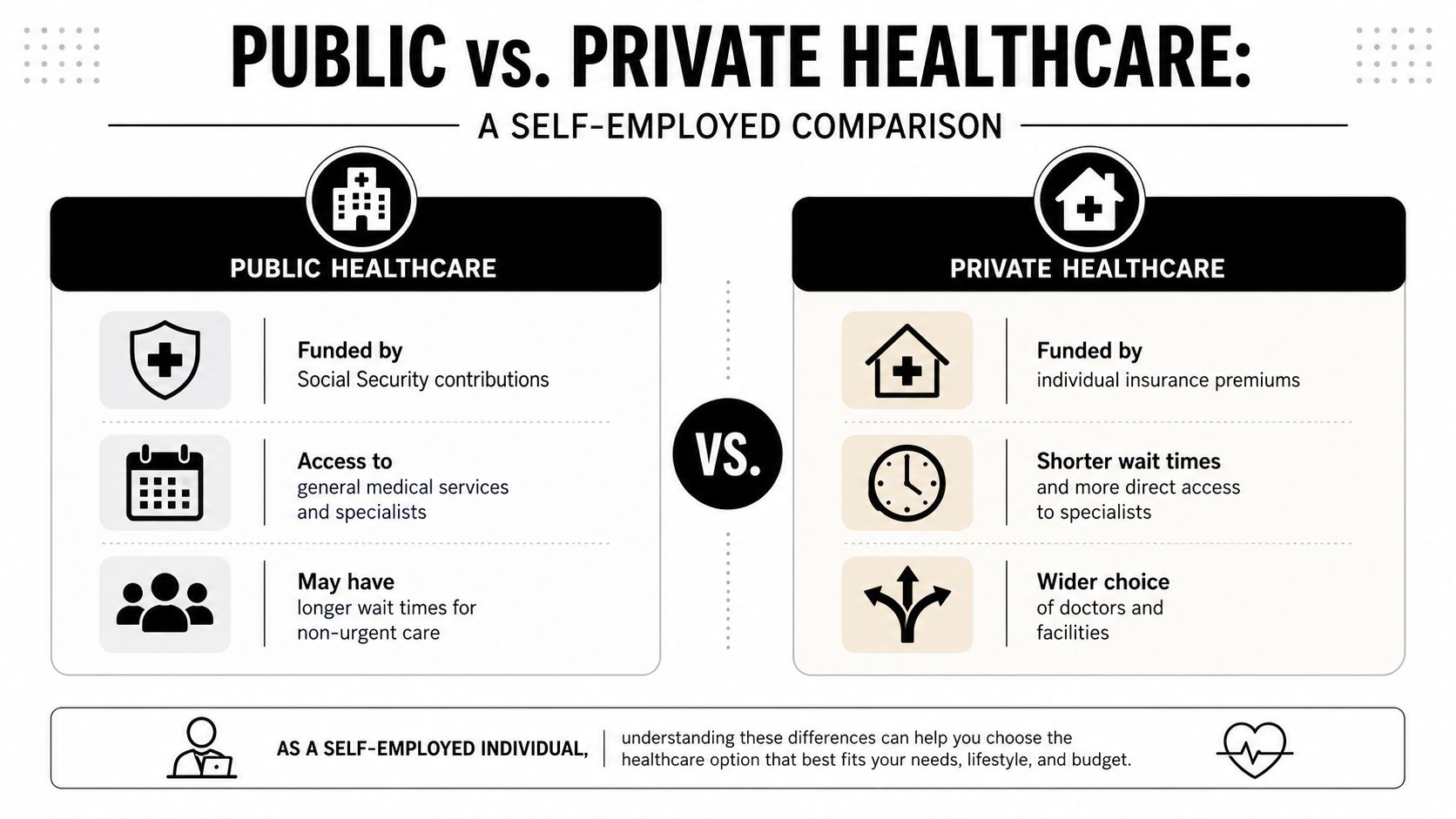
That public access is meaningful. It covers core healthcare through the Sistema Nacional de Salud, including general medical care, hospital treatment, and emergency services. For many people, that answers the basic fear of being uninsured.
But public access doesn't remove every practical issue. The same source notes that many self-employed people still choose private insurance for shorter waiting times, broader specialist access, and premium private care, and that average out-of-pocket expenses still account for around 21% of total costs, varying by region.
Where private cover changes the day-to-day experience
If you work for an employer, a delayed appointment is frustrating. If you work for yourself, it can interrupt income, client delivery, and travel plans. That's the key distinction.
Private insurance usually appeals to self-employed residents for practical reasons:
- Speed matters: Faster access can mean less time waiting for consultations or diagnostic steps.
- Choice matters: Many expats want the option to select an English-speaking doctor or a particular hospital group.
- Convenience matters: Private systems are often easier to use when you want direct specialist access and a more predictable patient experience.
Public healthcare protects you. Private healthcare often protects your schedule.
That doesn't mean private is always better in every respect. Public care remains a solid foundation, especially for major medical needs and emergencies. The trade-off is about how much control and speed you want in non-emergency care.
Public vs. private healthcare for Spanish autónomos
| Feature | Public System (Seguridad Social) | Private Insurance |
|---|---|---|
| Funding | Covered through your Social Security contributions as an autónomo | Covered through your own insurance premium |
| Core access | General medical care, hospital care, emergency services | Access depends on the policy and provider network |
| Specialists | Available through the public system process | Often more direct and flexible |
| Waiting times | Can be longer for non-urgent care | Often shorter |
| Doctor choice | More limited by the public pathway | Usually broader within the insurer's network |
| Language comfort | Varies by area and facility | Often easier to arrange for expats in private networks |
| Best fit | Strong baseline protection | Stronger control, convenience, and speed |
A lot of expats initially think they must choose one side. In practice, many self-employed people use both. Public cover gives legal and medical security. Private cover improves access, reduces friction, and makes healthcare easier to use while running a business.
That's why health insurance for self-employed people in Spain is rarely just a medical decision. It's an operational one.
Meeting Mandatory Insurance Rules for Visas and Residency
For many expats, the visa requirement changes the conversation immediately. You're not only choosing healthcare for personal peace of mind. You're choosing a policy that has to satisfy Spanish immigration rules.
When private insurance is not optional
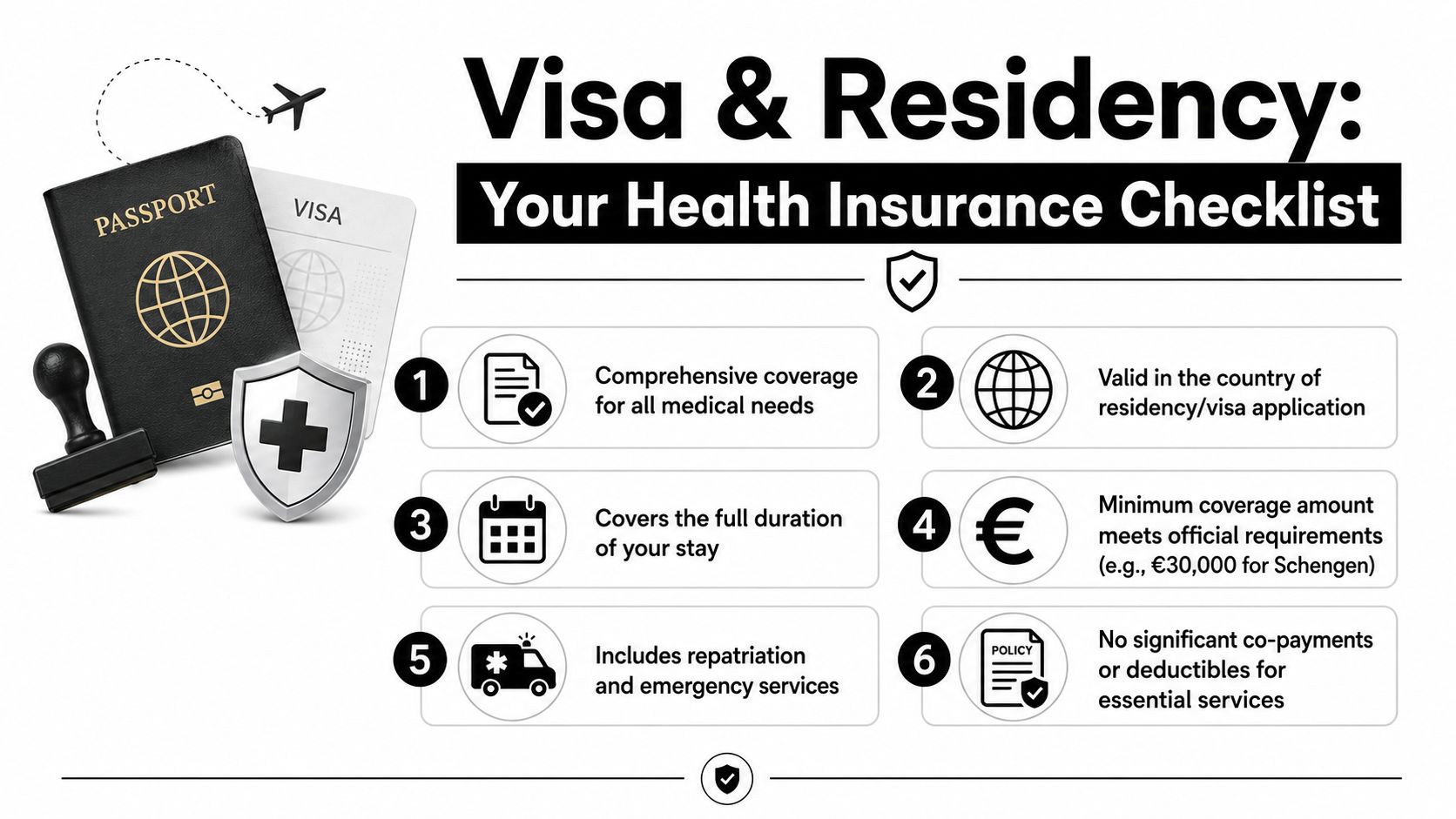
If you're applying for a residency route that requires proof of full health cover, a generic private policy can create serious problems. This comes up often with applicants for residence permits where the authorities expect private medical insurance to be in place from the start of the stay and valid in Spain.
The practical issue isn't just having a certificate. It's having the right policy wording and structure. If the plan falls short, the application can stall while you replace it, resubmit documents, or explain terms that should have been correct from the beginning.
A useful starting point is to review health insurance in Spain for residency and private cover requirements, then compare that against the specific visa route you're applying under.
The policy details consulates care about
Two terms catch applicants out repeatedly: sin copagos and sin carencias.
In plain English:
- Sin copagos means the policy should not rely on pay-per-use co-payments for essential services.
- Sin carencias means it should not impose waiting periods that undermine immediate, complete cover.
- Full duration matters. The policy should align with the period the authorities expect you to be covered for.
- Territorial validity matters too. The insurance has to be valid where your residence application requires it to be valid.
These details matter because immigration authorities don't assess your policy the way a casual buyer does. They're not asking whether it seems reasonable. They're checking whether it meets the formal standard for the permit.
A cheap policy can become an expensive mistake if it doesn't match the visa file.
How applications get rejected over insurance
The most common problems are ordinary ones:
- The policy has co-payments and the applicant didn't realise that would be an issue.
- The plan includes waiting periods for important treatment areas.
- The insurer certificate is too vague and doesn't clearly confirm the coverage conditions.
- The policy dates don't line up with the application timeline.
- The cover was chosen for price, not for consulate compliance.
Bureaucracy causes the most anxiety. People don't usually fear healthcare itself. They fear buying the wrong thing, submitting the wrong paperwork, and losing time while trying to fix it from abroad or under deadline.
A compliant policy removes that pressure. It gives you a clean file, one less moving part in the residency process, and a much better chance of getting through the administrative stage without unnecessary friction.
The Financial Case for Your Health Insurance Policy
Self-employed people often look at private health insurance as a household expense. That's understandable, but it misses the more useful way to think about it. In Spain, the right policy can also function as a tax-efficient business decision.
The deduction many autónomos overlook
The Spanish Tax Agency permits self-employed individuals to deduct up to €500 per year in health insurance premiums for themselves, their spouse, and children under 25, and this rises to €1,500 for individuals with disabilities, according to Grupo Baeza's explanation of deductible insurance for the self-employed in Spain.
The same source also notes that when family members are included, the total annual deductible amount can reach up to €4,500, provided the policy and payment setup meet the required conditions. Those conditions matter. The policy should be in the name of the self-employed person or their company, linked properly to the professional activity, and supported by the insurer's invoice rather than only a bank receipt.

A simple example helps. If you're self-employed and your annual premium for your own policy reaches the €500 deductible limit, that part can be treated as an allowable deduction if the structure is correct. If you insure your spouse and qualifying children as well, the deductible amount can be materially larger.
Why this is a business expense in practice
The tax angle is only part of the logic. The stronger argument is operational.
For a salaried employee, time off sick may still mean income arrives as normal. For a freelancer, consultant, or business owner, delays often hit work directly. Private cover can reduce the friction involved in arranging appointments, seeing specialists, and keeping treatment moving.
That matters most when:
- Your income depends on billable time: Missed days aren't abstract. They affect current revenue.
- You travel often in Spain: You need a network that's straightforward to use outside your immediate town.
- You manage family responsibilities as well as work: Faster access can reduce disruption at home and at work together.
Business view: A private health policy isn't just there for serious illness. It's there to protect continuity.
The part that often goes wrong
Many autónomos lose the tax advantage because the admin is sloppy. Common mistakes include:
- Wrong policyholder details: The policy sits in the wrong name for deduction purposes.
- Poor payment trail: Premiums are paid from an account that doesn't fit the business record you want to keep.
- Missing invoices: People save bank movements but not the insurer's formal invoice.
- No coordination with tax filing: The insurance exists, but the paperwork doesn't support the deduction properly.
This is why health insurance for self-employed people shouldn't be chosen in isolation. The policy itself, the billing method, and the document trail all need to match. When they do, the actual cost of the cover can look very different from the headline premium.
How to Choose the Right Type of Insurance Plan
The best policy for a self-employed graphic designer in Valencia isn't automatically the best policy for a family applying for residency in Málaga, or for a consultant dividing time between Spain and another country. The right choice depends on where you need treatment, how often you travel, who needs to be insured, and what underwriting issues are on the table.
Spanish private plans versus international plans
A Spanish domestic plan is usually the first place to look if you live mainly in Spain, want local private hospitals and specialists, and need a policy designed around the Spanish healthcare system. These plans are often the most practical for residents who want everyday usability inside Spain.
An international plan suits a different profile. It can make more sense if you spend long periods outside Spain, want broader territorial cover, or need continuity across countries rather than country-specific treatment pathways.
The trade-off is rarely about one being universally better. It's about fit.
- Spanish plans often work best for stable residents using Spanish providers regularly.
- International plans can make more sense for mobile professionals with cross-border needs.
- Visa applicants need to be especially careful, because a policy that sounds global and impressive can still fail the formal residency requirements if the wording or structure is wrong.
For a closer look at one route often considered by freelancers and business owners, this guide to Sanitas Professionals for the self-employed in Spain is a useful example of how specialised plans are positioned.
Family cover and older applicants
Family policies work well when you want everyone on one structure, one renewal cycle, and one administrative relationship with the insurer. They can also simplify tax handling when the setup meets the required conditions discussed earlier.
The important question isn't just price. It's whether each family member's real needs fit the same plan.
Consider these issues before choosing:
- Children's use of care: Families often value quick access for common appointments and peace of mind when problems appear suddenly.
- Partner eligibility for deduction: The policy setup should support clean documentation if you expect to claim allowable tax relief.
- Older applicants: Age can limit plan availability, change underwriting outcomes, or narrow the insurer pool.
Older residents often assume private cover is no longer realistic. Sometimes that's true for one insurer and not for another. Sometimes the issue isn't age alone, but the combination of age, medical history, and the level of cover requested.
If you're older or have a complicated medical profile, broad market comparison matters more than ever. One rejection doesn't mean the market has no options.
Pre-existing conditions need planning, not panic
Applicants' foremost worry often arises, and frequently without cause. A pre-existing condition doesn't always stop you getting cover. It usually means the application must be handled carefully.
Insurers may respond in several ways:
- Accept on standard terms.
- Accept with exclusions.
- Request more medical information.
- Decline and leave you needing a different insurer or policy type.
That's why the health questionnaire matters. Underwriting only works when the disclosure is complete and consistent. If people rush the form, hide information, or give vague answers, problems tend to appear later when they need care.
A good process looks like this:
- Gather your diagnoses, medication list, and any recent reports.
- Describe conditions clearly and consistently.
- Check whether the policy is being considered for residency, domestic use, or broader international protection.
- Compare insurers based on how they handle your specific profile, not on marketing language.
What doesn't work is buying the first online policy that accepts a payment card and hoping the medical details sort themselves out later. They won't.
Your Step-by-Step Guide to Getting Covered
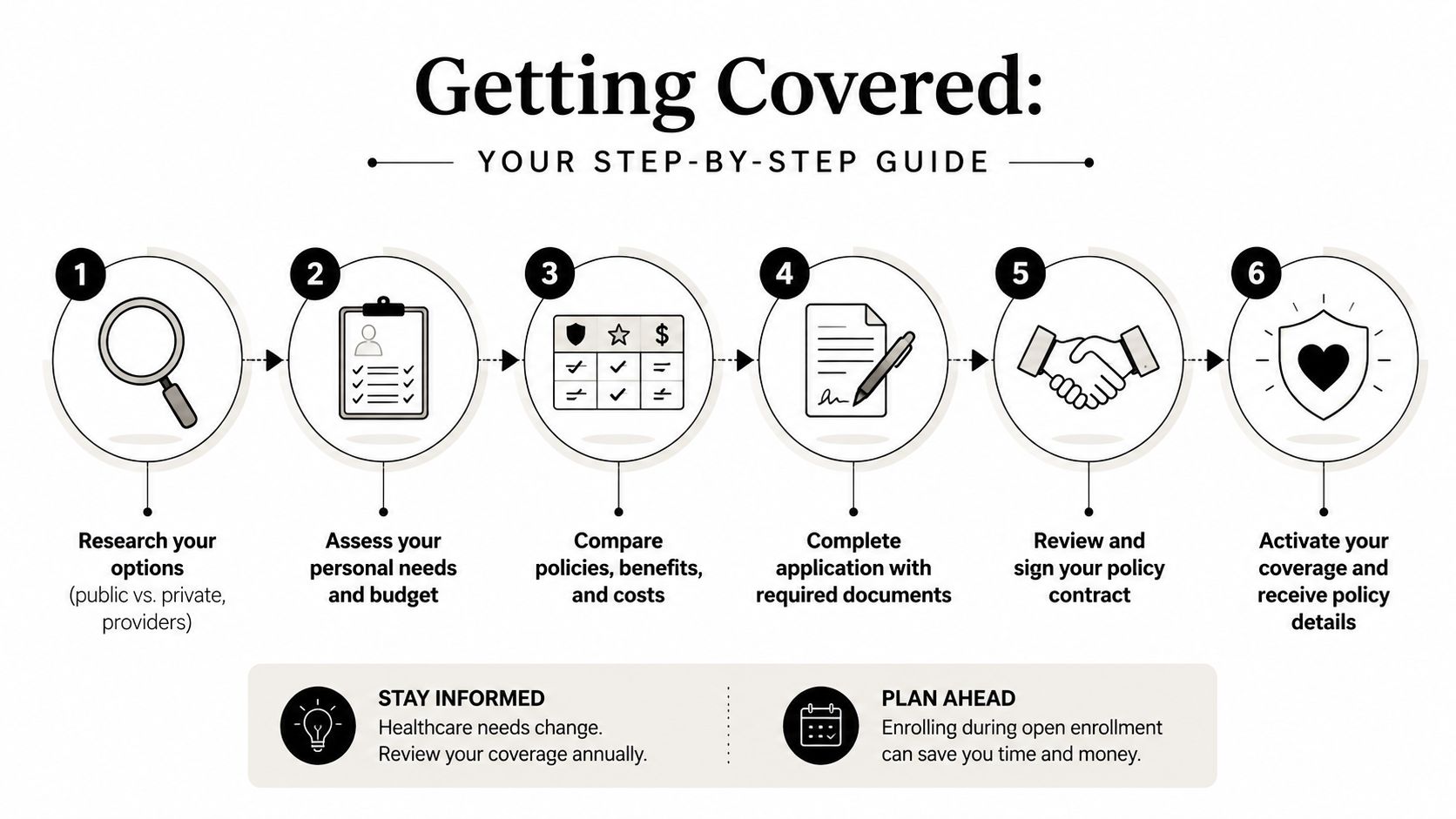
Once you know what kind of plan you need, the process becomes manageable. The people who get this done smoothly don't try to solve everything at once. They work in sequence and keep the paperwork clean from the start.
Start with your real use case
Before comparing insurers, decide what problem the policy must solve.
If your issue is residency, compliance comes first. If you already live in Spain and want easier specialist access, usability comes first. If you travel heavily, geography matters more.
Write down your absolute requirements:
- Residency use: Is this for a visa or permit file?
- Medical use: Do you mainly want quick appointments, diagnostics, and specialist access?
- Family use: Are you covering only yourself or adding dependants?
- Budget tolerance: Are you comfortable with a lower premium if the network is narrower, or do you want broader comfort and choice?
Prepare documents before you compare
This part saves a surprising amount of time. Have the basics ready first.
Most applications become easier when you have:
- Identity documents: Passport and, where available, NIE or residency details.
- Spanish bank details: Many insurers want direct debit from a Spanish account.
- Address information: Your registered address in Spain or intended address if you're relocating.
- Medical information: Existing conditions, medication, prior treatment, and any recent reports if relevant.
People often compare plans before they've prepared these documents. That creates delays later, especially when the chosen policy needs underwriting or urgent certificate wording.
Compare correctly and set the policy up properly
This is the stage where using a broker saves the most friction. An independent broker compares providers, checks whether a policy is suitable for your purpose, flags wording problems early, and handles insurer follow-up in plain English. If you want a practical overview of what that role looks like, this article on what a health insurance broker does in Spain is a useful reference.
When reviewing quotations, don't look only at premium. Check:
- Whether the plan is suitable for visa use, if that's your purpose.
- How specialist access works in day-to-day use.
- Whether co-payments apply, and where.
- How underwriting is handled if you have prior medical history.
- What documents the insurer will provide for residency or tax records.
The best quote is the one that still works when you need a certificate, a referral, or help with a claim.
Keep the paperwork clean after activation
Once the policy is active, keep the admin organised. This matters more than generally expected.
A simple routine helps:
- Save the policy schedule and any visa-use certificate in one folder.
- Keep insurer invoices, not just proof the bank collected payment.
- Check renewal terms early if your residency timeline depends on continuous cover.
- Update the insurer when circumstances change, especially address, bank details, or family status.
The final piece is ongoing support. Health insurance isn't only a buying decision. It's also a service relationship. People usually need help later with hospital networks, specialist access, renewals, policy changes, and understanding what the insurer is asking for.
That's why the smoothest experiences usually come from getting the setup right at the beginning, then keeping the policy administratively tidy as your life in Spain develops.
Conclusion Your Health Is Your Most Valuable Business Asset
For a self-employed person in Spain, health insurance is never just one thing. It can be the document that keeps a residency application on track. It can be the policy that gives you practical access to care without losing working time. And it can be a tax-efficient expense when it's structured properly.
That's why the decision deserves more thought than a quick online quote. The cheapest policy can fail on visa wording. A perfectly good domestic policy can be the wrong fit for a mobile international lifestyle. A strong plan can still create tax frustration if the invoices and payment setup are wrong. Most problems don't come from healthcare itself. They come from mismatch between the policy and the reason you needed it.
The good approach is simple. Match the plan to your legal status, your work pattern, your family situation, and your medical profile. If you do that well, private cover stops feeling like another monthly bill and starts functioning like part of your business infrastructure.
That shift matters. When you're self-employed, your ability to work, travel, attend meetings, manage stress, and recover quickly from health issues has direct value. Protecting that capacity is practical, not indulgent.
The best outcomes usually come when someone checks the small print before it becomes your problem. That includes visa compliance, underwriting, billing setup, renewal timing, and the plain question every expat asks sooner or later: “If something goes wrong, who helps me sort it out?”
If you want clear help choosing the right policy, Bsure Health Brokers can guide you through the process from start to finish. They compare Spanish and international insurers, help expats find visa-compliant cover, support applications involving families or pre-existing conditions, and keep the paperwork clean for day-to-day use in Spain. A conversation with the right broker can save time, avoid rejection-worthy mistakes, and make sure your health cover works for your residency and your business.