
You've got a visa deadline, a stack of forms open on your laptop, and three Spanish health insurance quotes that don't seem to describe the same thing. One looks cheap until you notice copagos. Another says it accepts applications “subject to underwriting.” A third costs much more than you expected, even though the cover sounds similar.
That's the moment most expats realize two things. First, Spanish private health insurance is not priced in the same way many English-language guides suggest. Second, if you've moved from the US, the biggest shock is often how pre-existing conditions are handled outside an ACA-style system.
A lot of online advice explains the American market well enough, but it doesn't answer the questions people commonly ask when moving to Spain. Why does one insurer care more about your age? Why does another ask detailed medical questions? Why can a policy work for residency but still be poor value? And why can a chronic condition change the whole outcome? As PeopleKeep notes about non-ACA markets, medical underwriting is still legally permitted in places such as Spain, and pre-existing conditions can double premiums or trigger exclusions.
If you want to understand how insurance premiums are calculated in Spain, you need the local logic, not a recycled US explanation. That means understanding the base formula, the rating factors Spanish insurers use, and the trade-offs between lower monthly cost and broader protection.
Table of Contents
- Introduction Decoding Your Spanish Health Insurance Quote
- The Core Formula Every Insurer Uses
- Key Factors That Adjust Your Premium in Spain
- The Pre-Existing Condition Puzzle for Expats
- Putting It All Together Worked Examples in Spain
- Actionable Tips to Reduce Your Health Insurance Premium
- How an Expert Broker Simplifies Premium Calculations
Introduction Decoding Your Spanish Health Insurance Quote
Most expats don't start by asking how insurance premiums are calculated. They start by asking why one quote is acceptable for a visa, another includes co-payments, and a third suddenly gets more expensive after the medical questionnaire.
In Spain, that confusion is normal. A quote isn't just a list price. It's the result of a risk decision, a coverage decision, and sometimes a medical underwriting decision. If you're retired, applying for residency, or managing an ongoing condition, those layers matter a lot more than the glossy brochure.
I see the same pattern with English-speaking clients. A family moving to Málaga often focuses first on hospital access. A retiree from the UK usually worries about age and whether past treatment will count against them. A remote worker applying for a visa often assumes the cheapest compliant policy is the smart move, then later finds the restrictions don't fit how they'll use healthcare in Spain.
Spanish health insurance quotes make more sense once you separate three issues: base price, coverage choices, and underwriting.
Why Spain feels different from US-focused guides
Many readers arrive with assumptions shaped by US health insurance rules. That's understandable, but Spain is a different market. The biggest gap is how insurers treat health history when underwriting is allowed.
For expats, the practical question isn't just “what does this cost?” It's “what exactly pushed the price to this level?” That's the question worth answering before you sign anything.
What you should look for in a quote
When I review quotes for expats, I tell them to ignore the headline monthly price for a moment and check these first:
- Visa suitability: Some applicants need cover with specific features for residency purposes.
- Underwriting outcome: A policy may be offered at standard terms, with exclusions, or with a higher premium.
- Cost-sharing: Copagos can make a low monthly figure less attractive if you expect regular use.
- Network scope: A broad national network and a more limited regional setup won't price the same way.
- Renewal risk: The starting premium matters, but so does how the policy behaves over time.
Once you know those moving parts, the quote stops feeling arbitrary.
The Core Formula Every Insurer Uses
Premiums aren't random numbers
At the foundation, insurers price cover using an actuarial method. The clearest version of the formula is Premium = (Expected Loss + Expenses + Profit Margin) × (1 + Risk Rate), where expected loss means the projected cost of claims, based on historical data and statistical models, as explained in this actuarial overview of premium calculation.
That sounds technical, but the idea is simple. Think of a bakery pricing a wedding cake. The baker has to cover ingredients, staff time, rent, delivery, and still make enough margin to stay in business. An insurer does the same with healthcare risk. The “ingredients” are future claims. The overhead includes administration, commissions, and operating costs. The margin keeps the insurer financially able to pay claims.
That's why two plans that sound similar can price differently. One insurer may expect higher claim costs from the type of members it attracts. Another may run a broader provider network or include richer outpatient access. Those choices feed into the same formula.
Why the formula matters to expats in Spain
For an expat, the practical lesson is this. Your premium starts with a base view of expected claims, then the insurer adjusts for your specific risk and the structure of the policy.
The technical side of underwriting has also become more advanced. If you want a broader look at how carriers use data in risk assessment, AI powered underwriting insights are useful background reading because they show how pricing decisions increasingly depend on pattern recognition, not just simple manual review.
Here's the useful way to read any Spanish quote:
- Start with the base premium. This reflects the insurer's starting price for a given plan design.
- Add your risk profile. Age, health disclosures, and similar variables can adjust the starting point.
- Add the policy structure. Copagos, coverage depth, and network breadth change the cost.
- Consider insurer overhead and renewal logic. Cheap at entry isn't always cheap in practice.
Practical rule: A premium is never just a price tag. It's the insurer's forecast of future cost, plus the cost of running the policy, adjusted for your risk.
If you understand that, the rest of the Spanish market becomes much easier to read.
Key Factors That Adjust Your Premium in Spain
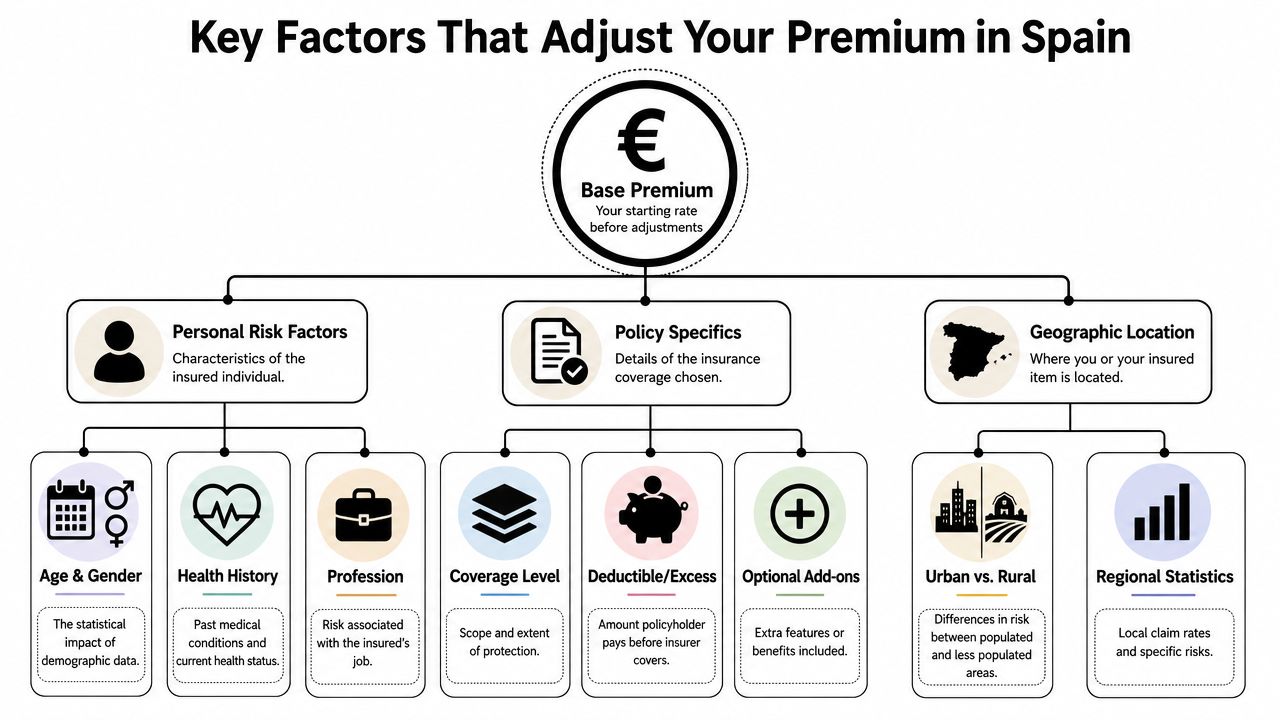
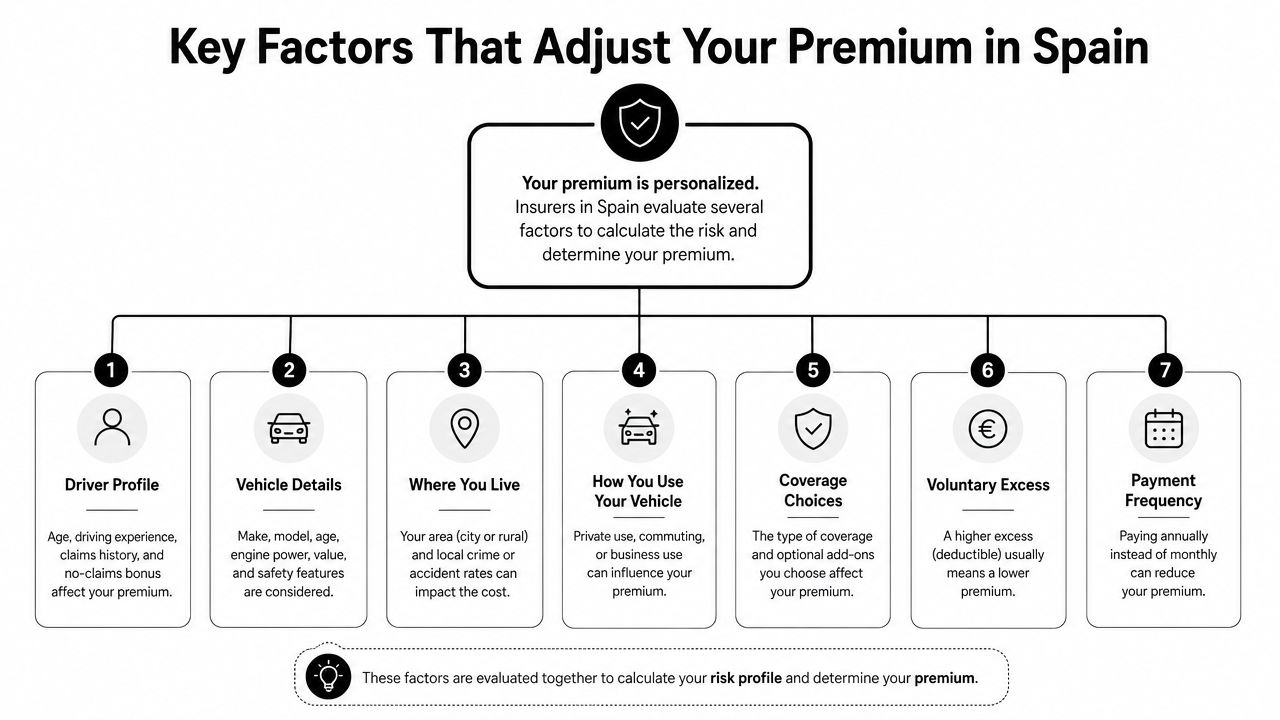
The easiest way to think about pricing in Spain is to imagine a base rate that gets adjusted up or down. Insurers don't usually start from scratch with every person. They begin with a standard plan price, then apply rating factors.
A useful technical concept here is the modified premium rate, where the base rate is multiplied by an experience or risk modifier. In health insurance, age is one of the clearest examples. As Sovereign Insurance explains in its discussion of premium setting, a 65+ age bracket may carry a 2.5x multiplier, and a 10-year age increase can result in a 40 to 60% premium hike depending on the tariff.
Age is usually the strongest pricing lever
For expats, age often drives the biggest visible change in premium. That's especially true for retirees. A person in their late sixties isn't just paying “a bit more” than someone in their thirties. The underlying multiplier can be materially different.
This is why many newcomers are surprised when they compare quotes across generations in the same household. The children may be inexpensive relative to the adults. The retired parent may shift the entire family budget.
If you're planning a move to Spain later in life, age isn't something you can negotiate away. What you can change is the plan structure around it.
Plan design changes the monthly price fast
After age, the next major factor is usually what you're buying.
A full-feature policy with broad specialist access, extensive hospital cover, and low friction on day-to-day use will usually cost more than a stripped-back policy. If you choose a plan with copago, you accept paying smaller amounts when you use services, and that often lowers the monthly premium. If you choose sin copago, the monthly price is usually higher because the insurer carries more of the day-to-day usage risk.
The same is true of network design. A broad national network often costs more than a more limited arrangement. For someone settled in one region and unlikely to travel much within Spain, a narrower setup can work. For a family moving around often, it may feel restrictive very quickly.
For readers interested in how quoting workflows are evolving for more complex client profiles, including affluent households with multiple assets and bespoke needs, this look at how firms automate high net worth insurance quoting is relevant because it shows how pricing gets shaped by layered variables rather than one simple list price.
Location network and profile details still matter
Spanish insurers also look at where and how you'll use the plan. The location itself can affect provider cost patterns and network economics. Living in a major urban area may create a different pricing context than living in a smaller town.
Then there are profile details that don't always get enough attention in online guides:
- Profession: Some occupations suggest different risk patterns.
- Family composition: A single applicant and a family policy don't behave the same way.
- Usage expectations: Frequent outpatient use makes copago decisions more important.
- Application details: Incomplete or unclear medical disclosures can complicate underwriting.
If a quote seems unexpectedly high, don't assume the insurer is being arbitrary. Usually one or two rating factors are doing most of the work.
The practical move is to identify those factors, then decide which ones you can control.
The Pre-Existing Condition Puzzle for Expats
Why US expectations often lead to confusion
Many English-speaking expats commonly misunderstand this aspect of premium calculation. In the United States, the Affordable Care Act prohibits insurers from charging higher rates based on pre-existing conditions, and health insurance premiums are calculated using risk pools instead of an individual's current medical prognosis, as described in Take Command Health's explanation of ACA-era premium calculation.
That is not how many expats expect private health insurance to work once they arrive in Spain. If you're used to ACA rules, you may assume a history of cancer, diabetes, cardiac treatment, or ongoing medication can't materially change the offer. In Spain, private insurers may medically underwrite the application.
That difference matters most for retirees, anyone with a chronic diagnosis, and applicants who need coverage quickly for residency or peace of mind.
What medical underwriting looks like in practice
Medical underwriting usually starts with the health questionnaire. The insurer reviews declared conditions, past treatment, medication, symptoms, and sometimes follow-up information from your doctors.
The possible outcomes vary:
- Standard acceptance: The insurer offers cover on normal terms.
- Exclusion: The policy may exclude a declared condition or related treatment.
- Surcharge: The insurer may offer cover at a higher premium.
- Decline: Some applicants won't be accepted by certain carriers.
The phrasing used can be critical. A client may say, “I had cancer, but it's all finished now,” while an underwriter sees a recent, serious medical history that still changes the risk profile. Someone else may declare stable diabetes and get a different outcome depending on the insurer's appetite, internal rules, and how the application is presented.
A lot of confusion disappears once you understand that “pre-existing condition” is not one uniform category. Insurers look at severity, timing, treatment status, and whether the condition is ongoing.
A chronic condition doesn't always mean “no.” It often means the application has to be matched to the right insurer and submitted carefully.
If you're trying to judge how a condition may be viewed before you apply, this guide to pre-existing conditions and health insurance in Spain is a useful starting point.
What doesn't work is hiding information. If an insurer asks a direct medical question, incomplete disclosure can create bigger problems later than a higher premium would have created at the start.
Putting It All Together Worked Examples in Spain
Theory is useful, but readers often want to know how these pricing factors play out in real life. The cleanest way to see how insurance premiums are calculated is to compare a few typical expat profiles.
These examples are illustrative, not market quotes. They show how insurers commonly think about pricing in Spain by combining age, plan design, copago choices, network expectations, and medical underwriting outcomes. If you want a personalised estimate based on your own details, a Spain health insurance premium calculator is the right next step.
Three common expat profiles
The first profile is a 30-year-old digital nomad applying for residency. This person usually wants a policy that satisfies administrative requirements, offers straightforward private access, and doesn't overpay for features they're unlikely to use heavily.
The second is a family of four moving to Marbella. Their priorities are different. They often want paediatrics, specialist access, easy appointment booking, and a dependable hospital network. Price still matters, but convenience matters more because the family will use the cover.
The third is a 68-year-old retired couple from the UK. Pricing becomes more sensitive for this age group. Age pushes the premium up, and any declared history such as diabetes, cardiac treatment, or previous cancer can change the underwriting result.
Sample monthly health insurance premiums in Spain
| Profile | Age | Plan Type | Co-Payment (Exceso) | Pre-existing Condition? | Estimated Monthly Premium |
|---|---|---|---|---|---|
| Digital nomad applying for a visa | 30 | Mid-range comprehensive policy suitable for residency | Low or none | No | Lower end of the typical private market range for a healthy younger adult |
| Family of four in Marbella | Adults and young children | Broad family cover with strong outpatient and hospital access | With copago | No significant declared issues | Mid-range to higher than a single adult because multiple members are insured and network breadth matters |
| Retired couple from the UK | 68 | Comprehensive cover focused on predictable access | Usually none or low | Possibly yes | Higher than younger profiles, with further increase or exclusions possible after underwriting |
The point of the table isn't a fake precise figure. It's the shape of the pricing logic.
For the digital nomad, youth and clean medical history keep the risk profile simpler. For the family, plan design and service convenience become major cost drivers. For the retired couple, age does heavy lifting before underwriting even reviews medical history.
A worked quote often changes because of one decision that seems minor on paper. Remove copagos, broaden the network, or add a medical disclosure, and the premium can move quickly. That's why two expats with the same nationality and city can receive very different offers.
Actionable Tips to Reduce Your Health Insurance Premium
You usually can't control age, and you shouldn't try to game medical disclosure. But there are sensible ways to reduce cost without buying a policy that becomes frustrating after you arrive.
Ways to lower cost without buying the wrong policy
- Choose copago if you're a light user: If you mainly want protection for bigger issues and occasional appointments, a policy with copagos can reduce the monthly premium.
- Match network size to your real life: If you'll live full-time in one area and don't expect much travel, a narrower network may be enough.
- Buy for visa compliance and actual use: Some people buy the cheapest residency-compliant policy, then discover it doesn't fit how they want to access care.
- Apply while you're younger if you can: Waiting rarely helps from a pricing perspective.
- Review at renewal: Don't assume last year's policy is still the right fit this year.
The common thread is simple. Lower premiums usually come from accepting more limits, more cost-sharing, or both. That can be perfectly sensible if the trade-off matches how you'll use care.
Trade-offs worth making and trade-offs to avoid
Some trade-offs are smart. Others create headaches.
A smart trade-off is taking copago because you rarely see doctors and want a lower monthly outlay. A bad trade-off is choosing a policy with a network so narrow that you struggle to book specialists where you live.
Another good trade-off can be choosing less “extras” if what you really need is dependable hospital and specialist access. A weaker move is focusing only on the first-year premium and ignoring whether your health history may make switching harder later.
Cheap insurance is only cheap if it still works when you need it.
A practical checklist before you buy:
- Confirm administrative suitability: Especially important for visa or residency use.
- Read the underwriting outcome carefully: Check exclusions, not just the monthly premium.
- Test the provider network: Look for hospitals and specialists near your home.
- Think about usage pattern: Heavy outpatient use and copago don't pair well.
- Ask what happens at renewal: Stability matters.
Most pricing mistakes happen because people compare only the monthly number, not the structure behind it.
How an Expert Broker Simplifies Premium Calculations
The hard part isn't finding insurance. It's comparing unlike-for-like policies while factoring in underwriting, visa suitability, and real-world use in Spain.
That's where broker support earns its keep. A broker can line up policies on a true comparable basis, flag when a lower premium hides meaningful restrictions, and help position a medical history in the clearest possible way before it reaches underwriting. If you're new to the process, this overview of what a health insurance broker does in Spain gives a practical sense of that role.

Where broker support makes the biggest difference
For straightforward applications, a broker saves time by filtering out unsuitable plans early. For complicated cases, the value is usually much higher.
That's especially true if you're older, have a serious medical history, or need a policy that satisfies Spanish administrative requirements without paying for the wrong features. One example in this market is Bsure Health Brokers, which compares policies for English-speaking residents and newcomers in Spain and helps with setup, paperwork, renewals, and ongoing policy changes.
A good broker doesn't change the insurer's math. What they do is help you avoid comparing the wrong products, applying to the wrong carriers, or accepting a quote that looks fine until you read the exclusions.
If you want help comparing Spanish health insurance on a like-for-like basis, including policies for residency, retirees, families, and applicants with medical history, Bsure Health Brokers is one practical place to start.