
You've probably had this moment already. You compare family policies, choose one that looks extensive, pay a meaningful monthly premium, and assume the hard part is over. Then someone in the family needs braces, a routine eye exam, new glasses, or a crown, and the insurer points to the exclusions page.
That surprise is common in Spain, especially for expats. The phrase family plan sounds complete, but in practice it often means strong medical cover with important gaps around day-to-day dental and vision care. If you're trying to build family health insurance with dental and vision that protects your household, the key is to stop thinking in terms of one magical all-in-one plan and start thinking in layers.
The good news is that this is manageable once you know how Spanish policies are structured. The expensive mistakes usually come from assumptions, not from the insurance itself.
Table of Contents
- The Hidden Gaps in Your Family Health Cover
- Why Standard Spanish Health Insurance Is Not Enough
- Core Concepts Included vs Add-On Coverage
- Decoding Costs and Finding Savings in 2026
- Navigating Waiting Periods and Exclusions
- Finding the Right Fit for Your Family
- Your Next Steps to Full Coverage
The Hidden Gaps in Your Family Health Cover
A family arrives in Spain, takes out private medical insurance, and feels relieved. Hospital cover is there. Specialists are there. Tests are there. Then the teenager needs orthodontic treatment, one parent needs a replacement crown, and the other discovers their eye exam and glasses aren't part of the policy at all.
That's not an unusual edge case. It's one of the most common misunderstandings I see among expat families comparing plans for the first time. The problem starts with the label all-encompassing. People read it as “everything important is included.” Insurers usually mean “broad medical care within the scope of this medical policy.”
A related misconception is well documented. There is a widespread misconception that adult dental and vision coverage is typically part of family health insurance, when in reality most standard plans explicitly exclude these benefits for adults, which leaves families buying separate supplemental cover after the fact, as noted by this explanation of adult dental and vision gaps in family plans.
Why this catches families out
The misunderstanding usually comes from three assumptions:
- Family means unified cover: Buyers expect one policy to protect children and adults across medical, dental, and vision needs.
- Higher premium means broader benefits: A stronger medical policy often improves hospital and specialist access, but it doesn't automatically include dental or optical care.
- Preventive care feels basic: Cleanings, checkups, glasses, and orthodontic consultations feel routine, so families assume they sit inside the standard package.
Many families don't discover the gap when they buy the policy. They discover it when they try to use it.
That's why shopping for family health insurance with dental and vision in Spain requires a different mindset. Don't ask only, “Is this a good family policy?” Ask, “What does it exclude, and what has to be added separately?”
What works and what doesn't
What works is reading a plan as a package of modules. Medical is one module. Dental may be another. Vision may be absent entirely unless you add it.
What doesn't work is relying on brochure language. If a policy summary says “complete” or “premium,” but the exclusions remove routine dental and optical care, you still don't have complete family protection in any practical sense.
Why Standard Spanish Health Insurance Is Not Enough
Spain's healthcare system is strong in many areas, and that reassures a lot of newcomers. But when families assume that public access or a standard private policy will fully cover dental and vision needs, they usually run into the same structural limitation. Adult dental and routine vision care sit outside the core protection generally expected from such policies.
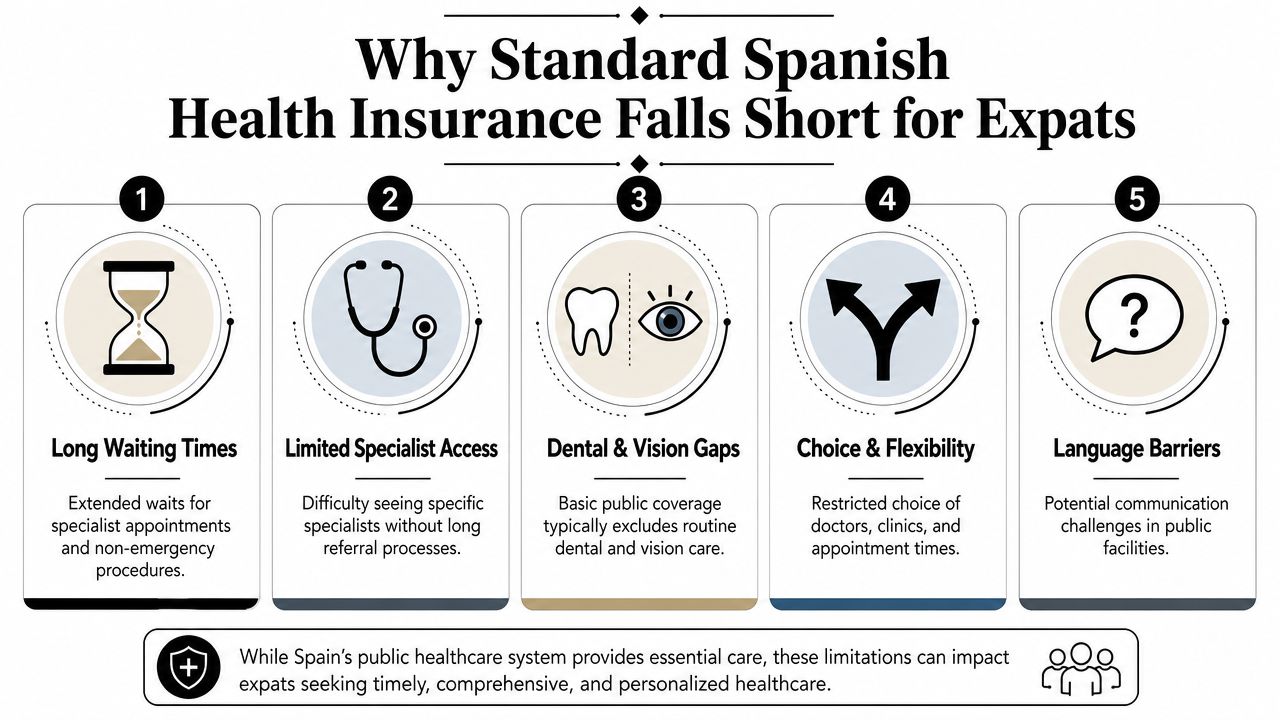
According to this guide to health insurance in Spain, 99.5% of residents participate in Spain's public system, yet public dental and vision support remains extremely limited. The same source notes that 4.75% of households spend more than 10% of their income on dental treatment, and the private dental insurance market is projected to grow at a 9.83% compound annual growth rate from 2025 to 2035 because public cover doesn't meet adult needs.
What the public system does not solve
For expat families, the issue isn't whether Spain has healthcare. It does. The issue is whether that healthcare covers the services families repeatedly need outside major illness or emergency care.
Common pain points include:
- Adult routine dental care: Many budgets often get hit first here.
- Vision maintenance: Eye exams, lenses, and corrective needs often sit outside expectations.
- Timing and convenience: Public systems can work well, but they don't always match the speed, provider choice, or language support expats want for children and working adults.
Why private medical cover still leaves gaps
A lot of families respond to the limits of public care by buying private insurance, which is sensible. But standard private medical insurance in Spain often mirrors the same boundary line. It improves access to doctors, diagnostics, hospitals, and specialists. It does not automatically convert into broad dental and vision protection.
Practical rule: If dental and vision matter to your household budget, treat them as separate buying decisions from the start.
That matters because families tend to underestimate how quickly “routine” services become expensive when several people need them in the same year. One child may need orthodontic assessment. One adult may need a crown. Another may need updated lenses. None of those feels extraordinary, but together they can reshape the total cost of healthcare for the household.
The real trade-off
The trade-off isn't public versus private. It's basic medical access versus complete family protection.
If your priority is visa compliance or fast access to doctors, a standard private medical plan may be enough for step one. If your priority is predictable family spending across medical, dental, and vision care, then step one isn't enough. You need to build around the gaps, not discover them later.
Core Concepts Included vs Add-On Coverage
A family policy can look complete on the quote and still leave routine dental and optical bills sitting fully with you. That is the misunderstanding I correct most often for expat families in Spain.
The practical starting point is simple. Treat medical, dental, and vision as separate coverage lines unless the policy wording clearly says otherwise. Standard private health insurance usually covers consultations, specialists, tests, hospital care, and surgery. Dental is often limited to a small preventive package or excluded. Vision benefits are even less likely to appear in the main contract.
That gap is why the exclusions page matters more than the product name. A plan described as “family” or “premium” can still exclude adult dental treatment, glasses, contact lenses, and routine eye exams. If you want a clear overview of how these dental options are usually structured, this 2026 expat guide to health insurance with dental cover in Spain is a useful reference.
How to separate core cover from paid extras
A standard family medical policy is the base layer of protection. It is built for illness, specialist access, diagnostics, and hospital treatment. Dental and vision, in many cases, sit outside that base layer as optional supplements, discounted service schemes, or separate products.
This distinction matters because the cost logic is different. Core medical insurance protects against large and unpredictable bills. Dental and optical cover are usually about reducing expected household spending on routine care, known treatments, and recurring needs. If a child is likely to need orthodontic reviews or two adults replace lenses regularly, an add-on can make sense. If nobody in the household uses those services often, paying privately may be cheaper.
These are the questions I ask before recommending any upgrade:
- What is included in the main medical contract in plain language?
- Is dental included as full cover, a discount network, or a paid supplement?
- Does the policy mention eye exams, lenses, or frames specifically?
- Do all family members need the same extras, or only one or two?
Spanish Family Health Plan Coverage Breakdown
| Feature | Standard Medical Plan | Dental Add-On | Vision Add-On |
|---|---|---|---|
| GP and specialist consultations | Usually included | Not the purpose of the plan | Not the purpose of the plan |
| Hospitalisation and surgery | Usually included | No | No |
| Routine dental checkups | Usually excluded or very limited | Common reason to add it | No |
| Fillings, crowns, implants, orthodontics | Usually excluded | Discounts or specific benefits may apply | No |
| Eye exams and corrective lenses | Usually excluded | No | Main reason to add it |
| Best use case | Core family medical protection | Predictable dental care costs | Regular optical needs |
The mistake is buying all three layers by default. The other mistake is assuming one layer already includes the other two.
A better approach is to build cover in order. Start with the medical policy that fits your visa status, region, and preferred hospital network. Then price dental and vision against your family's likely use over the next 12 to 24 months. That is how families avoid paying for extras they will not use, while also avoiding the nasty surprise of discovering that braces, crowns, or new glasses were never covered in the first place.
What to check before you buy
When I review policies, I read the exclusions and benefit schedule before I read the sales summary. Hidden costs usually show up there.
Check these points closely:
- Adult dental wording: If treatment is not named, assume it is excluded.
- Vision wording: If there is no clear reference to eye exams, lenses, frames, or reimbursements, assume there is no optical benefit.
- Type of dental benefit: Some plans give access to a network with reduced fees, not true insurance that pays the bill.
- Network fit: An add-on has little value if the approved dentists or opticians are nowhere near where you live.
- Age-specific limits: Children may get broader preventive benefits than adults, which can create a false sense of full family cover.
Do not buy the label. Buy the wording.
That is usually what protects a family budget. Not the lowest premium on the first page.
Decoding Costs and Finding Savings in 2026
Families usually ask the same budget question. Is it worth paying extra each month for dental and vision, or is it better to self-fund and pay as needed?
For dental at least, the answer often becomes clear once you compare monthly add-on pricing with private treatment costs. According to this breakdown of dental insurance value in Spain, individual private dental plans typically cost €7 to €25 per month. The same source states that these plans often include preventive care and offer 20% to 50% discounts on major procedures such as implants, which normally cost €1,200 to €2,000, crowns at €400 to €800 per unit, and orthodontics at €2,000 to €6,500.

What the small print means for your wallet
The biggest mistake is comparing premiums without comparing likely usage.
A family may reject an add-on because it increases the monthly bill. Then six months later they pay privately for checkups, a filling, a crown consultation, and an orthodontic review. The add-on they skipped would have softened those costs or made preventive care easier to maintain.
That doesn't mean every family should buy every supplement. It means you need to match buying strategy to household reality.
For example:
- Low-use household: Healthy adults with no current dental issues and no regular optical needs may prefer a lean setup.
- Growing family: Children often turn preventive care into recurring care. Dental planning becomes less optional.
- Known treatment year: If someone already expects a crown, implant discussion, or orthodontic pathway, paying everything out of pocket usually stops being the better gamble.
Where families usually overspend
Overspending rarely comes from buying cover. It usually comes from buying the wrong structure.
Common traps include:
Paying for a richer medical tier to solve a dental problem
This often fails because the richer tier still excludes the treatment you care about.Ignoring total household usage
One adult may not justify a supplement. Four family members often do.Choosing on headline premium alone
A cheaper plan with weak network access or poor discounts can cost more in practice.Adding products one by one without market comparison
Bundled planning can assist.
If you want to get a sense of how the base medical side affects household budgeting, this guide to family health insurance cost per month helps frame the bigger picture.
Cheap premiums can be expensive policies if they push routine care back onto your family budget.
A practical savings mindset
The best savings strategy is not “buy the cheapest.” It's “buy the cover that prevents the most expensive mistakes.” For some families that means adding dental immediately and leaving vision separate unless someone already wears corrective lenses. For others, especially where eye care is already part of family life, it makes sense to cost both from day one.
The important thing is to compare whole-year exposure, not just monthly premium.
Navigating Waiting Periods and Exclusions
A policy can look right on price and still disappoint you when you try to use it. That usually comes down to two things: waiting periods and exclusions.
In Spain, waiting periods are often called carencias. They're the period after policy start when certain benefits can't yet be used. Families often don't notice them until treatment is already planned, which is why they create so much frustration.
What waiting periods actually affect
Waiting periods don't usually create problems for every benefit. They tend to matter most for services that insurers consider predictable, higher-cost, or easy to buy only when treatment is already needed.
That often includes areas such as:
- Orthodontic treatment: Especially relevant for families with children or teenagers.
- Prosthetic or major restorative work: Where treatment cost is higher and planning is less spontaneous.
- Certain specialist extras: Depending on the insurer and product design.
The exact wording matters more than the sales summary. Two plans may both advertise dental access, but one may delay key treatments while the other handles them more flexibly.
How to reduce unpleasant surprises
The best protection is disciplined checking before the policy starts.
Use this checklist:
- Read the exclusions first: Don't stop at the benefits page.
- Ask which services are available immediately: “Dental included” is not enough detail.
- Check whether a switch qualifies for waived waiting periods: Some insurers are more flexible when you are moving from another qualifying Spanish policy.
- Get confirmation in writing: If a broker or insurer says a treatment is covered, keep the written answer.
If you're changing provider, this guide to medical insurance waiting periods in Spain is helpful for understanding how transfer situations are usually handled.
The safest time to ask awkward questions is before the start date, not after the treatment plan.
Common exclusions families should expect
Even strong add-on plans often draw firm boundaries. Cosmetic procedures are a common example. Certain advanced or elective treatments may also sit outside the insurer's intended scope.
That doesn't make the plan bad. It just means you should buy it for what it does well. Preventive care, network access, negotiated pricing, and support with common treatment pathways. Not for the fantasy version of total unlimited cover.
Families who understand that distinction tend to be much happier with their insurance.
Finding the Right Fit for Your Family
The right structure depends less on the brand and more on the family sitting behind the application. A visa applicant has one set of priorities. A retired couple has another. Parents with children approaching orthodontic age have a completely different decision to make.
For visa applicants
A family applying for residency usually starts with compliance. They need a policy that satisfies administrative requirements and gives confidence from day one.
The mistake here is treating dental and vision as an afterthought because the visa process is stressful enough already. That can work in the short term, but it often creates an immediate second purchase once normal family life begins in Spain. If children need checkups or adults already know they have deferred treatment, building a complete package early is often cleaner than patching gaps later.
For retirees and families managing ongoing conditions
This group needs sharper cost control. According to this guide to dental and vision riders and hidden premium increases, for expats over 65 or those with chronic conditions, adding dental and vision riders can increase premiums by 30% to 45% while still limiting coverage for major procedures.
That doesn't mean these families should avoid the add-ons. It means they should compare more carefully than everyone else.
Key questions include:
- Are the riders broad enough to justify the extra premium?
- Do they mainly cover prevention, or do they help with the treatments you're likely to need?
- Does the insurer place extra restrictions on age or pre-existing conditions?
- Would separate standalone products work better than riders attached to the medical plan?
For older expats, rushed buying hurts most. The wrong structure can leave you paying more while still funding a meaningful share of treatment privately.
For parents planning ahead
A family with younger children usually benefits from thinking one or two steps ahead instead of reacting when treatment becomes urgent.
That means looking at practical questions such as:
- Will this plan still make sense if orthodontics becomes relevant?
- Is the dental network convenient enough for school-term life?
- Do both parents need vision cover, or only one?
- Is there any point paying for broad extras that nobody in the household is likely to use?
Good family insurance planning is less about buying the most cover and more about buying the right cover before the need becomes obvious.
The best fit is rarely the most glamorous product. It's the one that matches your household's likely use, tolerance for out-of-pocket spending, and preference for convenience.
Your Next Steps to Full Coverage
If you want family health insurance with dental and vision that works in Spain, keep the process simple.
List your family's likely needs for the next year
Include regular checkups, glasses or contact lens needs, known dental work, and any child who may need orthodontic assessment.Review your current or shortlisted policy exclusions
Don't rely on plan names or sales language. Look specifically for adult dental, routine vision care, and any waiting periods that affect likely treatment.Compare structure, not just price
A base medical policy plus separate dental cover may work better than an expensive medical plan with weak add-ons. In some households, a vision add-on is essential. In others, it's unnecessary.Ask for written confirmation on the points that matter most
Network access, start dates, excluded treatments, and switching rules should all be clear before you commit.Get experienced help if the case is even slightly complex
That's especially true for visa applicants, retirees, families with teenagers, and anyone managing ongoing conditions.
Most families don't need more insurance jargon. They need a clean answer to a practical question. What combination of cover protects us properly without making us overpay?
If you want help comparing options without guessing, Bsure Health Brokers can guide you through the Spanish market and help you identify what's included, what needs to be added, and where hidden costs are likely to appear. For expat families, especially those dealing with visa rules, age-related pricing, or pre-existing conditions, having an independent broker review the fine print can save time, stress, and expensive mistakes.