
You can be fully insured in Spain, go to the right clinic, get the right scans, and still face a hard question the day a serious diagnosis lands. Who pays the mortgage, who covers the flights home, and what happens to your income if you can't work for months? That's where health insurance critical illness comes in, not as a replacement for medical cover, but as the money that helps life keep moving when treatment begins.
Table of Contents
- When a Diagnosis Changes Your Life in Spain
- What Critical Illness Cover Really Is
- Critical Illness Cover vs Standard Health Insurance
- Conditions Covered and Common Exclusions
- Why Expats and Retirees in Spain Should Care
- How to Add Critical Illness Cover to Your Plan
- What Affects the Price You Pay
- Choosing the Right Policy With Confidence
When a Diagnosis Changes Your Life in Spain
A retired couple in Alicante gets a cancer diagnosis, and the private insurer starts arranging consultations, tests, and treatment. The hospital side of the problem is handled, but the couple still has to pay rent on their apartment, cover extra travel for adult children arriving from abroad, and manage the ordinary costs that don't pause just because the diagnosis did. That's the moment many people realise the gap between medical cover and financial cover.
Critical illness protection exists for that gap. It is designed for the month when a diagnosis turns into paperwork, transport, household disruption, and a very different cash-flow picture. The medical plan helps with care, while critical illness cover is about keeping the rest of life stable enough to absorb the shock.
Why the diagnosis changes the whole budget
Serious illness rarely affects only the patient. It changes who drives, who cooks, who travels, and who pays for the things that were easy last week. For expats in Spain, that can mean a second language, a different care system, and family logistics spread across countries.
This is also why many people misread the product at first. They think in hospital bills, but the underlying problem is often income loss and practical disruption, not the invoice from the clinic. A useful background read on the wider family cost of severe disease is the financial impact of rare diseases on families, because it shows how the burden extends well beyond treatment itself.
Practical rule: if the illness changes your ability to earn or manage daily life, a lump-sum policy can matter more than another reimbursement policy.
The rest of this guide separates the moving parts cleanly, so you can judge whether the cover fits your own life in Spain instead of treating it like a vague add-on.
What Critical Illness Cover Really Is
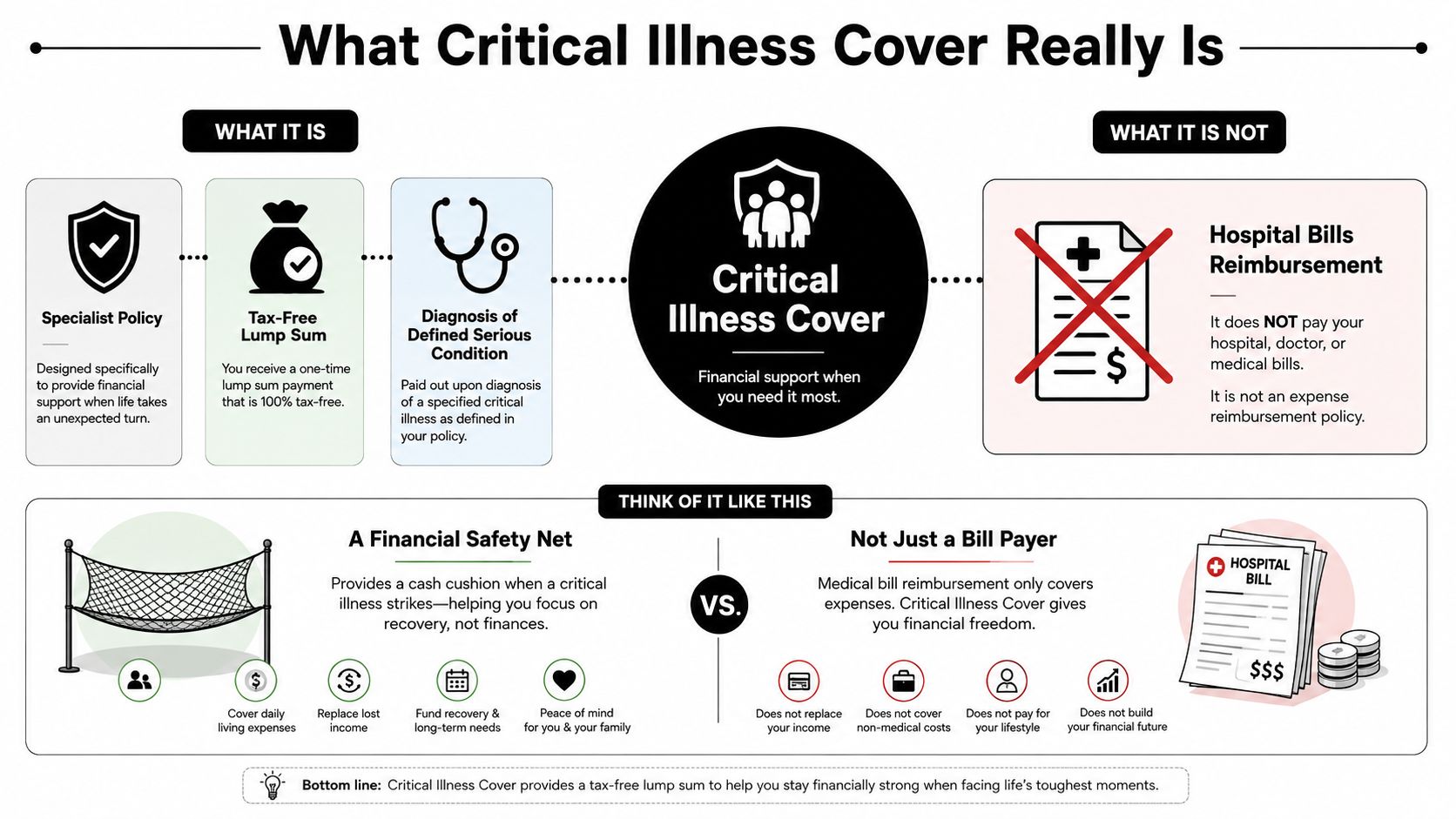
A sudden diagnosis can leave a household asking a very practical question, who pays for life while treatment is happening? Critical illness cover answers that question with a lump sum paid when the policyholder is diagnosed with a condition the contract defines very specifically. It does not reimburse hospital bills item by item. It works like a financial parachute, giving cash you can use where the pressure is greatest.
The payout is the point
Once the policy is triggered, the insurer pays one benefit rather than a stream of reimbursements. That money can go toward mortgage payments, private care at home, transport, family accommodation, or replacing income while work is impossible. The contract is built around the diagnosis event, so the exact wording of the condition matters more than the label on a hospital report.
That is why people should stop asking whether it “covers treatment” in the same way as health insurance. It does not work like a clinic invoice plan. It behaves like a cash reserve that becomes available when a serious illness interrupts ordinary life.
Why the wording matters so much
The policy pays when the medical event matches the contract language, not when someone says, “It was a heart problem.” Severity thresholds, exclusions, and diagnosis wording all affect whether a claim is paid. For a close look at how the market sets those standards, the ABI guide to minimum standards for critical illness cover explains the core conditions of cancer, heart attack, and stroke, while also showing how many plans add more conditions and tighter definitions ABI guide to minimum standards for critical illness cover.
The value of the product becomes clearer when you look at the wider financial shock of serious disease, not only the medical file. For readers comparing how illness affects household finances, the cancer-focused discussion in GoodRx's guide on critical illness insurance is a useful complement because it frames the payout as support for life costs, not only treatment. The same pattern appears in the financial impact of rare diseases on families, where the pressure reaches beyond appointments and medication into rent, travel, and day-to-day stability.
A simple way to hold the idea in mind is this. Health insurance helps pay for care. Critical illness cover helps keep the household running while serious illness is being handled.
Critical Illness Cover vs Standard Health Insurance
Standard health insurance and critical illness cover are often bought by the same person, but they do completely different jobs. One pays for care, the other pays for consequences. If you own both, you're covering both sides of the same crisis.
| What Each Product Actually Pays For | Standard Health Insurance | Critical Illness Cover |
|---|---|---|
| Consultations and tests | Usually covered, subject to the policy | Not the focus |
| Hospital stays and procedures | Usually covered, subject to the policy | Not paid as medical reimbursement |
| Prescription or treatment costs | Often covered in part, depending on the plan | Not paid as itemised treatment costs |
| Household bills during recovery | Not covered | Can be paid from the lump sum |
| Lost income | Not covered | Can be covered indirectly through the cash payout |
| Family travel and extra care costs | Not covered | Can be covered from the benefit |
Two products, two jobs
Standard health insurance pays the doctor, the hospital, and the testing pathway. Critical illness cover pays the family's next decisions. That can include a cleaner, taxi fares, hotel nights for relatives, or time away from work while a recovery plan unfolds.
This is why advisers often describe critical illness as a living benefit. It supports the period after diagnosis, when money pressure can be just as real as the medical event itself. For expats in Spain, that matters because many already carry private health insurance for access and continuity, yet still have no protection for the income and lifestyle hit that follows a serious diagnosis.
Why having both is stronger than relying on one
A strong setup treats health insurance as the access layer and critical illness cover as the cash layer. If your health policy helps you enter the system quickly, the critical illness payout helps you absorb what the system doesn't pay for. That combination is especially useful for people with fixed obligations, like rent, household support, or commitments in another country.
Bottom line: one policy gets you treated, the other helps you stay afloat.
That's the cleanest way to think about the two products. They overlap only in the sense that both are responses to illness, but the financial mechanism is completely different.
Conditions Covered and Common Exclusions
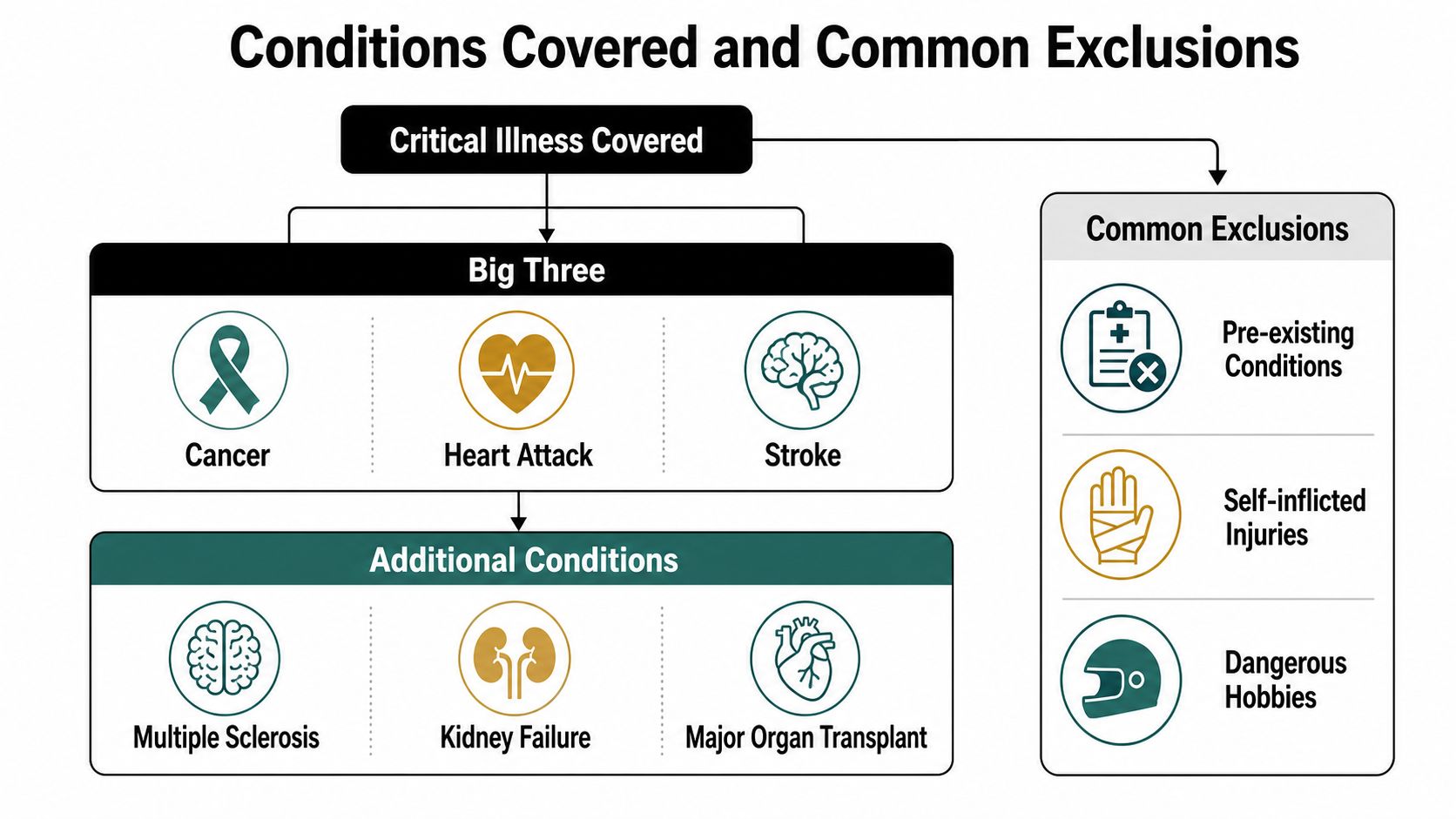
Claims are tied to defined conditions, not broad medical labels, and that is where many buyers get caught out. In published claims analysis, cancer, heart attack, and stroke account for a large share of critical illness claims, which is one reason those three conditions sit at the centre of many policies (PubMed analysis). The pattern is simple enough. These policies are built around a small set of serious events, then widened in different ways by different insurers.
The core conditions and how broader plans expand
The ABI guide to minimum standards for critical illness cover says UK policies must cover cancer, heart attack, and stroke to a basic standard ABI guide to minimum standards for critical illness cover. Many policies then add conditions such as multiple sclerosis, kidney failure, major organ transplant, blindness, and certain stages of Parkinson's or Alzheimer's disease.
That longer list can look reassuring, but the contract wording still decides the outcome. A diagnosis only triggers payment if it meets the policy's severity threshold. If the condition is milder, earlier, or described differently in the medical report, the claim may not qualify even when the illness name sounds familiar.
Common exclusions buyers often miss
The exclusions are usually the ones people expect to be there, yet do not read closely enough. Pre-existing conditions can be excluded, non-disclosure can void cover, and self-inflicted injuries are usually outside the policy. Some contracts also exclude claims where the condition does not meet the exact definition written in the wording.
A second point is the survival period. The IRDAI sample policy uses a 30-day survival period, together with medical confirmation supported by radiological, histological, or laboratory evidence IRDAI critical illness policy sample. That setup matters because the payout is meant for illnesses that create a sustained interruption, not only a diagnosis on paper.
If you want a plain-language reminder of the kinds of things people assume are covered but often are not, the Goodlabs guide on what isn't covered by insurance is useful background when you read the small print with a more sceptical eye.
For cancer-specific situations, some readers also want to see how serious-illness cover fits alongside treatment planning. Bsure's overview on health insurance for cancer patients is relevant here because cancer is one of the conditions people compare first across policies.
The diagnosis name is only the starting point. The wording decides whether the claim pays.
Why Expats and Retirees in Spain Should Care
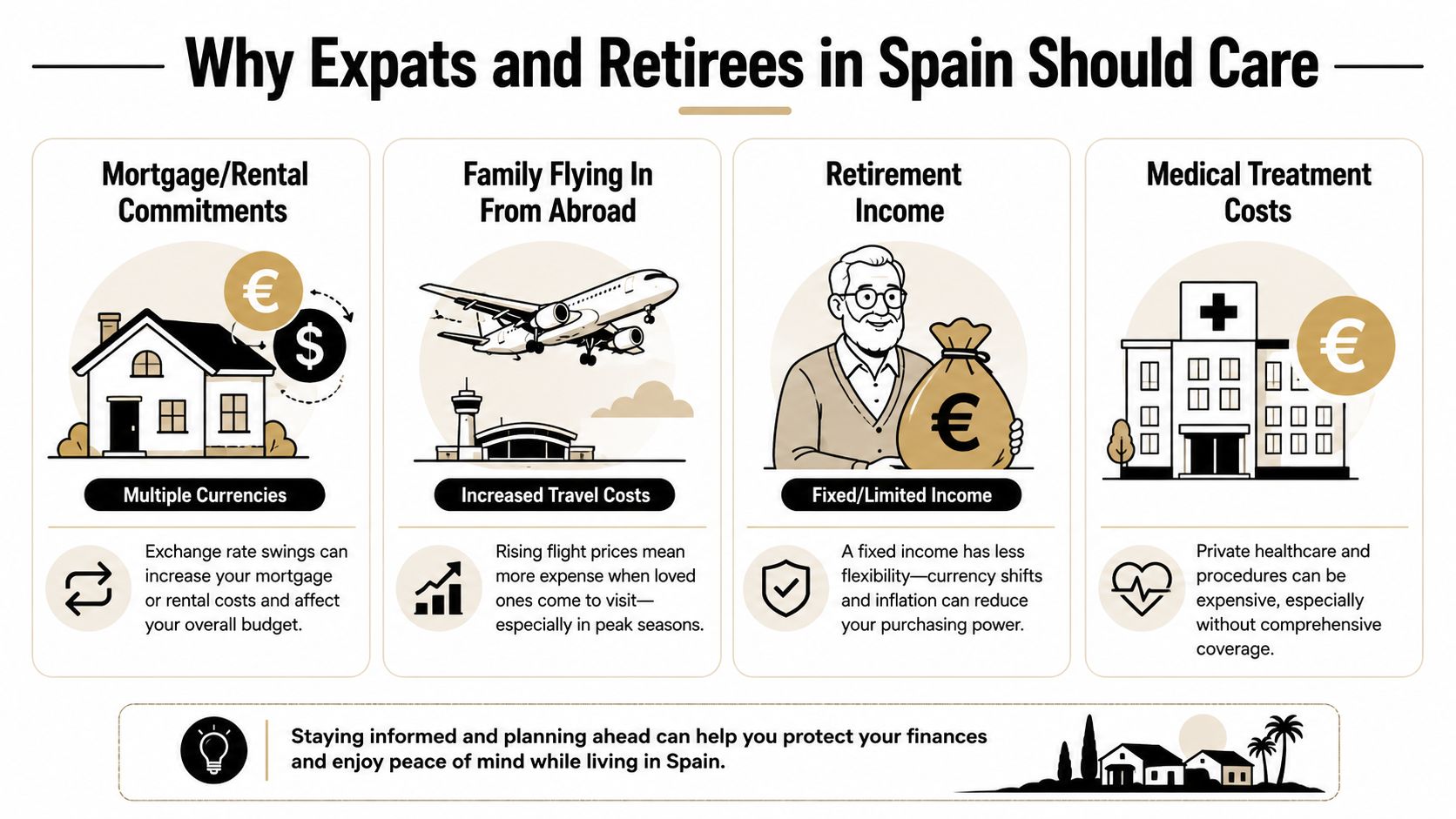
Spain is a good place to have access to private care, but access alone doesn't pay the bills that keep showing up after a diagnosis. Rent or mortgage commitments may be tied to a different income stream, family may need to fly in from another country, and retirement income can be far less flexible than it was during working life. Critical illness cover is useful because it protects the plan you already built.
The Spanish reality is financial, not just medical
Many expats in Spain already buy private health insurance for residency or visa purposes, and that cover can be perfectly adequate for consultations and treatment pathways. It still won't replace an income that disappears during recovery. If you're paying for a home, supporting a partner, or helping adult children across borders, the lump sum can keep the household stable while the medical plan does its own job.
Retirees face a different version of the same problem. Fixed income makes even ordinary disruption feel larger, and a serious diagnosis can quickly create costs that weren't in the monthly budget. The question isn't whether care exists. The question is whether the rest of life can keep moving without forcing bad financial decisions.
Who should think about it first
The main earner in a household is usually the person who matters most for this type of cover. That's true even if the family assumes the risk sits elsewhere. If the income stops, every other plan becomes harder to fund.
- Working expats: protect the income that pays the mortgage, rent, and school costs.
- Retirees: protect the savings and cash flow that support daily living and family visits.
- Households with cross-border ties: protect the budget for flights, temporary accommodation, and care coordination.
- People with visa-linked cover: remember that residency cover and living-benefit protection are separate things.
For older applicants, the structure can matter just as much as the premium. Policies available after 65 or 75 often need more careful comparison, and the wording around eligibility, exclusions, and waiting periods becomes especially important. That's where the product is less about optimism and more about practical continuity.
How to Add Critical Illness Cover to Your Plan
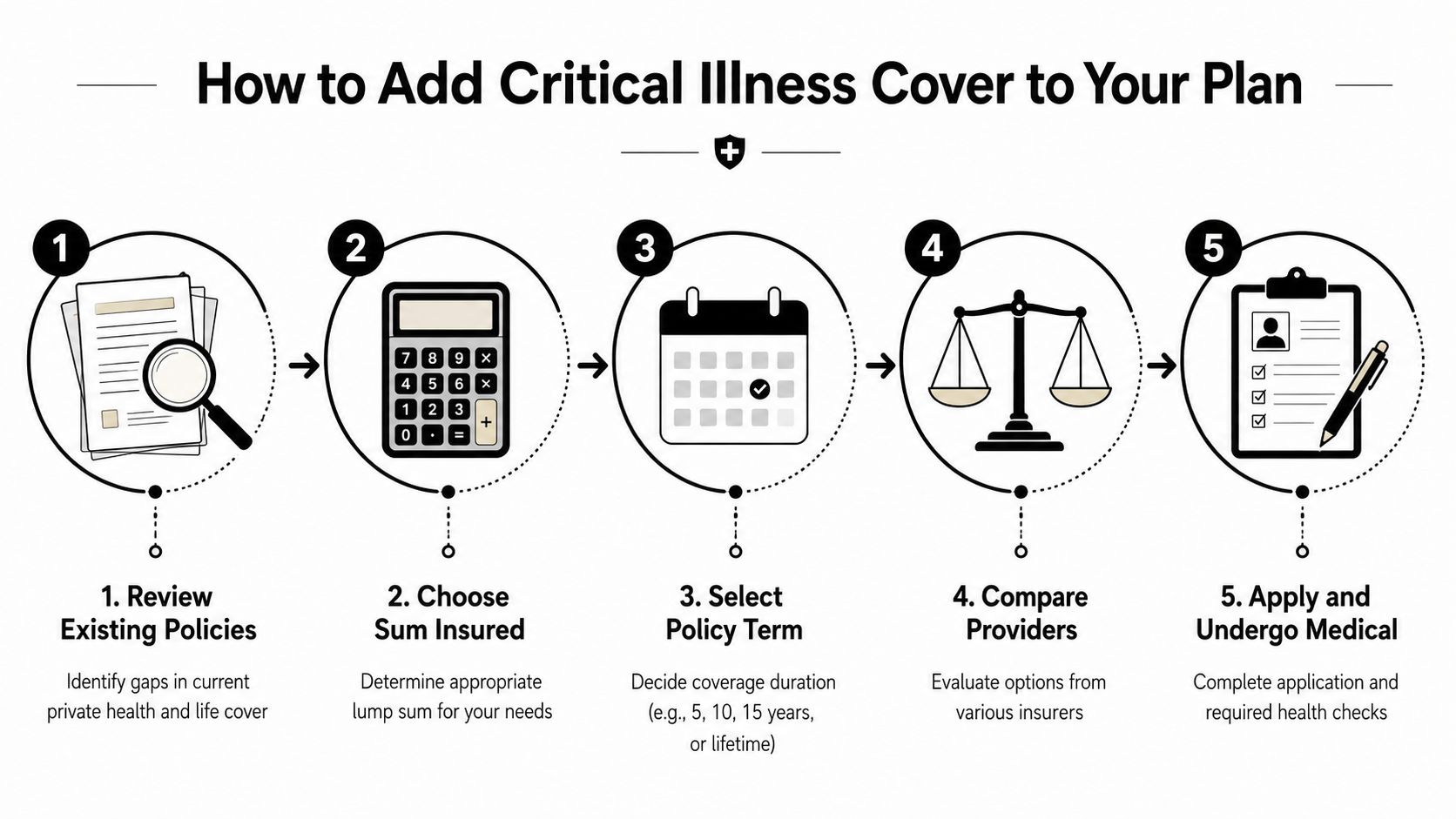
The first step is to look at what you already own. A lot of people discover they have private health insurance and life cover, but nothing that pays cash after diagnosis. That's the gap critical illness cover fills, and the size of that gap should guide the amount you buy.
Start with the number that would actually help
The lump sum should match real life, not a round number picked in a rush. That means outstanding debts, rent or mortgage obligations, family support, and the likely cost of time away from work all belong in the calculation. A useful rule is to think in terms of “How much cash would buy me breathing room?” rather than “How much cover sounds high enough?”
Practical rule: if the payout wouldn't change your choices after diagnosis, it's probably too small.
Underwriting is where the truth matters
Applications live or die on disclosure. Medical history, prescriptions, past treatment, and ongoing conditions all matter, because the insurer is deciding how to define the risk and whether any exclusions are needed. For a plain explanation of that process, Bsure's guide to what insurance underwriting means is a good reference point.
Some applicants need specialist impaired-life underwriting. That's not a rejection by default. It's the process of asking whether cover can be offered with exclusions, loadings, or alternative terms. In Spanish and international markets, an experienced adviser can compare wording across multiple carriers, challenge assumptions with senior underwriters, and see whether day-one cover is possible where health history or visa timing makes things awkward.
Switching can be smarter than starting from zero
If you already have a policy, don't assume it's the right one forever. Policy terms, claim definitions, and survival periods vary, and a switch can make sense when the current wording doesn't match your needs. Some products also allow waiting-period waivers where the applicant qualifies, which can help reduce gaps during a transition.
What Affects the Price You Pay
Age is usually the biggest pricing driver, because the risk of a claim rises as time passes and insurers price for that reality. Smoker status, the amount of cover you want, whether the policy is standalone or attached to life cover, and how broad the condition list is all affect the quote too. Two people with identical health profiles can still get different premiums if their chosen benefit design is different.
Why quotes can diverge so much
A larger lump sum means a larger possible payout, so the premium usually rises with it. Broader condition lists can also cost more because the insurer is promising payment across a wider range of serious events. A policy attached to life cover may be priced differently from a standalone critical illness plan because the insurer is balancing the overall package, not just one benefit.
The same is true for applicants with health history. Pre-existing conditions can lead to exclusions, premium loadings, deferred cover, or a declined application depending on the market and the insurer's appetite. That's one reason brokers compare more than price; they compare what the insurer is willing to write.
What an adviser does with the pricing puzzle
An experienced broker doesn't just forward the first quote. They look at where the insurer's definitions are broad, where they're strict, and where a manual underwriting conversation might improve the outcome. That matters for people with older histories, people moving countries, and anyone whose medical profile is more complex than a standard online form can handle.
For a broader look at rating logic across policies, Bsure's explanation of how insurance premiums are calculated is relevant because the same underwriting logic often shows up in critical illness pricing. The details vary by insurer, but the underlying idea is the same, the more uncertainty the insurer takes on, the more carefully the contract is priced.
Choosing the Right Policy With Confidence
The right policy is the one that fits your health history, your budget, and the life you live in Spain. Price matters, but so do the condition list, the survival period, the severity wording, and whether the benefit is standalone or tied to another policy. A cheap plan that excludes the condition you're worried about is a poor deal.
Questions worth asking before you sign
- Which conditions are covered? Ask for the exact wording, not just a marketing summary.
- What is the survival period? A few days' difference can matter when the diagnosis is severe.
- Are partial payments available? Some policies pay reduced benefits for earlier-stage conditions.
- How are pre-existing conditions handled? Look for exclusions, loadings, or special underwriting terms.
- Is the benefit standalone or bundled? That affects flexibility and sometimes pricing.
- What happens if I switch insurers later? The answer matters if your needs change.
If the policy is in a language you don't read comfortably, get a properly translated version before you buy. Accurate wording matters more than glossy brochures, and accurate insurance policy translation can be a sensible safeguard when a contract decides whether a claim pays.
Bsure Health Brokers is one option for people who want the contracts compared, the paperwork handled, and the renewal side managed by an English-speaking team in Marbella. They work with trusted Spanish and international insurers, which makes it easier to match cover to expat and retiree needs without having to decode every clause alone.
If you want help comparing critical illness options alongside your Spanish health insurance, visit Bsure Health Brokers and ask for a policy comparison that matches your residency, health history, and budget. Their team can help you separate treatment cover from living-benefit protection, so you know exactly what your plan will do when life changes fast.