
You're standing at the edge of a big move. The terrace looks perfect, the sea is close, and the agent keeps saying the paperwork is simple. What doesn't feel simple is the quiet fear that one missed document, one rushed transfer, or one hidden debt could turn a dream home into a long, expensive problem that also disrupts your health plans and insurance access.
That fear is rational. In Spain, the headline purchase price often covers only 75% to 85% of the total investment because taxes, fees, and closing costs usually add 10% to 15% on top, so a €300,000 home can require another €30,000 to €45,000 just to complete the purchase, before renovations, furnishing, or financing costs are added (lawants.com). Buyer frustration has also been documented for years, with a summarized survey showing 24% of respondents were unhappy or very unhappy with their buying experience in Spain, while recent market data says foreign buyers completed about 133,000 home purchases in the trailing 12 months to Q1 2025, equal to 18.0% of all Spanish home sales (Eye on Spain).
The safest approach is to treat the property search as a full-risk project, not a shopping trip. That means protecting your health coverage, stress levels, cash flow, and legal position at the same time.
Table of Contents
- 1. Failing to Secure Adequate Health Insurance Before Purchase
- 2. Ignoring Hidden Costs and Property Taxes Beyond Purchase Price
- 3. Purchasing Without Proper Legal Due Diligence and Title Verification
- 4. Not Obtaining Adequate Property and Liability Insurance Coverage
- 5. Underestimating Healthcare System Integration and Medical Tourism Risks
- 6. Failing to Account for Currency Exchange Risk and International Fund Transfers
- 7. Overlooking Community Association Debts and Ongoing Building Obligations
- 8. Inadequate Due Diligence on Property Condition and Hidden Structural Defects
- 8-Point Comparison of Property-Buying Pitfalls in Spain
- Securing Your Property and Peace of Mind in Spain
1. Failing to Secure Adequate Health Insurance Before Purchase
A lot of expats treat health insurance as something to sort out after the keys are in hand. That's a mistake. If you're moving to Spain for residency, retirement, or family life, your healthcare setup should be ready before completion, because a property purchase often triggers stress, travel, and administrative delays exactly when you least want a gap in cover.
The practical problem is bigger than one medical bill. A buyer who arrives with no recognised policy can face delays in visa processing, trouble accessing care during relocation, and a weaker position if a medical issue appears while contracts, deposits, and completion dates are still in motion. If you're trying to buy property and organise life in a new country at the same time, health insurance becomes part of the transaction risk, not a separate issue.
Make insurance part of the purchase timeline
Start the policy search 4 to 6 weeks before completion, not after you've moved. Disclose pre-existing conditions upfront, because hiding them can lead to claim problems later, and make sure the policy covers emergency room visits and hospital stays. If you need visa-compliant cover, confirm that the insurer and plan are acceptable for the purpose you need.
Practical rule: If you wouldn't sign the purchase contract without the title check, don't arrive in Spain without the health policy already lined up.
Some buyers prefer working through a broker that can compare policies and handle the paperwork. Bsure Health Brokers has a quick health insurance guide that's useful if you're trying to coordinate cover with a property completion date.
The health angle matters because relocation stress doesn't stay theoretical. A rushed move can expose family members to missed prescriptions, delayed follow-up care, or emergency out-of-pocket costs at the worst possible moment. Good insurance planning protects your body, your budget, and your residency file at once.
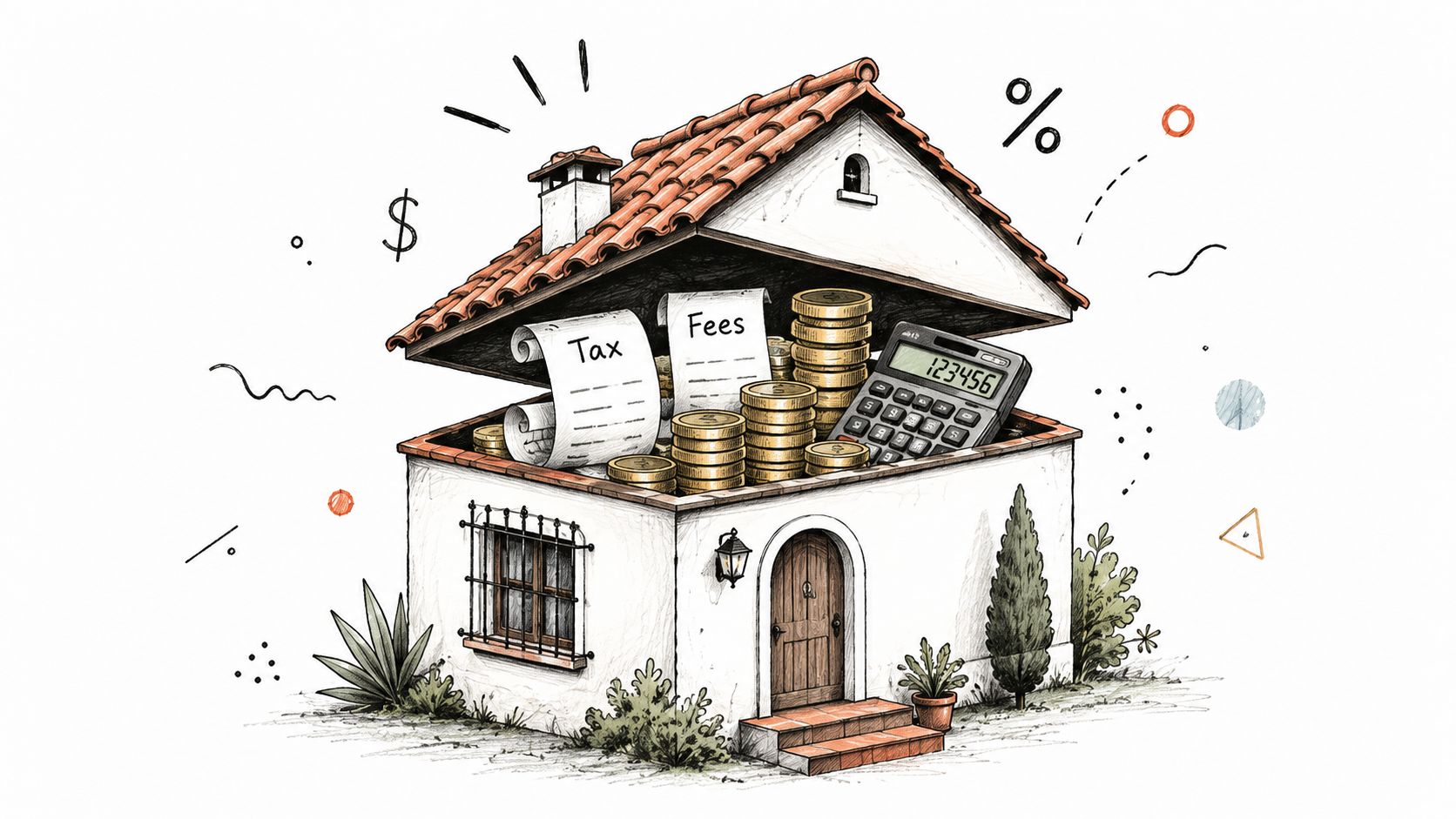
2. Ignoring Hidden Costs and Property Taxes Beyond Purchase Price
The asking price is only the first number that matters. Buyers who fixate on the listing often discover too late that the affordability test is the full acquisition cost, not the sticker price. In Spain, those extra costs are a predictable part of the process, which is why underbudgeting here can push people into bad compromises, including cutting back on health insurance or emergency savings.
That's how property buying starts affecting more than property. When the cash gap gets wider than expected, some buyers delay medical cover, accept weaker insurance, or leave no room for relocation costs, furniture, or the first few months of living expenses. The home may still be affordable on paper, but the life around it becomes fragile.
Build the full budget before you commit
Ask your lawyer or gestoría for a line-by-line cost estimate before you proceed. That estimate should include transfer tax, notary fees, registry fees, and valuation or mortgage-related costs if they apply. The verified guidance on Spain's market says the headline price often covers only 75% to 85% of the total investment, with 10% to 15% added on top for taxes, fees, and related closing costs (lawants.com).
The annual side matters too. Ongoing charges such as IBI, community fees, insurance, and maintenance can change what you can realistically afford month after month. If you're an expat, include currency conversion charges and cross-border transfer friction as well, because the money you think you're sending isn't always the money that lands.
Set a separate budget line for health insurance before you finalise the offer. If the property only works by stealing from your medical or emergency fund, it doesn't really work.
That's the trade-off. A slightly cheaper house that leaves you cash-poor is often a worse outcome than a better-priced purchase with strong reserves intact.
3. Purchasing Without Proper Legal Due Diligence and Title Verification
Many foreign buyers get hurt here. The property looks clean, the agent seems confident, and the paperwork feels official enough, so the buyer moves forward without independent legal verification. That's exactly where hidden debts, disputed ownership, illegal construction, or a mismatch between the property and the registry can surface later.
The legal risk isn't abstract. A buyer who skips due diligence can end up locked into a home that's hard to refinance, difficult to sell, or expensive to regularise. That can also affect relocation planning and even delay health insurance enrolment if the move is tied to residency paperwork and timing.
Check the property as if you may need to defend it later
Hire an independent Spanish lawyer, not one casually recommended by the seller. Ask for the nota simple before you make a serious commitment, and compare the registry details with the actual property, including boundaries, use, and any visible extensions. Independent guides warn about hidden liabilities, illegal construction, and incomplete ownership records, and newer risk coverage adds deposit diversion scams, fake seller schemes, and “legal house, illegal situation” cases to the list (Investropa).
A practical due diligence routine should also include these steps:
- Registry check: Confirm ownership, charges, and any burdens registered against the property.
- Community review: Ask for debts and recent minutes from the homeowners' association.
- Municipal check: Look for planning violations or unregistered works.
- Document match: Compare the title data with the physical layout and any renovations.
The mistake I see most often is trusting one reassuring document and stopping there. In Spain, a safe purchase is built from multiple checks that line up, not from one good-looking file.
If you're unsure whether a feature was legally added, treat it as unverified until the lawyer and registry say otherwise.
That discipline protects your finances, but it also protects your stress load. Buyers who discover problems after completion often spend months dealing with anxiety, appeals, and costly fixes that could have been identified earlier.
4. Not Obtaining Adequate Property and Liability Insurance Coverage
Owning the home is not the same as being protected by the home. Many buyers secure basic property cover and assume that's enough, but liability exposure can be far more expensive when a guest, tenant, or visitor is injured on the premises. For expats, that gap can become a serious financial shock because they may not be familiar with how responsibility is handled under Spanish law.
The risk is simple. If someone falls, gets hurt, or claims damage tied to the property, the owner can face a legal and medical-cost problem that goes beyond repair bills. If the property is rented out or used by frequent visitors, the exposure gets wider.
Don't buy the building and forget the people who enter it
Choose a policy that includes responsabilidad civil, not just damage to the structure. Review exclusions carefully, especially for pools, gardens, stairways, and structural defects. If you rent the property at any point, tell the insurer, because rental activity can change coverage terms.
A good policy should also include legal defence costs, not just claim payment. That matters because a dispute doesn't only consume money, it also consumes time and energy when you're already trying to relocate, manage contractors, and settle into a new country.
The best owners document the condition of the property at handover with photos and video, then keep repairs current so they're not seen as negligent. Simple actions, like maintaining handrails and lighting, reduce the chance of claims before they start.
Health insurance still stays separate. Property liability cover won't help with your own medical needs, and your private health policy won't protect you from third-party injury claims. The two policies solve different problems, and both matter when you're building a life in Spain.
5. Underestimating Healthcare System Integration and Medical Tourism Risks
A property move is often when people finally confront how different day-to-day healthcare can feel in Spain. Prescription norms, referral pathways, and specialist access may not match what you're used to, especially if you've come from a system where your records, GP, and insurer already know you. If you add medical tourism into that transition, you multiply the risk.
The worst version of this mistake is trying to save money on a procedure somewhere else while also managing a property purchase. You're then balancing travel, recovery, paperwork, and relocation at the same time. If the treatment goes badly, you may land back in Spain needing corrective care, specialist follow-up, or emergency support when your routine is already disrupted.
Keep medical decisions separate from the relocation rush
Avoid elective procedures during the property transition period unless they're clearly necessary and your care team is already in place. Transfer international medical records before you leave, and make sure any insurer you choose offers access to English-speaking doctors or a usable helpline.
- Medication continuity: Carry a written list of active medications, including generic names.
- Local doctor setup: Register with a Spanish GP quickly so referrals don't stall.
- Condition planning: If you have a pre-existing condition, verify specialist access before you move.
- Emergency support: Confirm what the insurer covers in emergencies and during travel.
Spain's healthcare system is manageable when you've prepared for the differences, but it's easy to overestimate how smooth the first few months will be. Bsure Health Brokers has a useful overview of the health care system in Spain if you're trying to align private cover with a property relocation.
Don't let a bargain medical procedure become the reason your move turns into a second health crisis.
The primary issue isn't only medical cost. Poor integration can delay treatment, create communication problems, and drain the energy you need to complete the purchase, furnish the property, and settle your family.
6. Failing to Account for Currency Exchange Risk and International Fund Transfers
A foreign buyer can do everything else right and still lose a serious chunk of the budget at the transfer stage. If your money is sitting in pounds, dollars, or Swiss francs while the completion date approaches, exchange rate movement can change the amount available for the property, health insurance, and emergency reserves.
This risk is especially painful because it looks invisible until the bank transfer lands. By then, the purchase contract may already be tight, the deposit may be fixed, and the remaining cash may no longer cover the full plan for relocation and medical protection.
Treat the exchange rate as part of the purchase price
Use a specialist currency provider rather than defaulting to a high-street bank. Compare exchange rate, transfer fee, and hedging cost together, because the cheapest-looking option is not always the least expensive overall. If the purchase timing is fixed, a forward contract can help lock the amount you'll receive before closing.
The safest budgeting habit is to hold your health insurance budget in euros before the property money moves.
That keeps the medical side insulated from the property side. It also reduces the chance that a bad FX move forces you to downgrade your cover or postpone enrolment.
A practical transfer plan usually starts weeks before completion. Monitor rates early, move part of the funds when the market is favourable, and leave enough time for compliance checks and bank processing. If you're working across borders, that timing buffer matters just as much as the rate itself.
The broader lesson is simple. Property affordability in Spain is not just about the asking price and taxes. It's also about how efficiently your money gets there and whether enough remains for the life you're building.
7. Overlooking Community Association Debts and Ongoing Building Obligations
Apartment living in Spain has its own hidden liabilities. A building can look fine from the street while the owners' association is carrying unpaid fees, planning a special assessment, or preparing for major maintenance that hasn't been clearly explained to buyers. If you miss that, you can inherit a financial surprise after completion.
That surprise can hit your health budget directly. When a buyer suddenly has to cover building obligations, the money reserved for private insurance, prescriptions, or relocation expenses can disappear fast. For expats, that kind of squeeze is especially damaging because the first year in Spain already carries enough moving parts.
Ask for the documents the seller hopes you won't request
Request the certificado de deuda from the building administrator and read the recent community meeting minutes. Those minutes often show whether the building is about to face facade work, lift repairs, or other shared costs that will land on owners. Also ask about the community bank balance, because a weak reserve can mean more assessments later.
Buyer caution here is not theoretical. Independent risk guidance notes that community debts and building obligations can transfer with the property, and recent market commentary highlights that unpaid community fees are often missed because they don't always appear the same way as a mortgage or formal lien (Investropa).
A strong buyer also speaks to residents. They know whether the building is well managed, whether the neighbours are fighting, and whether repairs keep getting postponed. Those are the signs that matter when you're about to commit long-term capital.
Ask one question before purchase, what major work is coming up that a newcomer might not see from the brochure?
That one answer can save a lot of grief. It may also preserve the insurance budget you need to stay medically and financially stable after the move.
8. Inadequate Due Diligence on Property Condition and Hidden Structural Defects
Some homes are beautiful because the problems are hidden, not because they're absent. Fresh paint can conceal damp, older wiring can sit behind clean walls, and unauthorised alterations can look normal until a surveyor checks the structure. Buyers who skip an independent inspection are often the ones who pay for it later.
Property defects become a health issue as well as a financial one. Damp and mold can worsen respiratory problems, poor insulation can be rough on older residents, and outdated electrical systems introduce safety risks that no buyer wants to discover after completion.
Inspect the building like the repair bill is already waiting
Commission an independent surveyor, and don't rely on the seller's summary. For older properties, ask for specialist checks where needed, especially if you suspect damp, structural movement, or outdated systems. If the building is older, asbestos testing may also be sensible where indicated by the property's age and materials.
A thorough inspection should look at the roof, gutters, windows, plumbing, electrical panel, and moisture signs. Speak to neighbours, too, because they often know whether the block has recurring flooding, subsidence, or long-standing maintenance problems that haven't been fully disclosed.
The verified market guidance on Spain's property risks also highlights hidden liabilities, illegal construction, and incomplete ownership records, which makes the condition check part of the same wider due diligence process (lawants.com). If you need a surveyor, hire one independently and insist on a report you can understand, preferably in English or clearly translated.
A buyer who finds defects before completion can renegotiate, walk away, or budget properly. A buyer who finds them after completion is usually stuck paying twice, once for the property and again for the damage.
8-Point Comparison of Property-Buying Pitfalls in Spain
| Pitfall | Implementation Complexity 🔄 | Resource Requirements ⚡ | Expected Outcomes 📊 | Ideal Use Cases 💡 | Key Advantages ⭐ |
|---|---|---|---|---|---|
| Failing to Secure Adequate Health Insurance Before Purchase | Moderate, underwriting, visa recognition and waiting periods | Premiums typically €2k–6k/yr; setup 2–6 weeks; disclosure required | High risk of catastrophic bills or visa delays if absent; protection if in place | Expats, retirees, visa applicants, buyers with pre‑existing conditions | Ensures legal compliance, financial protection, continuity of care |
| Ignoring Hidden Costs and Property Taxes Beyond Purchase Price | Moderate, tax calculations and regional rules to verify | Budget 15–25% extra; advisor/gestoría fees; inspection costs €300–800 | Total landed cost increases 15–25%, can deplete relocation/health budgets | All buyers planning affordability and long‑term costs | Accurate budgeting, avoids post‑purchase financial stress |
| Purchasing Without Proper Legal Due Diligence and Title Verification | High, title searches, mortgage registry and planning checks | Legal fees €2k–5k; time delay 2–3 weeks; specialist counsel needed | Prevents title disputes, frozen assets and litigation risk | International buyers, complex ownership histories | Protects investment, prevents costly legal battles |
| Not Obtaining Adequate Property and Liability Insurance Coverage | Low–Moderate, policy selection and limit verification | Premiums €200–500/yr; policy review and possible endorsements | Covers third‑party claims, avoids personal asset seizure in liability events | Owners, landlords, properties with pools or visitors | Asset protection, legal defence and medical cost coverage |
| Underestimating Healthcare System Integration and Medical Tourism Risks | High, record transfers, GP registration, language/navigation issues | Private insurance €2k–8k/yr; time for GP/specialist setup; translator costs | Risk of treatment gaps, misdiagnosis or costly follow‑ups without planning | Those needing continuity of care, retirees, recent medical procedures | Continuity of care, access to trusted specialists, reduced complication risk |
| Failing to Account for Currency Exchange Risk and International Fund Transfers | Moderate, timing, hedging and specialist transfers | Transfer fees 1–3%; hedging 0.5–1%; potential exposure 3–15% | Exchange swings can reduce available budget by 5–15%; hedging stabilizes funds | Buyers transferring large sums from GBP/USD/CHF | Saves on transfer costs, locks rates, protects insurance budget |
| Overlooking Community Association Debts and Ongoing Building Obligations | Moderate–High, checking certificates, minutes and reserves | Possible contingency €5k–50k+; admin/legal checks and surveys | Avoids inheriting delinquent fees or special assessments that drain funds | Apartment buyers, developments with shared amenities | Prevents surprise liabilities, enables price negotiation |
| Inadequate Due Diligence on Property Condition and Hidden Structural Defects | High, multiple specialist surveys (structural, asbestos, damp) | Survey costs €500–3k; remediation €20k–100k+ if defects found | Detects health/safety hazards (mold, asbestos) and avoids major repair bills | Older properties, pre‑1990 builds, buyers with health/vulnerability concerns | Protects health and finances, enables renegotiation or walk‑away |
Securing Your Property and Peace of Mind in Spain
Navigating the Spanish property market successfully isn't just about finding the right house. It's about protecting your financial and physical well-being from the first offer to long after completion. The strongest buyers treat the purchase as a system, not a single event, so they budget for all costs, verify the legal position independently, and make health insurance part of the plan before signing the contract.
That approach matters because the common pitfalls buying property Spain aren't isolated problems. A hidden community debt can squeeze the money you meant for medical cover. A weak currency transfer can leave you short at closing. A missed structural defect can create both repair costs and health risks, especially if mold, damp, or unsafe systems are involved. Even a simple insurance delay can become a visa, residency, or emergency-care problem when the move gets stressful.
The good news is that these risks are manageable when you front-load the right checks. Start with a realistic budget that includes taxes, fees, and ongoing charges. Hire an independent lawyer and surveyor. Confirm ownership, debts, planning status, and building condition. Lock in health insurance early, and keep it separate from the property budget so one problem doesn't wipe out the other.
With the right team in place, the process becomes much calmer. A trusted lawyer can protect the legal side, a currency specialist can reduce transfer risk, and a health insurance broker can keep your cover aligned with residency and relocation needs. Bsure Health Brokers is one relevant option if you want support comparing policies, handling paperwork, and keeping your cover organised as you move into Spain.
If you're planning a move and want health insurance sorted before completion, visit Bsure Health Brokers to compare cover, ask about visa-compliant options, and get help with the paperwork. A clean property purchase starts with clean protection, and the right insurance setup helps you settle in without turning relocation stress into a medical or financial setback.