
You're in Marbella, checking insurance quotes while trying to find a paediatrician near school. One policy looks affordable, another promises quick appointments, and neither makes it obvious whether your preferred hospital is included. If you're also preparing a Spanish visa application, you've got another question: will the policy satisfy the paperwork?
Searching for family health insurance near me should lead to a usable local medical network, not just a nearby sales office. Start with your province, the care each person needs and any residency requirements. Compare prices only after those checks.
Table of Contents
- Why Near Me Means Your Province
- Compare Family Cover Before You Buy
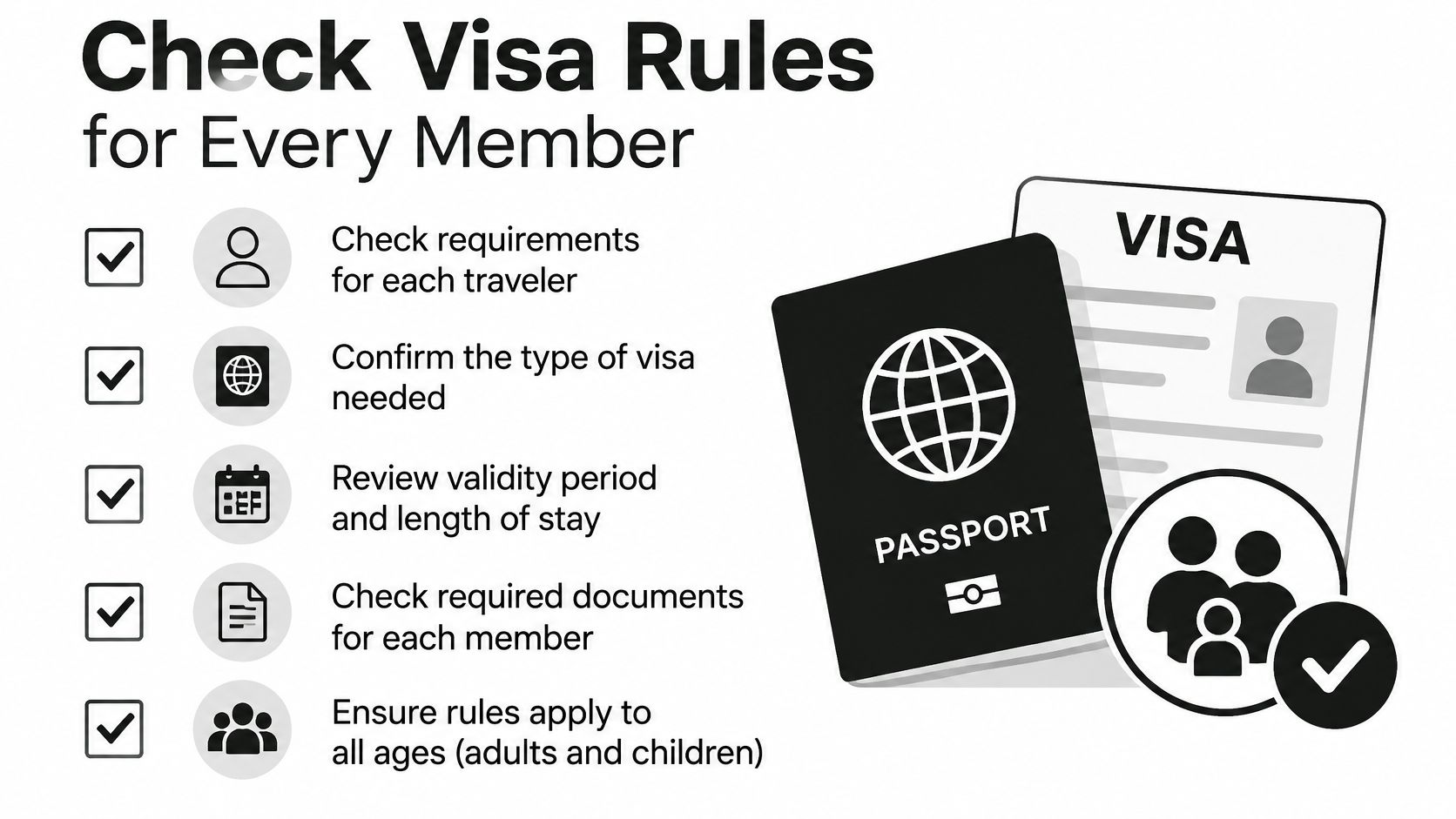
- Check Visa Rules for Every Member
- How to Shortlist Local Family Plans
- Budget for Copays and Excluded Care
- Get a Written Family Quote First
Why Near Me Means Your Province
Say your family lives in Marbella. You find a national insurance brand with an office nearby, but the hospital you want isn't listed under the particular product you're considering. The insurer's name is familiar. The cover still isn't right.
The useful definition of near me is your cuadro médico, the insurer's directory of participating doctors, clinics and hospitals. Your province is the starting point, but the practical test is narrower: can you reach the right paediatrician after school, get diagnostics locally and use a hospital you'd choose?

Private insurance sits alongside public entitlement
Spain's tax-funded National Health System provides universal coverage, with residency forming the basis of entitlement and public healthcare insurance compulsory; voluntary health insurance covered 20.8% of the population in 2021, according to the European Observatory's Spain health system summary. Private insurance is therefore best understood as an additional layer, rather than an automatic replacement for public healthcare.
Don't confuse that national framework with having your own public access fully arranged. Establish each family member's entitlement and complete the relevant registration before relying on it.
Families may want private cover for specialist appointments, maternity care, diagnostics or more choice over where they receive treatment. The value comes from the services they can use, not from possessing another insurance card.
Local test: A policy isn't convenient just because the insurer has an office nearby. The relevant doctor, facility and treatment must be accessible under your exact plan.
Check the service, not just the hospital name
A hospital appearing in a directory doesn't answer every question. Confirm that the department you need participates, that your chosen doctor accepts the product and that the treatment follows the policy's authorisation rules.
For example, a parent might find a listed hospital but discover that the preferred specialist sees insured patients at a different clinic. That's an appointment problem you can avoid before buying.
Our guide to checking a local Sanitas healthcare network provides a starting point for checking access. Apply the same discipline to every insurer: work from your home, school and likely appointments outward, rather than from a national brand inward.
Compare Family Cover Before You Buy
Public access, everyday private cover and visa family cover
A family tariff is only useful if it fits each person's care needs and the hospitals they can use. Compare access, contract limits and out-of-pocket costs separately. The figures for public waiting times below come from the Commonwealth Fund's Spain comparison guidance. Private appointment availability depends on the insurer's network and must be confirmed directly.
| What you check | Public SNS | Everyday private family plan | Visa-compliant private plan |
|---|---|---|---|
| First specialist or hospital consult | About 94 days for a hospital consultation in 2025 | Ask the insurer about appointments in your province and its cuadro médico | Confirm access within the included network |
| Nonurgent surgery | About 121 days in 2025 | Ask about local availability and check carencias before planned surgery | A prompt appointment does not remove an applicable waiting period |
| Copayments | Generally none at the point of care for covered public services; check prescriptions separately | Check copagos for visits, tests and treatment | Zero copayments for the non-lucrative requirement |
| Waiting periods | Public entitlement and registration, rather than a private policy carencia | Check waiting periods for hospital admission, surgery, maternity and diagnostics | Confirm that the applicable requirement is met without deficiencies or coverage gaps |
| Annual or benefit limits | Public benefits package administered in the autonomous community | Check limits for services such as dental and mental-health care | Unlimited cover of risks insured by the public system for the non-lucrative requirement |
| Who you can see | Public network serving your area | Participating cuadro médico, unless the contract includes reimbursement access | Included network under an authorised insurer, with cover valid for the required period |
Fast access isn't comprehensive cover
A carencia is a contractual waiting period before a particular benefit becomes available. It is separate from the time it takes to book an appointment.
A specialist may see you quickly and recommend planned surgery, while the policy's hospital benefit is still within its waiting period. Emergency treatment and planned admission can also follow different contract rules. Ask the insurer to explain both in writing. Don't assume an emergency exception covers every condition that feels urgent.
The public and private figures are not like-for-like measures: a public hospital consultation and a private first specialist consultation describe different services. Use public waiting-time figures as context, then ask insurers about actual local access. Your province and the plan's cuadro médico matter more than the insurer's nearest office.
A short specialist wait tells you about access. It doesn't tell you whether the insurer will pay for the treatment that follows.
Score each person separately
List every household member before judging the family tariff. A child with recurring paediatric appointments, an adult considering maternity care and an older dependant needing specialist follow-up may need different benefits.
- Expected care: Note routine consultations, paediatrics, maternity, diagnostics, chronic care and hospitalisation.
- Access conditions: Check referrals, prior authorisations and whether treatment must stay within the insurer's panel.
- Financial protection: Record copayments, benefit limits and care excluded from the contract.
- Continuity: Read renewal conditions before relying on the initial offer as a long-term solution.
A low tariff can still leave the person with the greatest care needs facing a missing hospital or a restricted benefit. Compare the contract terms and the local network, not just the monthly cost. Use this guide to compare health insurance plans and organise the differences that matter to your household.
Choose a suitable fit for each person, then assess the household total. The cheapest family tariff is poor value if its restrictions fall on the member who needs care most.
Check Visa Rules for Every Member
For a non-lucrative residence application, treat the insurance specification as a separate approval test. The requirements summarised in C1 Broker's Spanish expat insurance guidance call for an authorised insurer, cover for all risks insured by the public system, unlimited cover, no copayments, no deficiencies or coverage limits, and validity throughout the required period.
A product labelled for families or expats doesn't prove that it meets those conditions. Match the actual contract and certificate to the requirements of the relevant application authority.
Establish the route before buying
Don't assume every newcomer must purchase the same private policy. For a digital-nomad application, applicable public-system entitlement or an international Social Security agreement may provide an alternative evidential route. Verify whether the person qualifies and what proof the application authority requires.
A household can contain different cases. A retiree, working spouse and children may not all be applying on the same basis, even if they want to use the same private hospital.
Keep legal eligibility separate from preferences such as English-speaking doctors, direct billing and private rooms. Those features can matter enormously in daily life, but they don't replace compliant insurance evidence.
Audit the certificate person by person
Before submission, check the documents against the application rather than relying on the quotation's headline.
- Identity: Match each insured person's legal name and identifying details to their application documents.
- Dates: Confirm that the cover starts when required and remains valid throughout the required period.
- Cost sharing: Check that copayments aren't hidden in an attached schedule or optional benefit.
- Restrictions: Read exclusions, waiting-period wording and benefit limits alongside the certificate.
- Continuation: Understand payment and renewal arrangements so the intended cover doesn't lapse.
A thin local network can make a policy inconvenient even where the documentary requirements appear satisfied. Conversely, an excellent hospital list doesn't cure an unsuitable coverage clause. Both checks matter, but they answer different questions.
At Bsure Health Brokers, we find plans that meet Residency-Visa requirements and help people who need health cover for a Visa or NIE. That means distinguishing an insurance need linked to a particular immigration process from a resident's decision to add private healthcare.
Use our guide to Spanish visa health insurance requirements to prepare your questions. A resident who already has the necessary entitlement and only wants more convenient private appointments shouldn't automatically be pushed into a visa-focused product.
How to Shortlist Local Family Plans
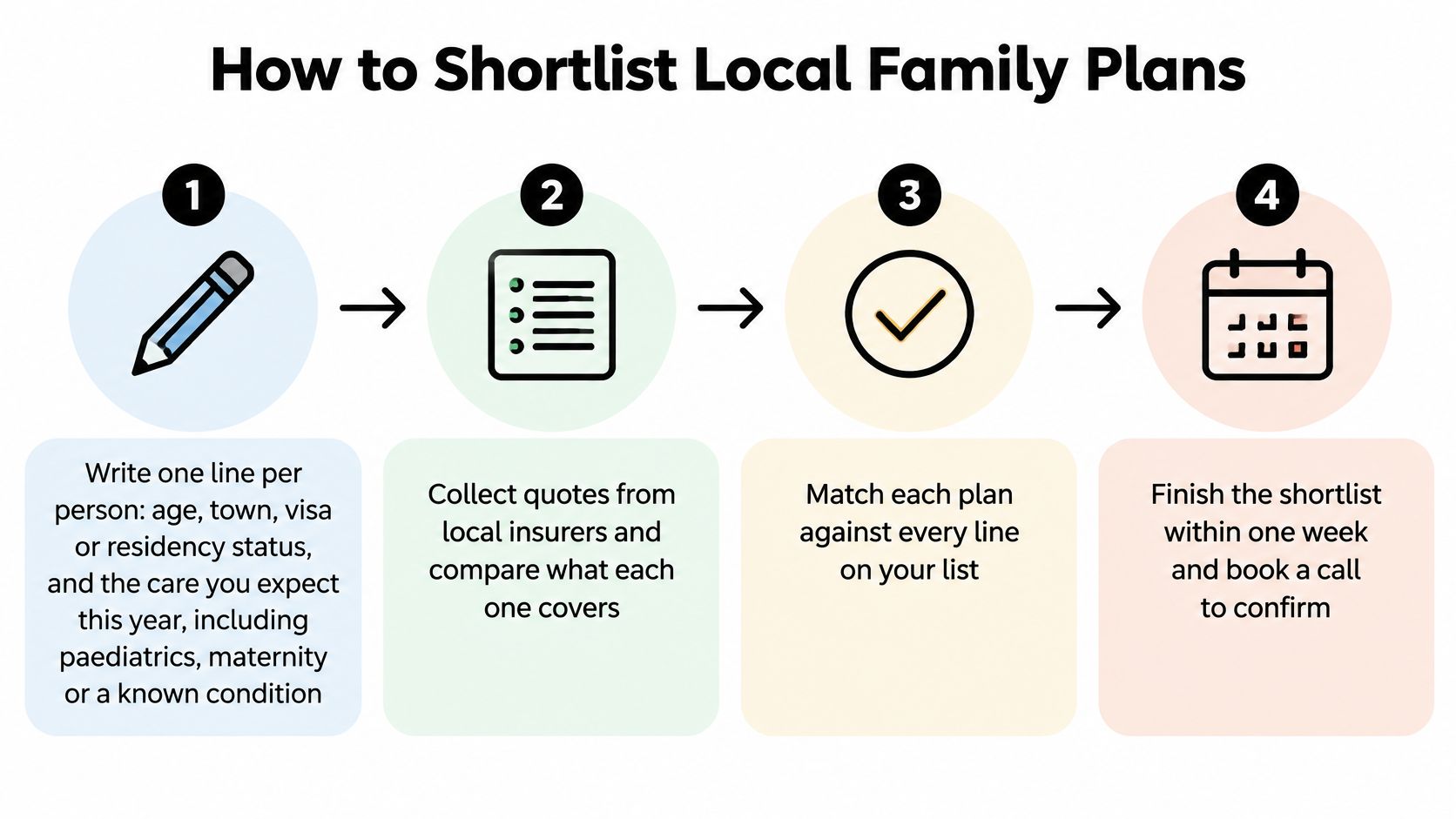
Use a working week as your organising deadline, not a reason to rush underwriting or buy before the documents arrive. Keep a spreadsheet with a tab for household needs, another for shortlisted contracts and a folder for written confirmations.
Build the shortlist in a fixed order
Write a line for every person. Include age, town, visa or residency status and expected care. Flag paediatrics, planned maternity and known conditions without trying to decide for yourself what an insurer will exclude.
Choose realistic facilities. List preferred hospitals and clinics within a journey you'd accept from home or school. Note language needs and the particular departments or specialists that matter.
Filter by the exact product network. Ask for confirmation that the named facilities participate in that plan in your province. A concrete failure to avoid is finding your hospital under the insurer's brand, then buying a different product that doesn't include it.
Request service-specific waiting periods. Record the rule for each planned treatment and ask how the contract handles emergencies. If you expect a nonurgent admission, don't accept a general statement about immediate specialist access as your answer.
Put the whole offer on the sheet. Include the premium, copayments, benefit sublimits, renewal terms and any family discount. Where international cover matters, identify the geographical scope and whether it covers planned treatment or only emergencies abroad.
Separate immigration evidence from healthcare preferences. Maintain a distinct field for anyone who needs application documents. Don't let a household-level label obscure a different requirement for a spouse or child.
Keep medical organisation separate from disclosure
A shared appointment record can help you identify likely usage before requesting quotes. If scattered calendars and medication notes are the problem, Stride's resource lets you compare family health tracker apps before choosing a tool for organising household information.
An app isn't a substitute for the insurer's medical questionnaire. Transfer relevant information carefully, and use a secure method agreed for sending medical records rather than placing detailed histories in a casually shared comparison sheet.
We ask clients key questions to identify the most suitable policy. When choosing insurers, we consider family discounts, international cover, low wait times and the cover required for residency in Spain; we have access to the entire health insurance market and only use insurers we trust.
That broader comparison matters when the best-looking offer fails a practical requirement. Don't keep a policy on the shortlist just because you've already spent time discussing it.
Buying rule: Don't accept the premium until the hospital names and relevant waiting periods are on paper.
Budget for Copays and Excluded Care
Build a split budget, not just a premium budget: the annual insurance cost, expected copayments and a separate allowance for excluded care. Standard Spanish and international private policies generally focus on eligible new acute conditions, while chronic and pre-existing conditions are commonly excluded, as explained in WeCovr's guide to private health insurance in Spain.
That distinction is especially important when a family member has diabetes, a cancer history, cardiovascular disease or ongoing medication. Household acceptance doesn't prove that the treatment this person is most likely to need has been accepted.
Translate underwriting into a spending plan
Underwriting results and the family budget
| Written decision | What the family actually has | Budget consequence |
|---|---|---|
| Full acceptance | Eligible treatment for that person is covered on the policy terms | Premium, plus applicable copays, sublimits and other contractual costs |
| Named exclusion | The policy is issued but a stated condition stays outside it | Keep public care or savings for that condition's tests, drugs and follow-up |
| Temporary exclusion | The issue remains excluded until the stated date or review conditions are satisfied | Fund interim care and confirm whether cover starts automatically or needs reassessment |
| Premium loading | The person is accepted at a higher rate | Compare the loaded household total with a public-care alternative, where entitled |
| Disease-specific limit | A cap applies to treatment for the stated condition | Budget for costs above the cap |
| Refusal of that member | Other household members may still be accepted | Arrange a separate public-care or self-funding plan for the declined person |
Prepare a medical timeline with diagnoses, dates, medication, surgery, investigations and recent results. Answer the health questionnaire exactly as requested, and resolve unclear questions before signing.
Don't reduce a complex medical history to a reassuring phrase such as stable now. The insurer needs the information it requests to make a decision, and you need the final terms to understand what you're buying.
Protect continuity for the person with ongoing needs
For an eligible person, S1 entitlement can support chronic-condition care through Spain's public system while private insurance serves other access preferences. Confirm the entitlement and registration rather than assuming that holding private insurance solves ongoing treatment needs.
Long-term disability planning may also require a separate financial discussion. Families with US financial ties can use Guiding Growth's explanation of ABLE accounts and special needs trusts to prepare questions for an appropriately qualified adviser; these aren't Spanish insurance benefits or substitutes for a care budget.
We provide quotes for serious health preconditions and compare options from top insurers. We also arrange cover and give advice for prior cancer, diabetes, high blood pressure, and multiple conditions and medication, but the individual underwriting decision must establish the actual scope.
Price the excluded treatment before celebrating the family discount. A lower premium can still leave the household with the larger bill.
Get a Written Family Quote First
Request a written quote before cancelling existing insurance or committing to a replacement. A verbal assurance about a hospital, medical condition or residency certificate isn't enough to make that decision safely.
Send the information needed to produce a meaningful offer: household ages, your town in Spain, preferred hospitals, immigration status and any medical history requested for underwriting. If you're switching, include the relevant existing policy details so continuity questions can be addressed before you give notice.
Ask for a decision-ready document
The quote should let you compare the offer without searching through an email chain for essential conditions.
- Price and payment: Identify the quoted premium, payment arrangements and any stated discount conditions.
- Use of care: Include the copayment schedule, relevant waiting periods and authorisation requirements.
- Personal terms: Attach the final underwriting decision and exclusions for each applicant.
- Ongoing cover: Record renewal conditions and the process for requesting changes.
Keep the quotation distinct from final acceptance. If medical review is outstanding, treat the offer as incomplete for decision-making purposes, even if the initial price looks attractive.
Make the handover explicit
We offer a no-obligation quote on request. You can contact Bsure Health Brokers at healthcover@bsureinsurance.com to start the comparison, using an agreed secure process for any sensitive medical documents.
We set up the health plan and manage the policy in all its aspects, including paperwork, renewals and changes. That support is relevant whether you're arranging initial residency cover, changing an existing plan or trying to retain a useful family arrangement without losing access to a preferred hospital.
We state that customers can save up to 40%, but that's a reason to compare, not a forecast for your household. Age, benefits and individual underwriting can change which offer makes sense, so don't make a saving the acceptance test.
Your final yes should rest on written confirmation of the cuadro médico, the visa wording where required, and the budget for excluded care. Keep existing cover in place until the replacement's acceptance, start date and contractual conditions are settled, and follow your current insurer's cancellation requirements.
Bsure Health Brokers offers no-obligation family health insurance comparisons and support with policy setup, paperwork, renewals and changes. Visit Bsure Health Brokers and send your family's ages, Spanish town, preferred hospitals and visa needs to request a written quote built around the care you'll use.