
A pre-existing condition exclusion is a policy clause under which the insurer accepts you but does not pay for a named illness, symptom, treatment or related recurrence. You can therefore have valid health insurance and still have to pay privately for the care you're most likely to need.
For someone moving to Spain, that distinction can affect both healthcare planning and the decision to change insurers. Acceptance isn't the same as protection: you need to know which treatments the insurer has agreed to fund, not whether it will issue a policy.
Table of Contents
- Why Pre-Existing Conditions Shape Your Cover
- What an Exclusion Removes and How Far It Reaches
- How Insurers Assess Your Medical History
- How Protection Rules Differ by Market and Period
- Why a Visa-Approved Policy May Still Exclude You
- What to Do If Your Condition Is Excluded or Declined
- Check the Exclusion Wording Before You Apply
Why Pre-Existing Conditions Shape Your Cover
In 2025, 38% of U.S. adults said denial of health-insurance coverage for a pre-existing medical condition affecting themselves or an immediate family member was a major concern, according to the West Health–Gallup Healthcare survey. That concern highlights an important question for anyone buying medically underwritten insurance: will the insurer accept the application, and on what terms?
Say you're preparing to move to Spain and take medication for diabetes and high blood pressure. You receive an affordable quote, arrange your moving date and assume your routine care will continue under the new policy. Only when the underwriting decision arrives do you discover that treatment connected with diabetes is excluded.
The premium hasn't told you what you needed to know. You now need to establish whether the restriction affects only diabetes management or also care for complications.
Who needs to look beyond the premium
This deserves particular attention if you have a cancer history, a chronic condition, several prescriptions or ongoing specialist follow-up. Retirees comparing private cover also need to consider continuity of treatment, rather than treating each new policy as an interchangeable purchase.
Visa applicants face an additional concern: they need suitable documentation for their application and a workable way to pay for medical care after arrival. Those are separate decisions.
Practical rule: Compare the care an insurer will pay for before comparing the price it charges.
An insurer may offer ordinary terms, charge more, restrict benefits or refuse the application. The written underwriting decision and policy wording, not the sales conversation, establish the terms you're being offered.
What an Exclusion Removes and How Far It Reaches
An exclusion isn't a yes-or-no answer about a diagnosis. The insurer accepts you but removes financial responsibility for the illness, symptom, body system, treatment or related recurrence described in the clause.
Think of a home policy covering the house except for damage originating in a particular room. Knowing which room is excluded isn't enough: you also need to know what happens if damage spreads elsewhere. In health insurance, the equivalent question concerns related symptoms and complications.
Underwriting outcomes and what each means for your cover
These are possible outcomes, not predictions based on a diagnosis alone. Every example assumes the insurer has explicitly offered the stated terms.
| Outcome | What the insurer does | What it means for you | Example |
|---|---|---|---|
| Standard acceptance | Accepts at the standard rate without a condition-specific restriction | The condition is covered under ordinary policy benefits and limits | A historical condition is accepted without special terms |
| Premium loading | Accepts but charges a higher premium | The condition remains covered under the agreed benefits at a higher cost | A controlled condition is accepted with a surcharge |
| Exclusion | Removes cover for named care | You fund excluded treatment yourself | Surgery for a previously injured knee is excluded |
| Waiting period | Delays eligibility for specified benefits | Those benefits aren't payable during the stated period | Specialist treatment becomes eligible after the period ends |
| Moratorium | Initially excludes qualifying medical history under stated rules | Cover may become available if the contractual criteria are met | Eligibility is reconsidered after a qualifying symptom-free interval |
| Decline | Refuses the application | That insurer issues no policy | An application involving active serious illness is declined |
A medical-insurance waiting period isn't necessarily a promise that an existing-condition exclusion will disappear. Check whether the documents impose separate restrictions.
Follow the connection between diagnosis and treatment
Consider a back-pain exclusion. It might exclude treatment for a flare-up while leaving an unrelated wrist fracture eligible for cover. Medical records help establish the distinction, but the actual clause controls the decision.
A cancer exclusion could reach beyond primary treatment to surveillance scans, recurrence or treatment of lasting side effects. For a retiree with diabetes, kidney disease and high blood pressure, wording that excludes diabetes-related complications could affect more care than the diagnosis alone suggests.
Understanding this isn't merely a matter of reading more carefully. A 2025 controlled experiment published in the Northwestern University Law Review found that neither required disclosure wording nor a more detailed alternative enabled consumers to fully understand an exclusion's practical impact.
Ask for written answers using your actual treatment needs. Is the restriction permanent or reviewable? Are follow-up care, complications and emergency treatment inside it? An agent's verbal reassurance shouldn't substitute for those answers.
How Insurers Assess Your Medical History
Medical underwriting is the insurer's assessment of your health history before it decides which terms to offer. The questionnaire starts that assessment, but supporting records can be important where an answer needs context.
The process below separates the information you supply from the decision you eventually receive.
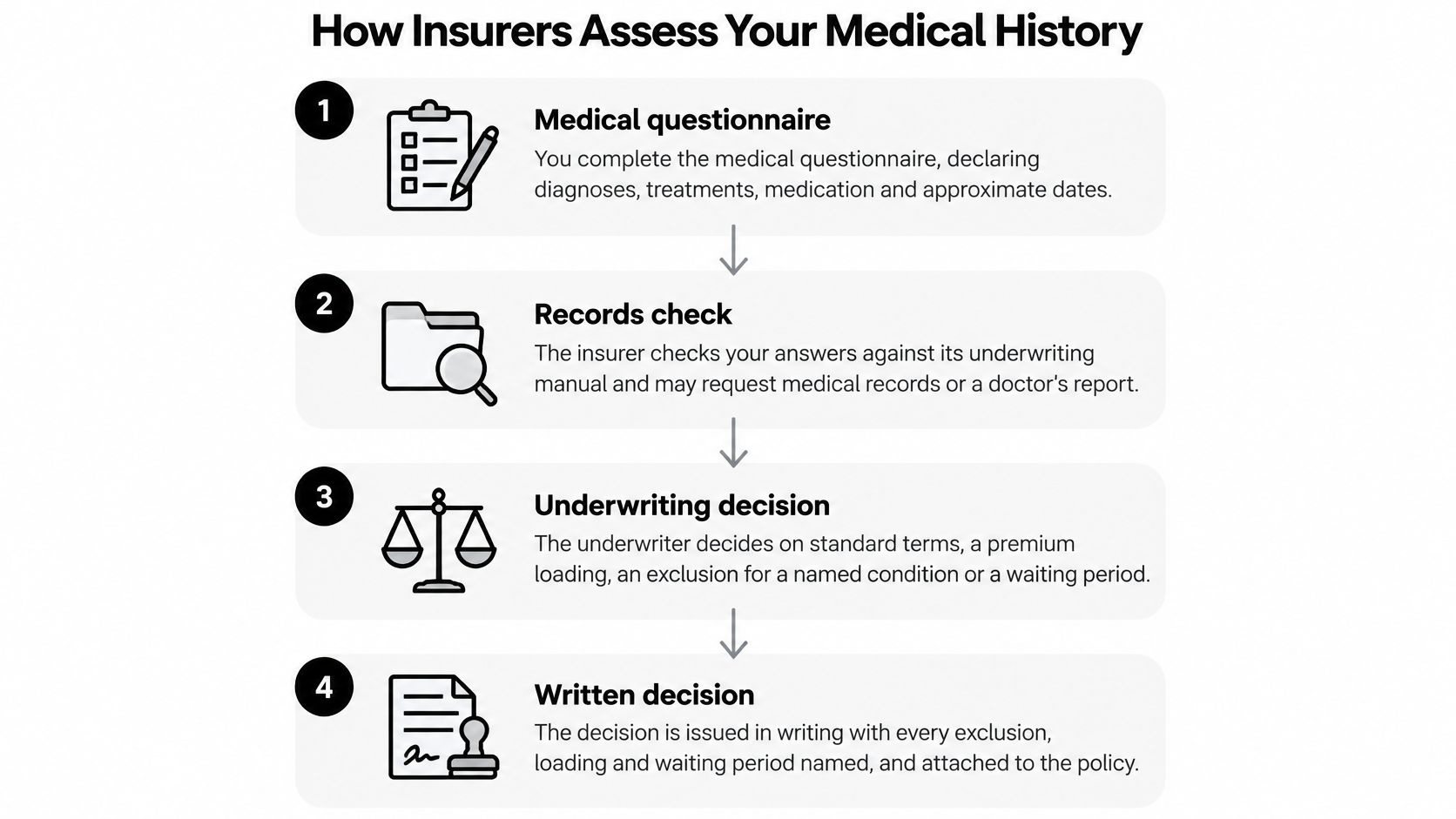
From questionnaire to written terms
Complete the medical questionnaire accurately. Give the diagnoses, treatment, medication and approximate dates the questions request, including investigations or symptoms where asked. Don't treat a controlled condition as nonexistent because you feel well.
Provide supporting records when requested. The insurer may ask for medical notes or a specialist's letter to clarify severity, treatment or recovery. A common slip is giving a reassuring summary that leaves out an admission or ongoing follow-up recorded elsewhere.
The underwriter applies the insurer's guidelines. These may assess how far back relevant history must be considered, alongside stability, medication and recent treatment. Don't assume another insurer's questionnaire uses the same look-back rules.
The insurer selects its terms. It may offer standard acceptance, a loading, an exclusion, a waiting period, a moratorium or a decline, where those options are available. A quote produced before this assessment shouldn't be treated as final acceptance.
Review the written decision before committing. Check that it identifies each special term and matches the medical information submitted. You can then accept, seek clarification or consider another insurer rather than discovering a restriction during a claim.
Give medical context without interpreting it yourself
A condition controlled with medication presents a different assessment question from a recent hospital admission for the same diagnosis. Give the underwriter the discharge summary, current treatment and follow-up plan rather than deciding which details seem favourable.
Medication also needs context. Courier Pharmacy's explanation of absolute versus relative contraindications helps distinguish different kinds of prescribing restrictions, but those clinical distinctions aren't insurance acceptance rules. Report the medication and its purpose accurately; don't change treatment to influence an application.
An incomplete or inaccurate answer can put a later claim or the policy itself in dispute, subject to applicable law and the contract. If you can't recall a date, identify it as approximate and obtain the record rather than guessing.
A useful written decision names the restriction, explains which care it reaches and states whether review is possible.
How Protection Rules Differ by Market and Period
Before the Affordable Care Act, medical underwriting was widespread in the U.S. individual insurance market. A Kaiser Family Foundation analysis using 2018 government survey data estimated that nearly 54 million American adults under age 65, about 27%, had conditions that would likely have made them uninsurable under practices used in most states before the ACA.
That's a historical underwriting benchmark, not a count of people currently denied insurance. It illustrates why a familiar diagnosis could once prevent access to individual cover.
Protections developed in stages
The National Human Genome Research Institute's HIPAA overview describes how HIPAA, enacted in 1996, limited employer-group exclusions generally to 12 months, or 18 months for late enrollees, for conditions diagnosed or treated during the preceding six months, with creditable prior coverage counted where the coverage gap was no longer than 63 days. These were limits on exclusions, not the broad prohibition that followed.
For plan years beginning on or after January 1, 2014, the HHS explanation of ACA protections explains that ACA-compliant coverage generally cannot refuse enrollment, exclude covered treatment or charge higher premiums because of a pre-existing condition. Short-term and limited-benefit products don't necessarily carry those protections.
Pre-existing condition rules by period and product
| Period or product | Rule | Who it covers | Limit or gap |
|---|---|---|---|
| Before HIPAA | Individual-market underwriting could lead to denial, exclusions or higher premiums | Individual applicants under historical market practices | Health history could prevent access to cover |
| HIPAA-era group protections | Limited exclusion periods and recognised qualifying prior coverage | Employer-sponsored group-plan members | Limited exclusions rather than eliminating them |
| ACA market reforms | Prohibit health-status refusal, pre-existing-condition exclusions and health-based premium increases | ACA-compliant individual and fully insured small-group plans | Ordinary benefit definitions and other lawful policy terms still matter |
| Non-ACA products, including some short-term plans | Exclusions may form part of product design | Buyers of products outside relevant ACA protections | Comprehensive-plan protections shouldn't be assumed |
The Alabama Department of Insurance's health-reform provisions also explain restrictions on lifetime and annual dollar limits for essential health benefits. Protection involves both access to benefits and the financial limits applied to them.
For a Spanish or international policy, start with the country's rules and the legal product category. Don't import an expectation from an American employer plan into a privately underwritten policy abroad. Identify the governing framework before deciding whether a proposed restriction is permitted or acceptable.
Why a Visa-Approved Policy May Still Exclude You
A common misconception is that a policy accepted for a Spanish visa must cover every existing medical condition. Public explanations can conflict, as the 247 Expat Insurance guide to non-lucrative visa insurance and pre-existing conditions illustrates: visa requirements and medical underwriting need separate examination.
Administrative acceptance isn't a personalised coverage decision. Check the current requirements for your application with the relevant authority, then examine the insurer's terms for your medical history.
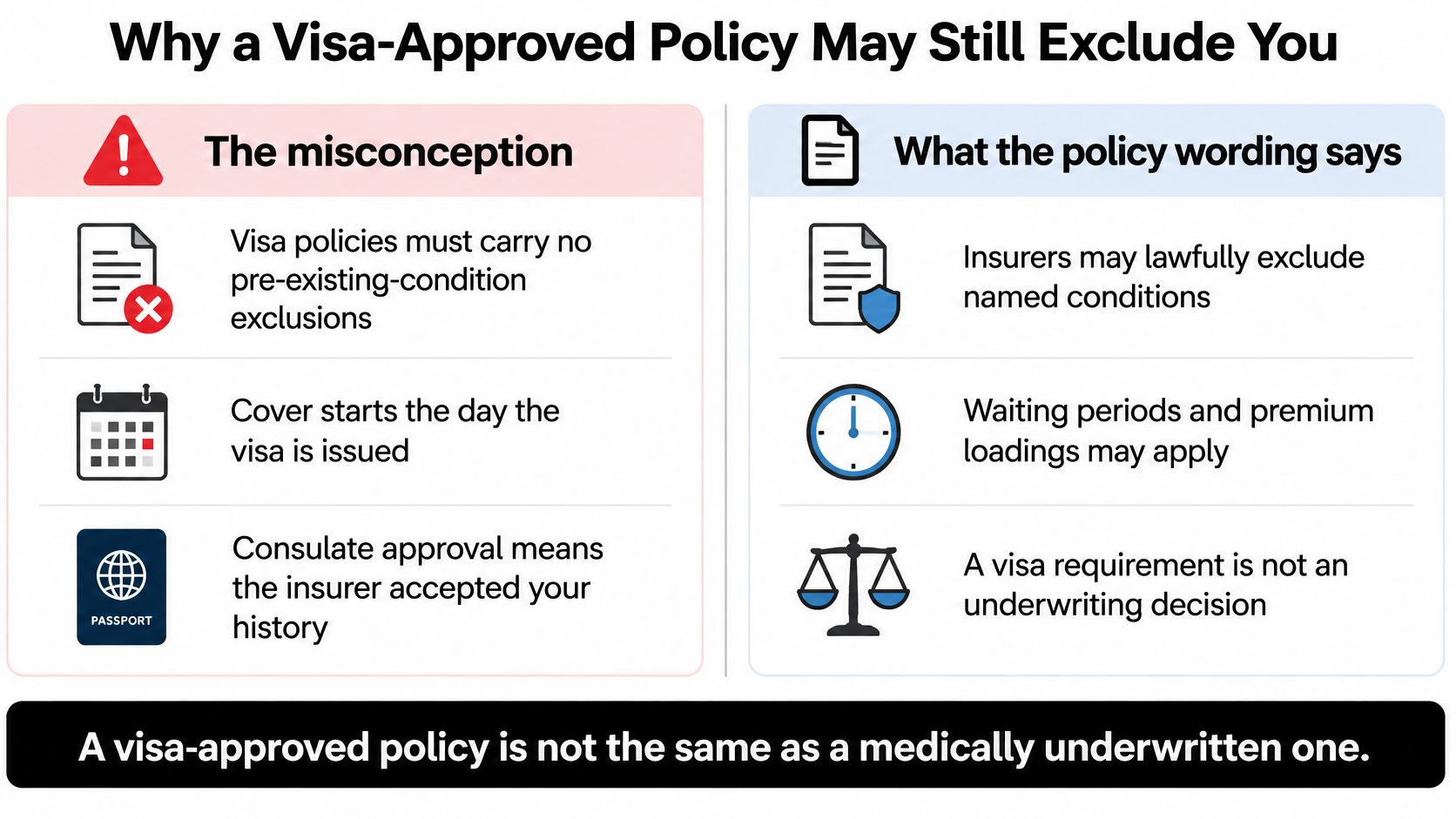
Three tests for a visa-linked policy
| Test | Question | If it fails |
|---|---|---|
| Insurer authorisation | Is the insurer authorised in Spain or the relevant country? | Don't proceed until verified; the policy may be unsuitable or invalid for the purpose |
| Visa documentation | Does the policy meet the applicable visa or residence documentation standard? | The application may be refused or require replacement documents |
| Condition coverage | Is your specific condition covered after underwriting? | You may have a protection gap and need to fund excluded care privately |
Say an applicant receives a policy with an exclusion for a damaged knee, and the policy documents are accepted for the residence application. That administrative outcome doesn't remove the knee exclusion. If surgery falls within it, the applicant still needs another way to pay.
This is especially important for newcomers from the U.S., UK and other non-EU countries who are arranging healthcare alongside relocation. Older applicants should assess realistic alternatives before making commitments that would be difficult to reverse.
Match the outcome to your arrival plans
An exclusion leaves named care unfunded. A loading increases the premium but may preserve the agreed cover; a waiting period postpones eligibility for specified benefits.
A moratorium makes future eligibility conditional, not guaranteed. A request for further medical evidence means the decision remains unfinished, while a decline means no policy has been offered.
Don't let a moving deadline turn an incomplete application into assumed cover. Our guide to getting health insurance quickly can help organise the practical steps, but speed shouldn't replace a completed assessment.
We support expats and internationals with complex pre-existing-condition and visa-compliance questions. Obtain the final underwriting terms before paying or relying on a proposed policy for your relocation.
What to Do If Your Condition Is Excluded or Declined
An exclusion or decline leaves a practical problem: how will you fund the care you need? Start with the treatment plan, not another headline quote, and work through the available options in order.
Establish whether the decision can change
First, find out whether the restriction has a review mechanism. For a reviewable exclusion or moratorium, identify the earliest review point, the required medical evidence and the criteria you must meet. A scheduled review isn't a promise of removal.
A waiting period needs a different check: which benefit becomes eligible when it ends, and does any separate exclusion remain? Without that distinction, you could wait and still have no cover for the treatment concerned.
Next, investigate alternatives without assuming that every insurer will reach the same decision. Through our health-insurance brokerage process, we ask the questions needed to identify suitable options and compare insurers' proposed terms.
Compare the financial consequences
The useful comparison is between the complete options available to you, not between a loaded premium and an unrealistically low estimate of private treatment.
- Ongoing care: Include consultations, monitoring tests and repeat prescriptions.
- Planned procedures: Request a written estimate covering the surgeon, hospital, anaesthesia and follow-up.
- Possible complications: Consider whether an admission or extended rehabilitation would also fall outside cover.
- Affordability: Decide whether you could fund excluded care when needed, rather than only in an uneventful year.
A higher premium with broader agreed benefits may be more manageable than a cheaper policy that excludes your main treatment needs. Equally, paying more doesn't automatically mean better protection: the wording still needs to justify the difference.
Don't cancel existing insurance until the replacement insurer has issued its final terms and you've assessed the loss of any existing protection.
Avoid treating a preliminary quote as an issued policy or a decline as proof that every route is closed. For each alternative, record the condition covered, treatment left outside cover and any review opportunity so you can make a meaningful comparison.
Check the Exclusion Wording Before You Apply
Before you sign, turn uncertainty into specific questions. The purpose isn't to obtain general reassurance about the policy, but to establish what happens when you seek the care you use.
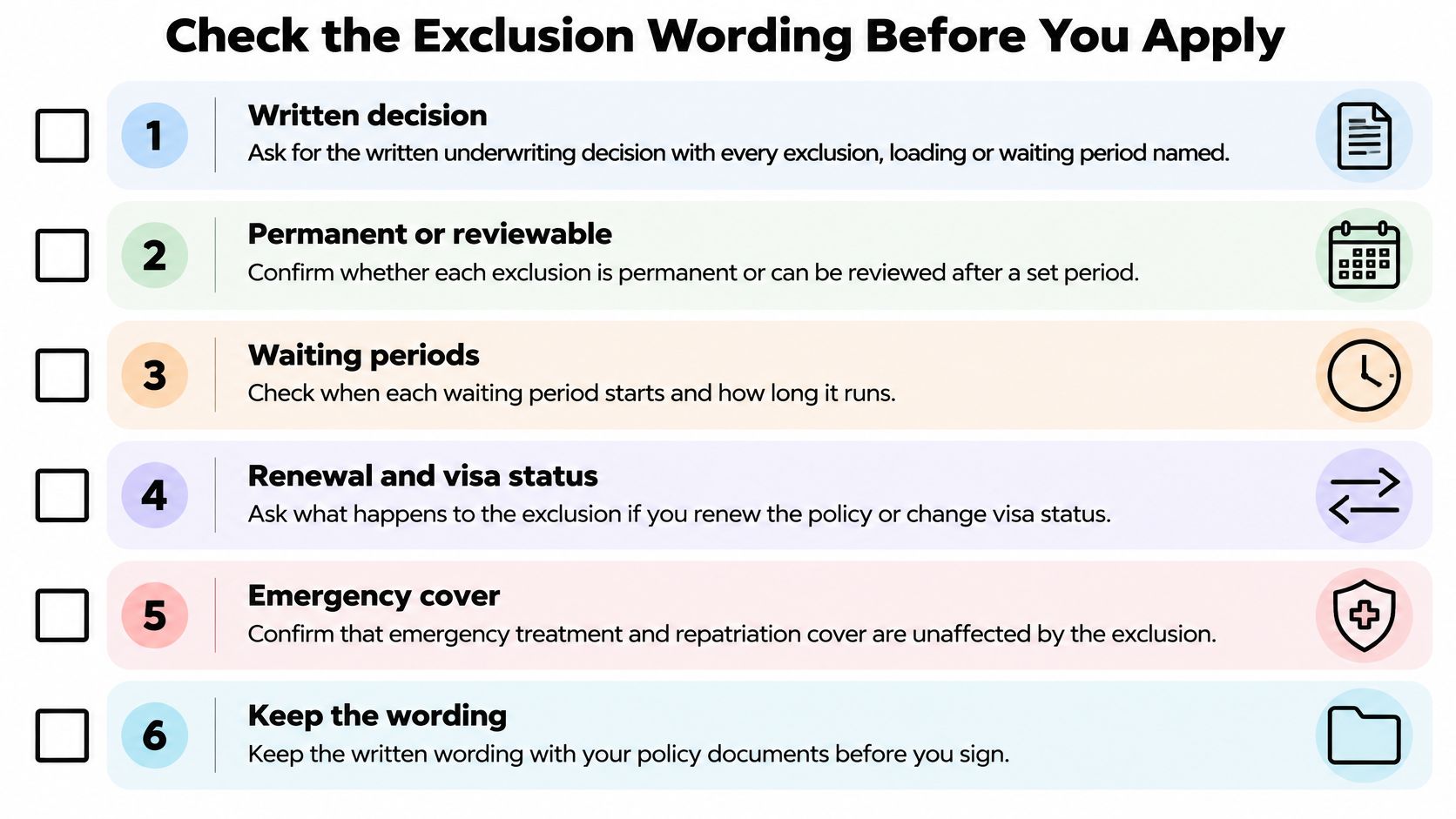
Your pre-signing checklist
Get the complete written decision. Request every exclusion, loading, waiting period and other special term, together with the policy wording. An insurance certificate alone may not contain enough detail to assess treatment eligibility.
Identify permanent and reviewable restrictions. Record the review timing, evidence required and criteria for reconsideration. Also establish what happens at renewal or if your residence circumstances change.
Test the boundaries with actual care. List your follow-up tests, prescriptions, specialist visits and foreseeable complications. Ask for a written explanation of emergency treatment too, rather than assuming urgency overrides an exclusion.
Verify authorisation and documentation separately. Confirm the insurer's status and the requirements applicable to your visa or residence application. Neither answer replaces a decision about your condition.
Compare the full cost of each option. Put the premium alongside the private-care costs you would retain. Distinguish a manageable routine expense from hospital treatment you couldn't comfortably fund.
Keep the application trail. Retain your questionnaire, supporting records, correspondence and final terms. Resolve discrepancies before the policy begins, and check that its effective date matches the cover you need.
Prepare information that makes comparison useful
Gather your medical records, a current medication list and dates of diagnosis, treatment and hospital admissions. Include the latest specialist summary where you have one, particularly if it explains recovery, stability or planned follow-up.
Bring that information to an independent broker and request a comparison of the exclusion wording, not just premiums. Our advice is independent and impartial, with no bias towards any one insurer, so we can help you assess the proposed terms against your circumstances before you commit.
Bsure Health Brokers supports expats and internationals with pre-existing conditions and visa-compliant health-cover requirements. Visit Bsure Health Brokers to request a no-obligation quote and help comparing underwriting terms, including what an exclusion could leave you paying privately.