
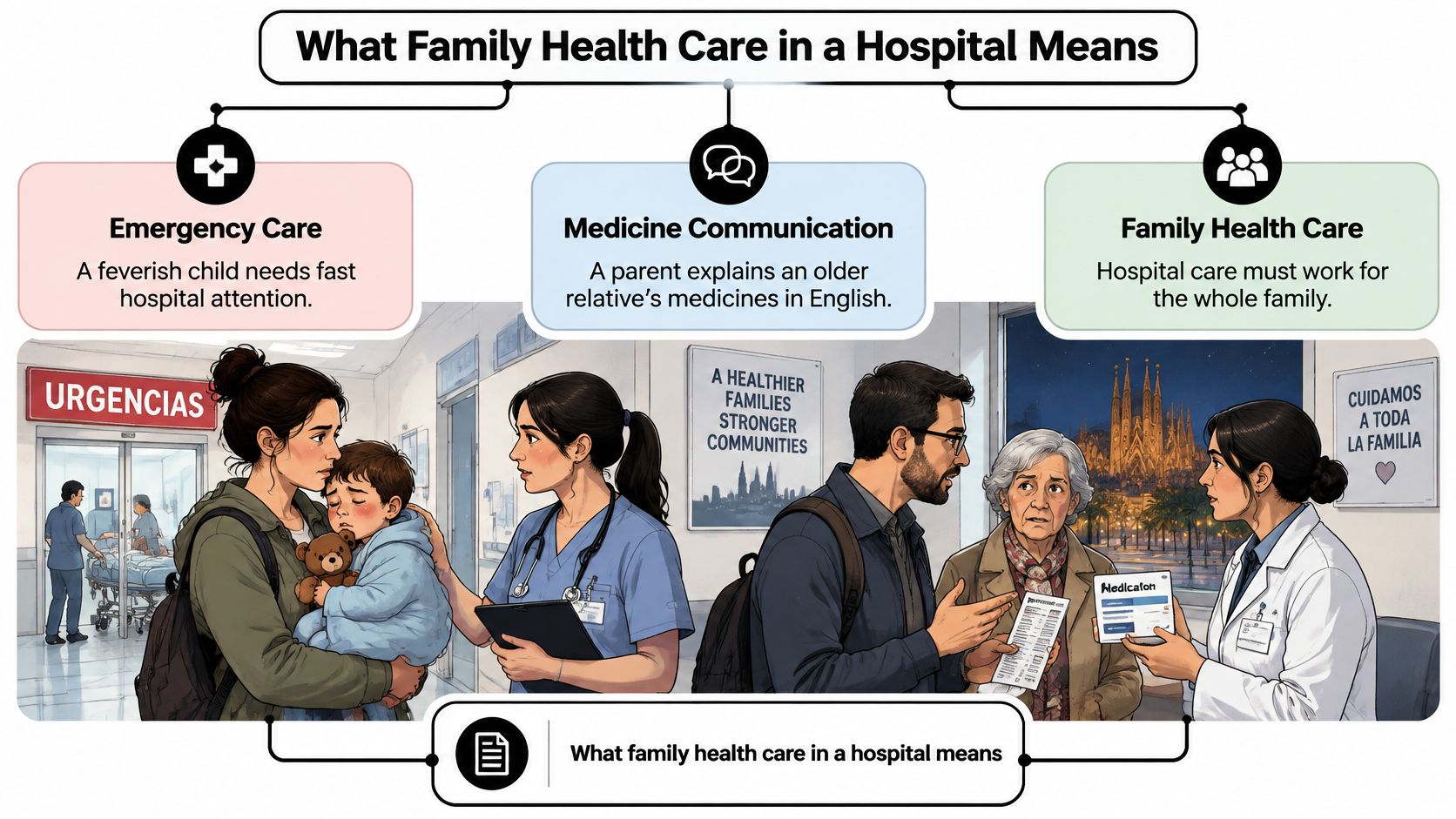
It's Saturday night in a Spanish city. You're in an emergency waiting room with a feverish child while your partner tries to explain an older relative's medicines in English. The hospital logo on your insurance card suddenly matters less than three practical questions: can someone treat the patient, understand the history and confirm who pays?
Choosing a family health care hospital in Spain means answering those questions before you're standing at reception. Private insurance can make planned care easier to access, but it isn't a replacement for public entitlement, a reliable medical history or a proper discharge plan.
Table of Contents
- What Family Health Care in a Hospital Means
- Who Gets Public Hospital Care in Spain
- Public and Private Routes From Arrival to Discharge
- Questions Parents and Guardians Should Ask
- How a Family Policy Pays the Hospital Bill
- Cover for Children Older Relatives and Illness
- Lock in the Hospital Network Before You Need It
What Family Health Care in a Hospital Means
In that waiting room, your household doesn't fit neatly into a single specialty. Your child needs assessment, your older relative needs someone to check their regular medication, and you need instructions you can understand.
Family-centred hospital care means those needs can be handled together, even when different clinicians provide the treatment. It isn't a separate department, and it certainly isn't a private room with a comfortable chair.
Know which door you're choosing
Families often confuse these settings:
- Centro de salud: Your primary-care centre, where the family doctor and community team assess ongoing problems, organise referrals and support recovery.
- Public hospital: A hospital within the Sistema Nacional de Salud, or SNS, providing emergency, specialist and inpatient care through the public pathway.
- Private network hospital: A hospital included in an insurer's cuadro médico, the directory of contracted facilities and professionals available under a particular policy.
A private hospital's presence in a directory doesn't establish that every doctor, test or specialty there is covered. Equally, a public health card doesn't mean you can book every hospital specialist directly.
Look beyond the room
For a household, useful hospital capability includes adult medicine, paediatrics, emergency assessment, diagnostics and access to critical care when needed. Maternity matters if you're planning a pregnancy, but you must check whether it's offered at that particular site.
Ask how the hospital communicates with relatives and who takes responsibility after discharge. A hospital that treats the immediate problem but leaves you translating unexplained prescriptions at home hasn't completed the practical job your family needs.
The household test: Can the team treat your child tonight without losing track of the medicines, allergies and follow-up needs that matter tomorrow?
Choose for the whole pathway. Speed and understandable communication are valuable, but so are emergency capability, community follow-up and a clinician who knows what happened during the admission.
Who Gets Public Hospital Care in Spain
Living in Spain and having confirmed public healthcare entitlement aren't the same administrative step. Don't assume a property purchase, a town-hall registration or an identification number establishes that every family member can receive planned public treatment without a bill.
Use the following checks before comparing private policies. Our guide to the healthcare system in Spain provides context for the public and private routes.
Establish each person's position
Identify the basis of entitlement. Gather the documents relevant to employment, social security, pension rights, residence or recognised dependant status. A NIE is an identification number, not proof of healthcare entitlement by itself.
Separate temporary visits from residence. If you're relying on an EHIC, confirm what it covers during your temporary stay rather than treating it as permanent resident insurance. Pensioners using an S1 should confirm that it has been registered through the appropriate Spanish process.
Complete regional health registration. Ask the regional health service which documents it needs for your circumstances, including any relevant residence and padrón records. Obtain an individual tarjeta sanitaria, or written confirmation of access, rather than relying on an appointment application alone.
Check dependants individually. Record how each child, partner and older relative qualifies. Don't assume an adult's successful registration automatically settles a relative's different immigration or social-security position.
Keep healthcare and immigration paperwork separate
A visa or residence application can require insurance evidence even while you're arranging access to public services. Check the requirements for your particular application, including whether copayments, exclusions or restricted benefits would make a policy unsuitable.
Ordinary travel insurance shouldn't be treated as interchangeable with residence health insurance. At Bsure Health Brokers, we help customers with visa or NIE cover requirements and the associated paperwork.
For an urgent medical problem, seek assessment rather than waiting for an entitlement dispute to be resolved. However, don't confuse receiving emergency treatment with confirmation that every subsequent service is free.
Before cancelling existing cover, obtain a clear answer about your registration and any remaining gap. Write down each family member's entitlement route, the document proving it and where that document is stored.
Public and Private Routes From Arrival to Discharge
Public and private family hospital care in Spain
| What families compare | Public hospital (SNS) | Private hospital on a policy |
|---|---|---|
| How you enter | Primary-care referral, another clinical referral or emergency assessment | Network booking, direct specialist access where permitted, or the policy's emergency route |
| Non-urgent specialist wait | Referral list, prioritised by clinical need | Check the named doctor's actual next appointment before choosing |
| Emergency | Assessment and triage according to urgency | Seek treatment, then establish the policy's notification and payment arrangements |
| Cost at the point of care | Confirm entitlement and whether any charge applies | Copayments, exclusions and uncovered services can leave a balance |
| Language | Request language support rather than assuming English is available | Confirm English with the treating team, not just reception |
| Children and maternity | Relevant services through the public pathway | Confirm the specialty, doctor and hospital are included |
| After discharge | Hospital instructions and primary-care follow-up | Treating specialist, with any further insurer approvals |
| Bed reality | Admission requires a suitable available bed | A network listing doesn't reserve a staffed bed |
Pick the row matching today's problem, rather than declaring one system the winner. For an unexplained but stable symptom, appointment access may drive your decision. For severe breathing difficulty, clinical urgency comes first.
The waiting-time issue is real: Spain's Ministry of Health key data report records that 38.2% experienced more than a three-month wait between primary-care referral and specialist consultation in 2024, while 2.6% of people reporting healthcare needs had unmet needs because of cost, waiting lists or distance. Those are national access measures, not predictions for your appointment.
From the first assessment to admission
Primary care starts the non-urgent route. Your centro de salud can assess whether you need home treatment, further investigation, a specialist or urgent hospital review. Tell the clinician about appointments or investigations you've arranged privately so the treatment plans don't conflict.
Emergency care follows clinical urgency. Don't delay a serious emergency while searching an insurer's directory. Bring identification, your health card or insurance details if available, and the patient's medication and allergy information, but don't postpone urgent treatment to collect paperwork.
The specialist stage is where private cover can be useful. Before booking, verify that the specific clinician accepts your exact policy at that location. Ask whether the consultation includes any proposed investigation or whether the test needs a separate booking and approval.
A fast consultation isn't necessarily a fast diagnosis. Ask when the scan can happen, who interprets it and when the specialist will discuss the result.
Admission adds another decision-maker. The treating clinician decides whether hospital treatment is medically necessary. For a private admission, the insurer also assesses whether the proposed treatment meets the contract's payment conditions.
Ask the admissions desk to record the authorisation reference and clarify which clinicians will bill separately. If treatment begins as an emergency, a relative should contact the insurer when it's practical and safe.
For the operational details, use our guide to using private health insurance at a Spanish hospital before a planned visit.
The stay, discharge and travel between regions
During the stay, organise the household around the clinical plan, not an assumed discharge date. Ask who will update the family and when the next decision is expected. Arrange school collection, work cover and help for relatives who remain at home.
Discharge is a handover, not just permission to leave. Before leaving, obtain a written summary covering the diagnosis, treatment, medication changes, pending results and follow-up arrangements.
Check who owns each unfinished task:
- Pending results: Which clinician will review them and contact you?
- New symptoms: Which warning signs need urgent reassessment?
- Appointments: Who books them, and does the private appointment need approval?
- Community care: What information should the centro de salud receive?
Care away from your usual region needs preparation. Carry accessible records and confirm how to obtain public care at your destination. For private treatment, check the destination hospital against your policy rather than assuming nationwide branding means every service is included.
Capacity also limits both routes. The OECD's hospital beds and occupancy assessment reports 4.2 hospital beds per 1,000 people and 72% average occupancy across OECD countries in 2023, defining usable beds as maintained, staffed and immediately available. An advertised bed count tells you less than whether the hospital can accommodate the patient's actual clinical needs.
Use public primary care and confirmed public entitlement as your foundation. Add private access where it gives your household a practical improvement in planned consultations, investigations or treatment.
Questions Parents and Guardians Should Ask
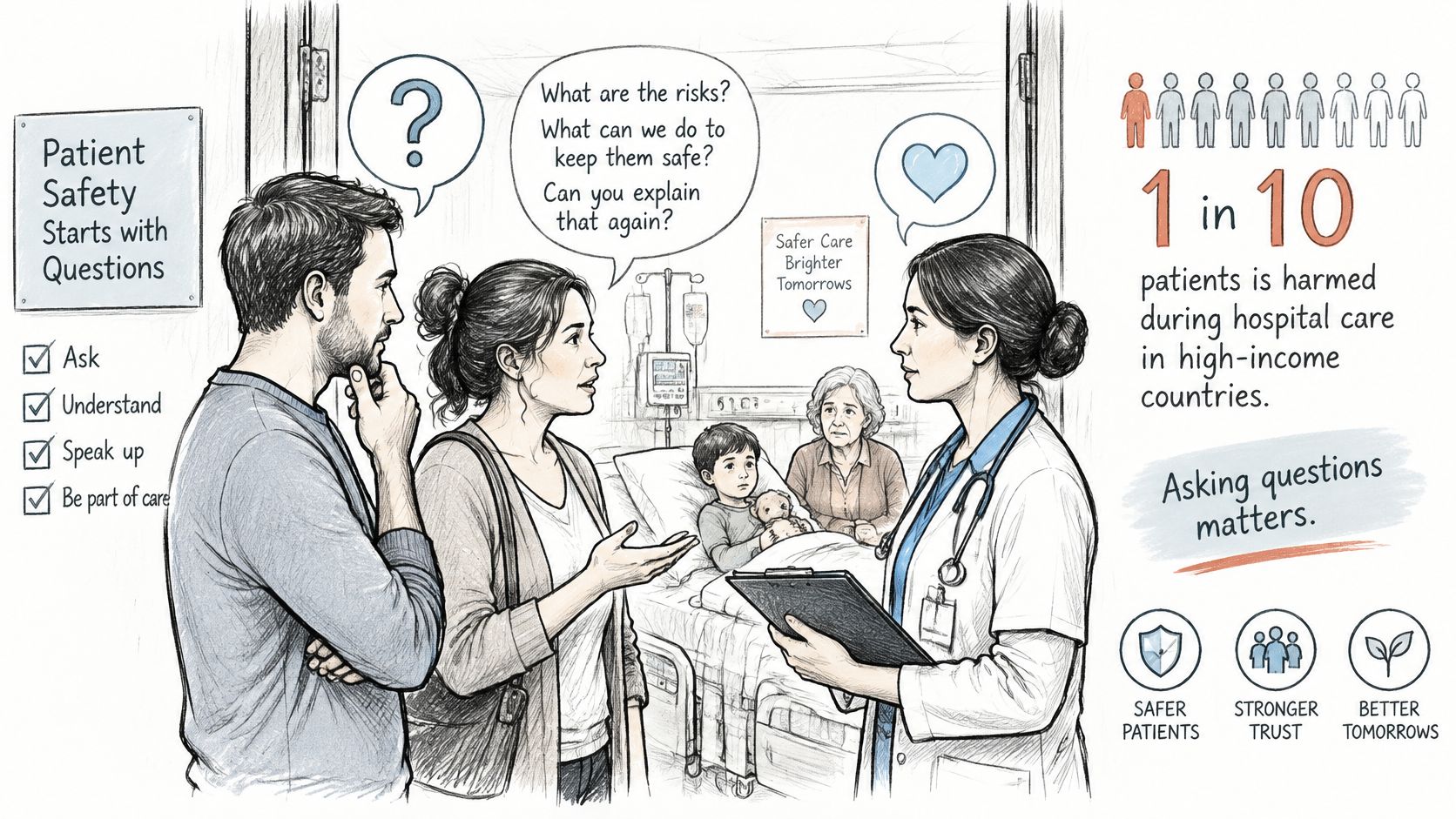
In high-income countries, approximately 1 in 10 patients is harmed during hospital care, and about 7 in 100 hospitalised patients acquire a healthcare-associated infection, according to the World Health Organization's quality health services fact sheet. These aren't Spain-specific hospital ratings, but they explain why safety questions deserve more attention than room photographs.
For a family, information can become fragmented quickly. A child's weight-based prescription, a parent's allergy and a grandparent's regular tablets may be discussed with different teams.
Ask who owns the clinical decisions
Start with responsibility, then work through the risks:
- Named clinician: Who is responsible for this admission, and who takes over outside their usual hours?
- Paediatric escalation: If my child worsens overnight, who can assess them and where would they be transferred if necessary?
- Medication reconciliation: Has someone checked regular prescriptions, inhalers, non-prescription products and medicines brought from abroad?
- Allergy recording: Where is the allergy documented, and can the prescribing and nursing teams see it?
- Infection precautions: What precautions apply to this patient, visiting relatives and anyone sharing the room?
Don't administer medicines from your bag without telling the clinical team. A familiar tablet can duplicate a hospital prescription or interfere with the current treatment.
Make communication and consent explicit
Ask whether a parent can remain overnight and what documents establish who may consent for a child. If the guardian is elsewhere, clarify the hospital's process early rather than leaving staff to resolve it when a decision becomes urgent.
For language, request an interpreter or suitable communication support. Don't assume a relative who speaks conversational Spanish can safely interpret an unfamiliar procedure.
Translate AI's resource on describing chronic conditions in Spanish can help you prepare a written history. Use that preparation to support the clinical conversation, not replace professional interpretation for consent or complex instructions.
Good-quality care should improve the chance of a good outcome while remaining evidence-based and responsive to the patient's and family's needs.
Ask how the hospital tracks infections, medication incidents and readmissions, and how families can raise a concern. A clear explanation of the process is more useful than a vague assurance that everything is safe.
Before leaving the bedside, save the answers in a shared phone note. Include the responsible team, agreed treatment changes and unresolved questions so the next shift doesn't have to reconstruct the conversation.
How a Family Policy Pays the Hospital Bill
Start with the invoice and work backwards. Which hospital, which doctor, which treatment and which approval will the insurer pay for? A family policy isn't a blank cheque because the patient has been admitted.
For a network policy, the hospital and treating professionals must satisfy the contract's requirements. A reimbursement policy works differently, so establish which arrangement you're buying before relying on either model.
Follow the failed-claim sequence
A claim can fail first at the network check. The building may be listed while the surgeon, anaesthetist or particular service isn't covered under your arrangement.
Next comes authorisation. A doctor recommending a scan or operation doesn't mean the insurer has approved payment. Obtain written approval for planned treatment and check whether it covers the full proposed episode.
Then examine copago, the amount payable for specified services. A modest consultation charge becomes more significant when several family members need repeated appointments; where an immigration application requires no-copayment cover, make sure the actual documents satisfy that requirement.
Carencias, or waiting periods, can block payment even when the service would otherwise be covered. Use the dates and wording in your contract, not a general promise about when a new policy becomes useful.
Finally, check exclusions and pre-existing conditions. Disclose the medical history accurately and obtain the insurer's written acceptance terms. Don't guess whether a previous diagnosis is too old or too minor to mention.
Check the terms against a real admission
Family hospital clauses to check before you rely on them
| Clause | Confirm this | Gap if it is missing |
|---|---|---|
| Hospital network | Named hospitals near home plus an emergency backup | Out-of-network admission or an unexpected bill |
| Paediatrics and maternity | Relevant specialties, facilities and doctors are included | Redirection to another facility |
| Emergency away from home | Regional access, notification requirements and travel limits | Treatment outside the agreed payment arrangements |
| Waiting periods | Exact start dates for admissions, scans and surgery | Planned treatment before eligibility begins |
| Copayments | Charges for each service and application-specific requirements | Repeated fees or unsuitable immigration paperwork |
| Pre-existing conditions | Written acceptance, exclusions and any additional premium | The relevant condition isn't covered |
| Authorisation | Which stays and tests require approval | Delay or refusal of payment for planned treatment |
Geography deserves its own practical check. Compare the listed hospital with the journey from home, school and wherever an older relative spends time, rather than measuring convenience by the insurer's nearest sales office.
A family discount only changes the price arrangement. It doesn't establish that maternity, childhood treatment or a parent's existing illness is included.
Payment rule: Treat cover as unconfirmed until the policy wording, acceptance terms and any required authorisation support the proposed treatment.
Keep those documents together. A marketing summary won't resolve a dispute about an excluded condition or an unapproved admission.
Cover for Children Older Relatives and Illness
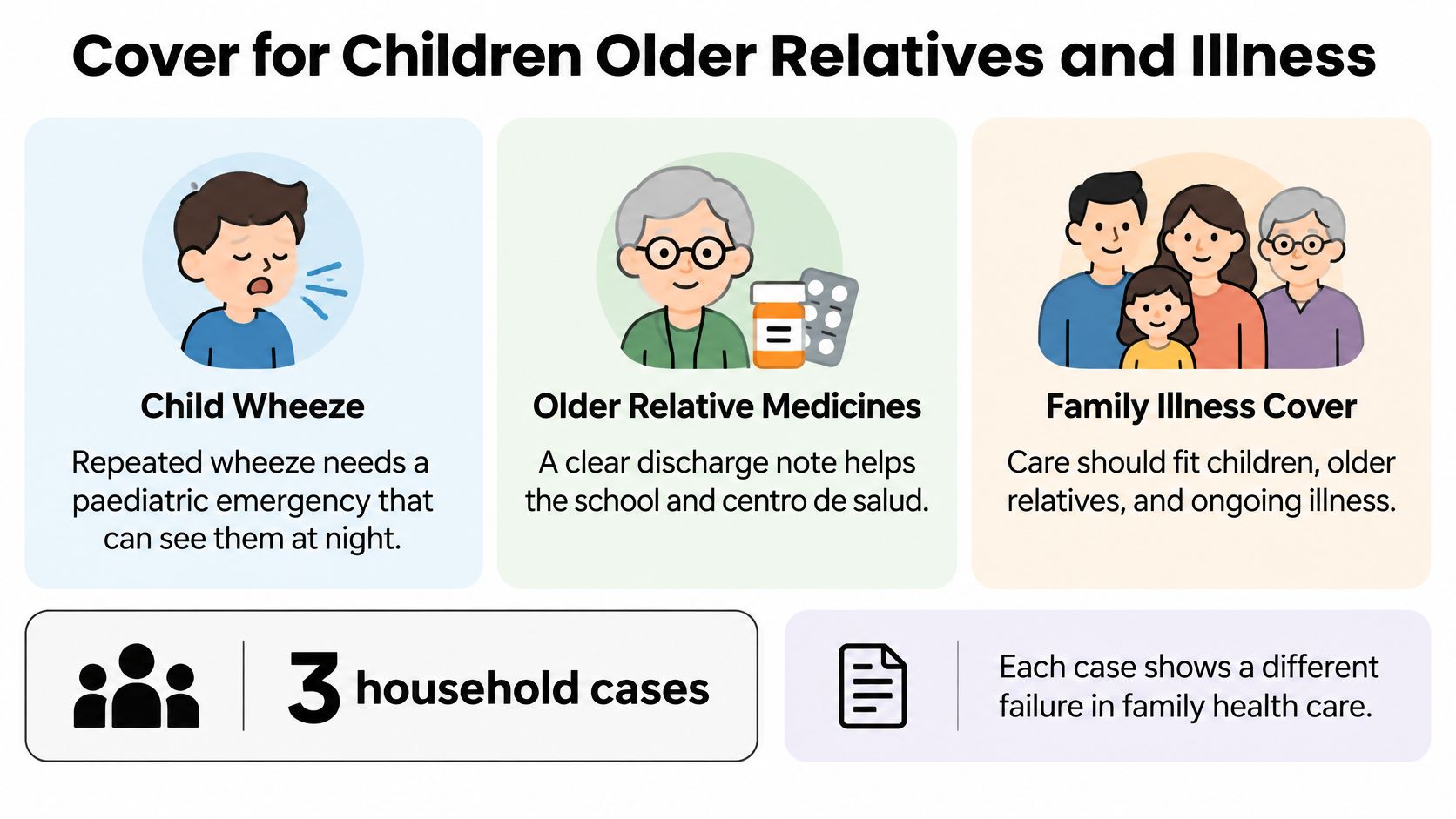
A hospital network can look excellent for a healthy adult and still fail the person in your household who needs it most. Test it against realistic admissions, not just routine consultations.
A child with repeated wheeze
Say your child has another episode of wheezing after the nearby private consultation clinic has closed. The adult hospital in the directory isn't enough if it can't provide the paediatric assessment your child needs.
Prepare an agreed action plan with the treating clinician, including when to seek urgent help. Keep the inhaler names, prescribed instructions and relevant reports accessible to whichever adult is caring for the child.
The preparation that changes the admission: confirm the out-of-hours paediatric destination before the next episode, and make sure the caregiver can explain what treatment has already been given.
An older relative with heart failure or diabetes
Your retired parent may benefit more from reliable monitoring and prompt medication review than from a luxurious inpatient room. The European Commission's Spain country health profile describes relatively low avoidable admission rates for congestive heart failure and diabetes, but also reports that 69.8% of respondents waited more than 24 hours for a family-doctor appointment, with an average delay of nine days.
Don't respond by abandoning community care. Agree how the household will obtain advice when symptoms change, arrange prescription continuity and identify who can accompany the patient.
The preparation that changes the admission: create a concise Spanish-and-English history and record the patient's consent for appropriate communication with a named relative. Include current medicines, recent changes and the usual treating clinicians.
A parent with a cancer history or several medicines
Suppose a parent is admitted for an unrelated surgical problem. Their earlier cancer treatment, blood-pressure medication or other ongoing condition may still affect anaesthesia, prescribing and recovery.
The insurance decision and the clinical decision are separate. The hospital needs the complete history for safe care; the insurer needs accurate disclosure to establish what it has agreed to fund.
Plan recovery before it becomes a discharge-day argument:
- Rehabilitation: Establish whether it is prescribed, available and covered.
- Home responsibilities: Decide who can help with meals, stairs, transport and personal care.
- Continuity: Identify who will update the regular specialist after the admission.
The preparation that changes the admission: obtain written underwriting terms and make a workable home-care plan.
When assessing a health insurance policy for your family, choose around the person most likely to need hospital treatment, not the healthiest name on the application.
Lock in the Hospital Network Before You Need It
Write down the hospital you would use for an emergency and the hospital you would choose for a planned specialist visit. Then test both against your household's needs, not their reputation alone.
For the emergency destination, establish whether it can assess your child or manage the older relative's likely problem. For planned care, identify the actual consultant and the route to investigations, admission and follow-up.
Make the paperwork match the destination
Keep a practical checklist:
- Clinical fit: The necessary specialty is available at the site you intend to use.
- Contract fit: The hospital and relevant professionals accept your exact policy.
- Timing fit: Waiting periods and approval requirements won't obstruct the treatment you're planning.
- Household fit: Travel, school collection, caregiving and recovery arrangements are realistic.
- Administrative fit: Your entitlement or insurance documents match the route you intend to take.
Don't buy on premium alone. A cheaper policy that excludes the relevant illness or leaves your usable hospital outside its network hasn't solved the problem.
We set up customers' health plans and manage the policy afterwards, so the discussion shouldn't stop when the application is submitted. At Bsure Health Brokers, we also help customers find the right specialist and support them in a serious medical emergency.
For a useful first call, have each person's age, visa or residence status, medical history and current insurance details ready. Add the cities your household uses and the hospitals on your shortlist, then call (+34) 952-830-252.
Apply the hospital test before paying: clinical access and insurance payment must both work. The right family health care hospital is the one that can take you tonight and that your certificate will still pay for in the morning.
Bsure Health Brokers offers national, family, residence and international plans, including options for older relatives and pre-existing conditions, and manages the policy after setup. Visit Bsure Health Brokers with your hospital shortlist and household details so we can help match the cover to the care your family needs.