
You've chosen a cheap health plan, paid the premium and added the certificate to your Spanish visa application. Then the consulate asks for more evidence because the policy includes co-payments. The cover looked suitable on the insurer's website, but it doesn't match the requirements for your application.
That's an expensive way to discover that medical access, immigration compliance and financial protection are different things. A policy can give you private specialist appointments without covering an existing illness. Another can pay emergency bills abroad but exclude routine treatment where you live.
The most useful examples of private insurance start with the problem you need to solve. For an expat in Spain, that might mean arranging residence cover, keeping a preferred consultant, protecting earnings or funding care later in life. These aren't interchangeable purchases.
Before paying, separate the insurer's sales summary from the contract. You need to know what triggers payment, which exclusions apply and whether the documents satisfy the authority handling your application.
Keep these distinctions in mind:
- Medical insurance pays for eligible healthcare, subject to its network, benefits and exclusions.
- Cash-benefit insurance pays an agreed benefit when a defined illness, dependency or inability to work meets the contract's conditions.
- Travel cover protects an eligible trip, not automatically your life as a resident.
The right purchase starts with your situation in Spain, not the lowest monthly premium.
Table of Contents
- 1. Private Health Insurance (Seguro de Salud Privado)
- 2. International Health Insurance
- 3. Visa and NIE Compliant Health Insurance
- 4. Senior Health Insurance (Over 65 and 75)
- 5. Critical Illness Insurance (Enfermedades Graves)
- 6. Long-Term Care Insurance (Seguro de Dependencia)
- 7. Income Protection Insurance (Seguro de Protección de Pagos)
- 8. Travel Medical Insurance
- How the eight private insurance types compare at a glance
- Turn These Examples Into a Policy That Fits Your Life in Spain
1. Private Health Insurance (Seguro de Salud Privado)
For a family living in Marbella, the deciding question may be simple: Can we use the hospital and specialists near our home? A national policy isn't much help if the local paediatrician you want doesn't accept that particular product.
Spanish private medical policies commonly use a cuadro médico, an approved directory of doctors, clinics and hospitals. Network-based cover can make costs more predictable, but you generally need to follow the insurer's rules for appointments, authorisations and treatment.
Private insurance also serves different purposes across countries. The OECD's population coverage guide distinguishes primary, complementary, supplementary and duplicate cover, including policies bought for additional provider choice and faster access.
Compare access, not just the hospital logo
A hospital's inclusion doesn't establish that every consultant, test or procedure there is covered. Check the exact policy name with the appointment desk, then confirm whether the insurer requires prior authorisation.
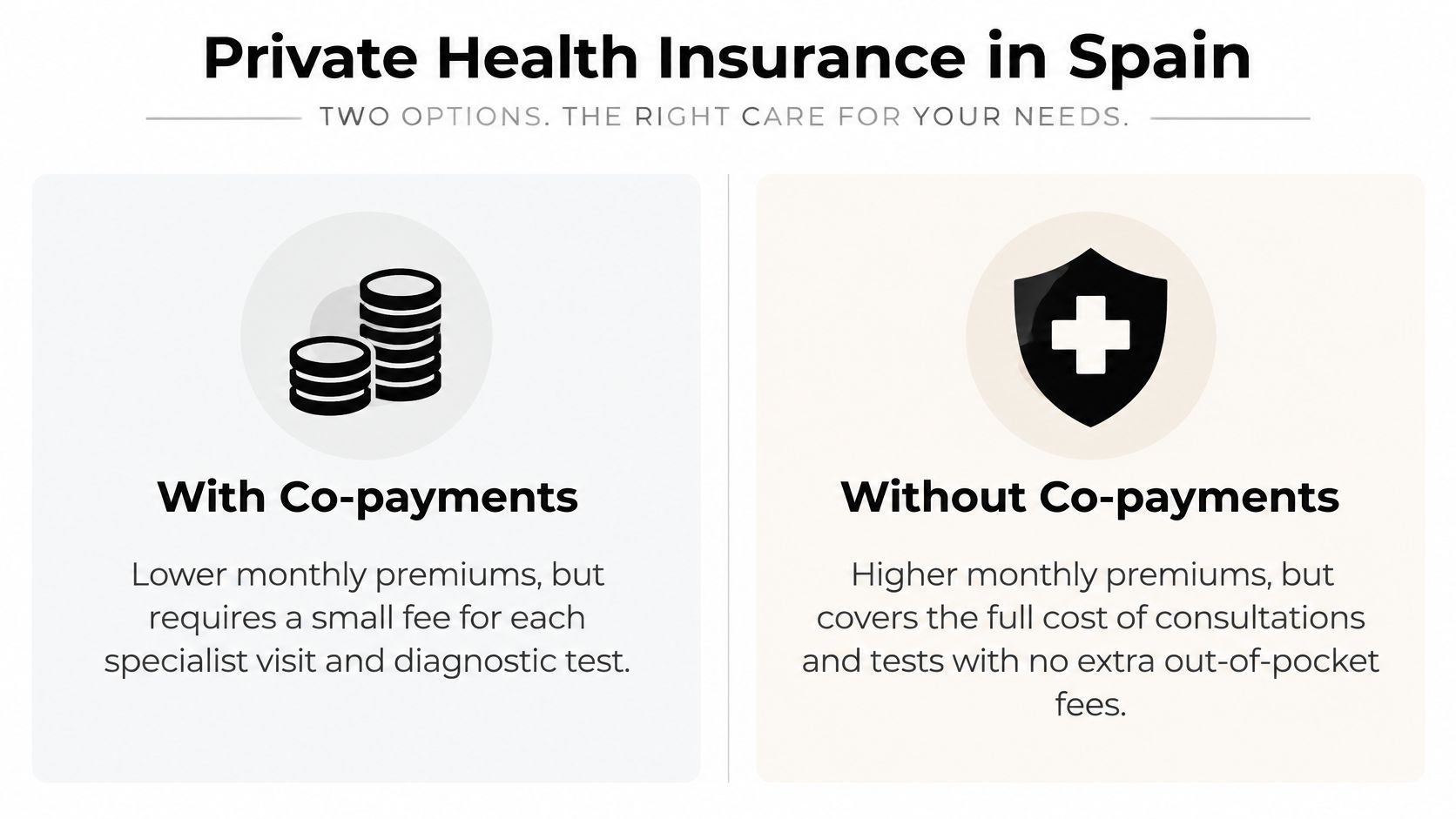
- Co-payments: Compare charges for consultations, diagnostic tests and repeated treatment.
- Carencias: Identify waiting periods for surgery, hospitalisation and other benefits.
- Existing symptoms: Declare medical history accurately, including treatment already recommended.
- Public healthcare: Confirm your public entitlement separately rather than assuming private insurance creates a public backup.
Say you're considering private cover after receiving a recommendation for knee surgery. Buying a policy doesn't automatically make that operation eligible. An existing condition exclusion or waiting period could prevent payment.
Before buying: Obtain the current cuadro médico, the co-payment schedule and written underwriting terms. Match them against the care you expect to use.
2. International Health Insurance
International health insurance suits a cross-border life, not merely an overseas holiday. If you live in Spain, work elsewhere and return regularly to your home country, you need to establish where routine treatment remains covered.
Say a remote worker divides their time between Spain and Asia. A Spanish network policy may work well at home but offer only limited emergency assistance abroad. An international policy may provide broader geographical cover, with a higher premium or deductible as the trade-off.

Separate residence cover from travel benefits
Check the area of cover, permitted countries of residence and treatment rules in your country of nationality. Worldwide branding isn't enough. A policy may exclude a territory, restrict planned treatment or reimburse only within specified limits.
Also distinguish medical evacuation from repatriation. Evacuation may mean transport to a suitable treatment facility, not a flight to the country or hospital you prefer.
A deductible is money you must be able to pay when treatment is needed. It isn't simply a device for lowering the quotation.
The trade-off deserves attention. The RAND Health Insurance Experiment found that cost-sharing reduced healthcare use, while some of the poorest and sickest participants experienced worse outcomes in selected areas of care.
For someone needing regular medication or specialist monitoring, predictable outpatient benefits may matter more than a low headline premium. Check direct billing too, because reimbursement cover can require you to pay first.
Before buying: Obtain written confirmation that Spain is an accepted country of residence, your regular destinations are included and any visa certificate matches your application requirements.
3. Visa and NIE Compliant Health Insurance
Immigration suitability is a requirement to verify, not a benefit to infer from a product name. A policy marketed to expats may still contain clauses that conflict with the documents requested for your particular application.
Start with the authority handling the case. Check the current instructions for your visa or residence route, including the required coverage, policy dates, payment evidence and certificate wording. Don't treat an application for an identification number as automatically identical to an application for residence permission.
A Commonwealth Fund profile of Spain reports that private coverage reached 26.4% of the population in 2024. That figure describes insurance uptake, not immigration acceptance.

Get the evidence before paying
For a retiree applying for a non-lucrative visa, the practical task is to reconcile the consulate's requirements with the actual contract. Check whether co-payments, deductibles, carencias, exclusions or limits conflict with those requirements.
- Certificate: Obtain the official insurance certificate with the applicant's details and relevant coverage wording.
- Effective dates: Align the start date and coverage period with the application instructions.
- Restrictions: Check whether any underwriting exclusion affects the required protection.
- Renewal: Understand continuation terms before relying on the policy for future residence paperwork.
Our guide to getting health insurance quickly explains the arrangements to prepare when timing matters. We help with the paperwork, but the responsible authority determines whether the evidence meets its requirements.
Before buying: Keep the authority's current instructions beside the proposed certificate and policy terms. Resolve any mismatch in writing rather than relying on a verbal assurance of visa compliance.
4. Senior Health Insurance (Over 65 and 75)
For an older applicant, a lower first premium may come with exclusions, new waiting periods or reduced access to familiar specialists. Check how the policy handles existing conditions and future renewals before comparing prices.
A retiree with diabetes who switches insurers could find that diabetes-related care is excluded or that their current specialist is outside the new insurer's medical network. The saving may not compensate for losing access to established care. Uncertainty about payment is a serious concern when illness strikes, so establish the scope of cover before you depend on it.
Treat switching as a fresh underwriting decision
Acceptance terms from an existing policy don't automatically transfer to a new insurer. Keep your current cover in place while the replacement application is assessed.
- Entry and renewal ages: Check the age limit for joining separately from the terms for renewing an existing policy.
- Age bands: Ask when premiums change with age and how renewal increases are calculated.
- Chronic care: Confirm whether consultations, monitoring, prescriptions and related complications are covered.
- Continuity: Get written confirmation of any recognition of previous insurance and any waiver of carencias, or waiting periods.
Health cover options for people over 70 or 75 can help you understand why age alone does not determine whether cover is available. Bsure Health Brokers helps applicants explain their medical history and compare the terms they are offered.
Switching rule: Keep your existing policy until the new insurer has accepted your application, issued its terms and confirmed the start date.
Before buying: Compare the acceptance terms, exclusions, access to local specialists and renewal provisions side by side. Check the next age-band premium with the insurer before committing. A quotation without underwriting terms is not a complete offer.
5. Critical Illness Insurance (Enfermedades Graves)
Critical illness insurance addresses a different problem from medical insurance: the household costs of a serious diagnosis. It pays a defined cash benefit when an insured condition meets the policy's criteria.
That money may help with housing payments, recovery costs or travel for treatment. It doesn't automatically provide hospital access, and a doctor's diagnosis doesn't necessarily satisfy the insurer's contractual definition.
Say someone has a stroke and needs changes to their home during recovery. A qualifying payment could help fund those adaptations. Whether the claim succeeds depends on the insured definition, medical evidence and any applicable exclusions, not just the name of the illness.
Read the definition before the benefit amount
Cancer cover needs particular care. Policies can distinguish between types, stages and severity, so don't assume every cancer diagnosis produces the same payment.
The guide to health insurance for cancer patients is useful when separating medical-cover questions from cash-benefit protection. Someone with a prior diagnosis needs an individual assessment, not an assumption that new insurance will cover a recurrence.
Check these contractual points:
- Illness definitions: Read the qualifying criteria, including exclusions for early-stage or less severe conditions.
- Waiting and survival provisions: Establish when cover becomes usable and what must happen after diagnosis.
- Payment structure: Check whether benefits are full, partial or limited to a single qualifying claim.
- Existing protection: Review overlap with life insurance, employer benefits and medical insurance.
For a Spanish visa application, don't present a critical illness certificate as a substitute for required medical coverage. Its cash payment serves a different purpose.
Before buying: Locate the full definition for the illness you're concerned about and the clause explaining when payment can be refused.
6. Long-Term Care Insurance (Seguro de Dependencia)
After hospital treatment ends, someone may still need help washing, dressing or eating. Long-term care insurance is designed to cover ongoing assistance, with benefits that may be paid as cash, reimburse eligible expenses or provide specified services.
A person with reduced mobility may prefer support at home, while someone with dementia may need residential care. Check which care settings the policy covers and how the insurer decides that the person qualifies.
Spain's private insurance benefits and public dependency support have separate assessments. Eligibility under one does not guarantee eligibility under the other, and a relative's account of someone's needs may not meet the insurer's claim criteria.
Establish who decides that care is needed
Read the policy's definition of dependency first. It should explain who assesses the claim and how the insurer evaluates physical and cognitive impairments.
- Assessment criteria: Check which daily activities or impairments qualify.
- Care setting: Confirm whether home assistance, residential care and nursing support are covered.
- Benefit duration: Find out how long payments continue and whether reassessment can stop them.
- Cost changes: Check whether benefits are fixed or can rise as care costs change.
Home adaptations need their own funding check, so ask your regional dependency service and local council what support is available for ramps and other changes to your home. You can also find grants for wheelchair ramps.
Review waiting periods and pre-existing condition exclusions if symptoms or support needs already exist. A policy bought after care becomes necessary may not cover that existing need.
Before buying: Ask for the dependency definition, assessment process and benefit schedule. Verify that your preferred care arrangement meets the policy terms.
7. Income Protection Insurance (Seguro de Protección de Pagos)
A self-employed consultant in Spain breaks a leg and can't travel to appointments. Medical insurance may pay for eligible treatment, but it won't automatically replace the fees the consultant loses while recovering.
Income protection covers an earnings problem. However, payment-protection products can be narrower, covering specified loan repayments or defined events rather than providing general income replacement.
Read the Spanish product wording carefully. Don't assume that protección de pagos, temporary incapacity cover and broader income protection describe identical benefits.
Match the claim definition to your actual work
For a desk-based consultant, a broken leg might not meet the insurer's definition of inability to work. For someone whose job requires physical activity, the same injury could have a different contractual consequence.
The deciding question is what duties you must be unable to perform. Check whether the policy assesses your own occupation, another suitable occupation or a broader ability to work.
- Waiting period: Match the unpaid period to accessible savings and any employment benefits.
- Employment status: Confirm eligibility for employees, company directors or autónomos, as relevant.
- Evidence of earnings: Establish which accounts, payslips or tax documents support the insured amount.
- Return to work: Check whether reduced hours or partial recovery changes the benefit.
Consider a salaried resident whose employer continues some pay during illness. Immediate insurance payments may be less useful than protection against a longer absence, provided the contract allows that arrangement.
Also read exclusions for conditions relevant to your work and medical history. A broad inability-to-work promise can be limited by detailed exclusions.
Before buying: Write down your occupation and main duties, then obtain confirmation of the incapacity definition, payment trigger and documents needed for a claim.
8. Travel Medical Insurance
Travel medical insurance protects an eligible trip, not automatically your ongoing life in Spain. It can cover emergency treatment, hospital care and assistance abroad, subject to the policy's geographical and medical conditions.
For a parent visiting family in Marbella, a travel policy may be the appropriate purchase. For someone relocating permanently, the same product may end when residency changes or exclude routine care in the new home country.

Match the certificate to the journey
If you need insurance for a Schengen visa, check the current instructions issued by the consulate handling your application. Verify the required medical and repatriation benefits, territorial scope and coverage dates rather than assuming any travel certificate will qualify.
- Residence eligibility: Confirm that the policy accepts your actual country of residence.
- Trip dates: Include the full journey and understand extension rules.
- Medical history: Complete the screening questions accurately and retain the insurer's acceptance.
- Assistance procedure: Save the emergency number and check when hospital admission needs authorisation.
Say a visitor develops an acute illness while staying with relatives. Emergency treatment may qualify, but follow-up after returning home or planned treatment in Spain may not.
Activities need checking too. Before you discover Northern Spain's scenic waterfalls, establish whether your planned walking route, guided excursion or adventure activity falls within the policy's terms.
Repatriation also requires attention. The insurer may organise transport only when medically necessary and approved by its assistance team, rather than whenever you'd prefer to return home.
Before buying: Verify the insured traveller, residence eligibility, destination, dates and medical acceptance. If a visa is involved, reconcile the certificate with the consulate's current requirements.
How the eight private insurance types compare at a glance
Each policy type addresses a different situation in Spain. Compare its use, limits and exclusions before deciding which fits.
| Item | Best For | Coverage Scope | Pre-existing Conditions | Main Drawback |
|---|---|---|---|---|
| Private Health Insurance (Seguro de Salud Privado) | Residents seeking access to private care | Care through a Spanish provider network, including consultations, tests, surgery and hospitalisation | Often excluded or subject to waiting periods | Network restrictions and premiums that rise with age |
| International Health Insurance | People who live in or travel between multiple countries | Regional or worldwide medical care, often with evacuation and repatriation | May be excluded or limited | Usually more expensive than local plans |
| Visa and NIE Compliant Health Insurance | Applicants needing health cover for Spanish residence requirements | Private care in Spain with application documentation; co-payment terms must be checked against the authority's requirements | May be excluded | Policy wording must meet current authority requirements |
| Senior Health Insurance (Over 65 and 75) | Older adults seeking age-suitable cover | Specialist care and, depending on the plan, chronic condition management | May be excluded, restricted or subject to extra costs | Premiums may rise by age band, and new applications may face age limits |
| Critical Illness Insurance (Enfermedades Graves) | People seeking financial support after a serious diagnosis | Lump sum for specified illnesses that meet policy criteria | Often excluded | Only listed conditions meeting defined criteria qualify |
| Long-Term Care Insurance (Seguro de Dependencia) | People wanting financial support for ongoing care | Benefits for eligible home, residential or nursing care | Often limited for care needs already present; check the dependency definition and exclusions | Benefits require meeting specific dependency criteria |
| Income Protection Insurance (Seguro de Protección de Pagos) | Employees and self-employed people who rely on earned income | Replaces part of earnings during qualifying illness or injury | May be excluded | Strict incapacity definitions and waiting periods |
| Travel Medical Insurance | Visitors and short-term travellers | Emergency treatment, hospital care and repatriation during a trip | Often excluded unless declared and accepted | Does not cover routine or long-term care |
Before buying, check the point that matters most for your situation: visa requirements and co-payments, waiting periods for treatment, access to the Spanish provider network, or how age affects premiums. For long-term care, confirm how the policy defines dependency and treats existing care needs.
Turn These Examples Into a Policy That Fits Your Life in Spain
Start with the situation that makes insurance necessary now. A visa deadline calls for documentary precision. An existing illness calls for careful underwriting. An approaching age band calls for a review of affordability and continuity, not a rushed switch.
Shortlist only the policy types that address that situation. A resident who wants private specialist access may need a Spanish medical policy. Someone living across borders may need international cover, while a self-employed person might also need separate protection against lost earnings.
Don't compare these examples of private insurance as though they all buy the same thing. A cash benefit won't necessarily pay a hospital directly. Travel insurance won't necessarily cover resident healthcare. A no-co-payment policy won't necessarily include an existing condition.
Compare the contract you'll receive
Build your comparison around documents rather than advertisements. Keep the personalised quotation, policy conditions, underwriting decision and benefit schedule together. Where relevant, add the cuadro médico, co-payment list and immigration certificate.
Then test the proposed cover against ordinary situations:
- Medical access: Can you see the specialist you need at a practical location?
- Treatment eligibility: Would an existing symptom, diagnosis or recommendation restrict payment?
- Affordability: Can you manage the premium alongside deductibles, co-payments and excluded treatment?
- Immigration evidence: Does the certificate match the current requirements for your application?
- Continuity: What changes if you move, renew, enter another age band or switch insurers?
Compare total expected cost, not just the monthly debit. Regular consultations, uncovered medication and travel for treatment can make an apparently cheaper policy less suitable. Equally, paying for extensive international benefits makes little sense if you only need local care and limited holiday protection.
We ask about your circumstances before comparing terms, and we help with policy setup, changes, renewals and communication with the insurer. Bsure Health Brokers is an independent broker based in Marbella, serving people across Spain. Our service is included in the policy price, so you pay the same as buying direct.
Before signing, resolve the clauses you don't understand and retain the written answers. Before switching, secure the replacement acceptance and check cancellation obligations on the existing contract. The aim is practical: usable cover, appropriate documents and costs you understand before you need to claim.
Bsure Health Brokers compares Spanish and international health insurance, including options for residence applications, older applicants and people with pre-existing conditions. Visit Bsure Health Brokers to request a no-obligation quote, and share your medical needs, preferred hospitals and any visa deadline so we can assess suitable options.