
Monthly private medical insurance in Spain runs from €60–€100 for adults under 40 to €200–€400 or more from age 70, according to thinkSPAIN's Spanish health insurance cost guide. The same guide puts the average at about €125 for people aged 55 and over. Those figures assume policies without co-payments. Treat them as shopping benchmarks, not a realistic annual healthcare budget.
What matters is what you pay after appointments, tests, excluded treatment and renewal changes. A cheap policy is poor value if it locks you out of your preferred hospital or leaves you funding the treatment you need.
Bsure Health Brokers' advice is to compare the annual cost of usable cover, not the lowest monthly premium. Start with your age, then check benefits, cost-sharing and medical acceptance before you commit.
Table of Contents
- Monthly Private Medical Insurance Cost by Age Band
- Basic Versus Complete Cover and What Each Costs
- Co-payments, Excess and Other Factors That Move Your Bill
- Regional and International Plans for Expats
- Realistic Budgets for Individuals, Families and Retirees
- Pre-existing Conditions and Renewal Increases
- Request a Like-for-Like Quote Before You Commit
Monthly Private Medical Insurance Cost by Age Band
For policies without co-payments, thinkSPAIN's Spanish health insurance cost guide gives estimated monthly ranges of €60–€100 for adults under 40 and €200–€400 or more for people aged 70 and over, alongside an average of about €125 for people aged 55 and over across insurers and cover levels.
Typical monthly premiums by age band in Spain
| Age band | Typical monthly premium | Notes |
|---|---|---|
| Under 40 | €60–€100 | Comprehensive cover without co-payments |
| 40 to 54 | Request an age-specific quote | No reliable band-wide estimate available |
| 55 and over | About €125 average | Average across insurers and cover levels |
| 70 and over | €200–€400 or more | Comprehensive policies with no co-payments |
Treat these as starting benchmarks, not guaranteed offers. Your personal quote must confirm eligibility, benefits and medical acceptance.
Read the benefit description before the price
The rows aren't interchangeable. An average across different cover levels doesn't describe the same product as a no-copayment policy. Nor should you interpret the older age bands as a promise that every insurer accepts new applicants at those ages.
For the middle age band, request a quote using your actual date of birth rather than interpolating between the other rows. Insurers' pricing structures aren't a straight line, and a national estimate can't tell you when a particular policy changes age brackets.
- Find your age band: Use it to establish a sensible shopping benchmark, not a target the insurer must match.
- Check the payment structure: Identify whether appointments and tests generate separate charges.
- Confirm the hospital benefits: Don't assume that a policy described as broad includes every hospital or treatment you want.
Budget beyond the starting offer
A healthy applicant's opening quote doesn't establish lifetime affordability. Ask whether the price includes an introductory discount, when that discount ends and how the insurer handles age-related reviews.
Practical rule: Multiply the monthly premium by twelve, then add the co-payments you expect in a typical year.
Keep uncovered treatment separate in your budget. Otherwise, you'll mistake the cost of holding insurance for the cost of obtaining healthcare.
Basic Versus Complete Cover and What Each Costs
The basic and complete starting prices in the opening are shopping labels, not standardised benefit packages. Don't assume that complete means everything is covered, or that basic means hospital treatment is included. The policy schedule decides.
A higher premium is worth paying when it buys benefits you'll use: access to a suitable hospital, stronger inpatient cover, a wider specialist network or less cost-sharing. It's poor value when it mainly adds extras you don't need.
Compare the actual contract
| What to compare | Lower-cost option | Broader-cover option |
|---|---|---|
| Appointments | Check charges for each consultation | Confirm whether consultations have separate charges |
| Hospital treatment | Verify whether admission and surgery are included | Check hospitals, authorisation and treatment limits |
| Specialist choice | Establish which doctors are available locally | Confirm your preferred specialists participate |
| Diagnostics | Check covered tests and approval requirements | Look for the tests relevant to your expected care |
| Additional benefits | Identify optional extras | Decide whether included extras justify the premium |
Choose basic cover if you're comfortable with its network, expect limited use and can absorb the separate charges. But don't buy an outpatient-only product if your priority is protection against private hospital bills.
Choose broader cover if you expect ongoing specialist appointments or want more hospital choice. Even then, check the precise treatment wording. A broader network doesn't automatically mean unrestricted reimbursement outside it.
Match the product to your purpose
Our range includes National Health Plans, Insurance for Residence, Family Plans, Health Plans for over 65s and 70s, Plans covering Preconditions, and International Plans. These describe different needs, not a simple ladder from cheap to expensive.
For example, a residence application calls for a suitability check against the application requirements. A family comparison needs member-by-member benefits and prices. A plan considering pre-existing conditions needs individual medical acceptance, not just a more expensive tier.
Don't pay extra for the word complete. Pay for a written benefit that changes what you can access or what you'll owe.
Our recommendation is to start with the treatment you need and work backwards to the product. Ask us: Which option covers my expected treatment, which hospitals can I use, and what will I pay when I use it?
Co-payments, Excess and Other Factors That Move Your Bill
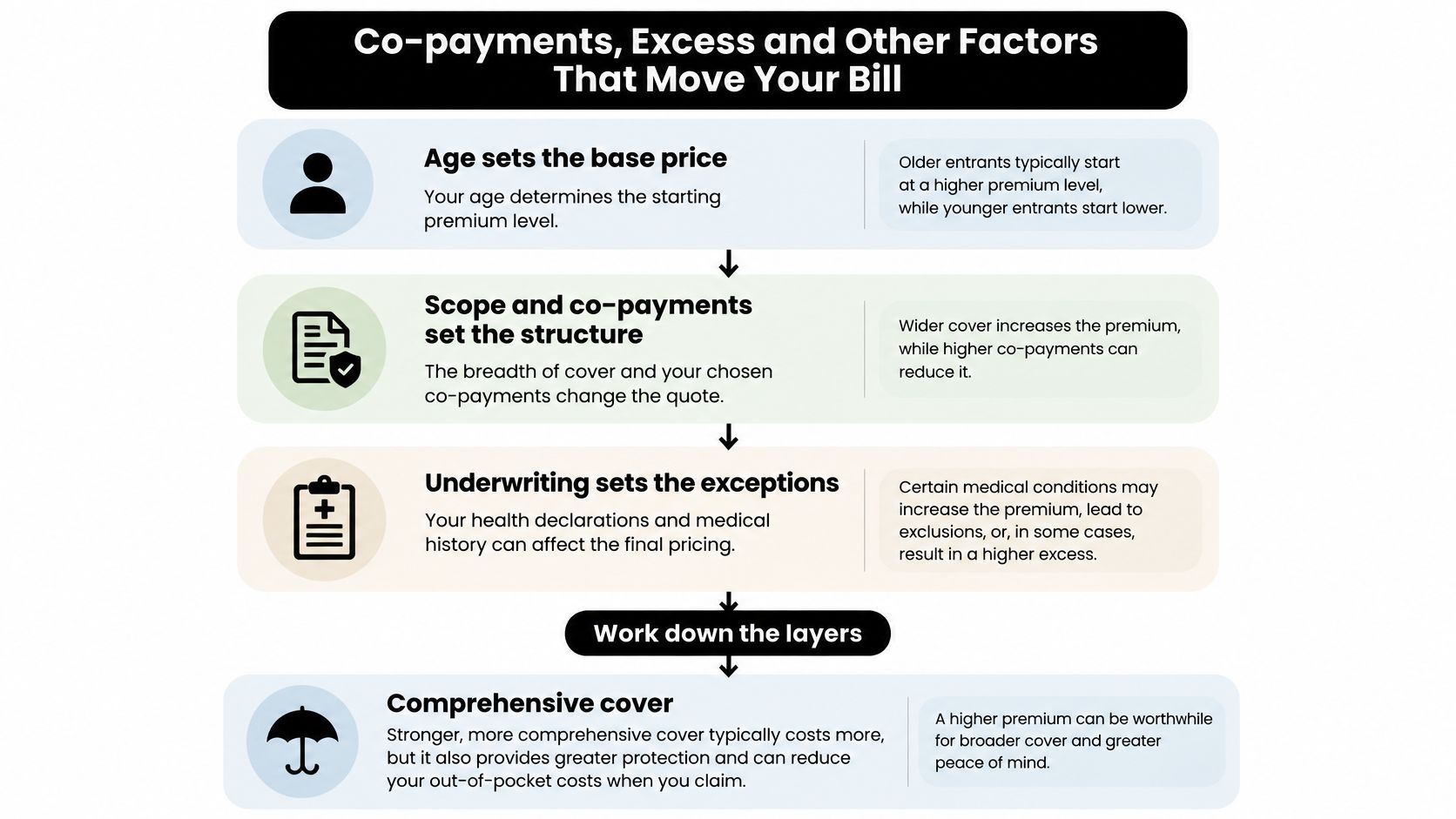
Age sets the starting price, scope and co-payments shape the payment structure, and underwriting determines individual exceptions. Work through those layers in that order. Comparing prices before checking the structure can make a limited policy look better than it is.
The diagram below shows how those layers fit together.
A co-payment is a fixed charge for an appointment, test or procedure. An excess is an amount you must pay towards eligible costs before the insurer contributes under the relevant policy terms. Percentage-based cost-sharing is different again; our guide to coinsurance in health insurance explains that distinction.
Test the cheaper policy with actual usage
Consider this hypothetical comparison, not an insurer's offer. Assume both policies cover the same specialist treatment and the broader policy has no co-payments.
| Hypothetical cost | Lower-premium policy | No-copayment policy |
|---|---|---|
| Monthly premium | €46 | €74 |
| Annual premium | €46 × 12 = €552 | €74 × 12 = €888 |
| Specialist charge | €40 per visit | No separate charge |
| Ten specialist visits | €40 × 10 = €400 | No separate charge |
| Annual total for this scenario | €952 | €888 |
The lower monthly price produces the higher annual bill in this scenario. That doesn't make every co-payment policy poor value. It means you should calculate using your likely appointments rather than assuming you'll never need care.
Run a quiet-year scenario and a treatment-heavy scenario. Include follow-up consultations and diagnostic tests, not just the initial specialist visit.
Check what sits outside the premium
- Consultations and diagnostics: Request the charge schedule for specialists, imaging, laboratory tests and any other services you expect to use.
- Medicines: Establish whether the policy includes the medication benefit you need. Don't assume a prescription means the insurer pays for the medicine.
- Network and authorisation: Check whether your doctor participates and whether tests, procedures or admissions require prior approval.
- Waiting periods: Obtain the applicable terms for surgery, maternity and other delayed benefits in writing.
- Excluded services: Identify treatments you would have to pay for yourself, even when the policy is otherwise active.
Family composition, geographical scope and the chosen provider network also affect the comparison. We consider family discounts, international cover, low wait times and the cover required for residency in Spain when selecting suitable companies. None of those features should be assumed from the monthly price alone.
Finish the comparison with three direct questions: What do I pay when I use it? What isn't covered? When can I use the surgical benefits? Request written answers, including the policy wording and personalised schedule, before accepting the quote.
Regional and International Plans for Expats
Compare local access. A policy with an impressive national hospital list can still leave you with an inconvenient choice near home. Search the insurer's current directory using your town or postcode, then check the specific hospital, specialist and service. Every department inside a listed hospital may not participate.
Match geographical cover to your life. A Spanish policy and an international policy are not interchangeable. If you divide your time between countries, establish where planned treatment is covered, where emergency benefits apply and whether geographical exclusions affect your usual destinations.
Bsure Health Brokers offers Insurance for Residence and International Plans for different needs. Bsure identifies which product suits your residence application and travel pattern. Neither is an automatic upgrade.
- Residence purpose: Tell us whether you are applying for a visa, arranging residence cover or replacing an existing policy.
- Local treatment: Give us the names of hospitals and specialists you want included.
- Cross-border needs: Specify where you expect routine care, not just where you might need emergency assistance.
Distinguish cover that pays public-system cost-sharing from cover that adds services or offers private alternatives to publicly available treatment. Those purposes deliver different value. And budget for the annual cost, not the starting premium: a cheap regional plan that excludes your local hospital is no saving.
Ask which cover fits your residence circumstances and which network serves your home. If you are changing countries or insurers, get written confirmation of waiting periods before cancelling existing protection.
Realistic Budgets for Individuals, Families and Retirees
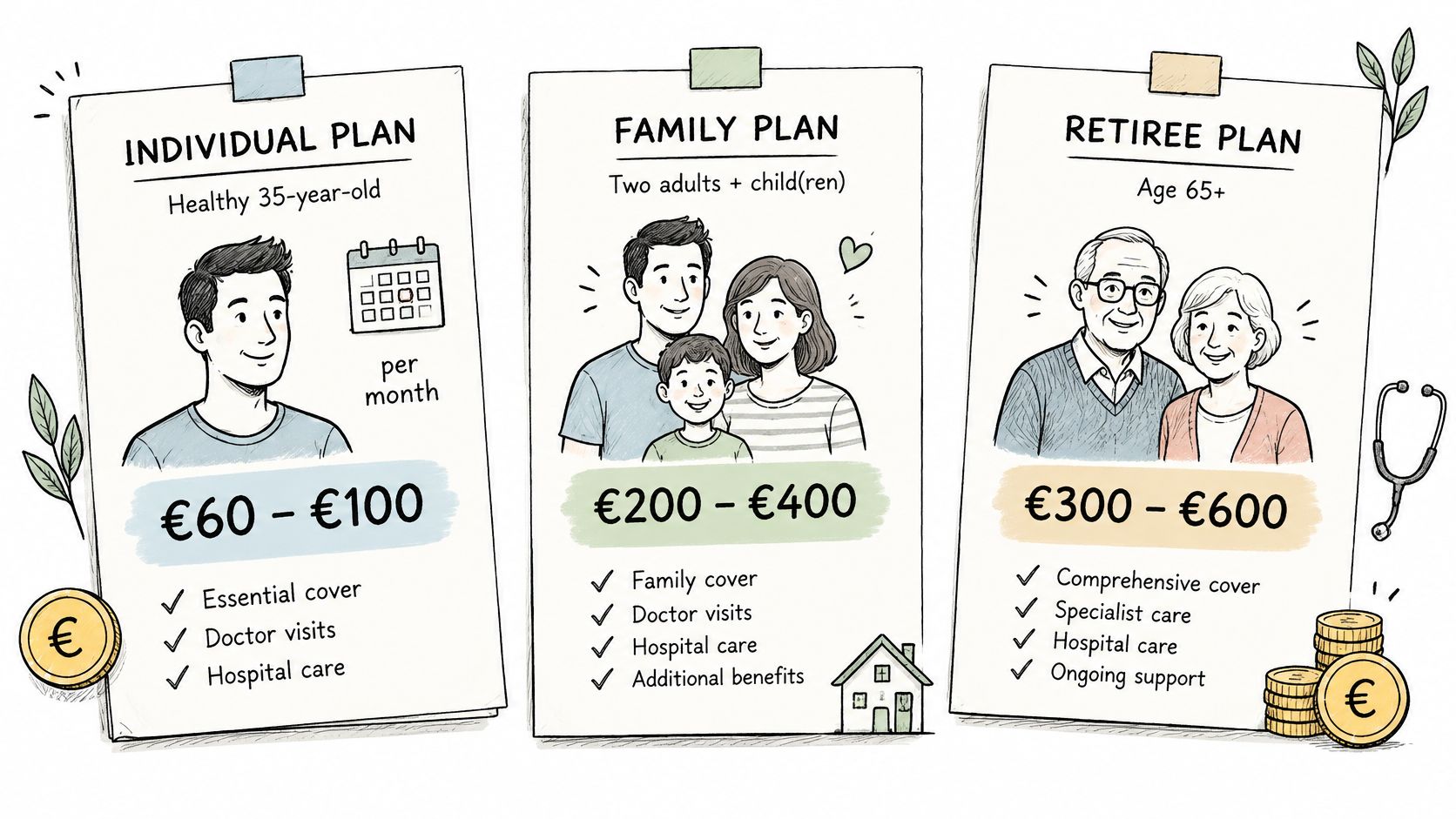
A starting premium is the least useful number in a household budget. Plan around the annual premium, likely out-of-pocket treatment and the terms the insurer accepts. The examples below are planning ranges, not personal quotes.
The illustration compares plans for different household needs.
A healthy individual
For a healthy adult under 40 choosing full cover without co-payments, use roughly €720–€1,200 a year as a planning range. That is the annual premium before any treatment the contract excludes. A no-copayment policy should not have appointment charges, but it may not cover every service you want.
Check the policy wording for dental treatment, medicines, and out-of-network care. Budget separately for anything not included, based on the care you expect to use. A generic allowance can mask the actual cost, so identify the services first.
A couple or family
For a household, add each member's annual premium and subtract only a family discount the insurer has confirmed. The table uses two adults under 40 as a simple family-planning example, not a quote for a household with different ages or medical histories. Children and other age bands need their own figures.
Don't multiply one adult's premium by the number of people in the household. Ages, chosen benefits and medical acceptance terms can change each person's price. With co-payments, estimate likely use for each member as well.
Annual cost by profile
| Profile | Monthly premium | Annual premium before co-payments |
|---|---|---|
| Healthy adult under 40, cover without co-payments | Roughly €60–€100 | Roughly €720–€1,200 |
| Retiree aged 70 and over, cover without co-payments | Roughly €200–€400 | Roughly €2,400–€4,800 |
| Two adults under 40, illustrative family budget before any confirmed discount | Roughly €120–€200 combined | Roughly €1,440–€2,400 |
A retiree
For a retiree aged 70 and over, the planning range is roughly €2,400–€4,800 a year before co-payments or treatment outside the policy. Start with that annual commitment, then add known self-funded care. The accepted price and cover terms matter more than an attractive starting premium.
Ask when the premium is reviewed and whether the quote includes a temporary discount. Consider whether the policy would remain affordable if the renewal price rises. A plan that fits this year's budget may be difficult to maintain later, and changing insurers can mean a fresh medical assessment.
Budget test: Can you keep paying the premium while also funding treatment the policy excludes?
Keep separate figures for premiums, co-payments and uncovered care. That gives you a more realistic annual budget than comparing monthly starting prices alone. For a like-for-like household comparison, use the accepted premium for each person and the same cover level, then account for expected use.
Pre-existing Conditions and Renewal Increases
A healthy-applicant price isn't the price of useful cover for someone with an ongoing condition. The first question is whether the treatment you need will be insured at all.
International Insurance's guide to Spanish health insurance explains that medical underwriting can result in exclusions, restrictions or refusal, not just a higher premium. That distinction matters if you have diabetes, cardiovascular disease, a cancer history or continuing medication needs.
Compare the costs the headline leaves out
Evaluate these separately:
- The accepted premium: Use the price after the insurer has assessed your medical declaration.
- Excluded treatment: Identify the consultations, tests and treatment you would fund outside the policy.
- Alternative access: Establish what public-system access you're entitled to and what private self-funded care would cost.
A waiting period isn't an exclusion. Waiting for a benefit to become active doesn't necessarily make a pre-existing condition insurable. Declare your medical history accurately and retain a copy of the completed questionnaire to reduce the risk of later disputes.
Our guide to health insurance with pre-existing conditions helps you prepare the questions that matter. We support expats and internationals with complex medical cases and visa-compliant coverage, and our advice is independent and impartial rather than biased towards one insurer.
Protect the renewal decision
Don't assume renewal increases will match general consumer inflation. Ask how the contract allows the insurer to review premiums for age, medical costs and claims experience.
Request the acceptance decision, condition-specific exclusions, entry-age rules and renewal terms in writing. Keep existing cover in place until the replacement insurer has confirmed acceptance and the start date. A cheaper unaccepted quotation isn't a replacement policy.
Request a Like-for-Like Quote Before You Commit
The starting premium is only one part of your cost. Compare accepted terms, likely treatment and out-of-pocket spending before choosing a policy.
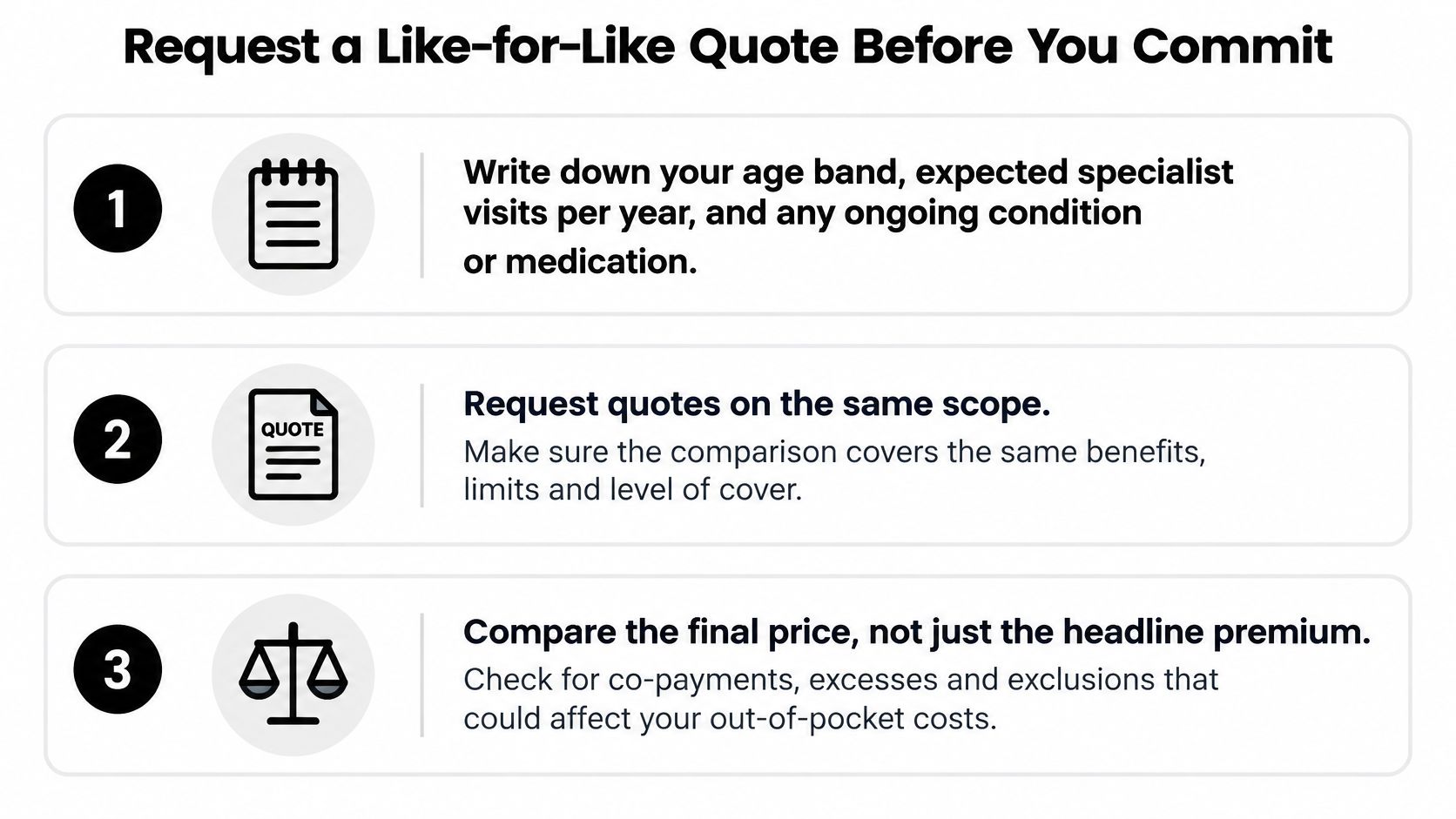
Prepare a comparison you can act on
- Describe your care profile. Share your age, ongoing conditions, medication, expected specialist use and preferred hospitals.
- Match the cover. Compare quotes with the same hospital scope, geographical cover and co-payment structure.
- Estimate annual spending. Add expected co-payments and known uncovered care to the premium.
- Check written terms. Confirm exclusions, waiting periods, renewal provisions and any household discount.
- Choose usable cover. Compare the accepted policy's realistic annual cost, not just its monthly premium.
Send Bsure your care profile, preferred hospitals and expected treatment to request a personalised comparison. The health insurance premium calculator can help you consider costs, but the insurer's accepted quotation and policy documents set out the cover you are buying.
Bsure Health Brokers offers a no-obligation quote and charges no separate fee. Its service is included in the policy price, which is the same as buying direct.
Ask for a like-for-like comparison, then check the matching benefits, annual cost and written terms. Don't commit while an important exclusion or treatment charge remains unclear.
Bsure Health Brokers compares Spanish and international policies, including options for families, retirees and people with pre-existing conditions. Request a quote based on your medical history and expected care, and review the acceptance terms before you choose.