
A 52-year-old British resident in Marbella wakes with chest tightness on a Sunday morning. He knows the nearest public emergency department, but he also knows the wait may be uncomfortable and uncertain. He looks at his NIE paperwork, his padrón registration and his Seguridad Social position, then asks the practical question: am I covered well enough?
That question gets a better answer when you stop treating private health insurance as a replacement for Spain's public system. You're usually buying a second route into care, one built around access, choice, convenience and communication. The contract matters more than the glossy brochure, especially once exclusions, waiting periods, co-payments and medical underwriting enter the picture.
Table of Contents
- A Simple Way to Think About Private Health Insurance in Spain
- Public Versus Private Cover in Spain
- What Private Policies Typically Include and Exclude
- What Drives the Price of a Spanish Private Health Plan
- Visa Rules Retirees and Pre-Existing Conditions
- How to Choose the Right Plan and the Right Broker
- Common Questions and Smart Next Steps
A Simple Way to Think About Private Health Insurance in Spain
Private health insurance in Spain is a contract between you and an insurer such as Sanitas, Adeslas, DKV, Mapfre or Asisa. You pay a premium, usually monthly or annually, and the insurer gives you access to a defined network of private doctors, clinics and hospitals under the policy terms.
That definition is technically correct, but it doesn't help much at 7:30 on a Sunday morning. The working definition I give expats is simpler: you're buying a faster, more convenient route through private healthcare, while keeping the public system as your safety net. A private policy may help you find a cardiologist sooner, book an English-speaking consultant, use a private hospital near home or obtain a second opinion without navigating several administrative layers.
Your NIE isn't health insurance. Nor is being on the padrón, by itself, proof that every medical service is available to you without charge. Eligibility for public healthcare depends on your residence, contribution status, registration and personal circumstances. The public system is funded through public contributions and taxation, while private insurance is funded through your premium and governed by a commercial contract.
The useful mental model: public healthcare protects your access to essential care. Private insurance buys you another door, often with more control over when, where and with whom you receive treatment.
That distinction explains why private cover can make sense for a healthy working couple, a family with children, a retiree who needs visa-compliant cover or an expat who wants English-language support. It also explains why a cheap policy can disappoint. If the hospital network is weak in your province, pre-existing conditions are excluded or the policy carries heavy co-payments, the card in your wallet may provide far less practical value than you expect.
For a broader explanation of the role private cover can play alongside Spain's public system, see this guide to why health insurance is important. The point remains straightforward: private insurance supplements public healthcare; it doesn't remove the need to understand or retain your public entitlement.
Public Versus Private Cover in Spain
Spain's public system, the Sistema Nacional de Salud, provides the essential foundation. Depending on your entitlement and autonomous community, you may access primary care, specialist treatment, emergency services, hospital stays, maternity care and chronic disease management through the public route. The Tarjeta Sanitaria is normally the practical access card once your healthcare rights and registration are in order.
Public care is not a second-rate system. It handles serious illness, emergencies and complex hospital treatment. Its weaknesses are more practical: appointment delays for non-urgent care, regional differences, limited choice of consultant and less consistent access to English-language administrative support.
Private insurance adds a parallel route. You choose from the insurer's cuadro médico, contact a listed clinic or hospital and arrange treatment within the policy rules. The experience can be more direct, with private rooms, consultant appointments, diagnostic facilities and specialist access located in the same network.
The differences expats notice first
The public system often works perfectly well for urgent treatment and routine management. The friction tends to appear when you need a paediatrician at a convenient time, a mental health appointment, an elective diagnostic test or an English-speaking specialist in your area.
Private cover commonly adds:
- Appointment choice: You can usually select from several doctors in the insurer's network rather than accepting the next available public appointment.
- Language support: Many private facilities in expat-heavy areas have English-speaking consultants and administrative staff, though you should confirm this locally.
- Hospital convenience: Private hospitals may offer private rooms and a more efficient admissions process.
- Extra benefits: Plans may include basic dental services, optical benefits, travel assistance or second opinions, but these additions vary sharply by insurer.
- Elective access: Specialist and planned treatment can be easier to arrange when you're not dependent on a public waiting list.
| Aspect | Public, Seguridad Social | Private Insurance |
|---|---|---|
| Primary care | Available through the public healthcare network | Available through the insurer's listed doctors and clinics |
| Specialist access | Referral routes and regional appointment systems | Direct access may be available, subject to policy rules |
| Emergency care | Public emergency departments and hospitals | Private emergency departments where included in the network |
| Hospital treatment | Public hospitals and clinically necessary treatment | Private hospitals, subject to authorisation and cover |
| Language | Spanish support varies by location | English-language care is more common in expat areas |
| Waiting times | Can be longer for non-urgent appointments | Often more flexible for consultations and diagnostics |
| Dental and optical care | Limited or separately funded in many situations | May be included as an add-on or discounted service |
| Cost at use | Often free or heavily subsidised when entitled | Premiums plus any co-payments, excesses or excluded charges |
The public system may also provide subsidised prescriptions, with the amount depending on your status and circumstances. Private insurance usually doesn't replace that pharmaceutical entitlement. It provides access to private medical services under its own terms.
Read this practical overview of the healthcare system in Spain before comparing policies. The right question isn't which system is superior. It's where private access solves a problem you have.
What Private Policies Typically Include and Exclude
A standard Spanish private policy is a bundle of benefits, conditions and limits. The headline may say “complete cover”, but that phrase has no value until you inspect the contract. You need to know which services are included, where you can receive them, who authorises treatment and what you'll pay at the point of use.
The core benefits
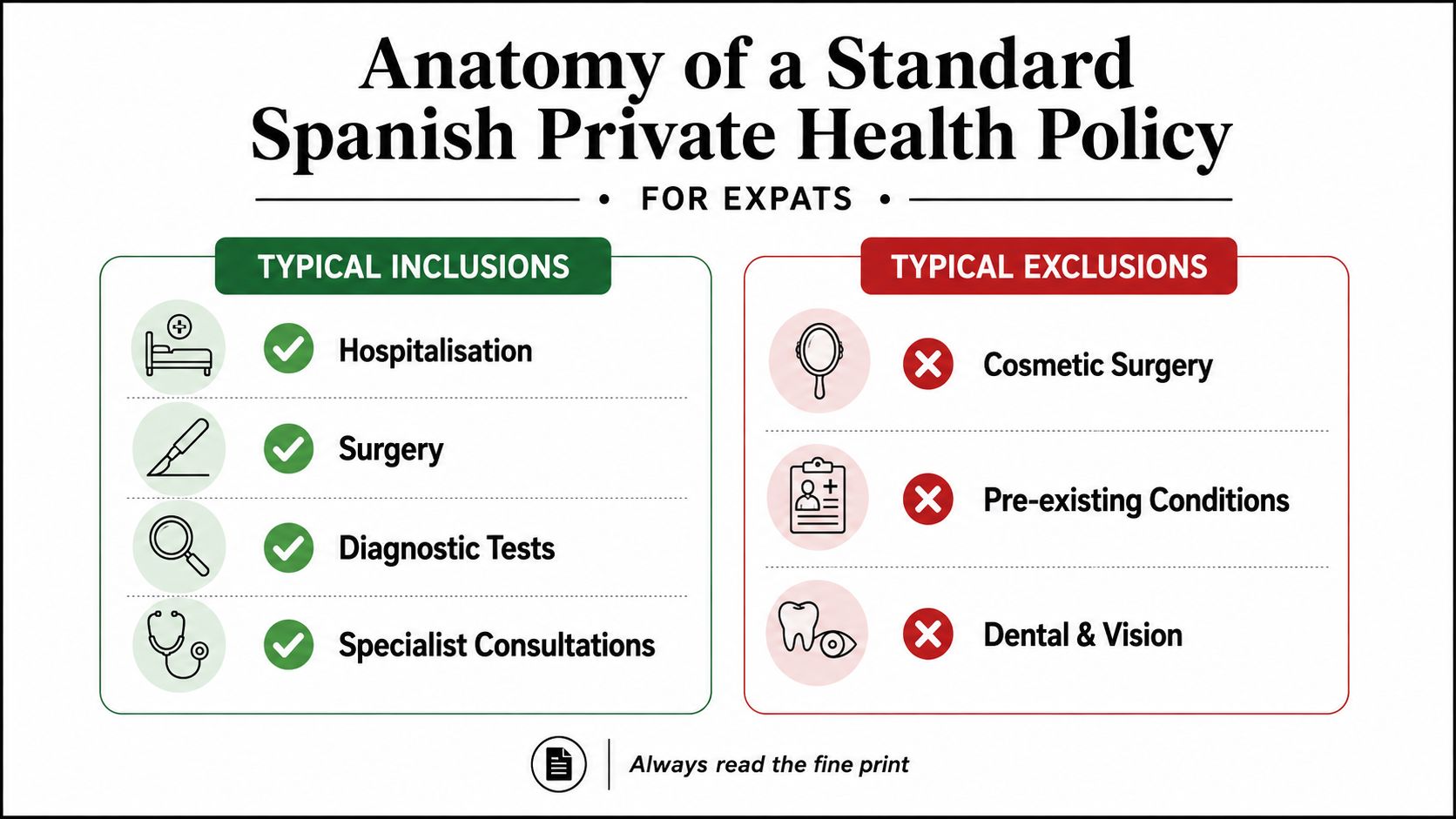
Most policies focus on hospitalisation, surgery, diagnostic tests, specialist consultations and emergency care. Mid-tier and higher plans may add maternity, paediatric care and ambulance services. The exact wording determines whether treatment needs prior authorisation, whether a referral is required and which hospitals are available.
Common extras include:
- Dental services: Basic examinations or cleaning may be included, while advanced treatment is discounted rather than fully insured.
- Physiotherapy: Sessions may be limited, authorised or restricted to listed providers.
- Psychology: Policies can include a defined number of consultations, not unlimited treatment.
- Preventive care: Health checks may appear as an additional benefit with eligibility conditions.
- Travel assistance: This can help abroad, but it isn't automatically worldwide medical insurance.
- Second opinions: Some insurers arrange specialist reviews for serious diagnoses or complex treatment decisions.
The exclusions that change the value
Pre-existing conditions are the most important area. An insurer may exclude a condition, apply a loading, accept it after a moratorium or decline the application. Cosmetic surgery, experimental treatment and some forms of assisted reproduction are commonly restricted. Work-related injuries and professional sports injuries may fall under separate arrangements.
Out-of-network treatment is another frequent trap. A private doctor may be excellent, but that doesn't mean the insurer will pay for the appointment. Check the cuadro médico for the exact province, facility and specialty.
Carencias are waiting periods before certain benefits become available. The period may apply to maternity, hospitalisation, surgery or other planned treatment, even though the policy has already started. Copagos are charges you pay per visit or service. Excesses are deductibles that you pay before the insurer contributes under the relevant terms.
Some policies use no co-payments, others charge a fee per consultation and some combine a lower premium with more cost at use. A policy with “full cover” can still leave you paying for an excluded consultant, an unauthorised test or treatment during a carencia.
Before signing, use this guide to health insurance exclusions and ask for the contractual wording, not just a sales summary. If a benefit matters to you, get it confirmed in writing.
What Drives the Price of a Spanish Private Health Plan
Insurers don't price every applicant in the same way. They assess the expected cost of providing care and the risk that the policyholder will need expensive treatment. Your premium is therefore a result of several inputs, not just the insurer's brand.
Age and medical history come first
Age usually has the strongest effect. Insurers group applicants into age bands, and premiums generally rise as the expected use of healthcare rises. The sharpest changes often appear in later working life and older age, so waiting until retirement to arrange cover can create a difficult choice if underwriting then excludes important conditions.
Medical history matters separately. A disclosed condition may be accepted with a premium loading, accepted with an exclusion or referred for individual review. Concealing symptoms, diagnoses or previous investigations is poor advice. The insurer can investigate a claim and use non-disclosure as a reason to dispute cover.
Cover level and cost sharing
A basic plan offering consultations and specialist access costs less than hospital cover with surgery, advanced diagnostics, maternity and extras. A zero-copay policy normally costs more because the insurer carries more of the routine usage cost.
A higher-copay plan may reduce the monthly premium, but it makes your real annual cost less predictable. That can work for someone who rarely visits a doctor and has enough cash for frequent small charges. It's a poor fit for a family with children, recurring consultations or regular physiotherapy.
Location also matters. Insurers price networks and provider costs differently by region, and island locations can be more expensive than mainland areas. The same policy design may therefore produce different quotes for Madrid, Málaga, Mallorca or the Canary Islands.
| Price driver | Lower-end impact | Higher-end impact | Typical direction |
|---|---|---|---|
| Age | Younger applicant with fewer age-related risks | Older applicant entering a later age band | Premium rises |
| Medical history | No disclosed conditions requiring special terms | Loading, exclusions or individual underwriting | Premium may rise or benefits narrow |
| Hospital cover | Outpatient consultations and diagnostics only | Hospitalisation, surgery and advanced treatment | Premium rises |
| Co-payment | Higher payment each time you use care | No payment at the point of use | Monthly premium rises as copay falls |
| Region | Lower provider-cost area | Island or higher-cost network | Quote varies by location |
| Maternity | No maternity benefit | Maternity with applicable conditions | Premium and restrictions increase |
| Dental and travel | Optional or limited extras | Broader supplementary benefits | Premium rises |
| Family size | Individual cover | Several adults or children on one policy | Total premium rises |
No-claims discounts, renewal pricing, family loading and annual excesses can further change the bill. Never compare only the opening premium. Ask what happens at renewal, what co-payments can accumulate to, whether an excess applies per claim or per year, and whether the quoted price includes every family member.
Visa Rules Retirees and Pre-Existing Conditions
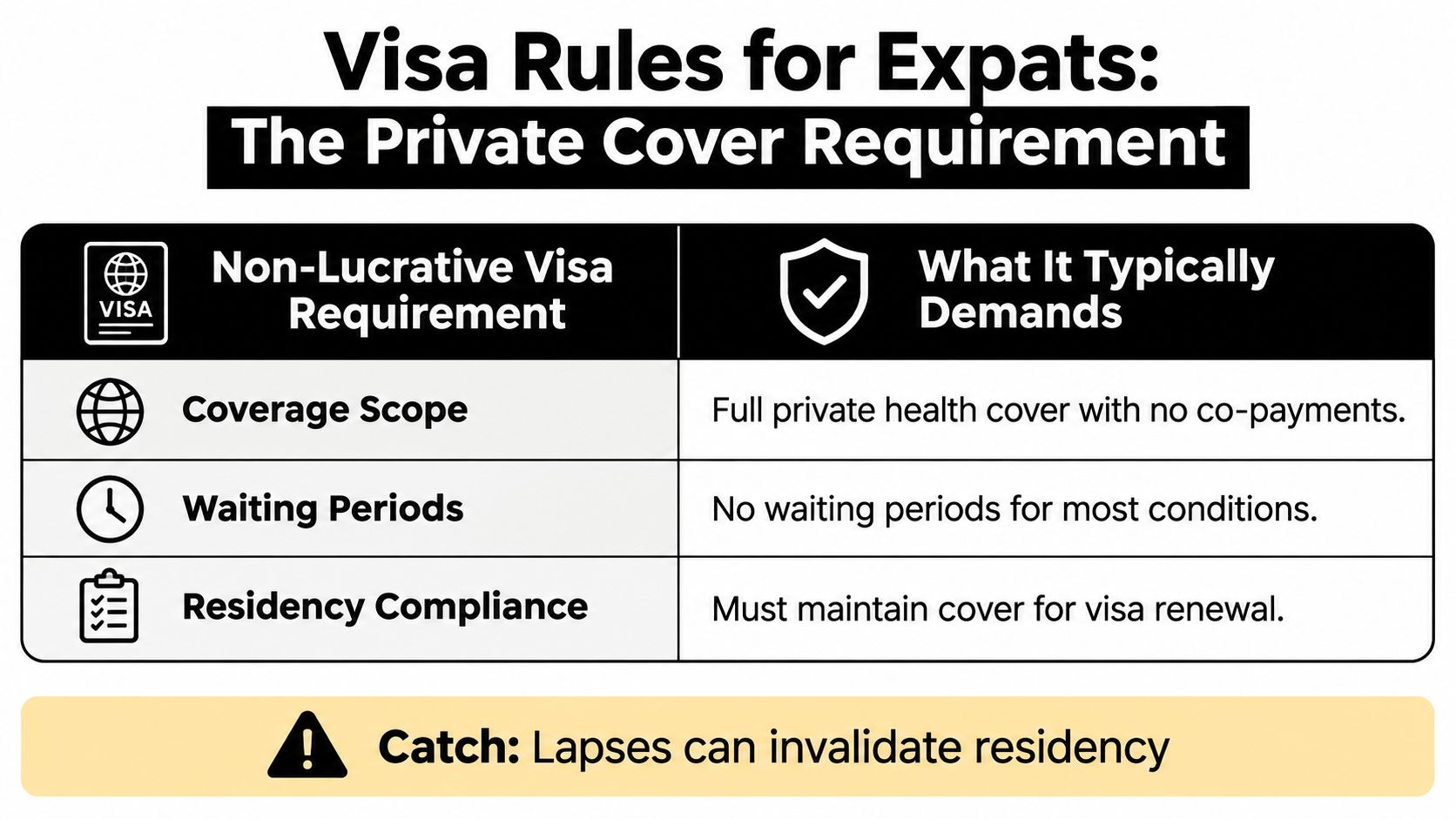
Visa compliance is where private health insurance stops being a lifestyle choice and becomes paperwork. For a Spanish non-lucrative visa, applicants generally need full private health cover with no co-payments and no waiting periods for most major services. The policy must remain active, and you'll normally need proof of cover when applying and renewing residency.
What catches applicants out
A policy that is perfectly suitable for an existing resident may fail a visa application. Common problems include a co-payment clause, waiting periods for hospital treatment, restricted cover that resembles travel insurance, an insurer that the consulate won't accept or a certificate that doesn't clearly state the required terms.
The digital nomad visa, student routes and EU citizen residency arrangements can involve different evidence and healthcare expectations. Don't assume a policy bought for one immigration route will satisfy another. Ask the insurer or a specialist broker for a certificate written for your exact visa category.
Keep the policy active through the renewal process. A lapse can create a documentation problem and may undermine the continuity you need to demonstrate to immigration authorities.
Retirees need underwriting discipline
Applicants over 65 can still find cover, but the market narrows. Each insurer sets its own maximum entry age, medical questionnaire and acceptance rules. Some plans impose age-related pricing, while others won't accept a new applicant above their stated limit.
Pre-existing conditions include more than a named diagnosis. Previous surgery, recurring symptoms, ongoing medication, investigations, abnormal test results and specialist treatment can all be relevant. The insurer may use full medical underwriting, where it assesses your history before offering terms, or a moratorium approach, where certain previous conditions remain excluded until the required period passes without symptoms or treatment.
Loading and exclusion are different trade-offs. A loading makes the policy more expensive but may preserve access to the relevant treatment. An exclusion lowers the cost or makes acceptance possible, but leaves you responsible for that condition. Waiting periods can still apply after acceptance, so obtain the schedule and medical terms before paying.
Complex cases require specialist placement rather than repeated online applications. A broker with access to insurers that consider older applicants and serious pre-existing conditions can tell you quickly whether the available choices are standard cover, restricted cover, an international plan or a public-system solution.
How to Choose the Right Plan and the Right Broker
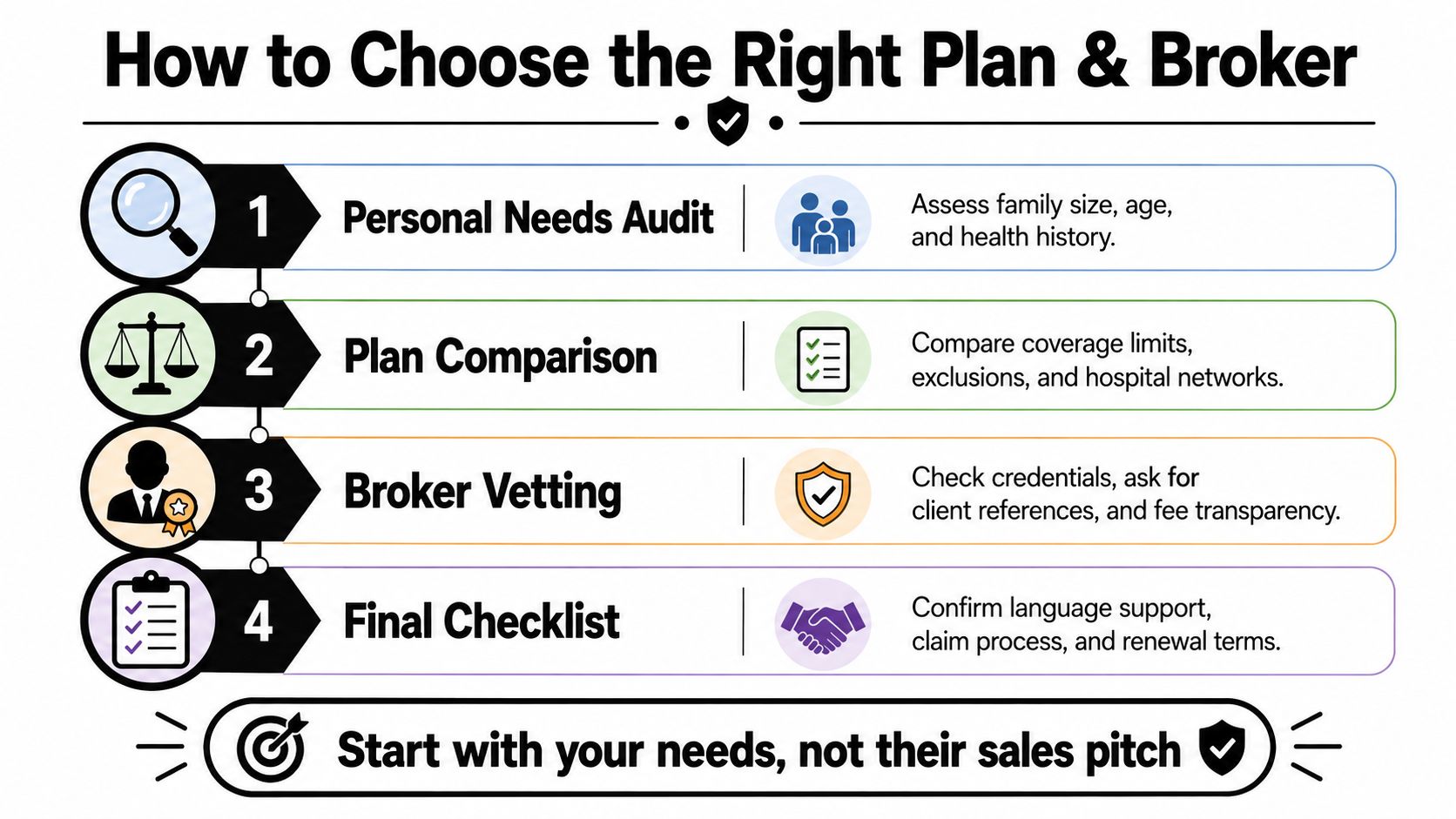
Start with your own requirements, not an insurer's logo. Write down your ages, family members, province, expected medical use, budget, visa route, existing medication and any benefit you won't compromise on. Maternity, paediatric access, cancer-related care, mental health, dental treatment and international travel can all change the shortlist.
A practical comparison process
Check the network locally. Open the cuadro médico and look for the hospitals, paediatricians, diagnostic centres and specialists you would use in your province. A large national network is irrelevant if the nearest suitable hospital is inconvenient or excluded.
Read the cost-sharing terms. Record every co-payment by service, the annual excess, any cap and the charges for diagnostics, emergency care and specialist appointments. Compare the likely yearly use, not just the monthly figure.
Mark the waiting periods. Identify carencias for hospitalisation, surgery, maternity, advanced tests and other planned care. Ask whether the insurer will waive them when you switch from existing cover and what proof of continuity it requires.
Resolve medical history before application. List diagnoses, medication, tests, operations and recurring symptoms accurately. Ask whether each condition is accepted, excluded, loaded or placed under moratorium terms.
Test the claims route. Find out who authorises treatment, how referrals work, whether the insurer has an English-speaking service team and what happens outside normal office hours.
A cheap policy with the wrong hospital is not cheap. It's a policy you'll resent when you need it.
A broker should explain these points without steering you toward a single insurer by default. Check whether the broker is regulated, how broad the insurer panel is, whether fees are disclosed and who handles renewals, amendments and claims support. Ask whether the broker is independent or tied to one insurer, and request the recommendation in writing.
The most useful action you can take this week is to gather your medical history and request like-for-like comparisons. Don't submit several incomplete applications online. Multiple declarations can create confusion, and a rushed answer about a previous diagnosis can cause problems later.
Common Questions and Smart Next Steps
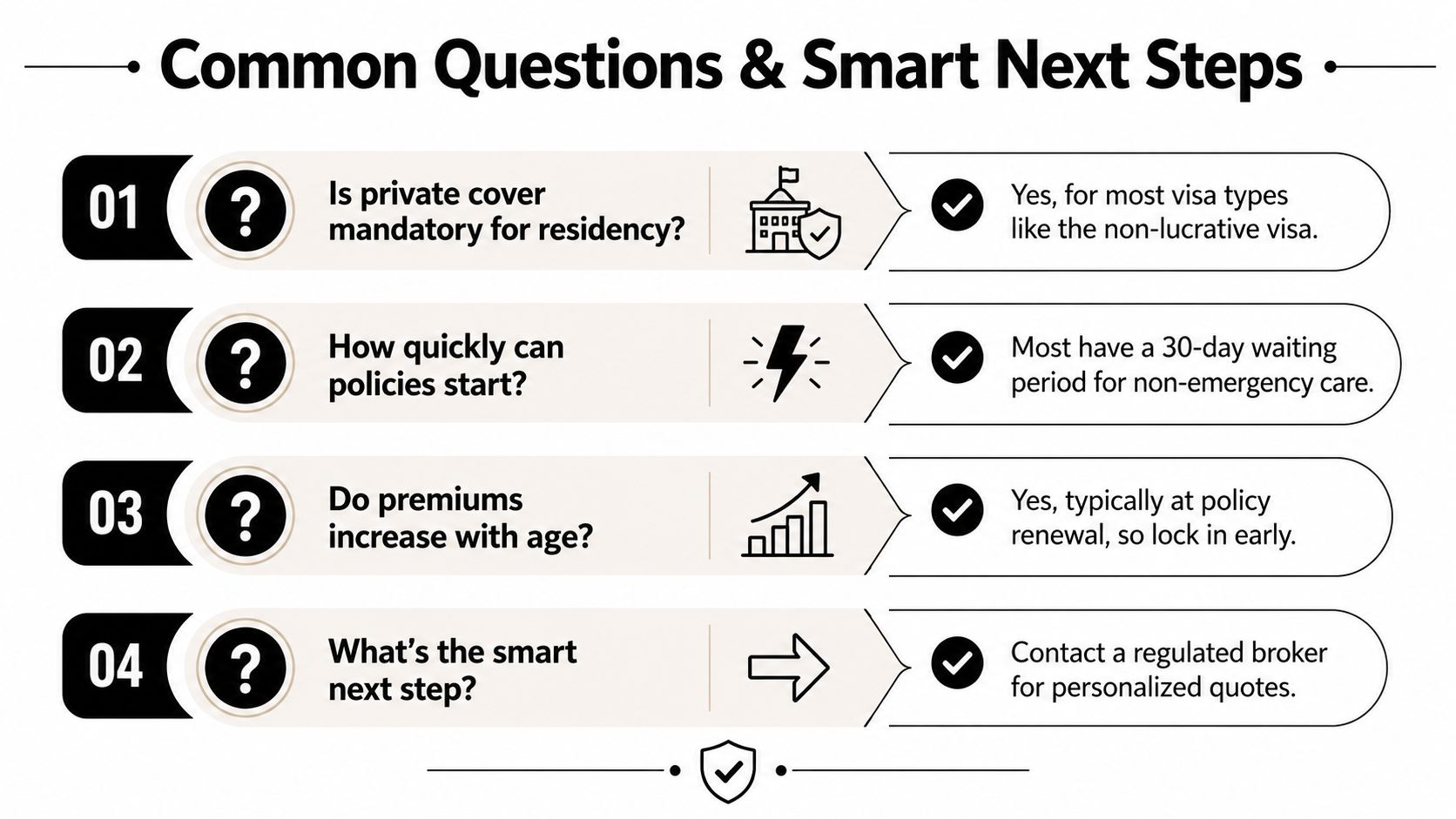
Is private cover mandatory for residency? It depends on your route. The non-lucrative visa commonly requires full private cover with no co-payments and no waiting periods for most major services. Other routes can have different requirements, so match the policy certificate to the visa or residency category rather than relying on a generic health card.
How quickly can a policy start? The start date and usable benefits are not always the same thing. Emergency care may be available under the policy terms from inception, while planned treatment can be subject to carencias. Ask for the exact effective date, waiting periods and authorisation rules before you cancel existing cover.
Can premiums rise with age or claims? Age is a major pricing factor, and renewal terms can change. A policy that looks affordable at entry may become less comfortable later, particularly if you're older or have developed a condition that makes switching difficult. Read the renewal clause and ask how the insurer handles future pricing.
What happens with repatriation? Ordinary Spanish private health insurance isn't automatically a repatriation policy. Travel assistance may include limited help abroad, but repatriation, evacuation and returning remains depend on the wording. If you travel frequently, request the assistance schedule separately.
Can you switch without losing cover? Sometimes, but don't cancel first. The new insurer may apply fresh underwriting, exclusions or waiting periods. Ask whether continuity terms are available, obtain written acceptance and keep the old policy active until the replacement is confirmed.
Your next steps are practical:
- Gather documents: Prepare passports, NIE details, residency paperwork and current policy documents.
- Write the medical list: Include medication, diagnoses, previous operations, investigations and ongoing symptoms.
- Set a realistic budget: Allow for premiums, co-payments, excesses and benefits you may use.
- Shortlist brokers: Choose firms with established Spain experience and access to more than one suitable insurer.
- Request comparable quotes: Ask each broker to quote the same cover level, hospital access, co-payment basis and visa requirements.
- Book a review call: Don't sign until someone has explained exclusions, waiting periods, renewal terms and claims procedures.
Private health insurance is worthwhile when it solves a specific access, language, visa or convenience problem. It isn't worthwhile when you buy a vague promise called “full cover” without checking what the policy excludes.
Bsure Health Brokers compares private health insurance for expats, families, retirees and applicants with medical history, then helps with paperwork, renewals and ongoing policy support. Visit Bsure Health Brokers to request a recommendation based on your visa route, location, family circumstances and health needs.