
You've found a Spanish insurer willing to quote, but the consulate may still reject the policy. Or you're a retiree with a clean medical history, yet the application stalls because your residency documents aren't aligned with the policy start date. That's the reality behind health insurance eligibility criteria in Spain. Age and health matter, but they're only part of the decision.
A policy qualifies you only when your residency position, visa category, underwriting profile, and contract wording all fit together. I've seen applicants focus on price, then discover that copayments, waiting periods, an exclusion, or an insurer's authorization status makes the document unusable. The right approach is to identify the weak gate before you submit anything.
Table of Contents
- What Determines Whether You Qualify for Health Insurance in Spain
- Public Versus Private Eligibility Two Separate Gateways
- Residency NIE and Visa Requirements for Applicants
- Age Limits and Underwriting for Retirees
- Pre-Existing Conditions and How Insurers Decide
- Waiting Periods Copayments and Geographic Exclusions
- Required Documentation and Common Pitfalls
- Getting Accepted or Finding a Real Alternative
What Determines Whether You Qualify for Health Insurance in Spain
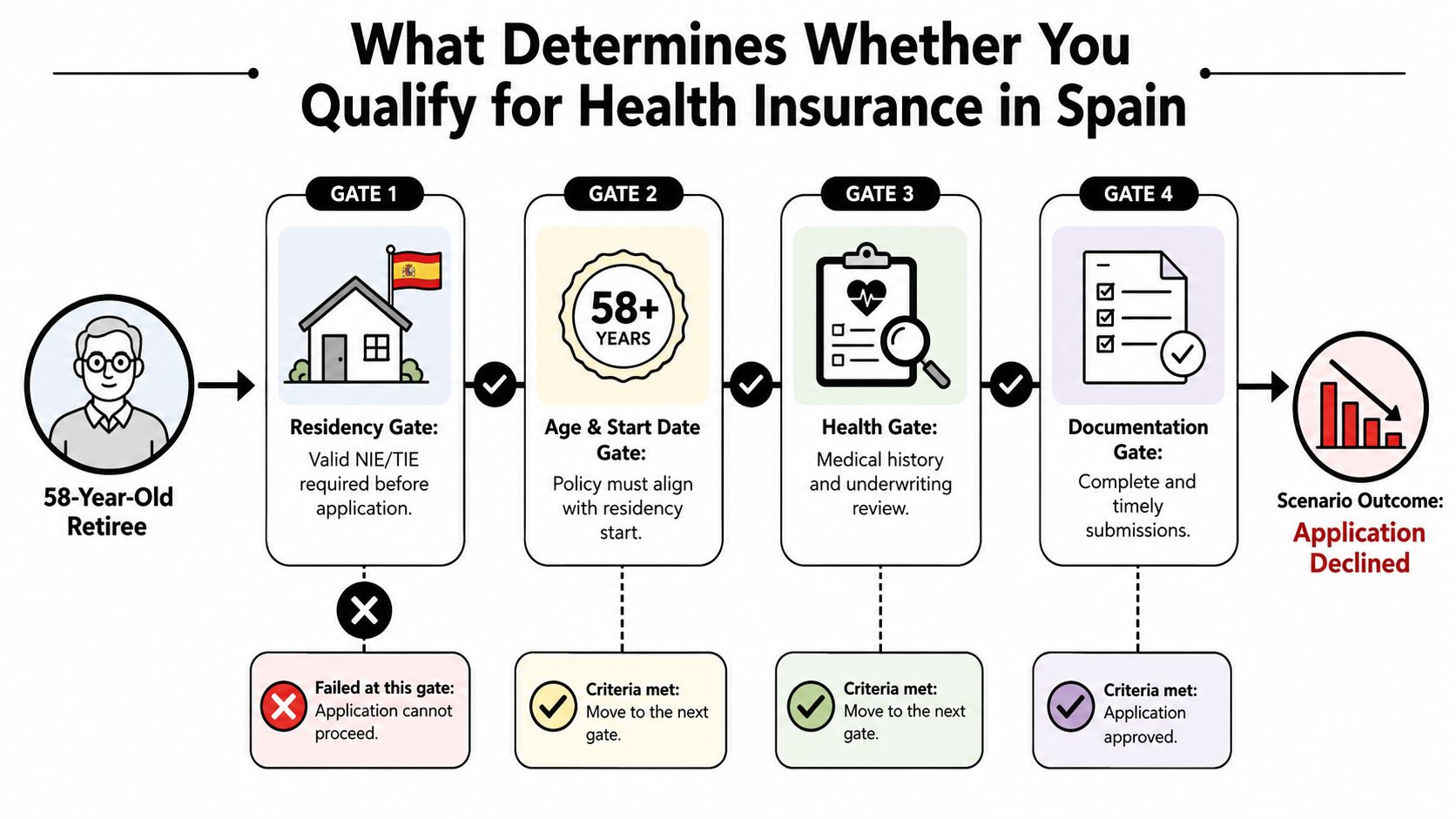
A 58-year-old British retiree in Jaén can have no significant medical history and still receive a decline if she applies before her NIE is issued. That outcome feels irrational until you understand the order insurers follow. They don't assess health in isolation. They first establish whether the applicant has a valid residency or visa pathway, then whether the requested policy fits that pathway.
Spanish applications usually turn on four qualification gates:
Residency gate: Your immigration position must support the application. For many non-EU applicants, private insurance is part of the evidence required for a long-stay visa or residence permit, and the insurer must be authorized to operate in Spain. Spain's residency insurance requirements explain why authorities assess legal validity and access from the beginning, not merely whether you bought a policy.
Visa category gate: A non-lucrative visa, family reunification application, student residence application, or another route can impose specific requirements. A normal retail plan may be medically useful but still fail the immigration test.
Age and underwriting gate: Insurers decide whether they can accept you, on what terms, and at what price. Your age can affect the medical questionnaire, renewal conditions, and whether the carrier directs you toward a specialist product.
Policy design gate: Copayments, waiting periods, geographic restrictions, exclusions, and the insurer's authorization status can invalidate an otherwise attractive policy. For visa purposes, cover generally needs to be valid throughout Spain, without copayments or waiting periods, and renewable for at least 12 months. Visa-compliant policy wording matters as much as the benefit list.
Practical rule: Don't ask an insurer only, “Can I buy this plan?” Ask, “Will this exact policy satisfy my visa or residence route, given my age and medical history?”
Failing one gate can make the other three irrelevant. A perfect medical profile won't repair an invalid immigration document, and a valid NIE won't force an insurer to accept a disclosed condition. Start by identifying your weakest gate, then apply through the route designed for it.
Public Versus Private Eligibility Two Separate Gateways
Public and private health insurance use different keys. Public access is usually connected to residence, employment, registration with Seguridad Social, dependency status, or an S1 or pension entitlement, rather than nationality by itself. In Spain, working and paying social security, qualifying as a dependent, or holding an S1 can connect a person to publicly funded healthcare. Some applicants may also explore the convenio especial route where they meet its requirements.
Private insurers operate separately. They assess the application through their own underwriting rules, accept or decline the risk, and issue a contract with defined limits. Your lack of access to Seguridad Social doesn't automatically prevent private cover, while legal residence doesn't automatically give you access to the public system. The broader residence-linked pattern is also reflected in this explanation of healthcare eligibility in Spain and internationally.
| Criterion | Public (SNS / Seguridad Social) | Private (Sanitas, Adeslas, DKV, etc.) |
|---|---|---|
| Main gateway | Residence, work, social-security status, dependency, or qualifying entitlement | Insurer acceptance and policy terms |
| Immigration function | May follow eligibility, but isn't always available before registration | Can provide evidence for qualifying visa and residence applications |
| Medical underwriting | Not generally based on private insurer risk selection | Medical history can lead to acceptance, exclusion, loading, deferral, or refusal |
| Cost structure | Publicly funded for people who qualify, with access governed by the system | Premium depends on age, plan, underwriting, and selected benefits |
| Speed and choice | Broad system access once entitled, but registration and appointments follow public processes | Often offers direct access to private networks, subject to the contract |
| Geographic rule | Operates within Spain's public system | Must meet nationwide validity requirements for many visa applications |
For a person already working in Spain and properly registered, public eligibility may be the logical first gateway. If you're applying for a non-lucrative visa and need proof before arrival, private insurance is usually the practical gateway because the policy can form part of the application file.
People often confuse “legal in Spain” with “covered by the SNS.” They're not the same. Read the guide to Social Security in Spain as a separate eligibility question, then assess private insurance on its own merits.
Residency NIE and Visa Requirements for Applicants
Your NIE is approved, but the visa file still fails because the policy certificate does not meet the consulate's wording. That situation is common. The NIE identifies a foreign national for administrative and fiscal matters. The TIE is the physical identity card proving residence status. You can hold an NIE before receiving a residence card, and that gap affects how an insurer records your status, risk, and policy start date.
Start with the immigration route
Identify the exact visa or residence category before requesting quotations. A generic “expat policy” may be valid for treatment but unsuitable for immigration. For many non-EU long-stay applicants, the policy must be full, authorized in Spain, valid nationwide, free of copayments and waiting periods, and renewable for at least 12 months. Spain-focused visa guidance also raises the issue applicants often overlook: whether someone with existing conditions can obtain cover that the authorities will accept.
The consulate or immigration office can compare the policy schedule with your application. Your name must match your passport, the insured period must cover the intended stay, and the certificate must state the territory and relevant restrictions clearly. A marketing page cannot replace compliant policy documents.
Match the policy to the visa
Non-lucrative applicants usually face the strictest documentation because they must show private medical access instead of relying on employment-based public coverage. Digital nomad and family reunification applicants should check the precise documents required for their routes. Students need to confirm whether age, study duration, and residence status change the insurance format.
Use this checklist:
- Confirm the visa category before requesting quotes.
- Ask the insurer to confirm authorization to operate in Spain.
- Obtain written confirmation of no copayments and no waiting periods where required.
- Set the policy start date against the immigration timeline.
- Submit the certificate, policy conditions, and payment evidence together when requested.
An NIE alone may not show the residence pathway or establish the correct start date. Tell the broker exactly which application you are filing, and reject a standard resident policy if you need a visa-compliant certificate. A cheaper policy saves nothing if the consulate cannot verify its territory, restrictions, or coverage.
Age Limits and Underwriting for Retirees
Age changes the insurance conversation more than most online forms admit. A younger applicant may receive a straightforward quote, while an older applicant can face a longer questionnaire, additional medical review, different products, or a refusal. The decisive issue isn't just whether you're retired. It's how the insurer places your age and health profile within its underwriting model.
Spanish private insurers commonly separate applicants into broad bands:
- Standard applicants: Routine acceptance and pricing are more common, assuming the medical declaration is clean.
- Mature applicants: The carrier may ask more detailed health questions and apply age-related pricing adjustments.
- Senior applicants: A dedicated product may be more appropriate, but networks, reimbursements, and exclusions need careful review.
The exact thresholds and terms vary by insurer, so don't treat an internet age band as a legal rule. Some products from Adeslas Seniors, DKV Residencial, and Sanitas Más Vital are designed for older applicants, while Asisa can provide specific quotations for people over 65 on certain plans. Acceptance still depends on the application and the contract.
| Age Band | Typical Surcharge | Acceptance Probability | Available Products |
|---|---|---|---|
| Younger or standard applicant | May be routine, subject to underwriting | Often straightforward when medical history is uncomplicated | Standard comprehensive plans |
| Mature applicant | May involve an age-related loading | Depends more heavily on medical declaration | Standard plans or mature-age products |
| Senior applicant | Pricing and terms require individual assessment | Carrier and medical history become decisive | Senior plans and selected tailored products |
The surcharge figures sometimes quoted online, including 25% to 80%, aren't universal rules. Treat them as possible underwriting outcomes, not promises. A carrier may instead impose an exclusion, request further evidence, or decline the application.
Timing matters: Applying before retirement can preserve continuity, but it doesn't guarantee future pricing or acceptance. Ask the insurer how renewal and re-underwriting work before relying on that strategy.
Technology also changes how insurers process applications. Matil's overview of automated underwriting systems is useful background for understanding why questionnaires can trigger structured decisions rather than a personal judgment from one underwriter.
If you're approaching retirement, compare terms before leaving employment. The guide to health insurance for retirees over 65 can help you frame the questions, but the final decision must come from the insurer's written offer.
Pre-Existing Conditions and How Insurers Decide
A pre-existing condition is generally a condition present before the policy begins. The insurer may exclude it, delay cover through a moratorium, apply a loading, request more medical evidence, or decline the application. That decision protects the insurer from taking on a known claim risk, but it can materially narrow access for applicants with chronic conditions or serious medical histories. Bupa's explanation of pre-existing conditions sets out why disclosure and policy terms must be assessed together.
Consider two very different applications.
Margaret, aged 62, declared hypothyroidism and mild hypertension. Adeslas accepted her application with a 12-month exclusion for thyroid-related claims and a 10% loading. After the moratorium, the thyroid-related cover became available under the policy terms.
Robert, aged 58, concealed a previous cardiac event. When he later claimed for angioplasty, the insurer rescinded the policy for material non-disclosure, leaving him liable for €28,000. That outcome is precisely why a clean-looking application isn't necessarily a strong application. A hidden fact can destroy cover when you need it most.
| Case Profile | Declared Conditions | Insurer Action | Claim Outcome |
|---|---|---|---|
| Margaret, aged 62 | Hypothyroidism and mild hypertension | Acceptance, 12-month thyroid exclusion, 10% loading | Thyroid-related cover followed the moratorium terms |
| Robert, aged 58 | Previous cardiac event not declared | Policy rescinded for material non-disclosure | Angioplasty claim left him liable for €28,000 |
The lesson is unsentimental: disclosure is cheaper than concealment. Insurers may request a medical questionnaire or a recent doctor's report, and the application should match your records. If you're unsure whether an old diagnosis matters, disclose it and ask how the insurer will treat it.
For a clearer explanation of the decision process, review health insurance underwriting before signing. Don't compare only premiums. Compare exclusions, moratoria, renewal language, hospital access, and whether the policy can satisfy your immigration route.
Waiting Periods Copayments and Geographic Exclusions
Three contract terms decide whether a policy works for your situation: carencias, copayments, and territorial limits. They affect both the price and whether an immigration authority will accept the certificate.
A carencia is a waiting period before specified treatment becomes covered. A copayment is the amount you pay when using a service. A geographic exclusion restricts where you can receive covered care. Those terms may suit an ordinary resident plan, but they can undermine an application that requires access from the start.
Read the certificate, not the advertisement
A policy may advertise hospital and outpatient care while applying a waiting period to surgery or a copayment to consultations. That can be acceptable for routine private healthcare and still fail an immigration requirement. Spain-focused visa rules commonly require full cover, validity throughout Spain, and no copayments or waiting periods for the required period. This broker explanation of visa and residency insurance explains why exclusions and certificate wording deserve the same scrutiny as the listed benefits.
| Visa Type | Copayments Allowed? | Waiting Periods Allowed? | Geographic Scope Required |
|---|---|---|---|
| Non-lucrative visa | Usually no, where full visa cover is required | Usually no | Nationwide Spain |
| Digital nomad visa | Check the route-specific requirement, though visa-compliant cover commonly excludes them | Check the route-specific requirement, though visa-compliant cover commonly excludes them | Nationwide Spain where required |
| Student residence | Depends on the application and duration | Depends on the application and duration | Must match the authority's stated requirement |
| Family reunification | Check the residence documentation | Check the residence documentation | Must match the required residence territory |
| Ordinary resident private plan | May be available | May be available | Spain, selected regions, or wider territory according to contract |
Schengen or worldwide cover does not automatically satisfy a Spanish residence requirement. A geographically broad policy can still include copayments or waiting periods that fail the immigration test. A Spain-only plan may fit the visa and cost less than international cover, provided the certificate states the required terms clearly.
Ask for the full policy conditions before paying. Confirm in writing that the certificate has no relevant restrictions. If the insurer will not provide that confirmation, choose another plan.
Required Documentation and Common Pitfalls
Most applications don't fail because the applicant lacks a passport. They fail because the documents don't line up. A missing signature, an outdated medical report, a name mismatch, or an application submitted before the NIE is physically issued can stop an otherwise viable file.
Build the file around verification
Expect more than a quote. Depending on your route and insurer, you may need:
- Identity documents: Passport, NIE, TIE if available, and matching personal details.
- Health declaration: A completed and signed medical questionnaire or Declaración de Salud.
- Medical evidence: A recent GP or specialist report when the insurer requests one.
- Immigration evidence: Visa paperwork, residence application details, or proof of the intended stay.
- Financial evidence: Proof of means for applicants whose visa route requires it.
- Payment details: IBAN and any additional contact information required for issuance.
- Translation support: Clinical histories and official documents translated when the receiving authority requires it.
A negative padrón check for previous coverage gaps may be requested in some application processes, but don't present it as a universal rule. The consulate and insurer each have separate documentary interests. The consulate checks whether the policy supports the immigration application. The insurer checks whether it can identify, price, and underwrite the risk.
| Document | Standard Expat | Non-Lucrative Visa | Retiree with No Working History |
|---|---|---|---|
| Passport | Required | Required | Required |
| NIE or residence evidence | Usually required | Required for the application context | Required where available |
| TIE | If already resident | If already issued | If already issued |
| Health questionnaire | Often required | Required where requested | Particularly important for underwriting |
| Medical report | If requested | If requested by the insurer or authority | More likely to be requested |
| Proof of means | Not always required by the insurer | Required for the visa route | May be relevant to the immigration file |
| IBAN and contact details | Often needed for issuance | Often needed for issuance | Often needed for issuance |
Treat every answer as if a claims adjuster will read it later. Don't guess dates, omit a diagnosis because it seems minor, or rely on an English nickname when your passport uses another name. If a condition is unclear, ask the broker or insurer to record the clarification before the application is submitted.
Getting Accepted or Finding a Real Alternative
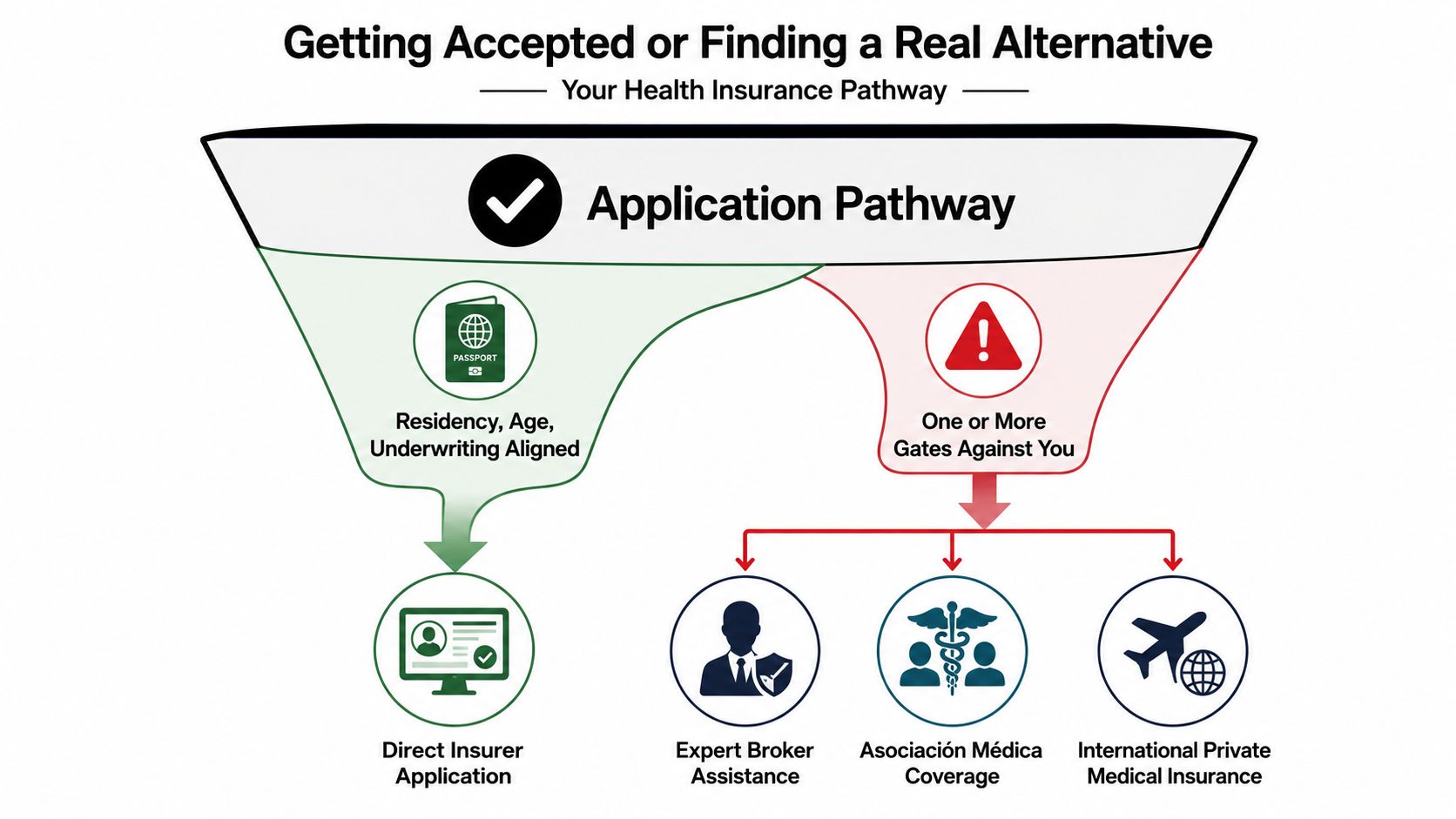
The cleanest route is simple. If your residency status, age, medical history, and policy requirements align, you can often apply directly through an insurer portal. The process becomes more technical when one gate is weak, particularly with a disclosed condition, a coverage gap, an older applicant, or a visa requiring strict wording.
Choose the route that matches the problem
Use a direct application when:
- Your visa or residence category is clear.
- The insurer accepts your age band.
- Your medical declaration is uncomplicated.
- You understand the copayment, waiting-period, exclusion, and renewal terms.
- The certificate wording has been confirmed as suitable.
Use a broker when the application needs judgment rather than data entry. A broker can package the health declaration, approach insurers whose underwriting fits the profile, compare exclusions, and explain whether a decline from one carrier is a market-wide problem or just a mismatch with that carrier. Spanish brokers such as Internaco, Vitally, and Assurance Patrimoniale are examples of firms applicants may investigate for this type of assistance.
If private acceptance isn't available, consider the alternatives carefully:
- Convenio especial: Potentially relevant to people who qualify for public coverage through that route, subject to the applicable requirements.
- Travel-medical cover: More suitable for temporary stays than long-term residence and may not meet a residence application's full conditions.
- International private medical insurance: Can offer broader territory and different underwriting, but the authority must accept the exact documentation and the cost may be higher.
- Medical association or specialist arrangements: These may help in limited circumstances, but they aren't interchangeable with a Spanish visa-compliant policy.
Broker test: If someone offers a policy before asking about your visa category, age, residency documents, and medical history, they're selling first and checking eligibility later.
Before submitting, confirm four points in writing: the insurer is authorized in Spain, the policy satisfies the immigration route, your declared conditions are treated exactly as stated, and the start date matches your application. A broker is most valuable when one of those answers isn't obvious.
Bsure Health Brokers compares Spanish and international options, checks visa suitability, and helps applicants address age and pre-existing-condition questions before committing. Visit them with your visa category and medical details ready, so they can assess the policy wording and guide the application from documentation through renewal.