
Which comes first, the insurer's decision about your diabetes or the waiting period every guide warns you about?
Guides often lead with carencia, the Spanish waiting period, as if the clock is the only thing standing between you and treatment. Underwriting comes first. An insurer looks at a declared condition, diabetes included, and decides whether to cover it, load the premium, or leave it out, before any waiting period starts. Serving that wait does not turn an excluded illness into a covered one.
A salesperson can sound reassuring on the phone. The underwriter's letter is the document that binds the policy. People lose money when they pay, sit out the wait, and only then read that the condition was written out from day one. Get that decision on paper before you pay, and check it against the illness you declared.
Table of Contents
- What Counts as a Pre-Existing Condition in Spain
- Full Underwriting and Moratorium Explained
- Five Ways Insurers Respond to a Declared Condition
- Why Waiting Periods Do Not Erase a Pre-Existing Condition
- Case Examples for Diabetes, Past Cancer and Multiple Medications
- Where Public Healthcare Fits When Private Cover Is Limited
- Get and Check the Written Decision
What Counts as a Pre-Existing Condition in Spain
A pre-existing condition is an illness, injury, symptom or diagnosis that existed before you applied for or enrolled in a health policy. The U.S. Department of Labor's HIPAA fact sheet records that definition alongside the rule it once carried: a condition counted if medical advice, diagnosis, care or treatment had been recommended or received in the six months before enrollment. The length of that window is set by the form you're asked to complete, not by the illness itself.
Read your medical file the way a landlord reads a rental history. A landlord isn't judging your character. They're asking what already happened, because past events predict the next twelve months. An underwriter does the same with your records, and the past stays visible even in a year when you feel perfectly well.
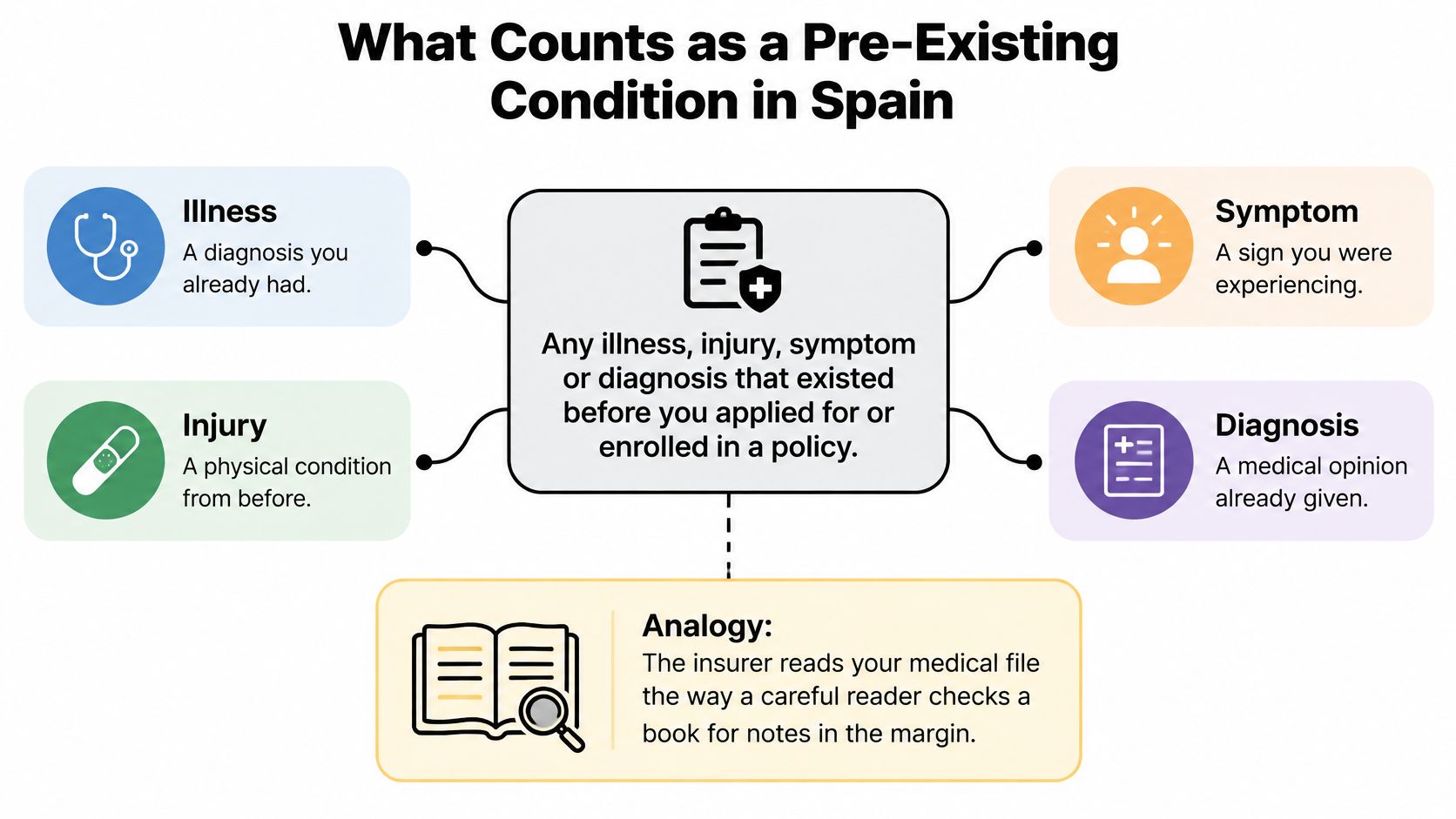
Almost everything on an application falls into four groups.
- A diagnosis you already have. Type 2 diabetes, high blood pressure, heart disease, asthma, a cancer treated years ago. Controlled conditions still count.
- An injury or a procedure. A knee reconstruction, a hospital stay, a gallbladder removed in another country.
- Regular medication. Anything you take daily or seasonally, including inhalers, statins and antidepressants.
- A symptom you noticed but never had investigated. A persistent cough, numbness in one foot, chest tightness on the stairs. An undiagnosed symptom is still part of your history.
A condition diagnosed in your home country counts exactly as one diagnosed in Madrid, and Spanish insurers routinely request those records. Omitting an entry isn't a small paperwork slip. It gives the insurer grounds to refuse a claim, or cancel the policy, years later, when the records it requests show the earlier consultation.
This isn't a niche problem. The Centers for Medicare & Medicaid Services cites a U.S. Department of Health and Human Services estimate that between 50 million and 129 million non-elderly Americans, roughly one in two people under 65, had a condition that could have threatened access to affordable individual-market coverage before the ACA's protections. The people arriving in Spain with files like that are not the exception.
Spend twenty minutes with a notepad before you speak to any insurer. List every diagnosis, every prescription, every operation and every symptom you can remember from the past several years, with approximate dates. Then test each line against the definition above, because anything that existed before your application date belongs on the form whether or not it still affects you.
Full Underwriting and Moratorium Explained
Ask what pre-existing condition insurance is in Spain and the honest answer is that it isn't a single product. It's whatever an insurer decides to do with your medical history, and how it decides depends on the underwriting method it uses.
Full medical underwriting
You disclose everything relevant at application: diagnoses, symptoms, consultations, medication, tests and treatment. The insurer then makes a decision you can read before you pay. It may accept the risk at standard premium, add a premium loading, apply a condition-specific exclusion, or decline cover outright.
Moratorium underwriting
You may not be asked for a full history at the start, and it's easy to mistake that for leniency. Claims are assessed retrospectively instead, against prior symptoms, advice, medication and treatment, so a claim can be refused even though the policy looked straightforward when you bought it. The Association of British Insurers describes a representative framework that commonly reviews conditions affecting the applicant during the previous five years and may automatically exclude related treatment during approximately the first two years of cover. Exact periods and definitions vary by policy, so ask for yours in writing.
The difference shows up in timing. Say someone had a knee operation three years ago and discloses it under full underwriting. They learn the outcome before paying a euro, whether that's acceptance, a loading or a knee exclusion. The same person under a moratorium finds out at the point of a claim, when the insurer pulls the surgical records and links the new problem to the old operation.
| Approach | What You Disclose | When Claims Are Checked | Possible Outcomes |
|---|---|---|---|
| Full medical underwriting | Diagnoses, symptoms, consultations, medication, tests and treatment | At application, before the insurer decides | Accept, premium loading, exclusion or decline |
| Moratorium underwriting | No full medical history at the start | Retrospectively, against prior symptoms, advice, medication or treatment | Claim paid or refused after look-back review |
Full underwriting gives you certainty early. A moratorium keeps the price simpler and hides the risk until the moment you need the policy most. When an insurer uses full underwriting, that process ends in one of five decisions.
Five Ways Insurers Respond to a Declared Condition
A declared condition produces exactly one of five outcomes, and only the last of them ends the conversation.
| Outcome | What It Means | What It Covers | Next Step |
|---|---|---|---|
| Standard acceptance | Insurer accepts the condition at the normal premium | Treatment as set out in the policy terms | Confirm the terms in writing |
| Premium loading | Policy accepted with a higher premium | Usually full cover for the condition | Compare the extra cost with other insurers |
| Condition-specific exclusion | Policy accepted but the named condition is excluded | Unrelated care only | Ask which complications are also excluded |
| Moratorium | No full history taken at the start; claims checked against past symptoms | Cover for the condition if the look-back review finds no earlier record of it | Ask for the review period in writing |
| Declined | Insurer refuses the application | No cover from that insurer | Try other insurers and check public healthcare eligibility |
What the table can't show is the part that decides your outcome in practice. The same file can produce different answers at different companies, because each applies its own underwriting rules. A decline from one insurer is a verdict from one company, not from the Spanish market.
That is the sharpest difference between Spain and the United States. Under the Affordable Care Act, Marketplace plans must cover treatment for pre-existing conditions and cannot reject applicants, charge more solely because of health history, or refuse essential health benefits because a condition existed before enrollment, as the U.S. Department of Health and Human Services sets out. A Spanish private policy runs on selection instead, which is why a well-documented application matters more here than a hopeful one.
A premium loading deserves its own note. It's usually a percentage tied to how the condition is expected to behave, so weigh the extra annual cost against what the policy pays for. Standard terms that exclude the cardiology follow-up you'll use are rarely better value than loaded terms that include it.
Moratorium outcomes are the least predictable of the five, because they rest on a review of records that happens later. Get the review period confirmed in writing. None of these five outcomes tells you when treatment becomes payable, and that timing is governed by something else entirely.
Why Waiting Periods Do Not Erase a Pre-Existing Condition
Most applicants treat a waiting period as the gate. Serve it, and everything opens. That belief survives because so many guides list carencia periods without ever mentioning the underwriting decision that came before them.
A carencia generally delays access to a specified service, such as planned hospitalisation or major surgery. It does not make a known illness eligible for cover later. Pre-existing conditions are assessed during medical underwriting, where the insurer may accept the applicant, apply a premium loading, impose a permanent or condition-specific exclusion, or decline the application, as the Waypoint guide to private health insurance in Spain explains. This matters most for expats arriving with a cancer history, diabetes, cardiac disease or a previous operation, because paying premiums for six or twelve months may produce no cover at all for the underlying condition.
A waiting period answers one question only: when does this service become available? It never answers whether your condition is covered.
Here's how that plays out. A reader with type 2 diabetes takes out a policy in January. The carencia for planned surgery passes in July. In October, a diabetes-related foot problem needs an operation. If the policy carries a condition-specific exclusion for diabetes and its complications, the claim is refused, and the waiting period had nothing to do with it. The exclusion was the barrier from the first day.
Ask three questions before you pay, and note where each answer has to appear.
- What is excluded? The exclusion schedule inside the policy wording, not a summary read over the phone.
- What is delayed? The waiting-period table, which should name each service and its period. If you want to understand how insurers set and apply those periods, our guide to medical insurance waiting periods in Spain walks through the mechanics.
- What was decided at underwriting? The formal letter, which should state the outcome for each declared condition in plain language.
A salesperson's verbal assurance carries no weight against the written policy. If someone tells you the diabetes will be covered after two years, ask to see the clause that says so. And declare what you know, because policies require relevant medical history, and a known condition left out gives the insurer grounds to deny a claim or cancel the cover.
Case Examples for Diabetes, Past Cancer and Multiple Medications
The three profiles below are illustrative, not promises. They show how one process produces very different decisions depending on the file in front of the underwriter.
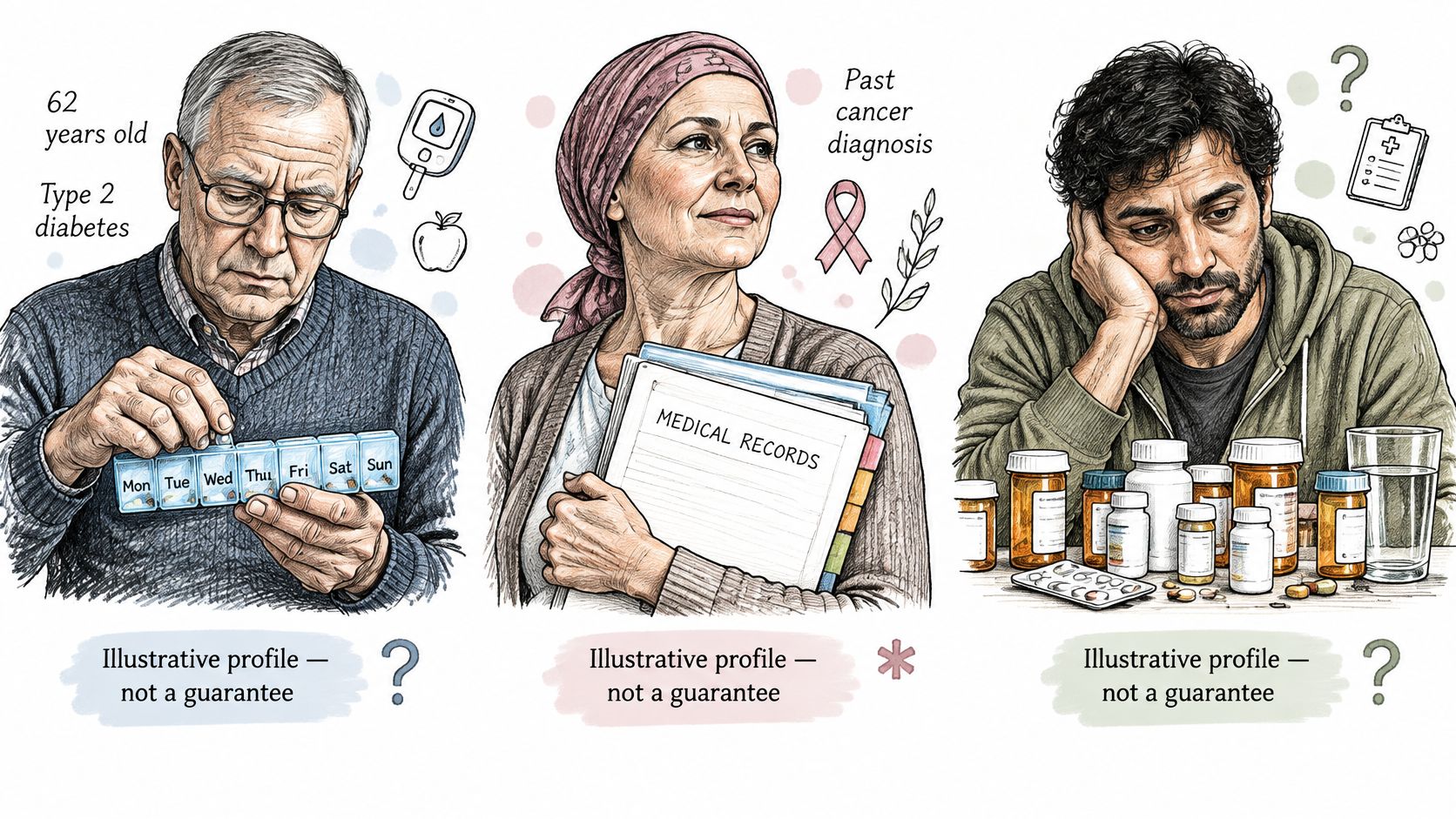
A 62-year-old with type 2 diabetes
Diagnosed eight years ago, controlled with metformin, no complications on record. Two outcomes are realistic: standard acceptance with a loading, or acceptance with an exclusion covering diabetes and its complications. The second is the one to interrogate, because complications have names. Retinopathy, neuropathy, kidney disease and amputation risk may all sit inside that wording. Some insurers will cover diabetes itself while excluding everything downstream of it.
Blood-sugar control shapes the long-term picture more than any policy clause, and this metabolic health guidance for weight loss patients explains the difference between insulin resistance and type 2 diabetes in plain terms. On the insurance side, our page on health insurance for diabetes in Spain covers the questions insurers ask most often.
Treated for cancer five years ago, now in remission
This is the profile where moratorium and exclusion produce very different experiences. Under a moratorium, earlier oncology treatment is reviewed against any later claim. Under a permanent exclusion, the wording usually covers the condition and its treatment, which can catch routine follow-up scans as well as a recurrence. Ask how the look-back period is defined and whether surveillance imaging is inside or outside the exclusion.
Three medications for blood pressure, cholesterol and a heart condition
Multiple declared conditions raise the chance of a loading or a decline, and age limits can close the door before any medical question is asked. Check each insurer's age rule first, because a week spent on a questionnaire is wasted if the company stops accepting new applicants at your age.
The pattern across all three is consistent. The more conditions and medications you disclose, the narrower the set of insurers willing to accept you, which is a reason to approach several at once rather than a reason to under-declare.
Bring the same file to every conversation.
- Diagnosis dates, month and year, for each condition.
- Medication names and doses, including anything you take occasionally.
- Surgery dates and the hospital, plus discharge summaries where you have them.
Where Public Healthcare Fits When Private Cover Is Limited
Private cover is one route to treatment in Spain, not the whole map. For a serious condition, access to the Spanish National Health System still depends on residence status, registration and contribution history. Confirm that position before you build a plan around a private policy alone.
Guides written for a general audience often treat a private policy as the only door to care. For residents who qualify, the public system can stay in place while private insurers price or restrict cover according to health status. The Guía Extranjeros guide to medical insurance for foreigners with pre-existing conditions puts the practical question directly: if private insurance excludes my condition, what happens in an emergency, during cancer follow-up, or when I need chronic-disease management?
Start with the policy's definition of an emergency. Stabilisation after an accident is usually treated differently from planned treatment of the excluded illness. The wording decides whether a complication of that illness counts as related care or as something separate. Ask it in those exact terms. That split is where disputes begin, and a salesperson's verbal assurance does not settle it. Only the written underwriting decision does.
Check first: residency status and registration decide your access to the public system, so settle that before you argue about exclusions with an insurer.
Ongoing needs work differently. Cancer follow-up and chronic-disease management may run through the public system if you are eligible, while the private policy handles treatment that is unrelated to the exclusion. A waiting period on the private policy does not rewrite that split. It only delays when a covered benefit starts. It does not turn an excluded condition into a covered one, and it does not replace a written decision that names the condition.
Visa and residency rules add another layer. A policy that looks adequate for routine outpatient use can fail an immigration authority's test if it carries significant exclusions, co-payments or waiting periods.
A four-part check before you choose
- Public-system eligibility. Confirm residence status, registration and contribution position first. Our guide to the Spanish health care system explains how entitlement is established.
- Written private terms. Get the underwriting decision and exclusion list on paper, condition by condition. Treat any verbal "you're covered" as provisional until that letter matches it.
- Emergency and ongoing treatment. Ask whether stabilisation, complications and follow-up are covered, and under which wording.
- Visa compliance. Match the policy to the requirement your residency application states, not to a general description of "international insurance".
Mental-health conditions follow the same logic. A declared history of anxiety or depression can be excluded like any other condition, and the practical question becomes who pays for sessions. The policy's wording determines whether sessions are covered, in-network or reimbursed, so read the exclusion schedule for mental-health treatment before you book. For a general picture of how networks and reimbursement are described, see in-network therapy at reVIBE Mental Health.
Older applicants, and anyone whose private options have narrowed, gain the most from working through this framework. The public system and a clearly underwritten private policy cover different parts of the same life: one for the care your status entitles you to, the other for whatever the written terms include.
Get and Check the Written Decision
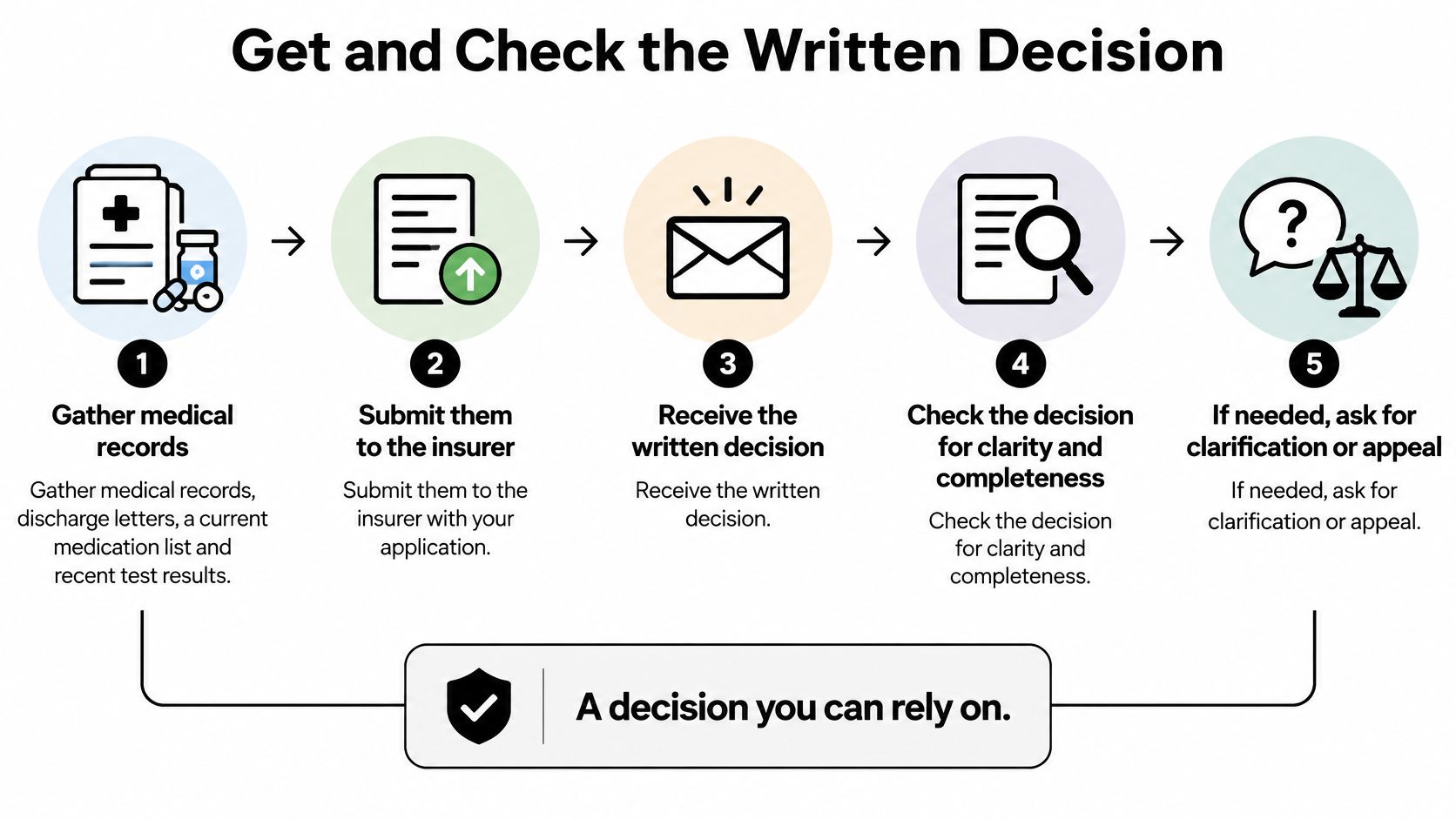
A verbal assurance is not an underwriting decision. To know what the insurer will cover, get its answer in writing and check the terms before you pay or use the policy for visa paperwork.
- Gather your medical file. Include medical records, discharge letters, a current medication list with doses, and recent test results. The insurer assesses the information you provide. Missing details can lead to assumptions or requests for more evidence.
- Complete the health questionnaire fully. Disclose mild or undiagnosed symptoms and every prescription. A short course of tablets or a physiotherapy referral may seem minor, but leaving it out can raise questions if the insurer later requests your records.
- Submit the application through the insurer or a broker. For a serious condition, the insurer may ask for a specialist report. It is better to wait for that report than to submit an incomplete application.
- Get the formal underwriting decision. Check that it says, condition by condition, whether each is accepted, subject to an additional premium, excluded, assessed under a moratorium, or declined.
- Read the exclusions and waiting periods separately. They answer different questions: an exclusion sets a limit on cover for a condition, while a waiting period sets when specified benefits begin. Check the emergency definition too, and read the full schedule and annex rather than relying on a summary table.
- Confirm the terms before paying or submitting visa paperwork. Make sure the written decision matches what you were told. A salesperson's verbal reassurance does not change the insurer's written terms.
A decision on a pre-existing condition and a waiting period are not interchangeable. Even if a waiting period ends, an exclusion may still apply. Written terms show which rule governs each condition and benefit. For questions about complementary treatment alongside oncology, what insurers pay for integrative oncology explains how those benefits are usually handled.
Keep the signed declaration, written underwriting decision, and exclusions list together in one dated file. If a claim is questioned later, those documents help show what you disclosed and what the insurer agreed to cover.
Bsure Health Brokers has worked in Spain's health insurance sector since 1989 and helps expats and internationals with complex cases, including pre-existing conditions and visa-compliant coverage. It compares options from trusted insurers and can provide a no-obligation quote.
If a previous application was declined or an exclusion is unclear, ask for the written terms before choosing cover. Bsure can compare plans for people with prior cancer, diabetes, high blood pressure, or multiple conditions and medications, and help you review the exclusions before signing.