
You've found the apartment, priced your services, and started collecting Spanish forms. Then you discover that registering as a freelancer isn't enough. Before you can legally enter Spain to work independently, the authorities want to see a credible business, the right qualifications, compliant documentation, and a health policy that survives close consular review.
That's why the Spain self-employed visa, formally the authorization for temporary residence and self-employment, rewards preparation rather than optimism. The route is demanding, but it becomes manageable once you understand its sequence. The most important practical lesson is simple: prepare the business authorization first, then build the visa file around it, while arranging compliant health cover early enough that it doesn't become the final obstacle.
Table of Contents
- Understanding the Spain Self Employed Visa Landscape
- Core Eligibility and the Business Viability Test
- Building a Compliant Business Plan and Financial Proof
- Navigating the Application Steps and Timeline Bottlenecks
- Securing Visa-Compliant Health Insurance in Spain
- Clearing Medical and Security Compliance Screening
- Finalizing Your Move and Planning for Renewals
Understanding the Spain Self Employed Visa Landscape
A typical applicant starts with a perfectly reasonable assumption: “I'll move to Spain, register as autónomo, and begin invoicing.” That plan works differently for EU, EEA, and Swiss citizens, who benefit from free-movement rights. For a non-EU national, Spanish registration is the destination, not the entry permission.
The official route requires an initial residence and self-employed work permit before the applicant applies for a national visa at the Spanish embassy or consulate in their country of residence. The visa authorizes entry so the applicant can carry out the approved self-employed activity in Spain, as explained in the Spanish Foreign Ministry's guidance on self-employed work visas.
Registration isn't authorization
This distinction causes expensive mistakes. A person may have a strong portfolio, overseas clients, and enough savings, but those facts don't automatically create permission to work from Spain. Immigration officers assess whether the proposed activity is realistic, properly licensed, financially sustainable, and connected to the applicant's professional competence.
The route is therefore closer to a pre-entry business assessment than to a casual freelance registration. You're asking Spain to admit you so you can conduct a specific economic activity, and the paperwork must tell one consistent story about that activity.
Practical rule: Treat your application as a business relocation file with an immigration component, not as a travel application with a freelance add-on.
Your preparation should also include the financial habits you'll need after arrival. Freelancers often underestimate how much administration sits behind apparently ordinary business costs, so guidance on what expenses can I claim UK can help you think more clearly about records, allowable costs, and evidence, even though Spanish tax treatment must be checked separately with a Spanish adviser.
The right mindset
The strongest applicants don't promise an exciting lifestyle. They demonstrate that they understand their market, can perform the work, have the necessary permissions, and can sustain the activity. That mindset shift removes much of the mystery from the process.
Build the application around three questions:
- Can you legally perform the activity?
- Can you prove you're qualified to perform it?
- Can the activity operate credibly in Spain?
If your documents answer those questions clearly, the process remains demanding, but it stops feeling arbitrary.
Core Eligibility and the Business Viability Test
Spanish authorities assess the applicant and the proposed activity together. A polished CV won't rescue an implausible business model, and a promising idea won't compensate for missing professional competence or licensing.
The official framework requires evidence of a viable business plan, sufficient financial resources for the project, relevant skills or experience, any required licenses, and a background check covering the previous five years. The official authorization guidance from Spain's Ministry of Inclusion reflects this broader test. The applicant must satisfy the opening and operation rules for the proposed activity, hold the necessary qualification or accredited experience, and meet the criminal-record requirement.
What officers are really testing
Think of eligibility as a chain. Each link must support the next.
| Assessment area | Evidence should demonstrate |
|---|---|
| Professional competence | Training, qualifications, portfolio, or relevant experience |
| Legal permission | Licenses, registrations, or approvals required for the activity |
| Economic viability | Realistic demand, investment, costs, and expected profitability |
| Personal admissibility | Compliance with health, security, and immigration rules |
| Economic contribution | A credible activity that can operate and, where relevant, create employment |
The policy logic has moved beyond a basic work authorization. The EU Immigration Portal's explanation of self-employed residence and work authorization presents the route as an evaluation of the plan, available funds, skills, licenses, and potential employment impact.
That matters for freelancers as much as for shop owners. A consultant should explain the service, target clients, pricing logic, delivery method, and expected costs. A physical business must address premises, permits, suppliers, staffing, and operating requirements. A regulated professional faces an additional question: whether their foreign qualification is accepted for the activity in Spain.
EU status changes the route
EU, EEA, and Swiss citizens don't use this visa pathway because their right to work in Spain comes from free movement. Non-EU applicants don't have that shortcut. They must prove identity and intent, but also present an investable business case and demonstrate compatibility with Spanish legal and public-interest requirements.
My recommendation is to test eligibility before paying for translation or booking an appointment. Ask a Spanish immigration professional or the relevant authority to identify whether your activity needs a license, whether your qualification is sufficient, and whether the proposed structure belongs under self-employment rather than another residence category. Fixing the category early is far cheaper than rebuilding a rejected file.
Building a Compliant Business Plan and Financial Proof
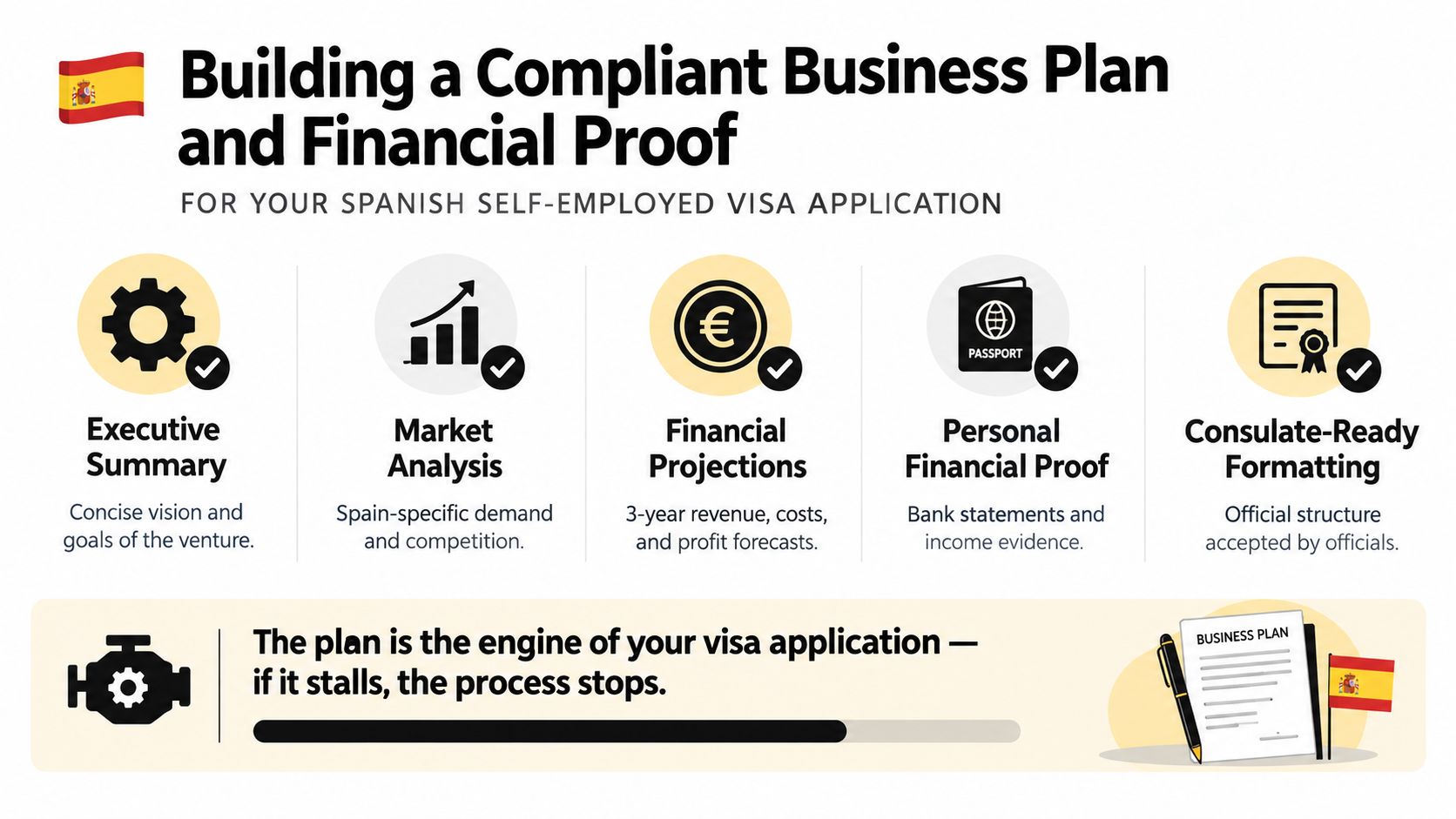
Your business plan is the engine of the application. If it describes an attractive idea without showing how the activity will function, the file has no reliable economic foundation.
Start with the activity itself. State exactly what you'll sell, who will buy it, where the work will take place, and which legal form you'll use. “Digital services” is too broad. “Independent conversion-copywriting services for Spanish hospitality businesses, delivered through defined client engagements” gives the assessor something concrete to evaluate.
Build the plan around evidence
Use this order:
- Define the service or business. Explain the offer, client problem, pricing method, delivery process, and expected workload.
- Explain the market. Use Spain-specific demand, competitors, customer segments, and acquisition channels. Avoid unsupported claims about market size.
- Show your competence. Match your experience and qualifications directly to the activity. Include portfolios, certificates, professional registrations, and previous work evidence where relevant.
- Map the legal requirements. Identify licenses, premises approvals, registrations, or professional permissions before submission. A plan that ignores a required license looks incomplete.
- Model the finances. Set out expected revenue, operating costs, personal financial resources, investment needs, and expected profitability. Every assumption should be explainable.
- Explain wider value. If the project could create employment or use local suppliers, describe that realistically. Don't promise jobs merely to make the plan sound impressive.
The official consular guidance requires a project plan with expected profitability, proof of sufficient investment, activity permits or licenses, and evidence of qualifications or experience. The Spanish consular self-employment information note is particularly useful because it shows how closely these elements are connected.
Make financial proof match the story
Bank statements alone don't prove viability. They should support the plan's stated startup requirements and show that you can maintain the activity while building revenue. If your plan describes a low-overhead consultancy but your account history suggests large unexplained transfers, add a clear explanation and supporting evidence.
For a product business, show supplier quotations, premises information, equipment needs, and licensing costs. For a freelancer, show client correspondence, signed proposals, service agreements, portfolio evidence, and a sensible breakdown of software, marketing, professional, and operating expenses.
A credible plan doesn't predict success with theatrical precision. It explains why the assumptions are reasonable and what evidence supports them.
Get the documents formatted for the receiving authority, not just for yourself. Use consistent business names, dates, currencies, translations, and references throughout the file. Contradictions between your CV, bank evidence, plan, and license documents create avoidable doubt.
Navigating the Application Steps and Timeline Bottlenecks
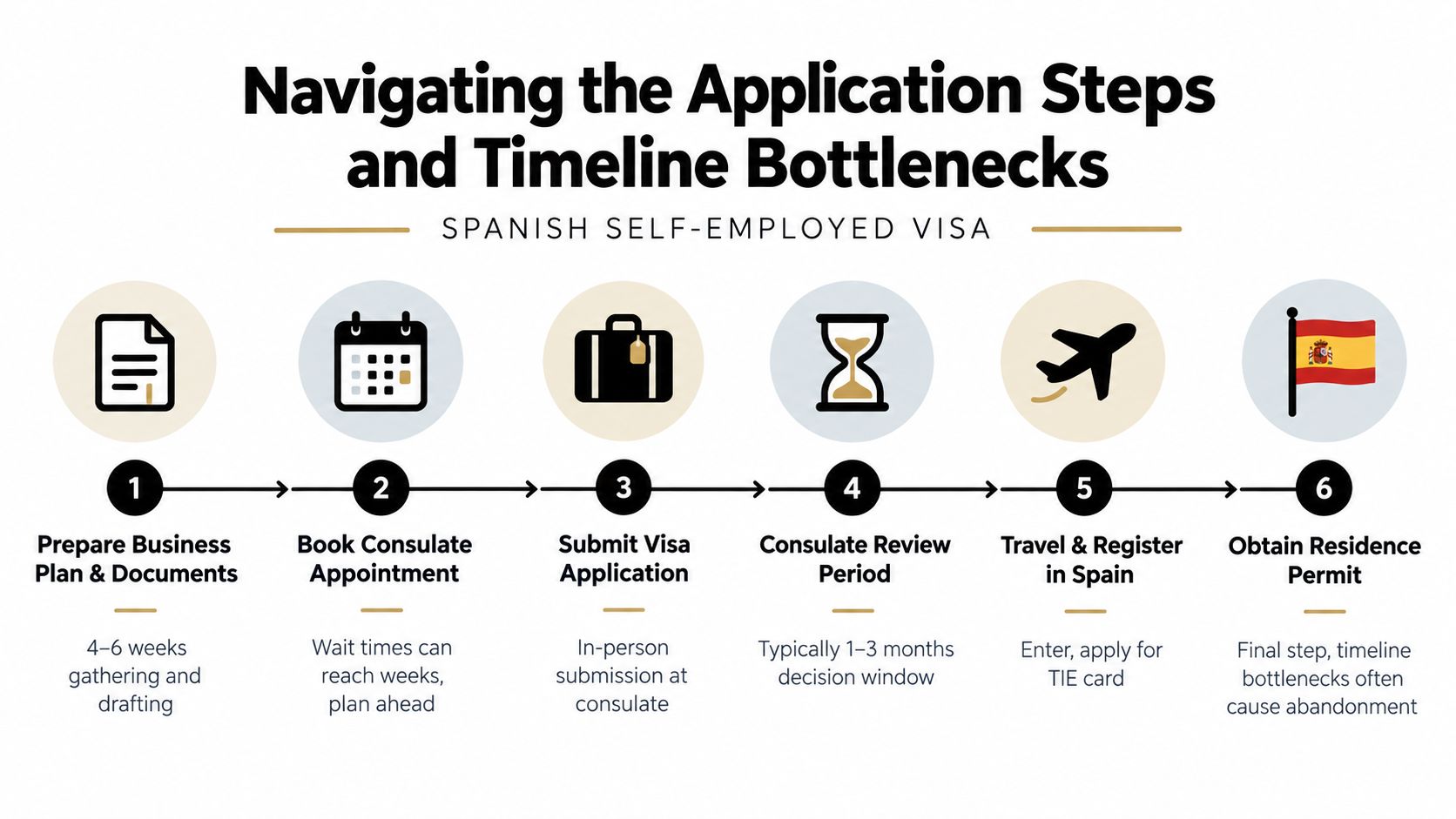
The biggest timing mistake is treating the consulate as the first decision-maker. It isn't. The immigration office in Spain must first assess and approve the initial residence and self-employed work authorization. Only after that upstream stage can the consular visa process move forward.
The cited consular guidance says that this prior authorization takes about three months from receipt. That period is not a pause you can use to start gathering the important evidence. Your plan, financial proof, qualifications, licenses, and compliance documents should already be coherent before the authorization application is submitted.
Follow the actual sequence
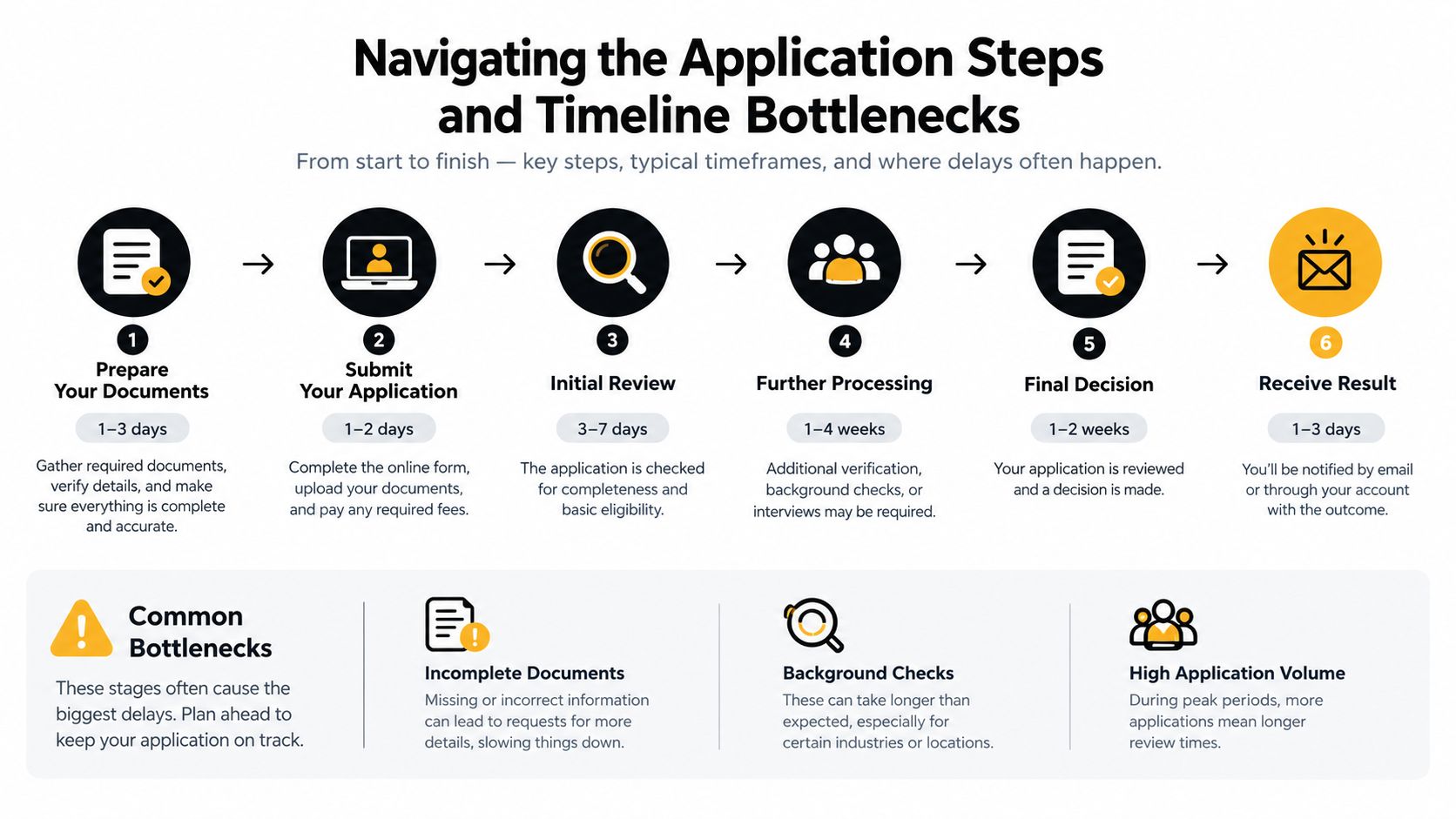
- Prepare the activity file. Confirm the business model, professional eligibility, licensing position, and financial evidence.
- Submit the initial authorization request in Spain. This is the upstream immigration stage that evaluates the proposed self-employed activity.
- Wait for authorization. The cited official note indicates a period of about three months from receipt. Treat that as a planning assumption, not permission to delay preparation.
- Assemble the consular visa file. Include the national visa form, recent passport photograph, valid passport, criminal-record documentation, medical evidence, and the authorization decision, alongside any documents the consulate requests.
- Apply at the Spanish embassy or consulate in your country of residence. The consular stage is where the visa allowing entry is requested.
- Enter Spain and complete local registration. Once admitted, arrange the physical residence documentation and register the activity before operating.
Protect the file from expiry
Documents have different validity periods and processing times. A criminal-record certificate obtained too early can become unusable, while a license application submitted too late can hold up the entire sequence. Keep a document tracker with the issue date, expiry rule, legalization status, translation status, and destination authority.
Background checks deserve their own planning line. Use this Spanish visa FBI background check guidance if it applies to your circumstances, but always verify the current consular instructions for your jurisdiction.
The safest schedule works backwards from the intended move, then protects the upstream authorization stage before booking the consular appointment.
Don't book non-refundable travel around an optimistic estimate. The visa depends on prior authorization, and the prior authorization depends on a business file that can withstand scrutiny. Sequencing is not administrative trivia. It determines whether your strongest documents are ready when the decision-maker sees them.
Securing Visa-Compliant Health Insurance in Spain
Health insurance is where otherwise persuasive applications can fail. Applicants often submit travel cover, an EHIC or GHIC card, or a private policy with an excess and assume that “insured” means “visa compliant.” Those are different tests.
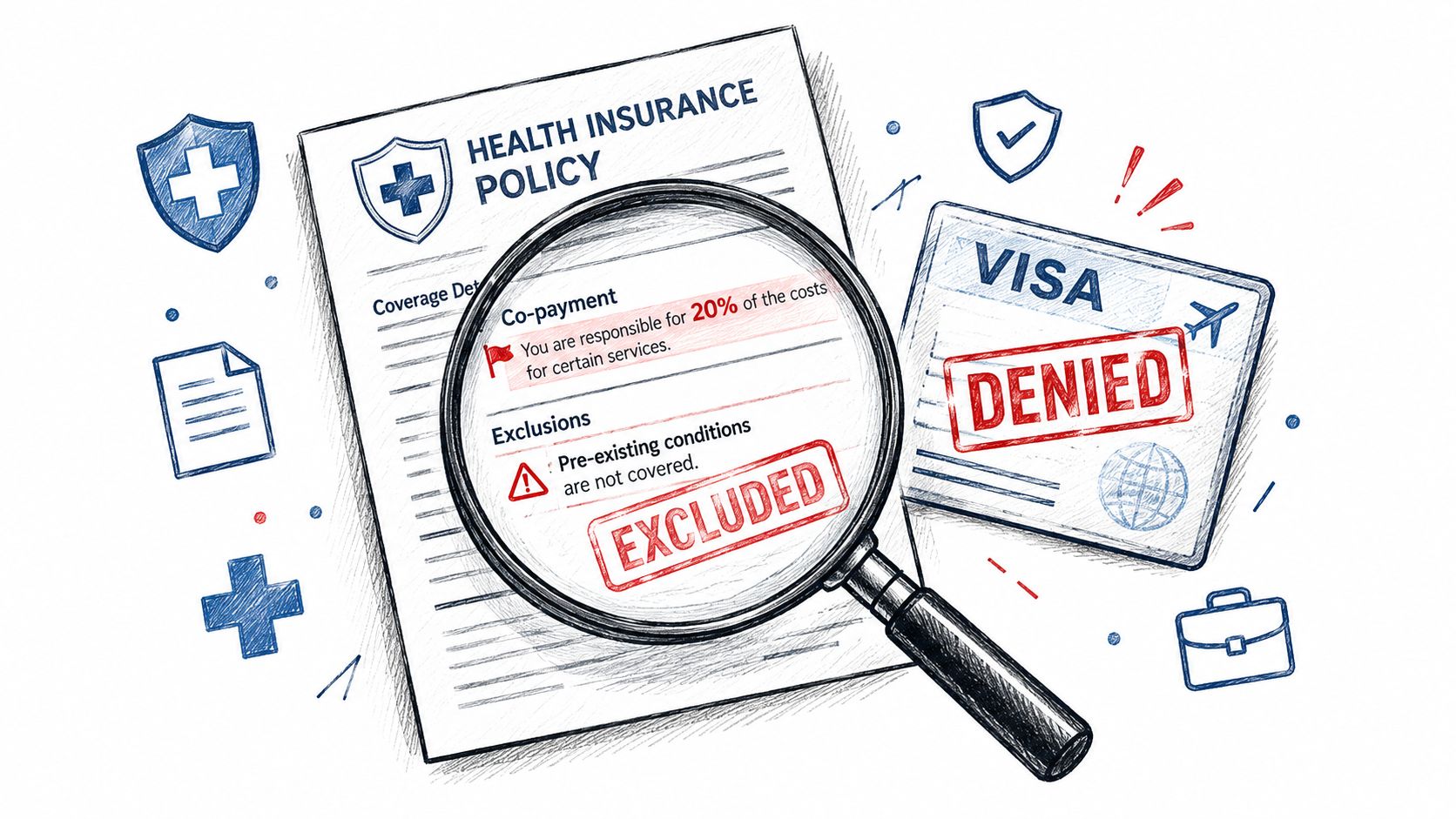
For a residence application, the relevant question is whether the policy provides the required access to healthcare under the consulate's conditions. A policy that requires you to pay a co-payment at every visit, imposes a waiting period, or excludes the treatment you need may not satisfy the file even if it looks thorough in a sales summary.
What to verify before buying
Ask the insurer or broker for written confirmation of the policy terms. Check these points directly:
- Zero co-payments. You shouldn't have to pay a charge each time you use covered medical services.
- No waiting periods. Cover should begin without carencias that leave key services unavailable during the relevant period.
- Broad medical coverage. Confirm inpatient, outpatient, specialist, diagnostic, and emergency treatment according to the consulate's requirements.
- No unsuitable exclusions. Read exclusions for pre-existing conditions, chronic treatment, and specialist care instead of relying on a general “full cover” label.
- Visa-ready documentation. Request a certificate that identifies the insured person, policy dates, coverage, and payment status in a format accepted by the receiving authority.
- Repatriation of remains. Check whether the consular requirements for your application include this wording and whether the certificate addresses it.
A travel policy is designed for temporary trips and often includes limits, excesses, or reimbursement mechanics. EHIC and GHIC cards are not substitutes for the private policy wording a visa application may demand. Don't let a cheap policy become the most expensive document in your file.
Pre-existing conditions need early attention
Diabetes, cancer, and other serious conditions require a proper underwriting conversation. Some insurers exclude them, some accept them with conditions, and some policies aren't suitable for visa purposes even when they offer useful everyday protection.
Apply early enough to disclose medical history accurately and obtain a certificate that matches the final policy. If an underwriter asks for medical information, answer fully. A missing disclosure can create problems at the visa stage and later when you need treatment.
Bsure Health Brokers can compare Spanish and international policies, explain exclusions and co-payment structures, and help prepare paperwork for visa-related applications. Their guidance on getting health insurance quickly is useful when the immigration sequence is already underway, but speed shouldn't replace checking the wording.
Clearing Medical and Security Compliance Screening
A viable business isn't enough if the applicant fails the admissibility checks. Spain's self-employed route also examines public-health and security criteria, which is why certificates must be planned alongside the business file rather than added at the end.
The medical requirement includes a negative medical certificate under the 2005 International Health Regulations. The certificate should address the required public-health test and follow the consulate's format, issuing, legalization, and translation instructions. A generic letter from a doctor may not be accepted only because it says you're fit to travel.
The criminal-record requirement is equally specific. Applicants must provide certificates from countries where they've lived during the last five years, as described in official Spanish consular guidance for the route. That can involve multiple issuing authorities, legalization or apostille procedures, sworn translations, and different delivery times.
Build a compliance matrix
Create one row for every country connected to your recent residence history. Record the authority that issues the certificate, the application method, the legalization route, the approved translation requirement, and the date by which the document should be requested.
Then check the medical certificate separately:
- Correct wording: It should address the relevant public-health requirement.
- Correct professional: Use the medical practitioner or format accepted by the consulate.
- Correct formalities: Confirm legalization, translation, and validity instructions.
- Consistent identity: Names and passport details must match across the file.
business compliance as a strategic advantage becomes a useful broader principle. Compliance isn't paperwork for its own sake. It creates an auditable record showing that your activity and personal documentation meet the rules authorities apply.
For the medical document itself, review the Spanish visa medical certificate guidance and compare it with the instructions issued by your responsible consulate. Requirements can vary in presentation, and the authority receiving your file controls the practical submission standard.
Finalizing Your Move and Planning for Renewals
Approval gives you permission to enter and begin the approved transition. It doesn't remove your local obligations. Treat arrival as the start of a second compliance phase.
Confirm the local sequence with the Oficina de Extranjería and the police station responsible for your address. Arrange your municipal registration, complete the required residence-card process for the TIE, and register your activity with the Spanish Tax Agency and Social Security before invoicing or operating as an autónomo.
Keep a renewal file from day one
Save invoices, contracts, bank records, tax filings, Social Security payment confirmations, licenses, insurance certificates, and correspondence with authorities in one secure folder. Renewals examine whether the activity exists in practice and whether you've maintained your legal and financial obligations.
Use this arrival checklist:
- Residence card: Confirm the TIE appointment and required forms.
- Tax registration: Declare the correct economic activity with the Agencia Tributaria.
- Social Security: Register under the applicable self-employed regime before beginning work.
- Business records: Keep invoices, expenses, contracts, and accounting evidence together.
- Insurance: Monitor the policy's renewal date and preserve proof of continuous compliant cover.
- Public obligations: Check tax and contribution payments regularly so arrears don't accumulate.
Your first application proves that the proposed activity is viable. A renewal must show that you operated it responsibly. Keep the business plan updated as your services, clients, premises, or licensing position change, and ask a Spanish gestor or immigration adviser before making a material change to the approved activity.
The route is paperwork-heavy, but it isn't mysterious. Prepare the upstream authorization, align the financial evidence, secure wording-compliant health insurance, and maintain clean records after arrival. That is how you turn the Spain self-employed visa from a bureaucratic risk into a controlled relocation project.
Bsure Health Brokers helps self-employed applicants compare Spanish and international health policies, check zero co-payment and waiting-period requirements, and prepare insurance paperwork for Spanish visa applications. Visit Bsure Health Brokers to request guidance on a policy that fits both your immigration file and your healthcare needs in Spain.