
You've found a Spanish health insurance policy that appears affordable, submitted it with your visa application, and then discovered that a small clause makes the entire document unacceptable. A copayment, a waiting period, or an unclear coverage certificate can create weeks of delay and leave you without the access to care you thought you'd purchased.
That's why a private medical insurance comparison for Spain shouldn't begin with the cheapest premium. It should begin with visa compliance, underwriting, hospital access, renewal terms, and the practical question of whether the policy will pay when you need treatment. The market is substantial but uneven across countries. Private health insurance represents about 10% of health spending on average across OECD countries, rising from around 8% in 2005 to 9.8% in 2019, while at least 30% of the population holds private cover in a third of OECD members, as documented by the OECD analysis of private health insurance spending.
For expats in Spain, the right policy is the one that meets the authorities' requirements, fits your medical history, and remains useful after the visa is approved.
| Comparison point | What to verify before buying |
|---|---|
| Visa compliance | Valid throughout Spain, effective from the required date, and accepted for your visa route |
| Copayments | Confirm that the policy has no copayments if your application requires full private cover |
| Waiting periods | Check whether carencias are removed or expressly absent |
| Pre-existing conditions | Obtain the written underwriting decision, including exclusions or loading |
| Hospital network | Confirm access near your home and to hospitals you'd actually use |
| Direct billing | Verify whether providers bill the insurer directly |
| Coverage area | Choose Spain-only, regional, or worldwide cover according to your routine |
| Renewal terms | Ask how age, claims, medical conditions, and tariff changes affect renewal |
Table of Contents
- The Hidden Traps in Spanish Health Insurance
- Core Criteria for Comparing Private Health Plans
- Domestic Spanish Plans Versus International Cover
- The Right Cover for Every Expat Profile
- Why an Independent Broker Secures Better Outcomes
- Your Checklist for Switching Insurance Providers
- Frequently Asked Questions About Spanish Health Cover
The Hidden Traps in Spanish Health Insurance
The rejection email usually arrives after you've already paid for translations, arranged appointments, and planned your move. The policy looked thorough, but the consulate noticed a standard copayment clause. You're then left explaining that the plan covers private treatment while trying to replace a document that should have been checked before submission.
That situation is avoidable. For many Spanish Non-Lucrative and Digital Nomad visa applications, applicants need private cover that operates throughout Spain, starts immediately, and avoids copayments and waiting periods. The practical visa requirements and the consequences of choosing a superficially cheap policy are discussed in this overview of healthcare requirements in Spain.
The cheapest premium can be the wrong price
Insurers often reduce premiums by changing the policy design. A plan may use copayments each time you visit a doctor, impose waiting periods before certain treatments, restrict access to a provider network, or exclude conditions disclosed during medical underwriting. Those features can be perfectly legitimate for an ordinary resident seeking affordable local cover. They can still make the policy unsuitable for a visa application.
A low monthly price also tells you very little about future access. A policy with a restricted network may be inconvenient if the nearest approved hospital is far away. A policy that excludes a relevant medical condition may provide little practical protection, even if its benefit list looks extensive.
Practical rule: Never send a visa application with a certificate that merely says “private health insurance.” Confirm the exact wording, effective date, geographical scope, copayment position, and waiting-period status first.
Compliance comes before benefits
Visa officers aren't comparing your policy against another insurer's brochure. They're checking whether the submitted cover satisfies the applicable rules. That means a modest difference in premium is irrelevant if the policy certificate fails.
Ask the insurer or broker for written confirmation of:
- No copayments: The policy must state the position clearly, not leave you to infer it from marketing language.
- No waiting periods: If carencias are waived, the certificate or contractual documentation should show that waiver.
- Immediate validity: The start date must align with the visa or residency requirement.
- Spanish validity: The policy should cover treatment throughout Spain when that is required.
- Insurer identification: The documentation should be suitable for consular review and clearly identify the contracting insurer.
The same discipline matters after approval. A plan can pass the visa check and still be poor value if it excludes your medication, limits specialist access, or renews on terms you can't sustain. Price is one input. It's never the decision.
Core Criteria for Comparing Private Health Plans
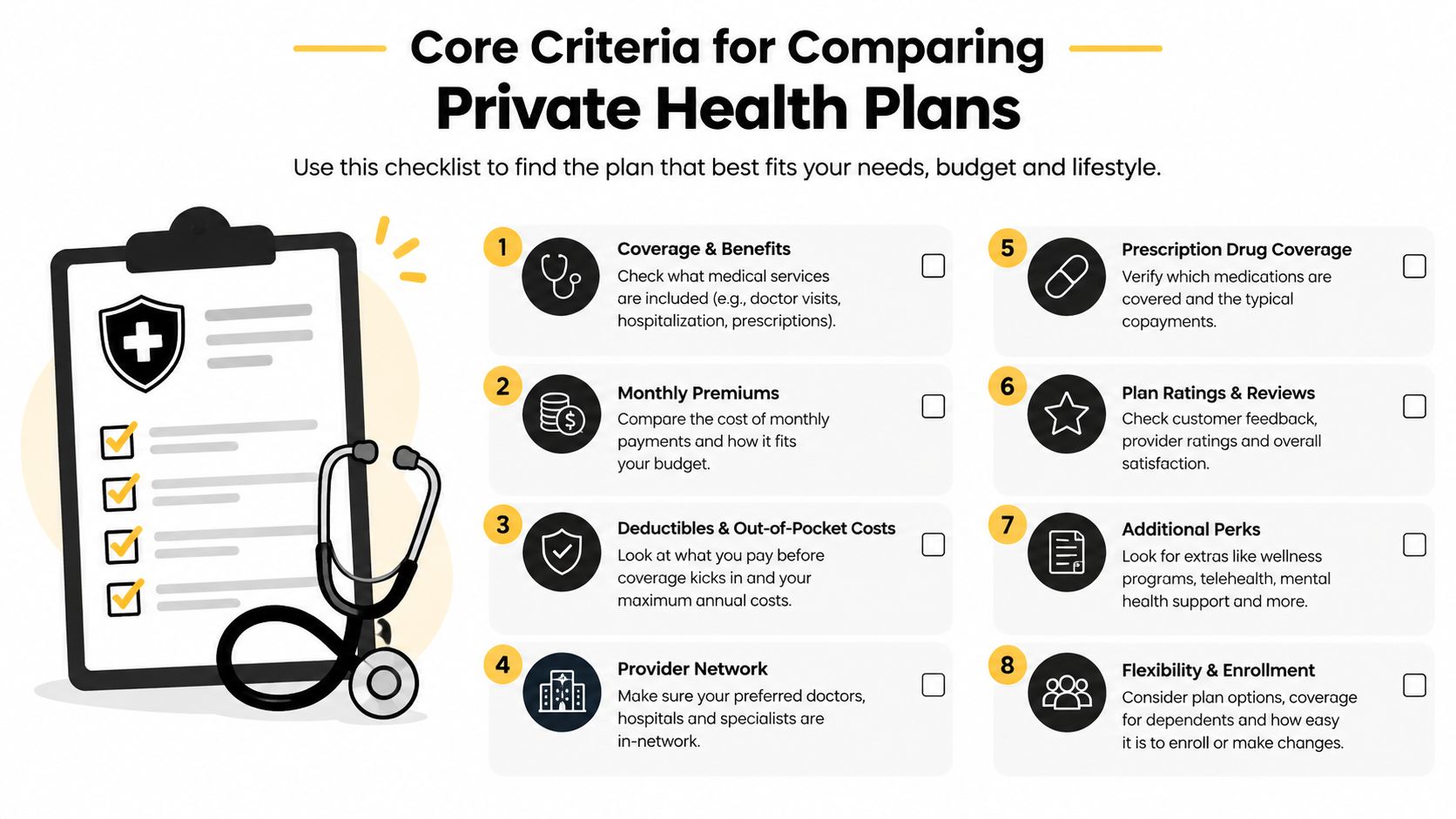
A sound private medical insurance comparison begins with the policy schedule and contractual wording, not an online quote. Similar premiums can conceal major differences in hospital access, direct billing, exclusions, benefit limits, and underwriting. Use this checklist for comparing private health insurance plans while checking the documents line by line.
Start with visa-critical terms
For visa applicants, copayments and waiting periods come before optional extras. A cheaper tariff is unsuitable if its conditions fail the immigration requirements or restrict access to the care you expect in Spain.
Use this guide to comparing health insurance plans as a prompt, then request written answers on:
- Copayment structure: Are consultations, diagnostic tests, and hospital services fully covered, or do you pay each time you use them?
- Carencias: Do waiting periods apply to hospitalisation, maternity, costly diagnostics, or surgery?
- Coverage territory: Does the policy cover Spain only, Europe, or worldwide treatment?
- Provider access: Are suitable hospitals and specialists available near your home?
- Billing method: Does the insurer settle bills directly, or must you pay first and claim reimbursement?
- Renewal: Can the insurer change the premium or policy terms at renewal?
- Medical exclusions: Which conditions, treatments, medications, or related complications are excluded?
- Benefit ceiling: Is there a maximum annual or lifetime amount?
A policy can satisfy a consulate and still fail in daily use. Confirm that exclusions do not remove treatment for an existing condition, that your preferred specialists are accessible, and that the renewal terms remain manageable.
Benefit ceilings matter particularly in international cover. A comparison of major global medical insurers shows policy maximums ranging from USD 1,000,000 to unlimited, depending on the tier, with worldwide options, worldwide cover excluding the United States, and restricted zones. Adding United States coverage can increase premiums by roughly 80% to 115%, according to the international medical insurance comparison from InternationalInsurance.com. If your life is centred in Spain, do not pay for worldwide flexibility without a clear need.
Calculate the cost beyond the premium
Domestic Spanish plans can cost less than international policies, while international cover may provide wider geography, portability, and different benefit structures. Actual pricing depends on age, health, territory, benefits, and underwriting. Compare the total arrangement, including copayments, excluded conditions, claims administration, and care outside Spain.
Do not place a Spain-only plan beside worldwide cover and treat them as equivalent products. Remove benefits you will not use, then confirm that the remaining policy still meets your visa or residency requirements and gives practical access to care. The right premium is the one attached to suitable terms, not just the lowest quote.
Domestic Spanish Plans Versus International Cover
A resident settled in Valencia, a retiree who spends winters abroad, and a family moving between Spain and another country need different insurance. Domestic and international policies solve different problems. A Spanish plan is built around local treatment, Spanish provider networks, and care concentrated in Spain. International private medical insurance, often called IPMI, is designed for people who move between countries, need portable cover, or require benefits beyond a Spanish network.
Spain has an established private insurance market, and private cover is widely used alongside the public system. That makes domestic insurance a normal part of healthcare planning for expats, not a specialist product reserved for large employers or frequent travellers.
| Feature | Domestic Spanish Plan | International Plan (IPMI) |
|---|---|---|
| Main purpose | Private treatment within Spain | Portable cover across selected countries or worldwide |
| Hospital access | Spanish insurer network and contracted hospitals | International network, often with regional or global options |
| Geographic scope | Usually focused on Spain | May include worldwide cover, with or without the United States |
| Billing | Often direct billing within the network | Direct billing or reimbursement, depending on provider and location |
| Benefit ceiling | Defined by the Spanish tariff | Can range from substantial maximums to unlimited cover |
| Visa suitability | Often suitable when it meets consular wording | Suitable only when the policy satisfies Spanish visa requirements |
| Medical underwriting | Spanish underwriting rules and exclusions | International underwriting, often with detailed country and condition terms |
| Best fit | Residents settled primarily in Spain | Frequent travellers, mobile families, and globally connected households |
| Price logic | Generally lower for Spain-centred care | Higher when portability and wider territory are included |
Choose domestic cover when Spain is your healthcare base
A domestic plan is usually the right choice if you live permanently in Spain, use local doctors, and have no planned treatment abroad. It gives you practical access to Spanish hospitals and specialists without charging for a global network you will rarely use.
It also suits many retirees and families who want predictable care near home. Check the policy against your visa or residency requirements before applying. Confirm age acceptance, renewal rules, exclusions, and whether the certificate states the absence of copayments if the consulate requires that wording. A policy can look affordable and still fail the application if its terms do not match the required conditions.
Choose IPMI for mobility, not prestige
International cover earns its higher price when you spend extended periods outside Spain, maintain a home elsewhere, or need treatment across borders. It can also suit people whose employer, family arrangements, or future plans require portable protection.
Select the territory before comparing insurers. Worldwide cover is unnecessary if your care will remain in Spain and nearby countries. United States inclusion can change the premium substantially, while a higher benefit ceiling does not guarantee access to your preferred Spanish hospitals.
Review the underwriting terms with equal care. International insurers may apply detailed exclusions, condition-specific limits, or medical assessments that affect real access to treatment. Confirm how pre-existing conditions are handled, which countries are covered, and whether care is paid directly or reimbursed. The right policy is the one that meets the consular test and works for your actual movements, not the one with the broadest brochure.
The Right Cover for Every Expat Profile
A family applying for residency, a retiree seeking renewal, and a couple planning for childbirth face different insurance decisions. Age, destination, household needs, and medical history matter more than the insurer's name. Compare the policy against the approval requirements and the care you will need.

Families need continuity, not a long benefits list
Check paediatric access, emergency hospitals, outpatient diagnostics, and specialists near your home and children's school. If maternity cover matters, verify the waiting period, pregnancy eligibility, hospital options, newborn enrolment rules, and how the policy treats complications.
Assess the quote as a household. One child may need regular specialist appointments while another uses very little care. A plan with a small copayment can look attractive, yet fail a visa requirement or become expensive with frequent visits. Review the full cost structure, provider access, and eligibility terms rather than comparing the adult premium alone.
Retirees must confirm acceptance and renewal
Applicants over 65 should begin with age eligibility. Some insurers accept older applicants only under selected tariffs, while others request medical information before offering terms. Do not cancel existing cover until a new insurer has confirmed acceptance in writing.
Ask how renewal works, how newly diagnosed conditions are handled, and whether the contract provides guaranteed renewal or another defined arrangement. A policy that accepts you today may be difficult to replace after a diagnosis. For older residents, continuity can matter more than a modest initial saving.
Visa applicants should remove avoidable objections
Request the visa-compliant certificate before paying for the application. Confirm the start date, Spanish coverage, absence of copayments, and the policy's position on waiting periods. If an insurer offers several versions of one product, the cheapest option may not satisfy the consulate.
Allow time to correct documentation. An incorrect certificate can delay the process and create extra expense, while selecting the compliant tariff at the outset prevents a predictable objection.
Pre-existing conditions require proper underwriting
Diabetes, previous cancer, cardiovascular disease, and other disclosed conditions can affect acceptance, exclusions, waiting periods, or premium terms. Never hide a diagnosis for a lower quote. If the insurer later links a claim to an undisclosed condition, it may refuse treatment or challenge the policy.
Prepare a concise medical file covering diagnoses, dates, treatment history, medication, test results, and current status. A broker can present the information to an underwriter and request written terms, such as standard acceptance, a specific exclusion, or a premium adjustment. One automated refusal does not settle every insurer's decision, but no intermediary can guarantee acceptance.
Underwriting reality: Ask what the insurer will cover, under which written terms, and whether those terms will remain useful as your circumstances change.
Why an Independent Broker Secures Better Outcomes
Buying direct works well when your circumstances are simple, your health history is uncomplicated, and you already understand the policy wording. Expats with visa deadlines, older applicants, complex conditions, or cross-border requirements face a different task. They need someone to compare underwriting decisions, not just display premiums.
An independent, DGSFP-registered brokerage can review Spanish and international products, explain exclusions, check provider networks, and identify whether a tariff is suitable for the intended visa route. That matters because online quote engines often treat medical history as a binary acceptance question. A human adviser can gather fuller information and approach insurers whose underwriting rules may differ.
What a broker should handle
A useful broker should be able to:
- Compare policy wording: Review copayments, carencias, exclusions, benefit ceilings, and renewal provisions.
- Coordinate underwriting: Present medical information clearly and obtain a written decision from the insurer.
- Check certificates: Make sure visa documentation reflects the actual policy terms.
- Support changes: Help with renewals, provider changes, referrals, and questions about specialist access.
- Explain trade-offs: Show whether a lower premium sacrifices geography, hospital choice, or continuity.
Bsure Health Brokers describes an independent comparison and support service for Spanish and international private health insurance, including policy setup, paperwork, renewals, and assistance with referrals or specialist access. If you're changing representation or need a formal record of intermediary authority, resources on digital broker of record letters can help explain how those documents work.

The broker's value should appear in the details. You should receive a clear explanation of why a plan fits your visa, location, age, and health history, along with the limitations that could affect a future claim. You can also review what a health insurance broker does before deciding whether intermediary support is appropriate.
Don't choose a broker merely because they show many logos. Ask which insurers they can access, whether they assist with medical underwriting, how they handle renewals, and what support remains available after the policy starts.
Your Checklist for Switching Insurance Providers
Switching can improve your network or reduce unnecessary benefits, but cancelling first is the fastest way to create a coverage gap. The safe sequence is acceptance, confirmation, continuity review, and only then cancellation.
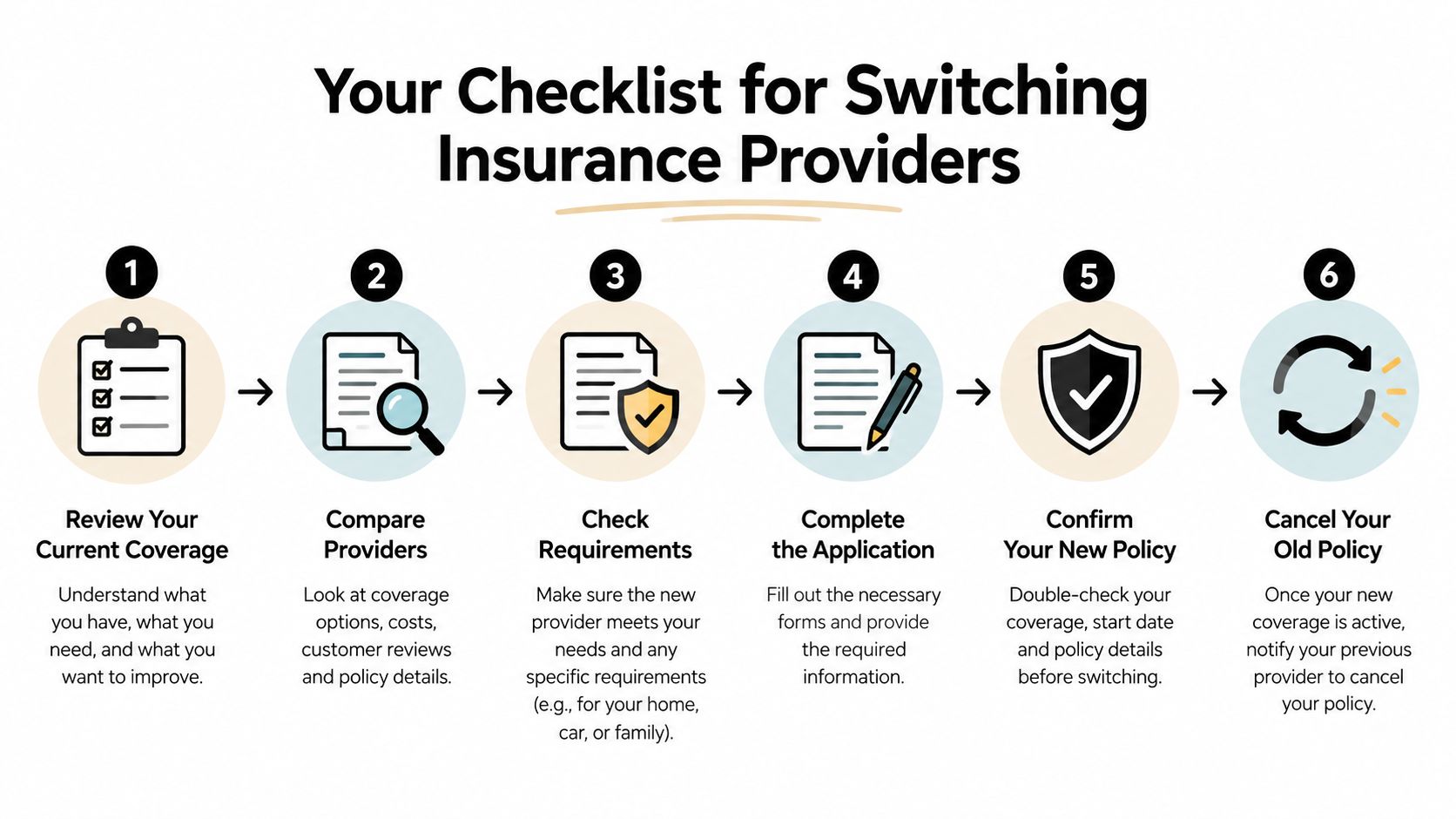
Follow the order, not the sales deadline
- Review your current contract: Check the renewal date, notice period, cancellation method, exclusions, and any outstanding claims.
- Collect continuity evidence: Request a certificate of no claims or a letter confirming continuous cover. Ask whether it records the start date and uninterrupted status.
- Apply to the new insurer: Disclose your full medical history and provide current policy documents if requested.
- Secure written acceptance: Don't rely on a preliminary quote. Obtain the final terms, exclusions, copayment structure, and effective date.
- Confirm carencias treatment: Ask whether the insurer waives standard waiting periods because of continuous prior cover. Get the waiver in writing.
- Cancel only after activation: Make sure the new policy is active before ending the old one, unless your adviser has confirmed another safe arrangement.
Check the replacement policy against your real usage
Compare your current hospitals and specialists with the proposed network. A lower premium won't help if your preferred clinic falls outside the new provider list or if direct billing isn't available where you live.
Review open treatment carefully. If you're midway through diagnostics, receiving regular specialist care, or awaiting surgery, ask both insurers how the claim will be handled. Changing providers can trigger fresh underwriting or exclusions, even when the new plan looks similar on the surface.
The guide to changing healthcare providers provides a useful administrative reference, but your policy documents remain decisive. Keep copies of acceptance, continuity letters, cancellation confirmation, and the new certificate in one file.
Switching rule: A saving is only real when the replacement policy preserves the access, continuity, and compliance you actually need.
Frequently Asked Questions About Spanish Health Cover
What happens when I reach 70 or 75?
The answer depends on the insurer and tariff. Some plans have age limits for new applicants, while others offer products designed for older residents. Reaching a particular age doesn't automatically mean your policy ends, but you should check the renewal clause and any age-based pricing provisions well before the renewal date.
Don't wait until your birthday creates an urgent problem. Ask the insurer whether renewal is guaranteed, whether benefits change with age, and whether a new medical assessment is required. If you already have a serious condition, switching may be harder than maintaining existing cover.
Can an insurer exclude a chronic condition at renewal?
A chronic condition may be subject to the original underwriting terms, exclusions, or benefit limitations. The insurer might also adjust premiums under the contract's renewal provisions. Your annual renewal notice should be read alongside the original policy wording, especially if you've developed a condition after joining.
Request clarification in writing if the renewal document is vague. You need to know whether the change affects the condition itself, related complications, medication, diagnostics, or hospital treatment. Never assume that uninterrupted payment means every newly required treatment is automatically covered.
Does Spanish private insurance cover treatment abroad?
A domestic Spanish policy may offer emergency assistance while travelling, but that isn't the same as planned treatment abroad or worldwide medical cover. Check the geographical clause, emergency duration rules, reimbursement limits, and authorisation requirements.
International plans can offer broader portability, but the territory still matters. Worldwide cover that excludes the United States is a different product from worldwide cover that includes it, and the latter can materially increase premiums, as noted in the earlier comparison of global medical plans. Choose based on where you live and seek care, not on a broad label.
Will my policy cover me elsewhere in the Schengen area?
Schengen access doesn't automatically turn a Spanish private policy into regional private medical insurance. Immigration movement and insurance territory are separate questions. Read the policy's emergency and planned-treatment provisions, then ask whether providers abroad are paid directly or reimbursed.
For visa purposes, the key requirement is usually Spanish compliance. For day-to-day life, the relevant question is whether your policy pays for the treatment you expect to use outside Spain.
Should I disclose every medical condition?
Yes. Give complete and accurate information during the application. Include diagnoses, previous treatment, current medication, and relevant investigations. An undisclosed condition can create a dispute when you submit a claim.
A transparent application may result in an exclusion or different premium, but it gives you a defined contract. That's safer than relying on a low quote whose apparent value disappears when you need care.
Bsure Health Brokers compares Spanish and international private medical insurance for expats, visa applicants, families, retirees, and people with complex medical histories. Visit Bsure Health Brokers to request options and get help checking compliance, underwriting terms, hospital access, and renewal conditions before you commit.