
You're at a Spanish insurer's office with a visa checklist in one hand and a policy quotation in the other. The adviser says the plan is completo, the brochure uses integral, and an English translation describes it as “full coverage.” It sounds reassuring, but you still need to know whether the policy has copayments, waiting periods, annual limits, or a provider that the consulate will accept.
That translation gap can create real problems. A policy may sound complete in everyday English while failing a residence application, or it may satisfy a formal requirement but leave you with restrictions that matter when you need a specialist or ongoing treatment. Spain's private insurance market is substantial, with private health spending representing almost 30% of total health expenditure and around 2% of GDP, according to an expat guide to private health insurance in Spain.
The phrase seguro todo riesgo en español doesn't have one universal meaning. Health, auto, and home insurers use related words to describe broad protection, but each product measures “broad” in a different way. For a non-EU applicant, the word also has a compliance meaning shaped by consular requirements.
This guide translates the language into practical decisions. You'll learn which Spanish terms to look for, how health cover differs from a todo riesgo car insurance and home insurance, what visa documentation normally needs to show, and how to compare a policy beyond its headline price.
Table of Contents
- Introduction Why Translation Alone Will Not Protect You
- What Comprehensive Insurance Means in Spanish
- How Comprehensive Differs Across Health Auto and Home
- Key Spanish Policy Terms That Define Truly Comprehensive Cover
- Visa and NIE Requirements for Comprehensive Health Insurance
- How to Choose and Buy Comprehensive Private Health Insurance in Spain
- Your Next Steps to Confident Cover in Spain
Introduction Why Translation Alone Will Not Protect You
A newcomer named Daniel once brings a policy certificate to a consular appointment after arranging cover online. The certificate says seguro médico completo, which he understands as full medical insurance. The policy does offer access to doctors, but the detailed conditions include copayments and a waiting period for some services. The certificate looks polished, yet the wording doesn't answer the questions that determine whether the cover is usable or acceptable.
Dictionary translation falls short. Completo means complete in ordinary Spanish, while integral suggests an all-round or integrated solution. In insurance, however, neither word automatically guarantees sin copago, sin carencias, or sin límite. Those terms describe features that must be checked in the policy documents rather than assumed from a label.
A similar mistake happens outside healthcare. An English speaker sees seguro a todo riesgo and assumes it means the same thing as a health insurance policy that covers everything. In Spanish motor insurance, it normally refers to protection for damage to your own vehicle as well as liability, subject to the policy's exclusions and conditions. A home policy described as multirriesgo hogar may combine several protections, but the insured building, contents, liability, and assistance sections still need separate review.
Practical rule: Treat “comprehensive” as a starting description, not as proof of complete protection.
For visa and residence applications, the distinction matters even more. Guidance for Spanish long-stay routes generally points to an insurer authorized to operate in Spain, nationwide validity, cover for the full stay, and protection equivalent to the public system. Some visa cases also refer to a €30,000 minimum medical coverage threshold, while consular documentation commonly expects insurance for at least 12 months and payment in advance, as summarized in a 2026 guide to private health insurance for expats.
The aim isn't to make you fluent in insurance Spanish. It's to help you ask the right questions before you sign, pay, or submit paperwork.
What Comprehensive Insurance Means in Spanish
Start with the phrase you've been given, then identify the insurance type. Spanish insurers may use seguro integral, seguro completo, or seguro a todo riesgo, but these expressions aren't interchangeable in every context.
Three expressions with different uses
Seguro integral usually communicates an all-round package. A health insurer might use it to describe medical, hospital, and specialist access in one policy. A home insurer could use similar language for a package covering the property, belongings, liability, and assistance.
Seguro completo is more conversational and often appears in sales descriptions or explanations. It suggests that the policy includes more than a basic option, but it doesn't by itself tell you whether there are limits, exclusions, or cost-sharing.
Seguro a todo riesgo has a more established role in motor insurance. It generally points to own-damage protection, which can include collision damage, theft, fire, and glass cover, depending on the policy. It shouldn't be translated mechanically as “all-risk” health or home insurance.
Una analogía útil es una maleta. “Integral” indica que la maleta está diseñada para contener muchas cosas. No te dice qué ha metido el fabricante dentro, si algunos compartimentos están cerrados con llave o si hay un límite de peso. El cuadro de la póliza y las condiciones aportan esas respuestas.
Read the context around the word
Look for the product category and the nouns that follow the description:
- Health: seguro de salud integral, cuadro médico, hospitalización, and sin copago.
- Auto: todo riesgo, daños propios, franquicia, and robo.
- Home: seguro multirriesgo, continente, contenido, and responsabilidad civil.
The same English word can therefore point to different Spanish products. If you're also arranging property finance as a non-resident, it helps to keep insurance documents separate from mortgage advice. Bluevectis offers information relevant to non-resident mortgage options in Spain, but a mortgage-related insurance request may concern the property or lender rather than visa-compliant medical cover.
The safest translation is functional. Ask, “What does this policy protect, under which conditions, and with what limits?” That question works whether the document says integral, completo, or a todo riesgo.
How Comprehensive Differs Across Health Auto and Home
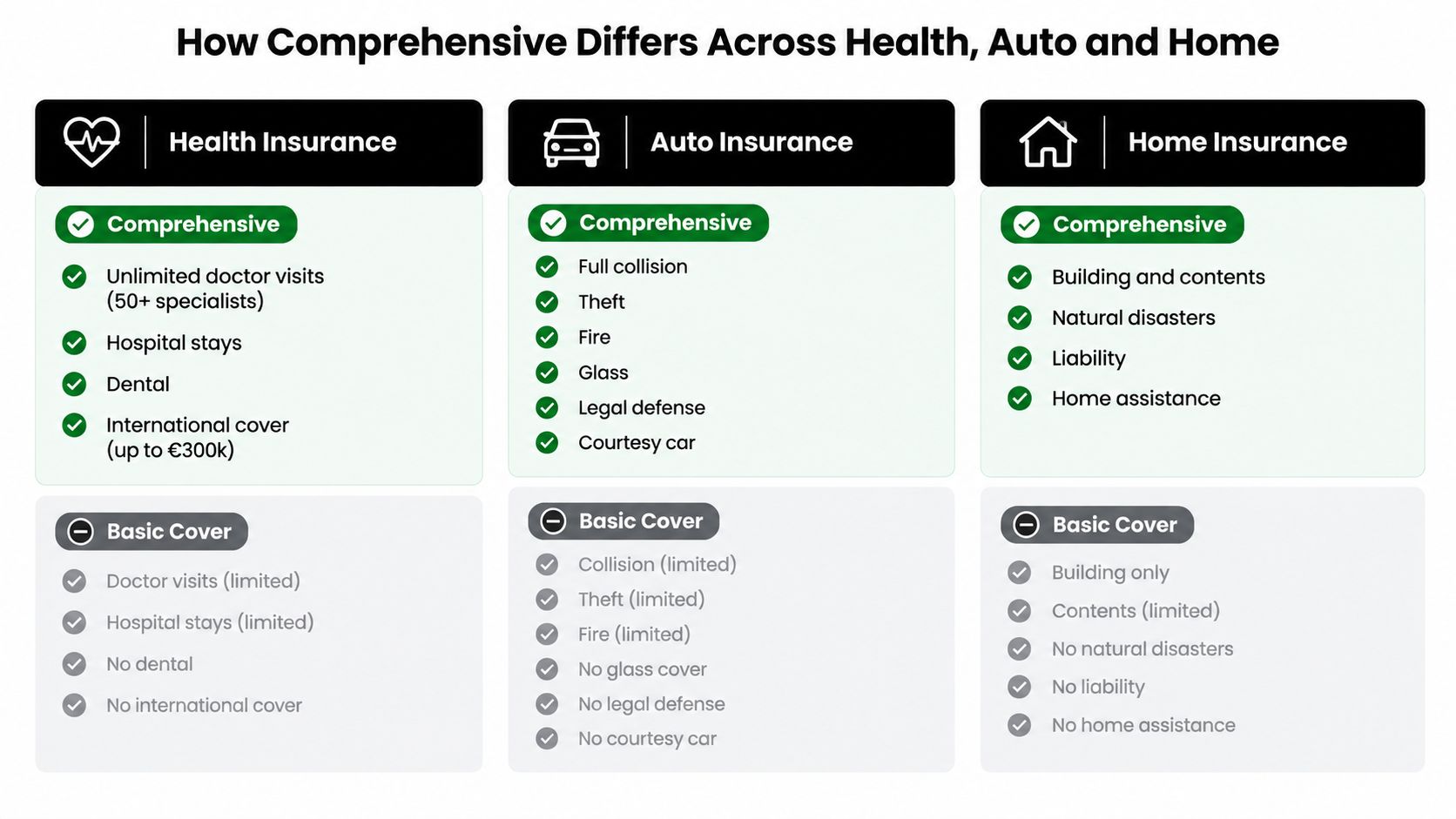
Cover changes meaning with the risk being insured. Health insurance is about access to treatment, auto insurance is about damage and liability, and home insurance is about the property, possessions, and responsibility for harm to others.
In health insurance, a broad policy may combine general medicine, specialists, diagnostics, hospital treatment, and emergency care. The practical value depends on whether you can use those services without copayments, whether a waiting period delays treatment, and whether you must remain inside a particular cuadro médico, or medical network.
In auto insurance, todo riesgo normally extends beyond mandatory third-party liability. It can respond to damage to your own vehicle after an accident, along with risks such as theft, fire, or broken glass. A policy with a franquicia, or excess, may still be called todo riesgo with a deductible, but you'll pay the agreed amount before the insurer contributes to a covered claim.
Home insurance uses a different vocabulary. Continente generally refers to the physical structure, such as walls, floors, and fixed installations. Contenido refers to belongings inside the property. A broad multirriesgo hogar policy may combine these with liability and home assistance, but you need to confirm which sections are selected and how the sums insured are calculated.
| Insurance Type | Spanish Term | Typical Comprehensive Scope | Common Misconception |
|---|---|---|---|
| Health | Seguro de salud integral | Medical consultations, specialists, diagnostics, hospital treatment, and emergency care, subject to the contract | “Comprehensive” always means every treatment is immediately available |
| Auto | Seguro a todo riesgo | Third-party liability plus damage to your own vehicle and selected insured risks | It guarantees payment for every type of damage |
| Home | Seguro multirriesgo hogar | Building, contents, liability, and assistance, depending on the selected sections | The policy automatically covers the full value of the property and belongings |
The word “complete” therefore describes scope, not an identical package. A health policy's important question may be whether it has sin copago and sin carencias. For a car, you'll focus on own-damage conditions and the excess. For a home, underinsurance and exclusions can matter more than the marketing label.
A policy is only as comprehensive as the protection you can actually claim.
Before comparing prices, write down the risk you want covered. A visa applicant needs compliant medical documentation. A driver may need own-damage protection. A homeowner or tenant may need liability and contents cover. Those are different decisions, even when the brochure uses the same English adjective.
Key Spanish Policy Terms That Define Truly Comprehensive Cover
The fine print reveals whether a Spanish health plan is genuinely broad or simply marketed that way. Learn the terms before you compare premiums, because two policies with similar descriptions may offer very different access.
The cost and timing terms
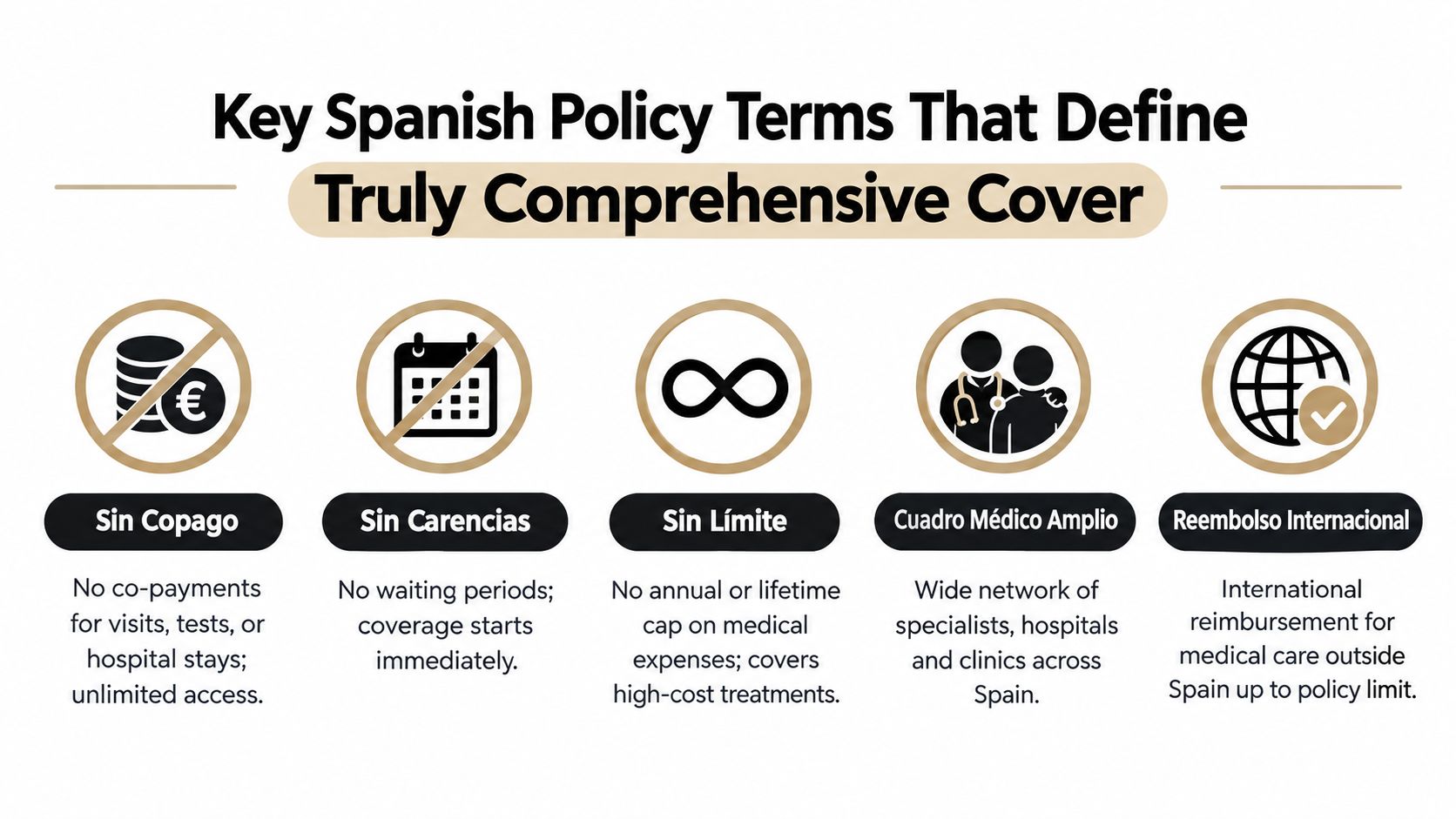
Sin copago means without copayments. A copayment is a charge you pay when using a covered service, such as a consultation, test, or treatment. If a visa application requires zero copayments, the certificate and policy must support that condition, not merely describe the plan as complete.
Con copago means with copayments. It isn't automatically poor insurance, but it may not suit an applicant who needs a no-cost-at-use structure for a residence application or someone who wants predictable medical spending.
Sin carencias means without waiting periods. A waiting period can delay access to particular services even after the policy begins. Ask whether the insurer waives all waiting periods or only some of them, and request the answer in writing.
Limits and provider access
Sin límite means without a stated limit, but check what kind of limit the document addresses. A policy may have no overall annual cap while still applying restrictions to particular services, providers, treatments, or reimbursement categories.
Cuadro médico is the insurer's medical network. A wide network can include doctors, hospitals, clinics, and diagnostic centres across Spain. “Wide” still needs a practical test: search for a hospital near your home, a specialist in your area, and facilities you can reach without unreasonable travel.
Reembolso means reimbursement. With a reimbursement plan, you may choose providers outside the network, pay first, and claim back the eligible amount according to the policy. Check the reimbursement percentage, geographical scope, claim procedure, and any stated limit before treating this as unrestricted international access.
Other words that affect the price
Prima is the premium, the amount paid for the insurance. Póliza is the policy, while condiciones generales and condiciones particulares contain the general rules and your specific terms. Exclusiones identify situations the insurer doesn't cover.
Pre-existing conditions deserve special attention. A company may accept an applicant while excluding a condition, applying a premium adjustment, requesting medical information, or declining the application. Don't assume that “comprehensive” means every previous diagnosis is covered.
For a plain-English glossary, use this guide to Spanish health insurance terminology. Then ask the insurer or broker to confirm four points in writing: copayments, waiting periods, benefit limits, and treatment of existing medical conditions.
Visa and NIE Requirements for Comprehensive Health Insurance
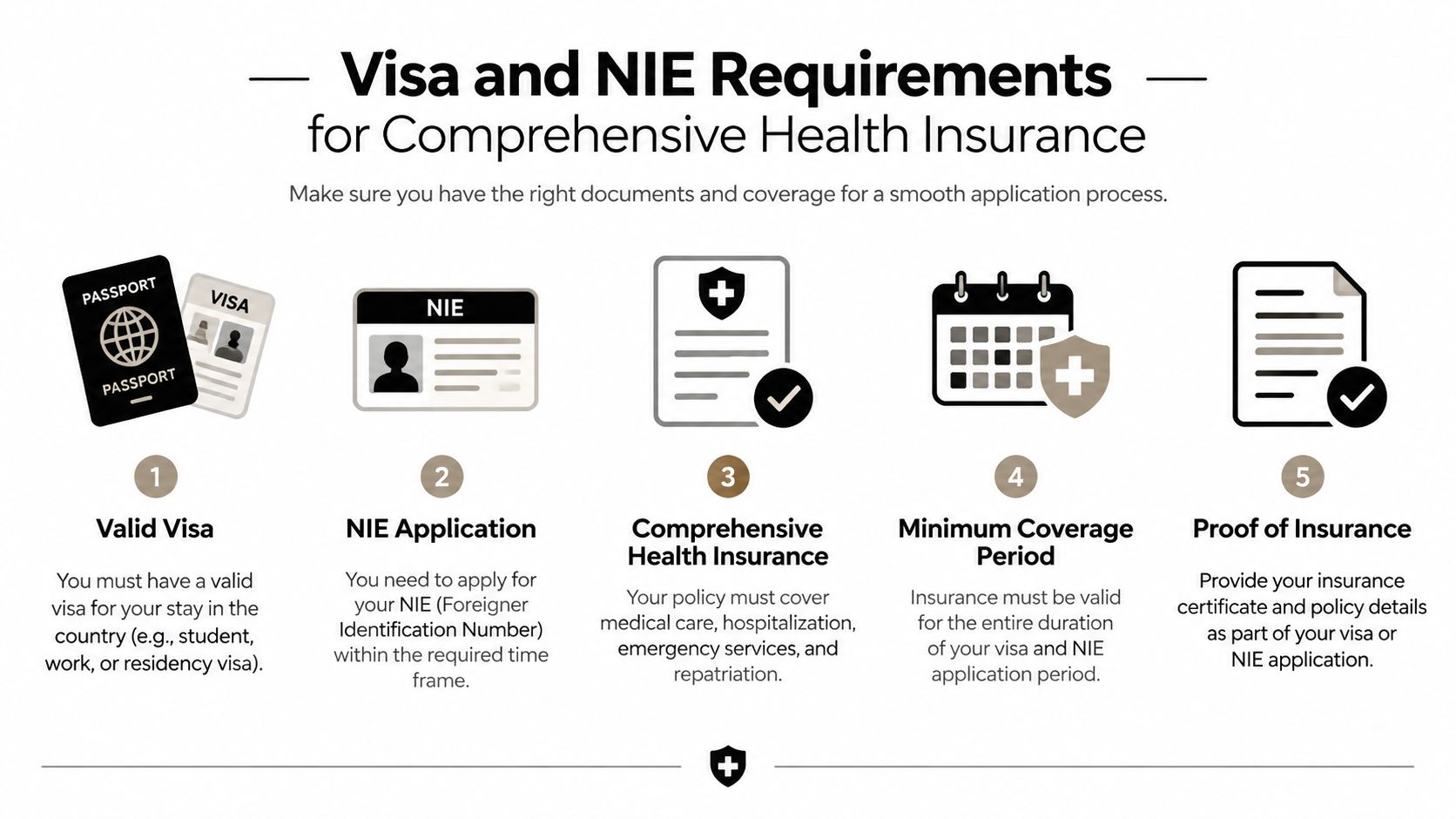
Visa compliance turns a broad insurance description into a document checklist. Requirements can vary by visa route and consulate, so applicants should follow the instructions issued for their specific application. Still, the recurring practical standard is clear: travel-style emergency protection usually isn't enough for a long-stay residence application.
What the policy normally needs to show
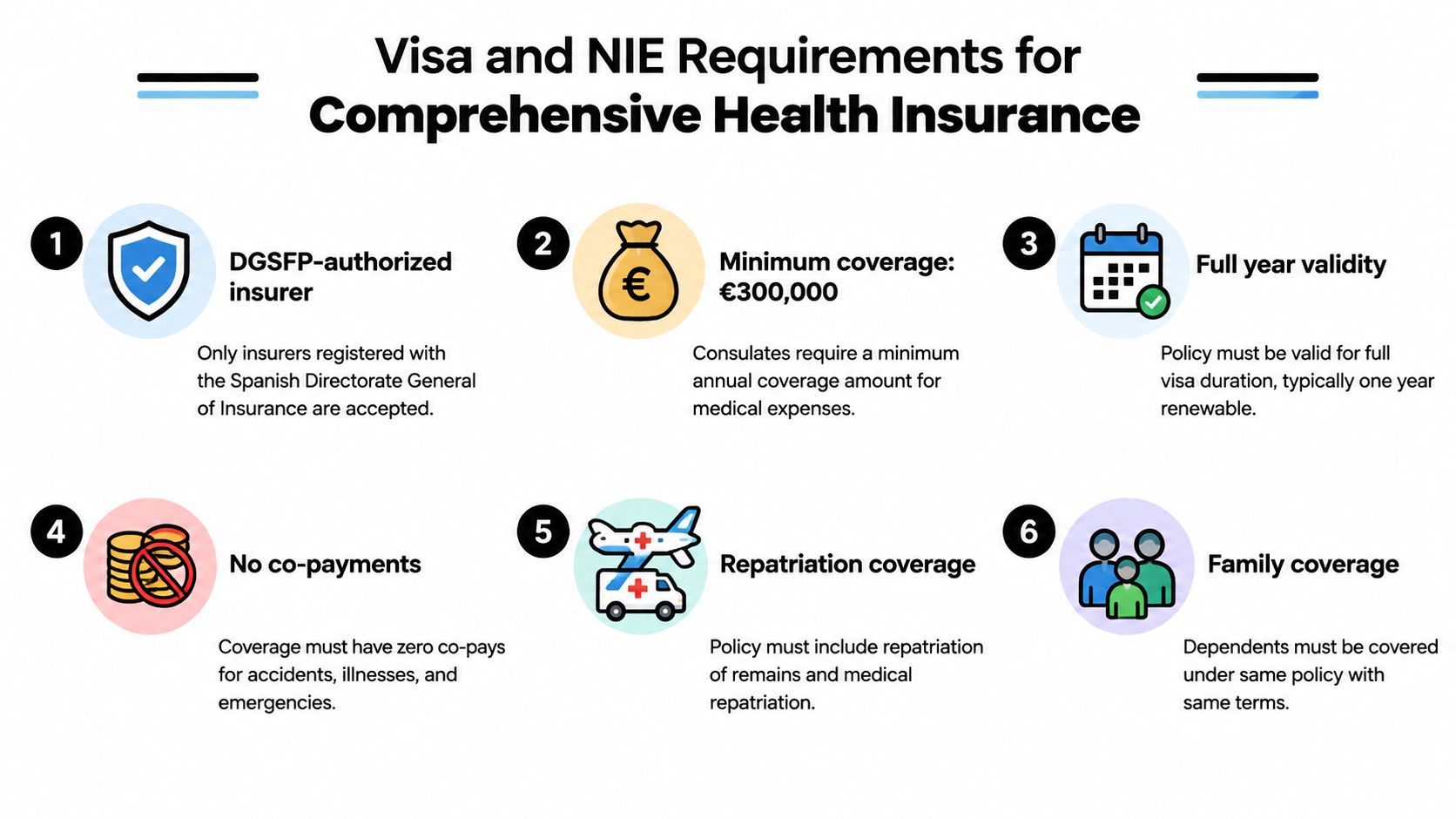
For many Spanish long-stay visas and residence permits, applicants need private health insurance from an insurer authorized to operate in Spain. Guidance for these routes commonly expects nationwide validity, cover for the full stay, and protection equivalent to Spain's public healthcare system.
A visa-oriented policy will generally need:
- Full validity: The policy should cover the required period, commonly at least 12 months, as reflected in guidance on Spanish expat healthcare.
- No copayments: Look for sin copago, not “low-cost access” or “affordable consultations.”
- No waiting periods: The plan should state sin carencias where the route requires immediate cover.
- No benefit caps: Check for the absence of annual or lifetime coverage limits where consular instructions require it.
- Nationwide access: The insurer should be authorized in Spain and the policy should provide broad territorial validity.
- Spanish documentation: Request an official certificate in Spanish, or arrange a sworn translation if the consulate requires it.
Some guidance also identifies a €30,000 minimum medical coverage threshold for particular visa cases, as described in Spanish visa health insurance requirements. Treat that figure as route-specific rather than a universal substitute for a full cover plan.
Why travel cover and public cards can fail
Travel insurance is usually designed for unexpected incidents during a temporary trip. It may focus on emergencies, evacuation, or repatriation rather than providing the ordinary medical access expected from a private health policy in Spain. A public healthcare card or reciprocal arrangement may support access under its own rules, but it doesn't necessarily provide the private policy certificate a residence application requests.
Before paying, send the exact policy wording or certificate requirements to the broker and, where appropriate, check the consulate's current instructions. The quick health insurance process for Spain can help you organize the application, but no guide can replace route-specific consular confirmation.
Keep the final file consistent. The applicant's name, passport details, policy dates, insurer authorization, payment status, and coverage wording should all match the visa application. A technically suitable policy can still cause delay if the certificate is incomplete or the dates don't cover the required stay.
How to Choose and Buy Comprehensive Private Health Insurance in Spain
A suitable policy has to pass two tests. It must satisfy the documentation rules for your immigration route, and it must work for your actual life in Spain. A plan that looks perfect on a consular checklist may be frustrating if your preferred hospital is outside the network or ongoing care is excluded.
Begin with your personal profile. Age, family size, location, expected medical use, and pre-existing conditions can change eligibility and price. Private health insurance in Spain can range from roughly €80 to €600 per month depending on age and plan type, according to neutral 2026 expat guidance on health insurance costs. Those figures are a market range, not a quote for your circumstances.
Retirees need to examine acceptance rules, renewal terms, exclusions, and how premiums may change over time. Someone with diabetes, cancer history, or another significant condition should disclose accurate information and ask whether the insurer offers full cover, an exclusion, a loading, or no acceptance. A lower initial premium isn't useful if the policy doesn't address the care you expect to need.
Compare the policy, not just the premium
Request written answers to these questions:
- Is the insurer authorized to operate in Spain?
- Does the policy have sin copago and sin carencias?
- Are there annual, lifetime, treatment-specific, or reimbursement limits?
- Which hospitals and specialists are available near your home?
- Are chronic and pre-existing conditions covered, excluded, or subject to review?
- Can the insurer issue a Spanish certificate suitable for your visa route?
- What happens at renewal, especially for older applicants?
A national Spanish plan may provide a familiar local network and straightforward access within Spain. An international plan may offer broader geographical flexibility, but its reimbursement rules and documentation need careful checking. Neither category is automatically more complete.
Get the paperwork before you commit
Ask for the certificate, conditions, exclusions, and payment confirmation before submitting your application. If a broker recommends a plan, ask them to explain each Spanish term in plain English and identify any difference between the marketing description and the contractual wording.
This guide to comparing Spanish health insurance plans is useful as a checklist. Buy early enough to resolve medical underwriting questions, correct names and dates, and obtain a certificate that matches the consulate's requirements.
Your Next Steps to Confident Cover in Spain
The practical meaning of insurance in Spanish comes down to context and proof. In health insurance, broad cover may still contain copayments, waiting periods, network restrictions, or limits. In auto and home insurance, the same idea describes a different set of protections, so the product category must come first.
For a visa or residence application, make three checks before you pay:
- Translation: Identify whether the document refers to seguro integral, seguro completo, a todo riesgo, or another product description.
- Terms: Confirm sin copago, sin carencias, broad access, and the relevant absence of caps or exclusions.
- Rules: Match the certificate to your visa route, including insurer authorization, dates, territorial validity, and Spanish-language documentation.
The market gives newcomers meaningful choice. Private health insurance penetration rose from 15.3% of the population in 2020 to 26.4% in 2024, according to the Commonwealth Fund Spain profile. That growth reflects the role private cover can play alongside public healthcare, but it also makes careful comparison more important because plans vary widely.
You don't need to decode every clause alone. A broker can compare local and international policies, check visa suitability, explain medical underwriting, and help assemble the certificate and supporting documents. The right choice is the policy whose wording, access, and conditions fit both your legal application and your everyday healthcare needs.
Bsure Health Brokers compares Spanish and international health policies, including options for visa documentation, families, retirees, and applicants with medical histories. Visit Bsure Health Brokers to request a comparison and get practical help with the policy, paperwork, and next steps.