
You've found the apartment, arranged the pension paperwork, and started planning which Spanish town will become home. Then an insurer asks your age, medical history, and intended residency status, and the attractive policy you had in mind turns out to be unavailable or unsuitable. For retirees, buying private health insurance in Spain isn't just a matter of comparing monthly prices. The decisive issue is often whether you can still enter the market on acceptable terms.
That age cliff becomes more pronounced as applicants move beyond standard entry ages. Premiums can rise sharply, available plans can narrow, and a medical history that seemed manageable can lead to exclusions rather than a higher price. The practical answer is to start early, disclose accurately, and compare the policy wording, not just the headline premium.
Table of Contents
- Securing Your Healthcare as a Retiree in Spain
- Choosing Between Spanish and International Plans
- Understanding Age Limits and Entry Caps
- Navigating Pre-existing Medical Conditions
- Estimating Your Monthly Premium Costs
- Taking Action and Securing Your Cover
Securing Your Healthcare as a Retiree in Spain
A common retirement scenario begins with confidence in Spain's public healthcare system. A new resident registers locally, expects to book a specialist appointment, and discovers that access depends on regional arrangements, referrals, and waiting times. If the appointment concerns a persistent symptom or a condition requiring regular monitoring, the delay can feel far more serious than an administrative inconvenience.
Private cover won't replace the public system, and it doesn't guarantee every treatment will be accepted. It can, however, give eligible retirees a separate route to private hospitals, specialists, and diagnostic services. It may also help applicants who need evidence of health cover for a Spanish residency process, subject to the specific requirements of the relevant authority and policy.

Why preparation matters before arrival
Retirees often delay the insurance search because they assume they can arrange cover after moving. That approach can create avoidable pressure. An insurer may need a completed medical questionnaire, clarification from a doctor, or additional information about previous treatment before it can decide whether to accept an application.
Language also affects the experience. A policy may provide access to a strong local network, but the practical value depends on whether you can understand authorisation rules, appointment procedures, exclusions, and claim instructions. Ask how the insurer handles English-language support and whether the hospitals and specialists in your intended area fit the plan.
Practical rule: Treat health insurance as part of the relocation plan, not as a task to complete after you've arrived.
Public access and private access serve different purposes
The public system remains an important part of healthcare in Spain. Private insurance is usually chosen for reasons such as faster specialist access, provider choice, private facilities, and administrative convenience. The right decision depends on your eligibility, health needs, location, travel pattern, and residency route.
The market is now substantial rather than marginal. Private coverage reportedly rose from 15.3% of Spain's population in 2020 to 26.4% in 2024, according to reporting cited by La Vanguardia's profile of Spain's private health insurance market. That scale gives retirees more product choice than they might expect, but it also means insurers segment applicants carefully by age, medical risk, benefits, and location.
The mistake is to assume that a popular policy is automatically suitable for an older applicant. Availability comes before affordability. Establish which insurers will consider your age and medical history, then compare the cover that remains.
Choosing Between Spanish and International Plans
A retiree who lives mainly in Spain usually values dependable access to local hospitals and specialists. Someone who spends several months abroad may need a different structure. Domestic Spanish policies and international plans address those patterns differently.
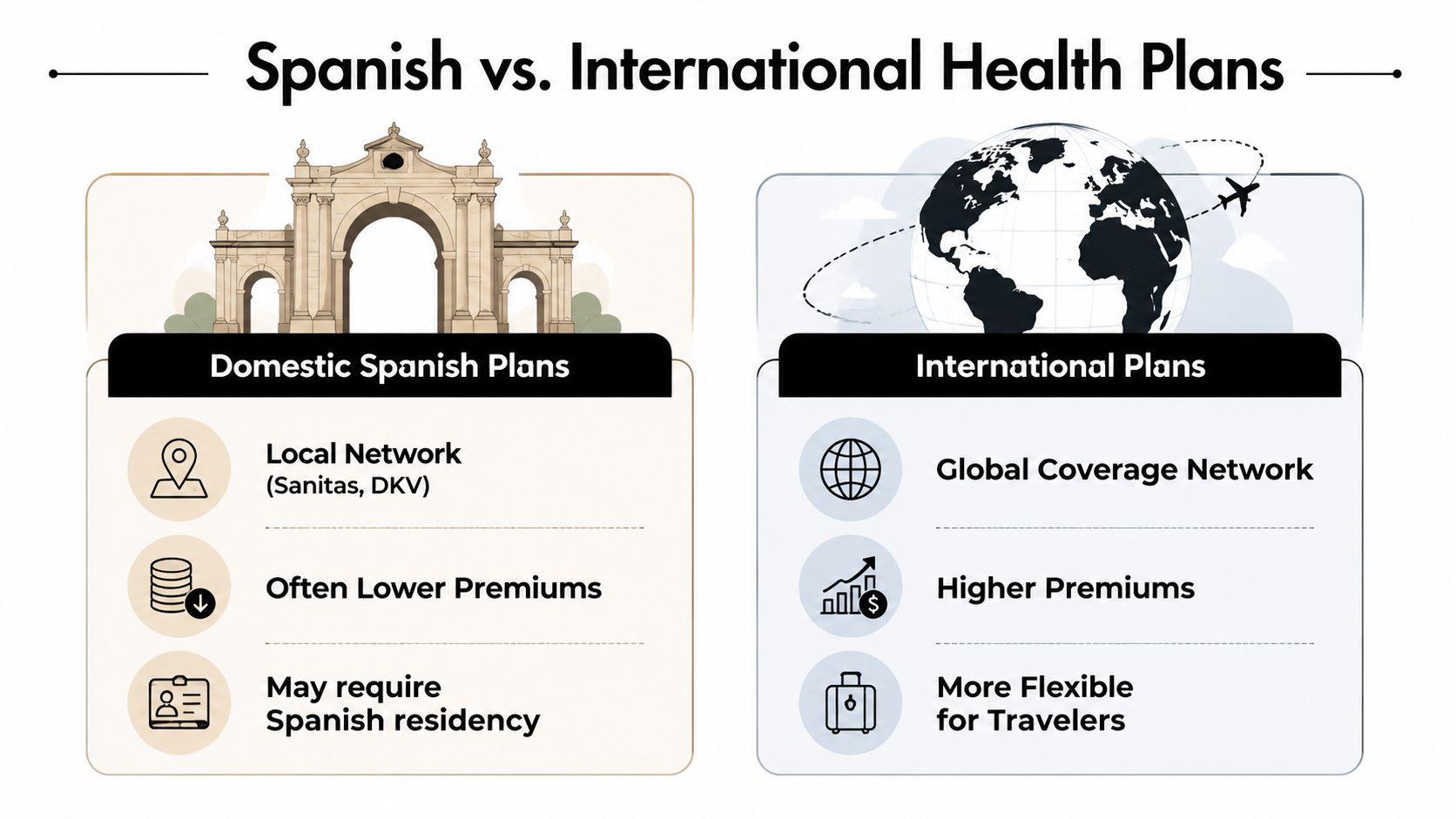
Local carriers, including familiar names such as Sanitas and DKV, generally design their products around treatment in Spain and access to Spanish hospitals, clinics, and specialists. International providers usually focus on wider territorial flexibility, which can suit retirees who divide their time between countries or want access to care outside Spain.
The difference also affects how claims work. A local network plan may require or encourage treatment with participating providers. An international reimbursement plan may allow you to choose a provider and claim eligible costs under the contract. That flexibility can bring higher excesses, deductibles, reimbursement limits, or more paperwork.
The structural trade-off
| Domestic Spanish plans | International plans |
|---|---|
| Built around treatment in Spain | Designed for broader geographic use |
| Often emphasise local hospital networks | May offer reimbursement outside a fixed network |
| Can suit retirees who live mainly in Spain | Can suit retirees who travel or maintain healthcare links abroad |
| May have residency or territorial conditions | May carry higher excesses or deductibles |
These categories describe general structures, not every contract. A policy marketed as international may still restrict routine treatment to particular territories. A Spanish plan may include travel assistance without covering planned treatment abroad.
Your residence pattern should guide the shortlist. A retiree living permanently in Madrid, Málaga, or Barcelona may prefer a domestic policy for a direct route to local specialists. Someone spending extended periods outside Spain should ask about territorial limits, emergency treatment, planned treatment abroad, reimbursement percentages, and currency or claims procedures. Compare the full wording, not only the benefit summary, and use this guide to international health insurance plans when assessing wider territorial cover.
The private market is mature and segmented, with products built around different ages, locations, networks, and medical risks. That maturity has produced choice, but it does not make every policy suitable for an older applicant. Availability and underwriting still narrow the options before premium comparisons become useful.
Medication planning deserves the same attention as hospital access. Retirees who travel should confirm how prescriptions, medical letters, and replacement medication are handled before departure. The FindMyScript travel guide offers practical preparation advice, but your insurer's own terms determine what the policy will cover.
Understanding Age Limits and Entry Caps
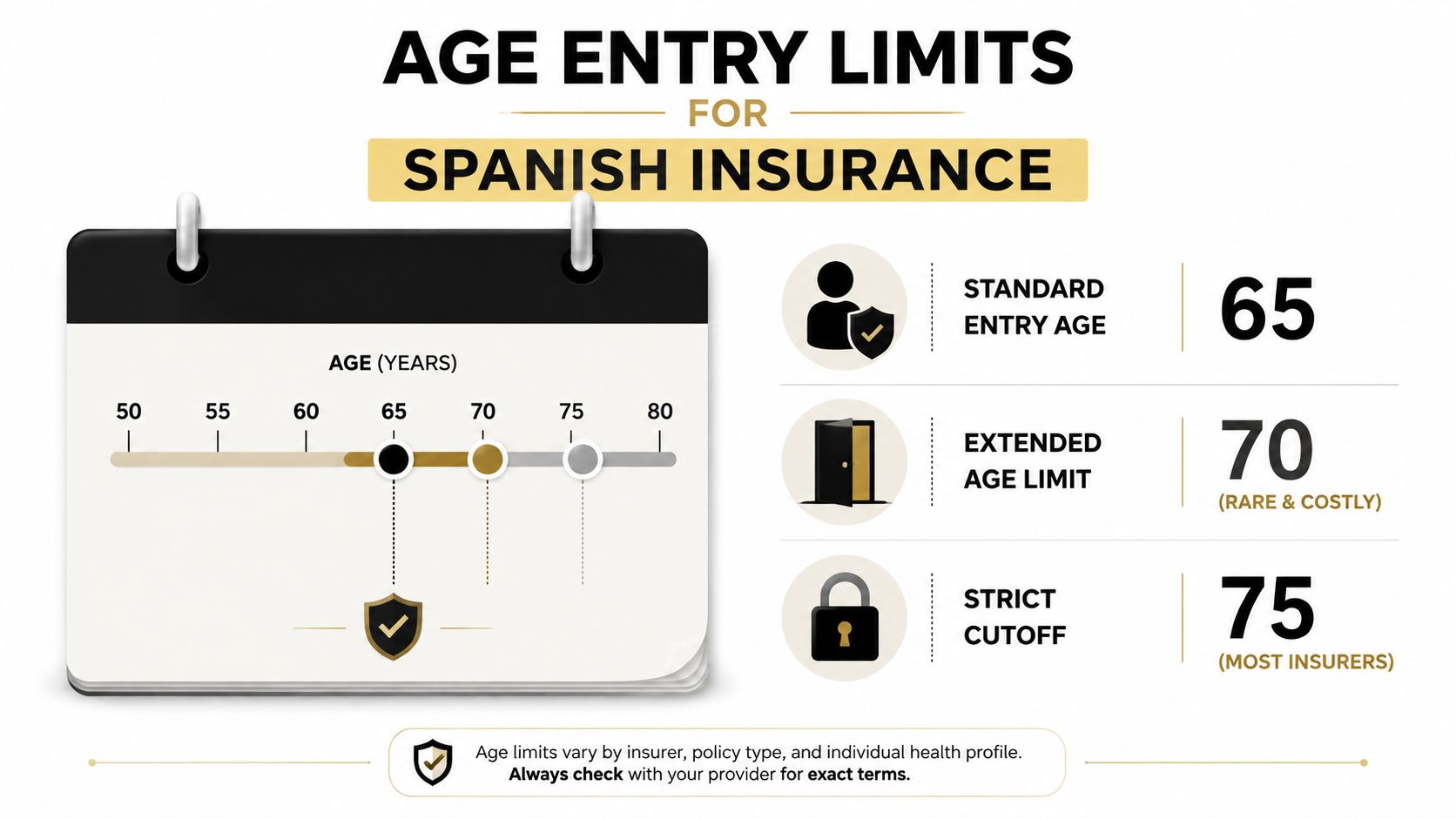
The most important age question isn't “How much will the policy cost?” It's “Will this insurer accept a new application at my age?” Spanish private health insurance doesn't have one universal entry limit. The cap belongs to the policy, and major carriers commonly restrict new applicants to roughly 65–75, with some higher-age options available only through specialist products or individual underwriting, as described in this guide to retirement health insurance in Spain.
That creates the age cliff. Before the standard threshold, you may be able to compare several plan designs. After it, the available pool can become much smaller, and insurers may ask more detailed medical questions or decline higher-risk applicants.
Use an age-first application process
Start with the entry rules, not the brochure benefits. A practical sequence looks like this:
- Confirm your age on the proposed start date. Some applicants compare plans while below a threshold but submit after crossing it.
- Ask whether the limit applies to new applicants or renewals. These are different questions. A plan may restrict entry at an older age while allowing an existing policy to continue.
- Separate standard and senior-specific products. A specialist plan may accept older applicants but use a narrower network or different underwriting terms.
- Request written confirmation of eligibility. A general telephone indication isn't the same as an underwriting decision.
- Prepare your medical information before applying. Missing dates, incomplete treatment details, or unexplained medication can delay the assessment.
The distinction between entry and continuation is important. Many policies renew for life once they're in force and premiums are paid, according to the cited industry guidance. That means a retiree who secures suitable cover earlier may have more certainty than someone who waits until after the insurer's entry cap.
What insurers need from older applicants
Expect questions about diagnoses, medication, previous operations, hospital treatment, ongoing investigations, and regular consultations. Answer precisely. Don't minimise a condition because it feels stable, and don't assume an old procedure is irrelevant without checking the question's wording.
Acceptance is never automatic. An insurer may accept the application, accept it with exclusions, request further information, or decline it. Comparing multiple underwriting appetites is often more productive than repeatedly submitting the same incomplete application to a single provider.
Navigating Pre-existing Medical Conditions
A retiree with controlled diabetes, a past cancer diagnosis, or heart disease may still obtain private insurance, yet the policy could exclude the condition that prompted the application. Spanish insurers do not usually address pre-existing conditions by charging a higher premium. They may exclude the condition and related care from the contract. Availability can also narrow sharply after the age cliff, so an exclusionary offer may be the only private option available rather than a choice between several fully detailed policies.
The practical question is whether the remaining cover serves your needs. A policy may give useful access for unrelated illnesses while excluding chronic management, follow-up appointments, or complications. Review the policy against the care you are likely to need, not only against whether an insurer is willing to issue it.
Disclosure protects the policy
Give the insurer an accurate account of diagnoses, treatment, medication, tests, and unresolved referrals covered by its questionnaire. Do not minimise a stable condition or assume an old procedure is irrelevant. If the medical history was incomplete, the insurer may later argue that the application did not disclose information relevant to a claim.
Read exclusions by the care they affect, not only by the diagnosis named. Check whether the wording includes symptoms, complications, related organs, follow-up consultations, diagnostic tests, or medication. Request written clarification if the exclusion is broad or unclear.
Underwriting insight: An exclusion may be preferable to a rejection when you understand exactly what remains covered.
For a practical checklist of questions and underwriting issues, see this 2026 guide to getting health insurance with pre-existing conditions.
The public pay-in alternative
The Convenio Especial deserves consideration when private insurance is unavailable or leaves too much care outside the contract. Available industry information describes it as accepting applicants with pre-existing conditions, with a cited cost of about €60 per month for applicants under 65 and about €157 per month for those over 65.
This route is part of the public healthcare system. It may not offer the private hospital experience, provider choice, or speed that attracts retirees to private cover. It can still provide a sensible fallback for applicants who are medically declined or would receive major exclusions.
Use this process:
- Map excluded care: List the treatment your private policy would leave outside cover.
- Compare the fallback: Check whether the Convenio Especial meets your essential needs and eligibility.
- Protect continuity: Keep existing cover until replacement arrangements are confirmed.
- Get specialist review: Ask someone familiar with underwriting and public access rules to examine the contract.
Estimating Your Monthly Premium Costs
Age is one of the strongest pricing factors in private health insurance for retirees in Spain. The figures available for 2026 show why a single “average retiree premium” is misleading. Different plans can vary by network, copay structure, benefits, underwriting outcome, and age band.
A 2026 market guide places standard private cover for people in their 60s at about €180–€300 or more per month, while selected plans for 65-year-old profiles start from roughly €24–€67.50 per month. For people over 70, cited comparisons commonly show prices beginning around €43–€101 per month or more, depending on benefits and copays. These ranges come from the senior healthcare and insurance guide from Expatica, and they shouldn't be treated as a personal quotation.
Retiree Health Insurance Cost Estimates for 2026
| Age group | Plan type | Estimated monthly cost |
|---|---|---|
| 60s | Standard private cover | €180–€300+ |
| 65-year-old profiles | Selected plans | €24–€67.50 |
| Over 70 | Selected plans, depending on benefits and copays | €43–€101+ |
| Over 65 | Convenio Especial benchmark | Just over €150 |
The table shows why two apparently contradictory quotes can both be genuine. A low-cost selected plan may use copays, a restricted network, or limited benefits, while a plan with broader access can sit much higher. A retiree applying after an age threshold may also find that the cheaper product is no longer available.
Price should follow protection
Start by deciding whether you need local network access, reimbursement flexibility, no-copay cover, travel protection, or a policy suitable for residency documentation. Then examine the financial mechanics: deductibles, consultation fees, reimbursement ceilings, renewal terms, and exclusions.
The public Convenio Especial costs just over €150 per month for people over 65, providing a useful comparison point rather than an automatic recommendation, as reported in the Expatica senior healthcare guide. A private plan may cost less or more depending on design, but the cheaper premium may transfer cost to copays or reduce provider choice. This explanation of how insurance premiums are calculated can help you assess the quote beyond its first monthly figure.
Taking Action and Securing Your Cover
The strongest application is organised before an insurer's underwriter sees it. Gather identity documents, proof of address where relevant, residency information, prescription details, consultant letters, operation dates, and recent medical history. Don't send a vague summary when the questionnaire asks for specific facts.
A safer application sequence
Begin with eligibility. Give your age, location, intended start date, residency purpose, and desired territory of cover. This quickly removes plans that can't accept you or don't match your intended use.
Prepare the medical questionnaire carefully. Keep medication names, diagnoses, treatment dates, and specialist details together. If you've had a condition monitored rather than treated, explain that accurately rather than leaving the answer ambiguous.
Compare the contract, not the sales label. Confirm the provider network in your area, authorisation rules, exclusions, renewal terms, copays, deductibles, and territorial limits. For a residency application, ask the insurer or adviser to confirm the documentation required by the relevant authority.
Wait for the underwriting outcome. A preliminary quote isn't acceptance. Don't rely on cover until the insurer has issued the policy and confirmed its start date.
Broker support can be practical, not ornamental
An independent broker can submit your circumstances to insurers with different age limits and underwriting approaches, rather than forcing you to repeat the same application blindly. The broker should explain exclusions in plain English, identify missing documents, and distinguish a visa-compliant certificate from a policy that merely provides some medical benefits.
Ongoing help matters too. Retirees may need assistance with renewals, specialist authorisations, claims, or changes in address and residency status. Choose an adviser who explains what happens after the policy starts, not only how to obtain the initial quote.
The central lesson is simple: apply before the age cliff, disclose everything, and judge affordability against usable protection. If private cover excludes the care you're most likely to need, compare the public pay-in route rather than accepting a policy that creates false reassurance.
Bsure Health Brokers compares Spanish and international health plans for retirees, helps organise underwriting information, and supports policy paperwork and ongoing administration. Visit Bsure Health Brokers to request a comparison based on your age, medical history, location, and residency needs.