
You've arrived in Spain, the school paperwork is almost finished, and your child needs a paediatrician. You're comparing insurance quotes, but it's hard to tell whether a lower premium means good value or a bill every time you book an appointment. Before choosing, you need to know what happens on an ordinary sick day, not just during a hospital emergency.
Table of Contents
- Why Private Health Insurance for Children Matters in Spain
- What Child Health Cover Typically Includes
- Family Policies Versus Child Add-Ons
- Understanding Pricing and Age Limits
- Pre-Existing Conditions and Medical Underwriting
- Choosing the Right Benefits and Networks
- The Enrolment Process and Required Documentation
- Continuity, Switching, and Avoiding Coverage Gaps
Why Private Health Insurance for Children Matters in Spain
For an expat parent, choosing private health insurance for children is partly about healthcare and partly about finding your feet. You want to know whom to call, whether you can explain symptoms comfortably, and where your child would go if something more serious happened.
Start by separating your family's public-healthcare entitlement from what you want a private policy to provide. Ask for confirmation of your public access separately, then assess private cover against practical priorities: appointment availability, language support, specialist access, and hospitals near home.
Start with the care you'll actually use
Suppose your child develops recurring ear pain. The useful questions aren't whether the policy includes specialists. Can you book a paediatrician directly? Does the nearby clinic offer appointments in English? Would an ear, nose and throat consultation require a referral or insurer approval?
These are things to verify, not benefits to assume.
- Access: Ask clinics about booking arrangements and current appointment availability.
- Communication: Confirm the doctor's language, rather than relying on a general promise of English-speaking support.
- Purpose: Separate everyday healthcare preferences from any insurance requirements attached to your residency application.
Mental health belongs in this conversation too. California Teen Center's guide to paying for teen mental health is a supplementary resource for parents considering treatment funding, but its California context shouldn't be mistaken for Spanish policy rules.
Practical rule: Build your child's safety net around actual providers and written benefits, not the word “comprehensive.”
The right starting point is a short description of your family's needs. Include regular appointments, existing treatment, travel habits, and the healthcare arrangements you already have. That makes comparing policies more manageable than beginning with a page of unfamiliar insurance terms.
What Child Health Cover Typically Includes
Think of a child's policy as a toolkit. The benefits list tells you which tools might be available; the policy conditions explain when you can use them and what you'll pay. Don't assume every Spanish private policy contains the same equipment.
Check each category separately
Ask for a benefits schedule covering these areas:
- Routine consultations: Paediatrician and GP appointments, including whether sick visits and preventive check-ups have different charges.
- Preventive care: Developmental reviews and vaccinations. Ask separately about the consultation, vaccine product, and administration.
- Specialists and diagnostics: Consultations, blood tests, imaging, and any referral or authorisation requirements.
- Urgent and hospital care: Eligible facilities, admission arrangements, and the process for contacting the insurer.
- Dental and therapeutic care: The specific treatments included, rather than a broad dental or rehabilitation label.
A dental benefit, for example, shouldn't be interpreted as a promise to pay for every dental procedure. Likewise, access to a therapist doesn't tell you whether assessments, ongoing sessions, and related reports are all covered.
The Children Psych California benefits guide offers another resource for thinking about mental-health insurance questions. Use it as a prompt for discussion, not as evidence of what a Spanish insurer must provide.
Separate included care from usable care
Underinsurance means having a policy that still falls short through unaffordable costs, unsuitable provider access, or unmet medical needs. US research summarised by Michigan Medicine on inadequate children's coverage found that around one in three privately insured children was underinsured. That isn't a Spanish estimate, but it's a useful warning against judging protection by enrolment alone.
Ask what happens after repeated appointments, not just the first consultation. Check treatment limits, exclusions, and whether benefits remain affordable throughout a course of care.
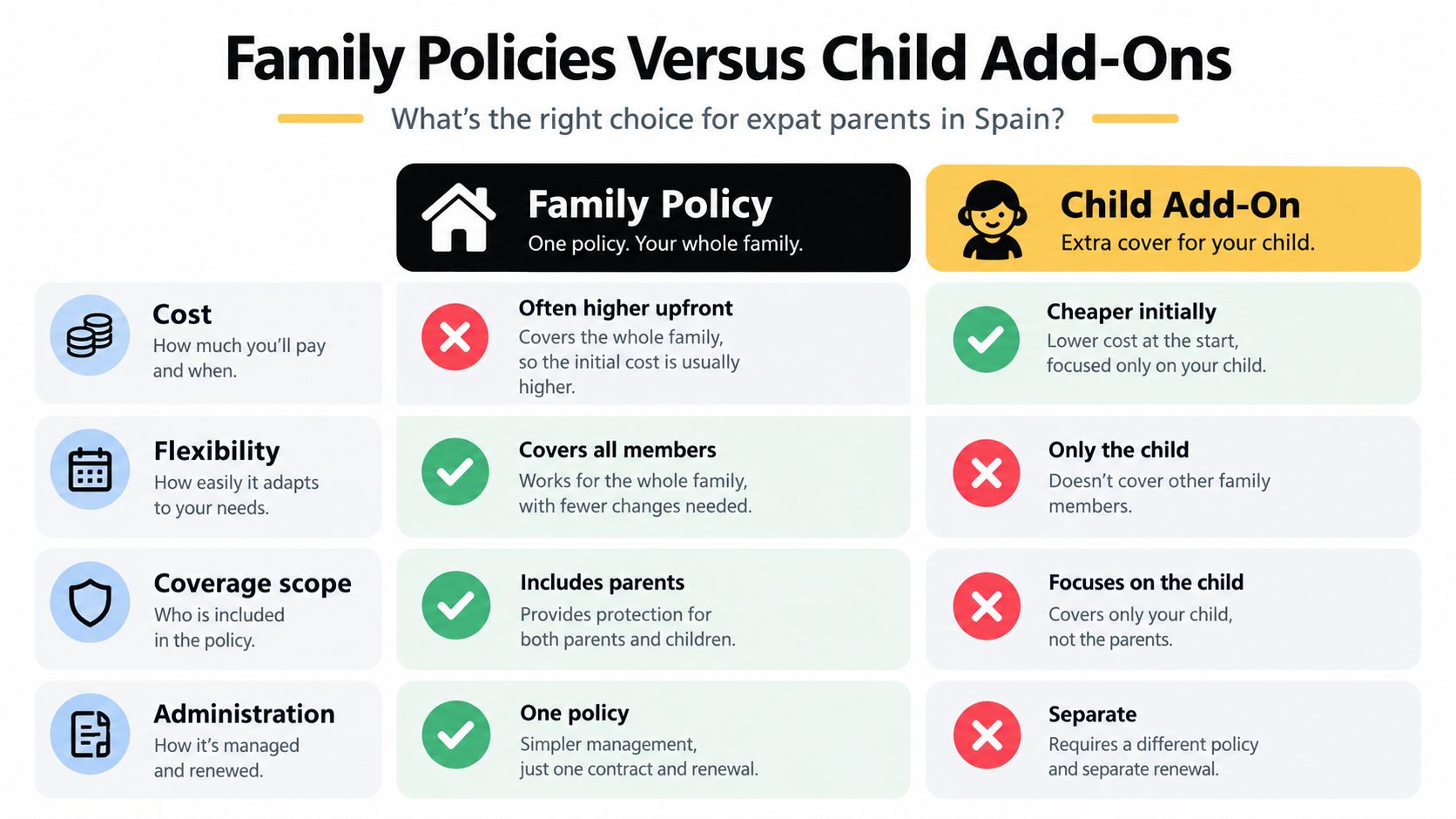
The comparison below introduces another distinction to examine: who shares the contract. Treat it as a discussion aid, not a quotation or guarantee of policy structure.
Family Policies Versus Child Add-Ons
A family policy and a child add-on aren't necessarily competing products. Adding your child may mean including them in an existing family contract. A separate child-only policy is another possibility to ask about, subject to the insurer's eligibility conditions.
Before comparing prices, ask the insurer to describe exactly who holds the contract, who is insured, and whether the child's membership depends on an adult remaining enrolled.
| Decision | Shared family contract | Adding a child to existing cover |
|---|---|---|
| Household fit | Compare when several family members need insurance | Compare when the parent's existing plan already works |
| Administration | Check whether documents and renewals are handled together | Ask what changes to the existing contract |
| Benefits | Verify each person's benefits separately | Confirm the child receives the required paediatric benefits |
| Future changes | Ask whether members can leave independently | Establish what happens if the parent leaves |
Compare the household, not just the child's price
Consider a household where a parent already has suitable employer cover. Moving everyone into a new contract might duplicate benefits. In another household, separate policies could mean different hospital networks and more administrative work.
Neither arrangement is automatically cheaper or more protective. Request comparable quotations with the same benefits and cost-sharing terms, then compare the whole household cost.
For a starting point on shared arrangements, review the family health insurance policy options and ask how the proposed structure would work for your household.
Newborns deserve a separate conversation. Ask whether adding a baby requires an application, what deadline applies, and what conditions govern acceptance. Don't assume a parent's maternity benefit automatically establishes the baby's continuing insurance.
The pricing illustration below is conceptual. It doesn't establish Spanish premiums or prove that prices rise steadily with a child's age. Obtain age-specific quotations instead.
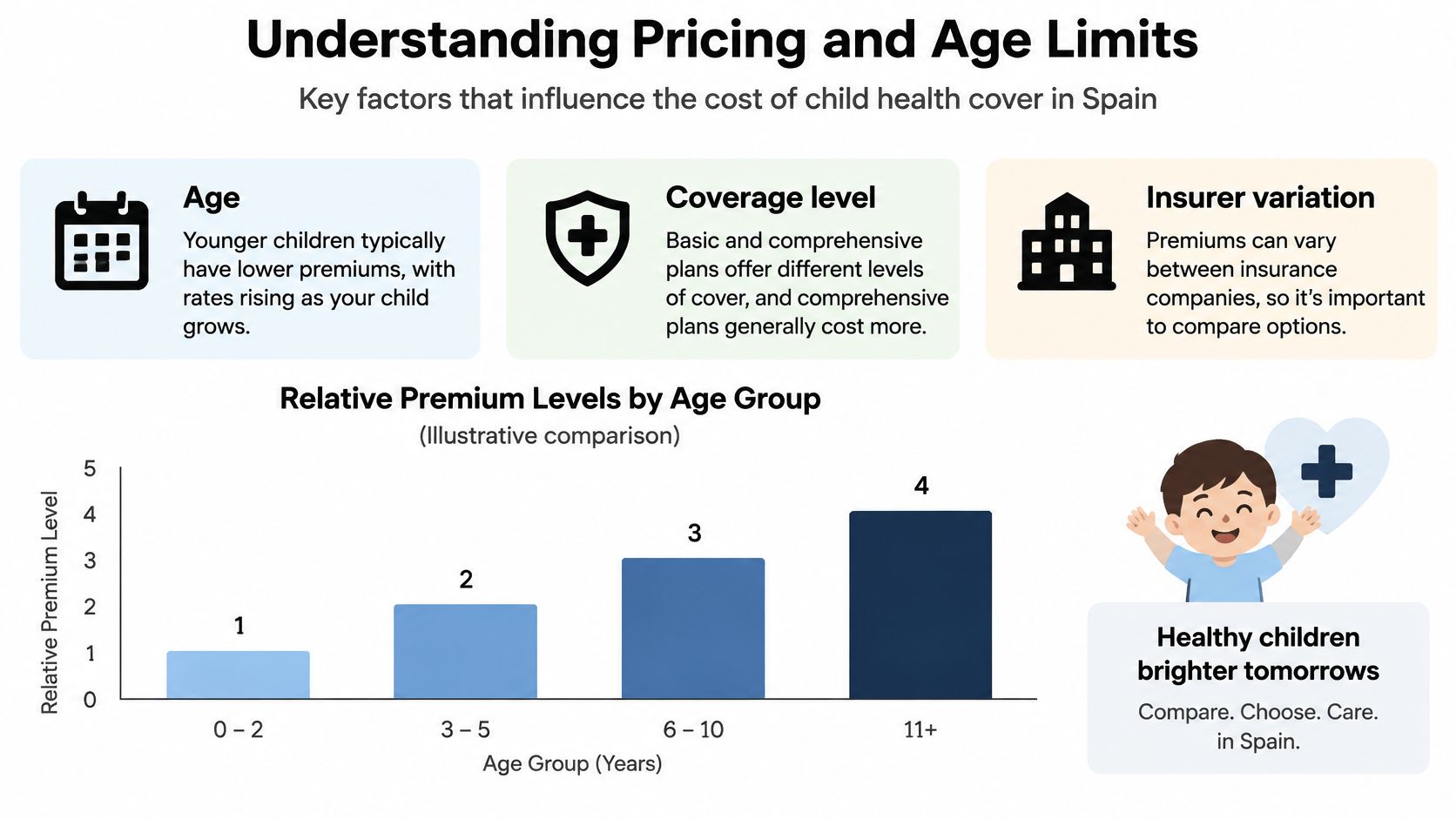
Choose the arrangement that fits your family's administration and healthcare needs. A child's age alone isn't enough to decide.
Understanding Pricing and Age Limits
The premium is the subscription price, not necessarily the total bill. A copayment is a charge attached to an eligible service. A deductible is an amount you must pay before the relevant insurance benefit starts paying, according to the contract.
There's no reliable universal price to apply to every child in Spain. Request a personalised quotation and ask which details affect it, including age, benefits, location, network, medical assessment, and any international component.
Calculate an ordinary year and a demanding year
Use your child's likely care as a budgeting exercise, without inventing a medical forecast.
- Ordinary care: Price the consultations, prescriptions, dental treatment, and check-ups you reasonably expect.
- Repeated treatment: Ask what you'd pay if specialist visits, diagnostics, or therapy continued over time.
- Financial limits: Establish whether out-of-pocket spending has a contractual ceiling and which expenses sit outside it.
An affordability lesson comes from the United States, not Spain: the Census Bureau's health insurance report records private coverage for 61.2% of children under age 19 in 2023, with substantial differences by household income. Those figures don't predict Spanish costs, but they underline why household budget deserves as much attention as the benefits list.
Use the family health insurance monthly cost guide to frame quotation questions, then rely on the insurer's written offer for your actual price.
Ask what changes as your child grows
Request the contract's dependent-child definition, any student-status conditions, and the process for moving to adult cover. Don't import another country's age limits into a Spanish policy.
For families managing disability-related expenses across borders, Guiding Growth's discussion of ABLE accounts and special needs trusts provides a separate financial-planning resource. Those are US concepts, not Spanish insurance benefits; obtain jurisdiction-specific advice before applying them to your circumstances.
Pre-Existing Conditions and Medical Underwriting
Your seven-year-old broke an arm two years ago and the fracture healed fully. The application form still asks about previous operations and hospital treatment. Do you mention it? Yes, and calmly: medical underwriting is the insurer reading the health information you supply before deciding what it will cover and on what terms. It works like a landlord checking references before signing a lease, except here the references are medical records.
A resolved injury and a lifelong condition produce different answers. The insurer's job is to weigh your child's history, and your job is to give it the records to do that fairly.

An application usually follows the same path:
- You complete the health declaration. Answer every question exactly as written, including ongoing symptoms and investigations, and keep specialist letters, operation reports, and medication details nearby.
- The insurer may request more detail. If a question is ambiguous, ask how to answer it and keep the response.
- You receive a written decision. That document, not the acceptance email, sets out what is covered.
The decision itself can take several shapes:
| Underwriting outcome | What it means in practice |
|---|---|
| Standard acceptance | Cover at the quoted premium with no special conditions |
| Exclusion | A named condition, and possibly related symptoms or complications, sits outside the policy |
| Waiting period | A specified benefit becomes available only after a set delay |
| Higher premium | Cover is offered, at a price that reflects the medical history |
| Postponement or decline | No terms are offered now; the insurer may reconsider later |
The exclusion row deserves a second look. "Asthma excluded" and "asthma and related respiratory conditions excluded" are very different offers: a winter chest infection could fall inside the second wording while remaining covered under the first. Ask the insurer to confirm in writing which symptoms, investigations, and treatments each exclusion touches, and remember that a waiting period delays a benefit whereas an exclusion removes it.
The guide to health insurance with pre-existing conditions helps you frame questions before the insurer decides, and a broker can organise the paperwork. Even so, read the completed declaration yourself before signing, because the answers on it carry your name.
One point expat parents often miss: underwriting usually applies person by person. On a family policy, an exclusion for your child does not change your own terms, and a child added to an existing adult policy may be assessed differently from a child on a stand-alone plan. That is also where underinsurance creeps in. Accepting a wide exclusion because it lowers the quote can leave you paying privately for the exact care your child needs most, which defeats the purpose of insuring at all.
Choosing the Right Benefits and Networks
Say your six-year-old needs speech therapy, and the insurer's directory lists three clinics near your home. Does that mean you're covered? Not yet. The directory confirms a clinic exists. Whether your child's policy pays that therapist is a separate question, and so is whether sessions need prior authorisation or how many visits the benefit allows each year.
Checking all of that together is provider verification: matching the clinician, the location, the service, and the payment arrangement to the terms your family bought. A famous hospital name on a brochure proves very little on its own.
Before signing, walk the route from concern to appointment in your head. Who assesses a new worry, and how do you book that first visit? Does a specialist need a referral, and who arranges it? Will the insurer authorise tests or treatment before the clinic schedules them? Does the provider bill the insurer directly, or do you pay up front and claim reimbursement? Can your child use the same service near home and in another part of Spain when you travel? Each answer changes how usable the policy really is.
Two checks expat parents tend to skip: confirm language availability with the practice itself, since directories rarely record which paediatricians consult in English, and treat emergency access and scheduled paediatric consultations as separate questions. Having one confirms nothing about the other.
One more idea worth borrowing from paediatric research is the medical home, a regular primary-care team that coordinates a child's care rather than a building the child lives in. In a pooled US analysis of insurance adequacy and medical-home access, 84.9% of children with adequate insurance and medical-home access had a preventive visit, compared with 72.0% among children with inadequate or inconsistent insurance and no medical home. The study shows an association, so it cannot prove that a particular policy caused the difference.
The question it raises for your family is still practical: who connects the pieces? Ask how test results reach the paediatrician, how specialist recommendations get followed up, and whom you call when two clinics give conflicting instructions. A policy that coordinates routine care is often worth more than a long directory you struggle to use, and underinsurance can hide in a cheap premium just as easily as in a narrow benefit.
The Enrolment Process and Required Documentation
Say you have chosen a policy for your 4-year-old and you want cover to start on 1 September before school check-ups. What happens between saying yes and being able to book? That gap is where expat parents get caught out, because a quote is only an offer, an application receipt only proves you applied, and only the issued policy schedule confirms your child is insured.
Use that distinction to set up a simple folder on your phone or computer. One file for what was offered, one for what you disclosed in the health declaration, and one for what the insurer accepted. In a US analysis of preventive-care access among low-income children, researchers' simulations estimated that enrolling uninsured children would increase well-child visit receipt from 29% to 43%. That model does not describe Spain, but it underlines a point that applies here too. Getting enrolled and getting care are two separate jobs.
Start the paperwork by asking the insurer for its exact list before you send anything sensitive. Most families need the child's passport plus any NIE document requested, the policyholder details and Spanish address, and the health declaration with prior visits or treatment noted. Ask whether records need a Spanish translation. Confirm the payment method and the precise start date in writing.
If you need the policy for a residency file, request the confirmation letter against the requirements for your case at the same time. Vaccination records are often helpful for that first paediatric visit, even when the insurer does not ask for them. Send everything through the insurer or broker approved channel only.
When acceptance arrives, read the schedule line by line against the quote. Names spelled correctly? Benefits as offered? Any medical terms attached? Payment and effective date correct? Raise errors the same day.
Then make care usable for anyone who looks after your child. Save where the member card lives, how to request an authorisation, how to book, and who to call outside office hours.
Keep a family handover note: Record the insurer's contact details, policy reference, chosen clinic, and authorisation process in one accessible place.
Newborn parents get one extra step. Ask for the insurer submission rules in advance for your specific policy. General deadlines you see online do not replace them.
Continuity, Switching, and Avoiding Coverage Gaps
Moving jobs, changing countries, or reviewing the household budget can make an insurance switch sensible. The difficult part is protecting care that's already underway. Continuity means checking both that insurance remains in force and that the next policy supports the treatment your child needs.
US figures illustrate why enrolment shouldn't be treated as a permanent solution. The CDC's early-release health insurance estimates show that children's uninsured share rose from 4.1% in 2021 to 5.6% in 2025, while private coverage increased from 53.8% to 57.0%. These aren't Spanish coverage rates, but they demonstrate that broader private enrolment can coexist with uninsured children.
Compare the handover, not just the replacement premium
Before changing anything, identify what you'd lose. That includes agreed medical terms, access to a particular clinician, and arrangements for ongoing treatment.
A transition from international insurance to a Spanish policy deserves particular care. Compare geographical coverage, planned treatment abroad, reimbursement arrangements, and access during visits to your home country. A more expensive international contract isn't automatically better for everyday local care, and a local policy shouldn't be assumed to replace international benefits.
Travel insurance is another separate comparison. If you're moving to resident cover, establish the new policy's suitability for your actual residency purpose rather than assuming that any medical insurance certificate will do.
Use a continuity checklist
- Obtain written acceptance first: Don't cancel existing insurance while the replacement application is still being assessed.
- Match the dates: Confirm when the new cover becomes effective and when the old insurer would stop providing cover.
- Review new restrictions: Identify waiting periods, exclusions, and any changed treatment limits.
- Protect ongoing appointments: Check the clinician's participation and ask how existing treatment authorisations will be handled.
- Check cancellation terms: Obtain the old contract's notice requirements and cancellation acknowledgement.
- Retain the record: Save both insurers' correspondence and the final replacement documents.
Ask whether any waiver or continuity concession is available, but don't assume previous insurance guarantees it. Rely on written confirmation tied to the proposed contract.
Reduce costs without removing essential protection
Choose savings that fit your child's use of care. A higher deductible or more cost-sharing is only worth considering if the product offers it and your household can comfortably fund the resulting bills.
Similarly, compare a restricted geographical network only after checking where your family spends time. Request any available household discount, but measure the final offer against equivalent benefits rather than the discount label.
| Approach | What you manage | What to verify |
|---|---|---|
| Direct application | Comparing wording, contacting insurers, tracking acceptance | Whether you can obtain clear answers to the difficult questions |
| Broker-assisted application | Supplying accurate needs and medical information | Which insurers are compared, what support is included, and how the broker is paid |
A broker can be useful when the comparison involves medical history, international benefits, or several family members. Ask about fees and remuneration rather than assuming every intermediary works on the same basis; the insurer still makes the coverage decision.
Before committing, bring the decision back to your child: suitable clinicians, affordable repeated care, clear medical terms, and a safe transition. Put renewal reminders in your calendar and review the policy when your family's circumstances change, not only when the premium arrives.
Bsure Health Brokers offers independent comparisons of Spanish and international health insurance, with support for family applications, paperwork, renewals, and policy changes. Visit Bsure Health Brokers with your child's care needs and existing policy details to discuss family cover, child enrolment, and any medical-history questions before choosing or switching.