
You've found a Spanish health insurance policy that appears affordable, then noticed the excess option. The premium drops, but the wording leaves you wondering whether you'll pay once a year, every time you claim, or whenever you're admitted to hospital. If you're also preparing a visa application, managing an existing condition, or arranging cover for an older family member, that small line in the policy schedule can affect far more than your monthly budget.
Private health insurance excess is a practical trade-off between premium cost, access to care, and financial exposure. The right choice depends on how the insurer applies the excess, whether the policy meets your visa requirements, and how much you could comfortably pay when treatment is needed. A policy that looks cheap can become expensive if the excess resets for every claim or treatment episode.
Table of Contents
- Introduction to Private Health Insurance Excess in Spain
- What Private Health Insurance Excess Means and How It Works
- How Excess Affects Your Premium and Out of Pocket Risk
- Real World Examples and Calculations for Expats
- How Excess Interacts With Age Pre Existing Conditions and Visa Rules
- How to Choose the Right Excess for Your Expat Profile
- Final Checklist and How a Broker Helps You Get It Right
Introduction to Private Health Insurance Excess in Spain
An excess is the amount you agree to contribute toward an eligible claim before the insurer pays the remaining covered cost. In everyday terms, you're sharing part of the initial risk with the insurer in exchange for a lower premium. The exact arrangement varies, so the word “excess” alone isn't enough to tell you what the policy will cost in practice.
This matters particularly in Spain because expats often buy insurance for two reasons at once. You may want convenient access to private doctors and hospitals, while also needing evidence of suitable cover for a residence or visa application. A policy with an excess or co-payment may be financially reasonable for an established resident, but it may not satisfy the conditions attached to a particular application.
The term can also mean something different in practical use from one market to another. Australian private hospital insurance, for example, can apply an excess per admission or within a policy-year structure, with the payment linked to the date of treatment. If treatment crosses a renewal date, the same course of care can create another excess obligation under that type of design, as explained by Australia's PrivateHealth.gov.au guidance on managing a policy.
Why the wording deserves attention
The key questions aren't difficult, but they must be answered before you sign:
- How much is the excess?
- Does it apply per policy year, per claim, per person, or per admission?
- Is there an annual maximum?
- Does it apply to outpatient care, hospital treatment, or both?
- Does the policy include co-payments as well?
- Will the insurer issue wording accepted for your visa application?
Deductibles have become a mainstream feature of private insurance in major markets. In the United States, 41.7% of privately insured people under 65 were enrolled in a high-deductible health plan in 2023, while the median annual individual deductible among private-industry workers in those plans was $2,500, according to AHRQ's Medical Expenditure Panel Survey report. Spain's products and visa rules aren't identical, but the underlying lesson is useful: the premium is only one part of the cost.
What Private Health Insurance Excess Means and How It Works
Think of a restaurant bill shared between you and the insurer. You agree to pay the first part of the eligible bill, and the insurer pays the covered balance according to the policy terms. If the treatment isn't covered, falls within an exclusion, or requires a referral you didn't obtain, the excess doesn't turn an excluded service into an insured one.
The basic process usually follows four steps:
- You receive eligible treatment. The service must fall within the policy's covered benefits and comply with its conditions.
- The insurer assesses the claim. It checks the treatment, provider, authorisation, exclusions, and applicable limits.
- You pay the excess. The payment may go to the medical provider, hospital, or insurer, depending on the arrangement.
- The insurer pays the balance. It pays only the covered amount left after applying the excess and any other cost-sharing.
The important detail is how often the excess is charged. A policy can apply it once during a policy year, each time you make a claim, or for each admission or treatment episode. Independent guidance notes that insurers use different structures, so buyers must verify the frequency rather than assume that “annual excess” is standard. The distinction can be especially important for expats comparing policies quickly, as explained in this guide to health insurance excess frequency.
Excess, deductible, and co-payment
In many insurance conversations, excess and deductible mean broadly the same thing. Both describe an initial amount you pay before the insurer contributes. Spanish policy documents may use terms such as franquicia, exceso, or copago, so ask the broker or insurer to translate the financial effect, not just the word.
A co-payment works differently. Instead of paying an initial amount before cover begins, you may pay a fixed contribution for each consultation, test, or service. A policy can contain both an excess and co-payments, which is why “no excess” doesn't automatically mean “no out-of-pocket costs.”
Read the schedule, not only the headline
Look for phrases such as:
- “per insured person per policy year”
- “per claim”
- “per admission”
- “subject to an annual cap”
- “outpatient excess”
- “hospital excess”
- “co-payment applies”
If the wording isn't clear, request written confirmation before purchase. A low premium is useful only if you understand the occasions on which you'll have to provide additional money.
For a broader explanation of related terms, see this health insurance terminology guide. It's often easier to compare policies after you've separated the excess from co-payments, exclusions, waiting periods, and benefit limits.
How Excess Affects Your Premium and Out of Pocket Risk
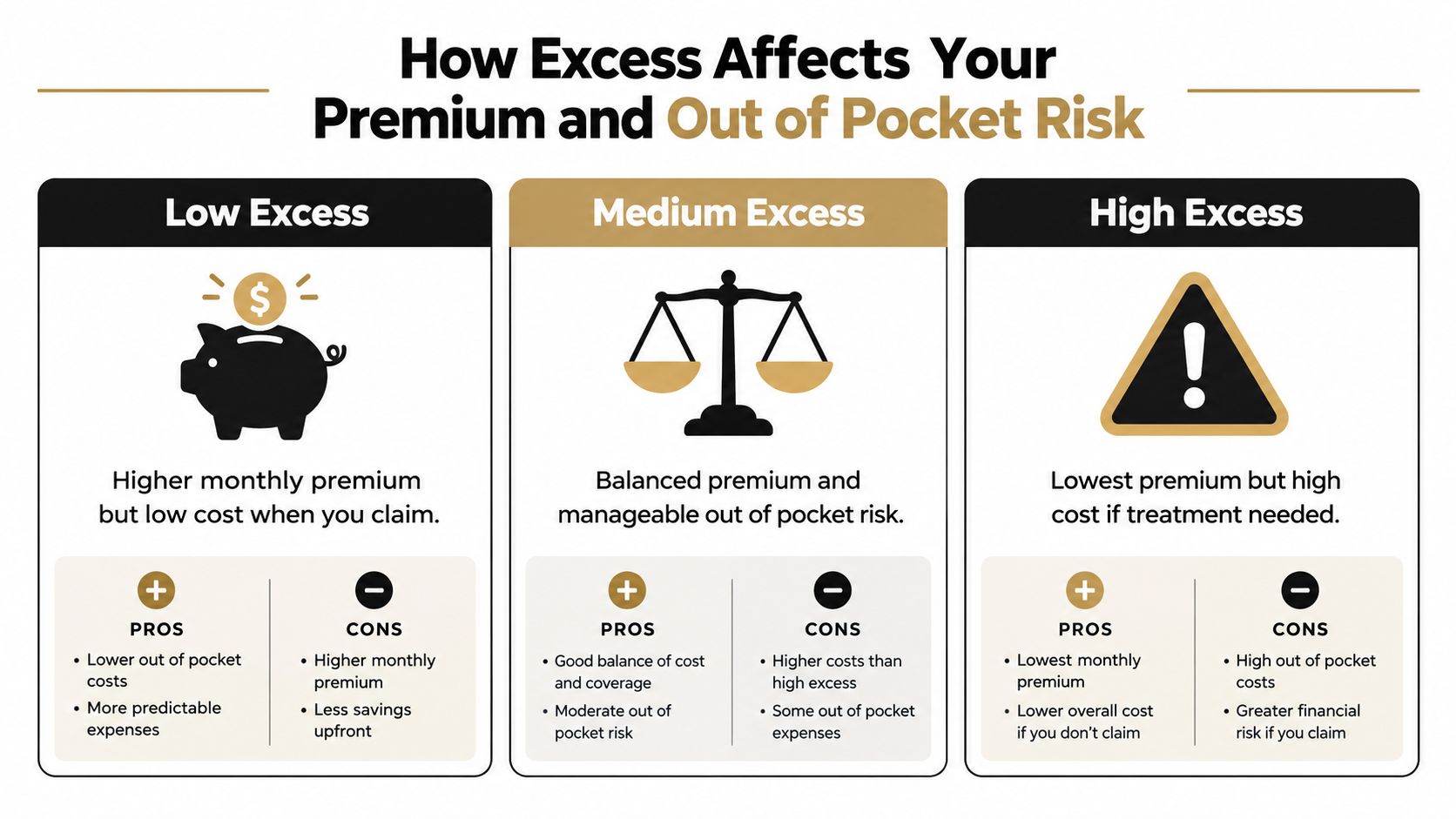
Insurers generally charge less when you accept more initial financial responsibility. From their perspective, a higher excess reduces the amount they pay on smaller or early claims. From your perspective, it can make regular premiums easier to manage, but it transfers more risk to the day you need treatment.
The best option isn't automatically the lowest or highest excess. It's the option whose possible claim cost fits your finances and expected use of healthcare.
| Excess level | Premium effect | Best for | Watch out for |
|---|---|---|---|
| Low | Usually higher | People who want predictable claim costs | You may pay more even in a year when you don't claim |
| Medium | Often balanced | Residents seeking a compromise between monthly cost and treatment exposure | Check whether the excess resets per claim |
| High | Usually lower | People with spare savings who expect limited use | A serious or recurring condition can make the upfront cost difficult |
Why framing can change behaviour
The structure affects more than arithmetic. Research from the Netherlands compared a deductible with a no-claims refund and found that average annual healthcare expenditure was about 8.6% lower under the deductible design. The study on deductible framing and healthcare expenditure suggests that people may respond differently when they face an immediate payment than when they receive a later rebate.
That doesn't mean an excess is suitable for everyone. It means the way a policy presents cost-sharing can influence how people use care. Some buyers may postpone a consultation because they're concerned about paying the excess, even when early medical advice would be sensible.
Use a simple affordability test
Ask yourself three questions:
- Could I pay the full excess promptly if a significant claim arose?
- Would paying it affect rent, school fees, or essential living costs?
- Am I choosing the excess because it suits my expected healthcare use, or only because the premium looks attractive?
You can compare the premium difference against your likely cash exposure with a health insurance premium calculator. Treat the result as a planning aid, not a substitute for checking policy wording. The calculation is meaningful only when you know whether the excess applies once per year or repeatedly.
Real World Examples and Calculations for Expats
Worked examples expose the traps that a headline premium can hide. The figures below illustrate how an excess operates, rather than predicting what any particular Spanish insurer will charge.
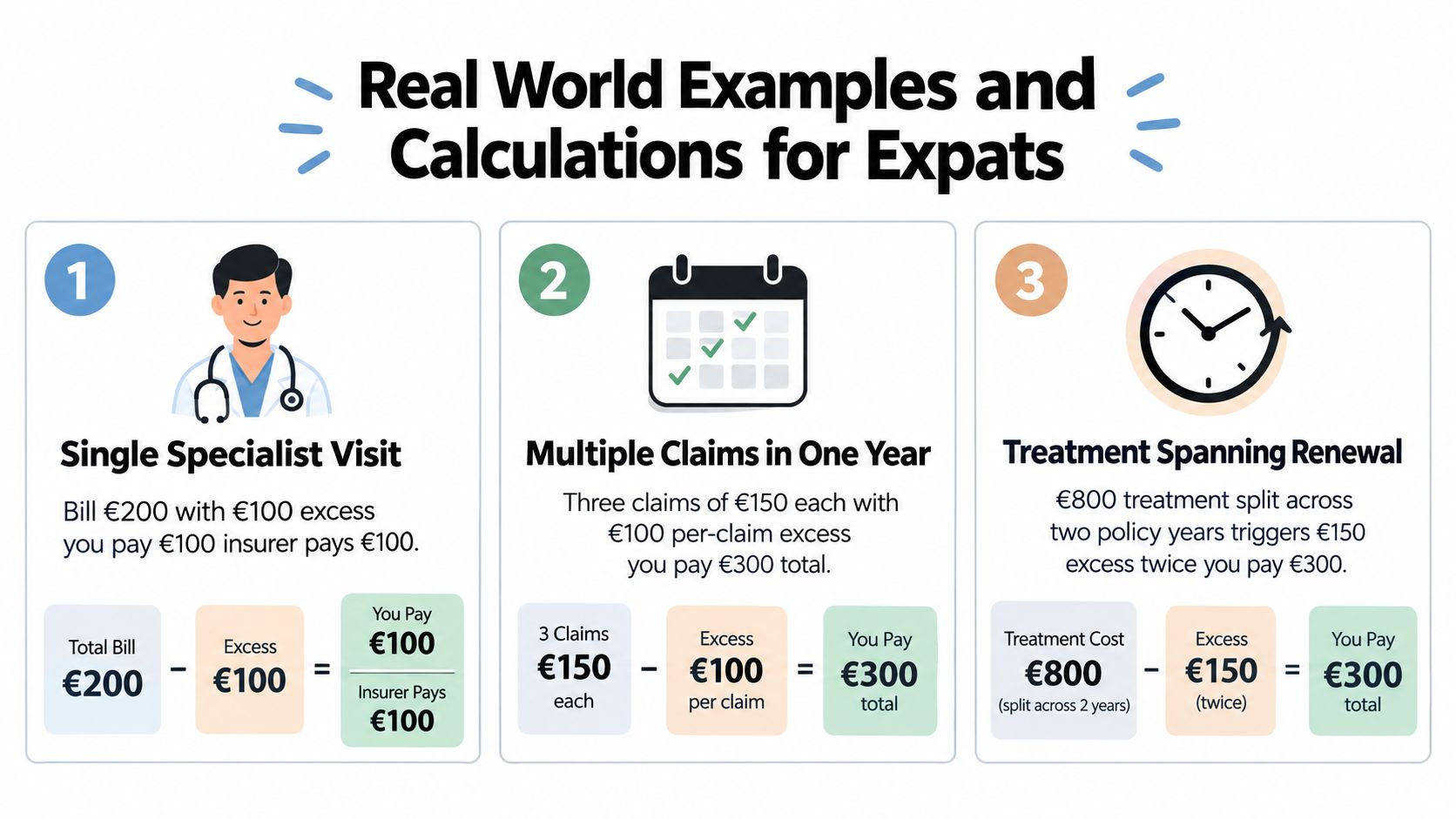
A single specialist visit is the simplest case. If the eligible bill is €200 and the policy excess is €100, you pay €100 and the insurer pays €100, assuming the service is covered and all authorisation rules were followed. If the bill is lower than the excess, you may pay the whole eligible amount yourself.
Several claims during one policy year
Suppose you have three unrelated eligible claims, each costing €150, and the policy applies a €100 excess per claim. You'd pay €100 for each claim, making your total contribution €300, while the insurer would pay the remaining covered amount.
That outcome differs sharply from a policy applying one excess per policy year. Under an annual model, the first eligible claim might trigger the excess, while later eligible claims could be covered without another excess, subject to the policy's exclusions, limits, and authorisation conditions. Never assume that “per year” applies because the policy renews annually. Confirm how the insurer defines the claims year.
Treatment crossing a renewal date
Timing can create another surprise. If an €800 course of treatment spans two policy years and the policy applies a €150 excess in each year, the same clinical episode can trigger the excess twice. Your total contribution would therefore be €300, assuming both parts are treated as claimable under the policy structure.
Practical rule: Ask whether the excess is triggered by the admission date, treatment date, invoice date, claim date, or policy renewal date.
These examples also show why a policy with a cheaper premium may have a higher effective cost for someone who uses healthcare several times. Add the premium to every excess payment you might realistically face, then check whether the policy imposes separate co-payments, benefit limits, or referral requirements.
A lower premium can be good value only when the claims structure remains affordable for your pattern of care.
How Excess Interacts With Age Pre Existing Conditions and Visa Rules
The advice to choose a higher excess for a lower premium suits someone expecting little healthcare use and holding enough savings for the first bill. It becomes less suitable when you need regular treatment, monitoring for a serious condition, or care for an older family member.
Recent claims evidence shows why applicants with higher healthcare needs should look beyond routine consultations. QBE's 2025 Accident & Health Market Report announcement on the rise of high-cost claims reports that circulatory claims rose almost 60% after COVID, while neoplasms remained the predominant excess-loss claim across deductible levels. This cannot predict your medical future, but it shows the risk of choosing an excess from the premium quotation alone.
Age changes the affordability calculation
Older applicants may find fewer products, different underwriting decisions, or premiums reflecting wider health risks. A high excess can make a policy look affordable at purchase, then create a difficult bill when investigations, specialist reviews, or hospital treatment become more likely.
Applicants aged over 65 or 75 should ask whether the same excess options remain available at renewal. Check whether age-related changes can affect the premium or benefits. If you are moving to Spain with a partner, compare each person's exposure because the excess may apply per insured person, not once for the household.
Pre-existing conditions require precise questions
A condition disclosed during underwriting may be excluded, accepted with a specific limitation, or covered after further assessment. The excess does not change that decision. Ask for written clarification covering the condition, related symptoms, follow-up tests, medication, and possible complications.
Waiting periods also need separate attention. A benefit may become available later rather than from the policy start date, while an excess may apply after the waiting period ends. Keep the insurer's acceptance terms with the policy schedule. This helps you tell the difference between an excess, an exclusion, and a waiting period.
Visa compliance comes first
Applicants for Spain's Non-Lucrative and Digital Nomad visas are commonly asked for private health insurance meeting specific consular conditions. In practice, this often means no excess and no co-payments, although the exact requirement can depend on the application route and the authority reviewing the documents. A policy described as “full cover” may still fail the relevant checklist.

Request a certificate and policy wording prepared for the application. Check that the documents state the required absence of cost-sharing. A lower premium has little value if the certificate does not support your visa file.
How to Choose the Right Excess for Your Expat Profile
Start with your purpose for buying cover. A healthy professional already living in Spain may prioritise a lower recurring premium and accept a carefully limited excess, provided there's an emergency reserve. A family with children may prefer predictable costs because consultations and minor illnesses can occur at inconvenient times.
Retirees need a different test. Consider regular prescriptions, specialist monitoring, planned procedures, and the possibility that a per-claim excess could recur. For applicants over 65 or 75, ask about renewal terms, medical underwriting, age-related premium changes, and whether the excess remains available throughout the policy's life.
A profile-based approach can help:
- Young, healthy professional: Compare a low and medium excess, then check whether outpatient consultations trigger it. Don't choose a level you couldn't pay quickly.
- Family with children: Examine whether each family member has a separate excess and whether multiple claims create repeated charges. A higher premium may buy more predictable day-to-day access.
- Retiree or person with ongoing care: Focus on claim frequency, specialist access, waiting periods, and condition-specific terms before considering premium savings.
- Visa applicant: Treat compliance as the first filter. Remove policies with excesses or co-payments if your application requires full cover without them.
Policy wording checklist
Before accepting a quotation, request clear answers to these points:
- Is the excess per person, household, year, claim, admission, or episode?
- Does it apply to outpatient services, inpatient treatment, or both?
- Is there an annual cap on total excess payments?
- Are co-payments charged separately?
- Do you need a referral before seeing a specialist?
- Which hospitals and doctors are inside the approved network?
- What are the emergency-care rules?
- Which pre-existing conditions are excluded or restricted?
- What waiting periods apply?
- Will the insurer provide documentation suitable for your visa route?
Read the answers alongside the benefit schedule, not just the marketing summary. If two insurers use similar words but different claim mechanics, compare the likely out-of-pocket pattern rather than the premium alone.
Final Checklist and How a Broker Helps You Get It Right
Before signing, confirm the excess amount and its trigger. Check whether it resets per policy year, claim, admission, or person, and look for any annual cap. Then review co-payments, exclusions, waiting periods, referral rules, emergency limits, and the hospital network.
Pay special attention to conditions that are easy to overlook in a quotation. A policy may restrict a pre-existing condition, require prior authorisation for planned care, or treat out-of-network treatment differently. Visa applicants should also confirm that the certificate and wording meet the requirements of the relevant Spanish authority, particularly where zero excess and no co-payments are expected.
An independent adviser can compare these details across Spanish and international insurers rather than presenting the cheapest headline premium. A broker may also help request underwriting decisions for disclosed conditions, organise paperwork, explain renewal changes, and identify whether a product works for a retiree, family, resident, or visa applicant. For context on the adviser's role, see this explanation of what a health insurance broker does.
Write down the maximum amount you could comfortably pay, then reject any policy whose excess structure exceeds that comfort level. The right cover should remain usable when you're ill, not merely affordable on the day you buy it.
Bsure Health Brokers compares Spanish and international policies, including no-excess and excess options, and helps expats check claim rules, medical terms, and visa documentation. Visit Bsure Health Brokers for personalised guidance on choosing cover that fits your healthcare needs and budget in Spain.