
You've found a flat in Marbella, booked your visa appointment and been told that private health insurance may be part of the paperwork. Then the questions start. Does the policy need to have no co-payments? Are waiting periods acceptable? Will the insurer cover a condition you've already declared? Does a Spanish policy still help if you move elsewhere?
Learning how to buy private health insurance in Spain means solving those practical questions in the right order. The cheapest quote isn't useful if its certificate fails a consulate's requirements, and a broad international policy may be unnecessary if you only need reliable access to Spanish hospitals. The right purchase balances immigration rules, healthcare needs, budget, age, medical history and the risk of future premium increases.
Table of Contents
- How Buying Private Health Insurance Works for Expats in Spain
- Choosing Between National and International Cover in Spain
- What You Need Before You Get Quotes
- Completing Your Application and Activating Cover
- Managing Renewals Claims and Switching Providers
- Common Pitfalls to Avoid and Your Next Steps
How Buying Private Health Insurance Works for Expats in Spain
A typical newcomer starts with a simple assumption: choose a familiar insurer online, pay the premium and download a certificate. That approach can work for a straightforward resident application, but it often breaks down when the visa requires cover without co-payments or waiting periods. A policy can look generous in a sales summary while still containing an excess, delayed benefits or wording that doesn't satisfy the relevant authority.
Private cover matters even in countries with public healthcare. OECD data on private health insurance shows that private insurance accounts for about 10% of all health spending on average across OECD countries, while in a third of OECD members it covers at least 30% of the population. The role differs between countries, but the lesson for expats is consistent: private cover may supplement public care, provide faster access, or be required to establish residence.
Spain's public system remains central, yet newcomers may face registration delays, eligibility questions or a need to show private cover before they can complete their immigration process. Insurers also vary in how they handle English-language support, direct access to specialists, hospital networks and applications from older applicants.
What visa-compliant cover really means
Visa rule: A compliant policy must match the wording and conditions required for your specific application. “Private health insurance” on its own isn't enough.
Start by identifying the purpose of the policy. A non-lucrative visa, family application, student arrangement and residence renewal may involve different documentary expectations. Your broker or immigration adviser should confirm the requirement, while the insurer must issue a certificate that accurately reflects the cover. Don't rely on a generic marketing page or assume that a policy suitable for a resident will satisfy an initial visa application.
A practical workflow usually looks like this:
- Confirm your visa or residence route and the people who must be insured.
- Gather identification, address and medical information.
- Decide whether Spanish national access or international portability matters more.
- Request comparable quotes, not isolated prices.
- Check co-payments, waiting periods, exclusions, hospital access and certificate wording.
- Complete underwriting, pay the first premium and verify the active start date.
- Keep the policy documents available for the visa appointment and future claims.
An independent health insurance broker can translate those requirements into a shortlist instead of leaving you to compare incompatible policies. The useful service isn't just sending several prices. It's checking whether the policy works for your intended immigration route and whether the benefits remain practical after approval.
Choosing Between National and International Cover in Spain
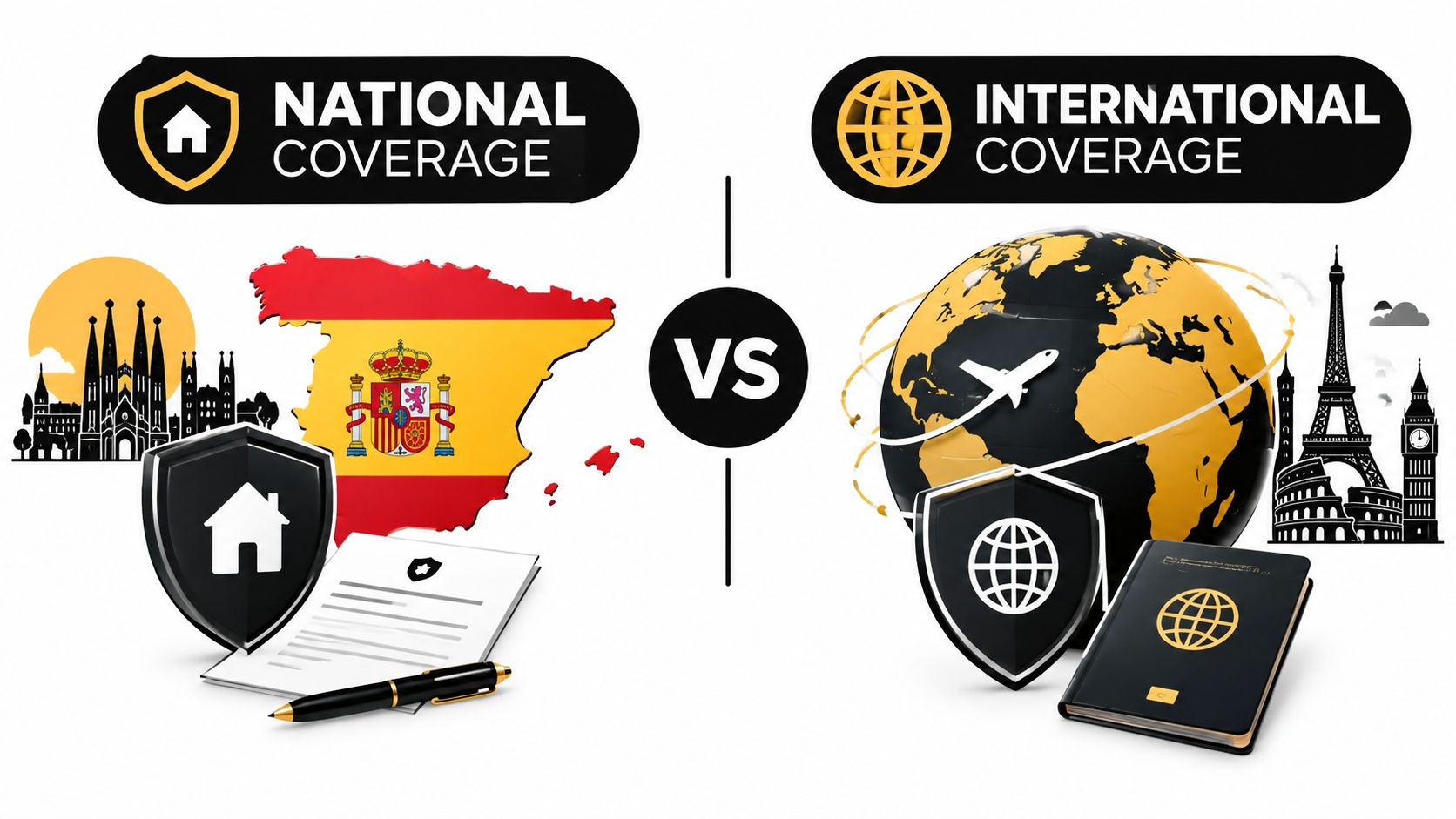
Spanish national plans are designed primarily around treatment in Spain. They can be a sensible choice for someone who lives here permanently, uses local hospitals and wants a focused network. International plans generally place more emphasis on portability, overseas treatment and support for people whose lives span several countries.
Neither category automatically wins. A retiree settling permanently on the Costa del Sol may value local hospital access and predictable Spanish administration. A consultant who spends extended periods in different countries may accept a higher premium for broader geographical protection. Families should also consider whether children need treatment abroad, whether both parents travel frequently and how easily the insurer handles claims in English.
Compare the features that affect daily use
| Feature | Spanish National Plans | International Plans |
|---|---|---|
| Main treatment area | Spain-focused networks and providers | Wider geographical options, depending on the selected area of cover |
| Hospital access | Strong local relevance and established Spanish provider relationships | Useful where treatment may be needed across borders |
| Language support | May vary by insurer and service channel | Often designed for internationally mobile members, but support standards still vary |
| Portability | Usually less suitable if you relocate permanently | Often better suited to moves between countries, subject to policy terms |
| Pre-existing conditions | Underwriting may lead to exclusions, surcharges or refusal | May offer more specialised international underwriting, but isn't automatically more permissive |
| Visa suitability | Can be appropriate when it meets the required conditions | Can be appropriate only if its wording and territorial terms satisfy the application |
| Best fit | Permanent Spain residents seeking local value | Mobile families, international workers and people prioritising cross-border access |
Visa applicants need to be particularly careful. A plan with co-payments may reduce the quoted premium, but it may not meet the requirement for full cover. Waiting periods can create a similar problem. Even if the insurer accepts your application, a consulate or immigration authority may expect immediate access to the benefits described in the certificate.
For applicants over 65 or 75, availability and underwriting deserve early attention. Some insurers place age limits on new applications, while others assess health conditions individually. Families with known medical issues should avoid choosing a policy solely because it appears inexpensive. The insurer's decision on exclusions, loading, waiting periods and renewal terms matters more than the headline price.
Match the policy to your likely life in Spain
Ask where you'll receive care. If the answer is mostly private hospitals and specialists in Spain, a national plan may offer the cleaner fit. If you'll divide your time between Spain and another country, ask whether the international policy provides genuine treatment access or only emergency assistance outside Spain.
Also check practical details that brochures tend to compress: direct specialist access, diagnostic testing, outpatient limits, mental health benefits, physiotherapy, maternity, dental options and emergency repatriation. International cover can be valuable, but it's wasteful if you pay for territories and services you won't use. Conversely, local cover can become restrictive if a future relocation is likely.
What You Need Before You Get Quotes
Good quotes start with good information. Prepare your passport, NIE details, visa or residence route, Spanish address and requested start date before contacting insurers. If your NIE hasn't been issued yet, ask how the insurer will identify you temporarily and whether the final certificate can be updated later.
Medical information needs equal care. Insurers ask about diagnoses, symptoms, medication, consultations, investigations and previous treatment because underwriting depends on the actual risk, not just your age or occupation. Hiding a condition may produce a faster quote, but it can create a dispute when you later claim for related care.

Build a clean medical summary
Write a short timeline for every relevant condition. Include the diagnosis, current status, medication, recent consultations, planned follow-ups and whether treatment is ongoing. Attach supporting reports where available, particularly for chronic conditions such as diabetes, cardiovascular disease or cancer.
The issue is significant for older expats and families moving with established healthcare needs. Bupa's 2025 insights on international health cover discusses the growing relevance of ageing expatriate populations and chronic disease, including obesity and type 2 diabetes. It also notes that GLP-1 treatments can be costly, with coverage often limited to clinically appropriate type 2 diabetes cases. That doesn't determine your individual outcome, but it shows why a medical declaration needs detail rather than a one-word answer.
Underwriting may lead to several different outcomes:
- Standard acceptance: The insurer covers the applicant under the policy's ordinary terms.
- Specific exclusion: A known condition or related treatment isn't covered.
- Premium adjustment: The insurer charges more to reflect the assessed risk.
- Waiting period: Certain benefits begin only after the stated period.
- Declined application: The insurer decides it can't offer the requested cover.
Don't treat an exclusion as a minor footnote. Ask whether it applies only to the diagnosed condition or also to related symptoms, tests and complications. Ask whether the insurer will reconsider it after a period of stable health, although no review is guaranteed.
Request genuinely comparable quotes
Give every insurer the same requirements. State whether the policy is for a visa, whether co-payments are acceptable, whether you need international cover, which family members are included and whether you require repatriation. Ask for the full terms, not only a price and a benefit summary.
A useful quote request asks:
- Does the plan include co-payments, an excess or annual deductibles?
- Which benefits have waiting periods?
- What exclusions apply after medical underwriting?
- Is direct access to specialists available?
- Which Spanish hospitals and clinics participate?
- Is emergency treatment outside Spain included?
- Is repatriation included, and under what conditions?
- How are premiums reviewed at renewal?
- Can the policy remain valid if you change country?
- What wording appears on the certificate for the visa file?
You can also use a health insurance premium calculator as an initial budgeting aid, but an indicative result isn't a final underwriting decision. The quote-ready pack should contain your identity documents, residence details, medical summary, coverage requirements and deadline in one message. That gives a broker or insurer enough context to compare like with like.
Completing Your Application and Activating Cover
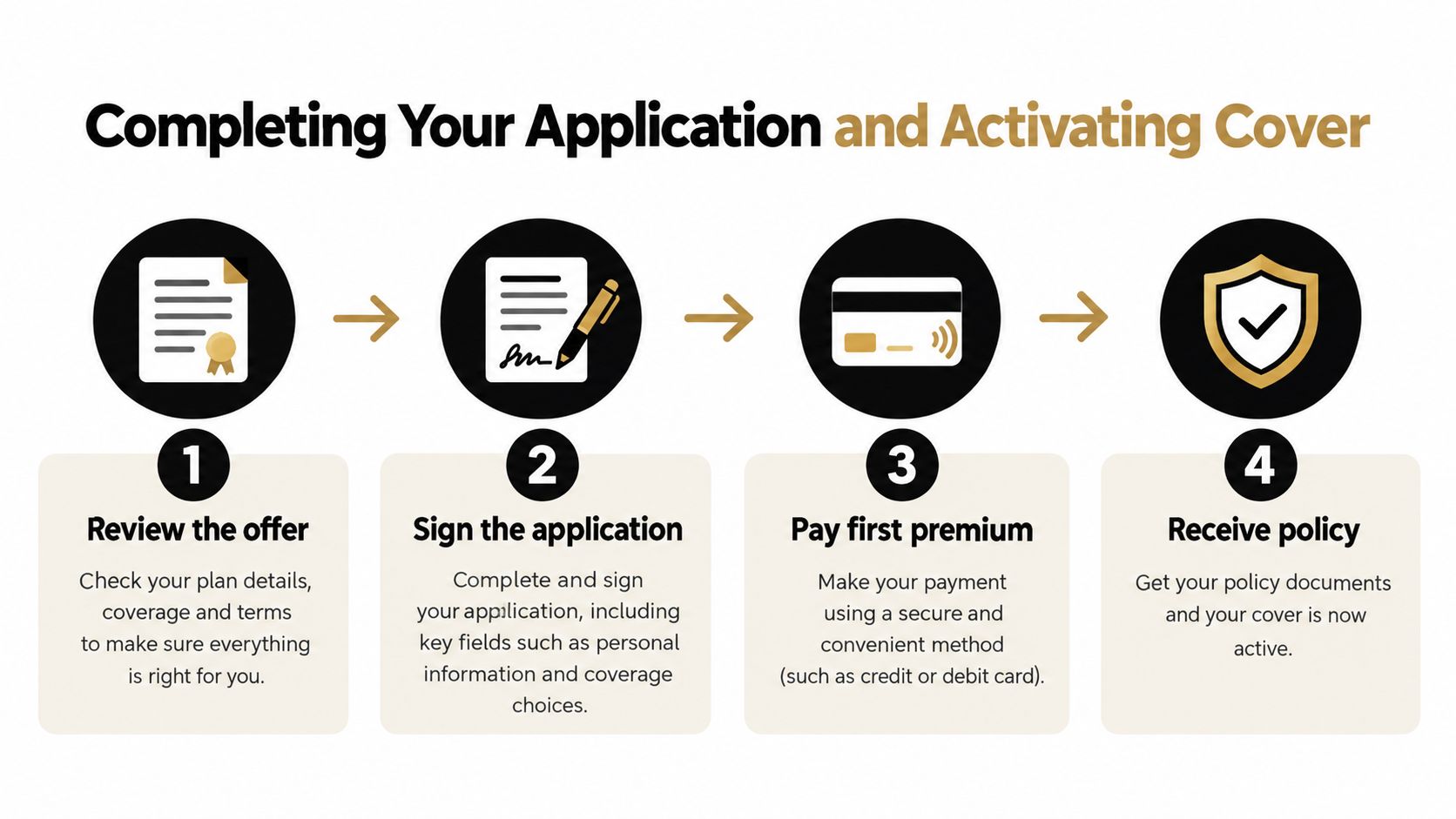
The application stage is where a promising quote becomes a binding contract. Read the offer beside the application form and policy conditions. Confirm the insured names, dates of birth, address, coverage area, plan level and requested start date before signing.
Review before you sign
Look specifically for the items that are easy to miss in a polished quotation:
- Co-payments and excesses: Check whether you pay a fixed amount per visit, service or claim.
- Waiting periods: Identify the benefits that aren't immediately available.
- Medical exclusions: Read the exact wording and ask how related treatment is treated.
- Territorial limits: Verify whether cover is Spain-only, Europe-wide or global.
- Hospital access: Confirm the facilities you'd realistically use near home.
- Visa certificate: Make sure the document reflects the conditions requested by the authority.
Complete the health declaration yourself and answer every question carefully. If a question is unclear, ask the broker or insurer before submitting it. Don't assume that a condition is irrelevant because you haven't needed treatment recently. A truthful declaration allows the underwriter to make a clear decision and gives you a record of what was disclosed.
The wider private market illustrates why plan type and enrollment route matter. In the United States, Congressional Research Service data recorded 189.4 million people with private health insurance in the first quarter of 2022, including 124.9 million in self-insured group plans, 46.5 million in fully insured group plans and 18.0 million in nongroup plans. Spain's purchasing process is different, but the broader lesson applies: the channel and contract structure affect eligibility, administration and cost.
Pay and verify the policy
Once the insurer accepts the application, arrange payment using the method requested. A Spanish bank account may simplify recurring direct debit, but ask what alternatives are available if your account isn't open yet. Keep proof of the first payment and the insurer's confirmation.
Before attending a visa appointment, obtain:
- The policy certificate with the correct personal details.
- The effective date and confirmation that cover is active.
- The terms showing whether co-payments and waiting periods apply.
- Evidence of payment if requested.
- Contact details for claims and customer support.
- Any health cards or digital access instructions.
If timing is tight, don't wait until the day before the appointment to discover that underwriting is incomplete. An insurer may need clarification about a medical answer, and a certificate can't accurately confirm active cover until the policy has been accepted and paid. A broker can coordinate the questions, documents and corrections, but you should still check the final certificate yourself.
After activation, download the insurer's app if one exists, save the emergency number and learn whether referrals are required. Find out how to search for English-speaking doctors and whether the hospital can bill the insurer directly. A policy only becomes useful when you know how to access it.
Managing Renewals Claims and Switching Providers
Buying the policy is the beginning of the financial relationship, not the end. At renewal, assess what you'll pay, what has changed and how much care you could fund yourself if benefits were reduced. A low starting premium can become poor value if the insurer raises prices sharply or trims practical benefits.
Medical-cost pressure is a real renewal issue. The 2025 Global Medical Trend Report projects global medical-benefit cost growth of 10.3% in 2026, following 10.0% in 2025 and 9.5% in 2024. Its projection for 2026 also reaches 14.0% in Asia Pacific and 11.9% in Latin America. Those figures aren't a forecast specifically for every Spanish policy, but they underline why renewal inflation and benefit erosion belong in the original buying decision.

Read the renewal as a new decision
When the renewal notice arrives, compare the new premium with the previous one and inspect every benefit schedule. Check hospital lists, outpatient limits, therapy allowances, prescription treatment, excesses and any changes to access rules. Ask whether the increase reflects age, general medical inflation, a plan change or another underwriting factor.
Annual renewal question: “If I stayed with this policy for another year, what would my likely out-of-pocket exposure be, and what has changed since last renewal?”
Telemedicine can be useful for minor concerns, follow-up questions and routine guidance, particularly for people living far from a preferred hospital. It doesn't replace physical examination, diagnostic testing or specialist care. Modular benefits can also make sense when you want to add or remove dental, optical or other options, but only if the saving outweighs the extra administration and the remaining core cover still suits you.
Claims and switching require timing
For a claim, follow the insurer's procedure rather than assuming every provider bills directly. Ask whether you need prior authorisation, a referral, an appointment number or an invoice. Keep reports and receipts, and record the date of every call. English-speaking support is valuable when a hospital admission or specialist referral involves unfamiliar Spanish terminology.
Switching can be attractive after a renewal increase, poor service experience or a change in where you live. The risk is losing continuity. A new insurer may reassess your medical history, apply exclusions or impose waiting periods, even if your previous policy covered the condition. Never cancel the existing plan until the replacement has been accepted, paid and confirmed as active.
Before moving, ask for written confirmation of any waiting-period waiver or continuity arrangement. Compare the new provider's exclusions with your existing benefits, especially if you've developed a condition since the original application. Guidance on changing healthcare providers is most useful when it considers both the price and the medical consequences of moving.
Common Pitfalls to Avoid and Your Next Steps
Most expensive mistakes happen before the first claim. A visa applicant chooses a plan with co-payments because the premium is lower, a family overlooks waiting periods, or an applicant answers the medical declaration too quickly. Another common error is comparing only this year's premium and ignoring how renewal terms, age and medical-cost pressure may affect the policy later.
Use this short check before committing:
- Visa compliance: Confirm the policy meets the exact requirement for your route.
- No hidden cost sharing: Check co-payments, excesses and deductibles in the full terms.
- Immediate access: Identify waiting periods and verify the certificate's wording.
- Complete health disclosure: Declare diagnoses, medication, tests and ongoing care accurately.
- Suitable provider network: Check hospitals and specialists near your Spanish home.
- Renewal exposure: Ask how premiums and benefits may change over time.
- Continuity protection: If switching, secure acceptance before cancelling the old policy.
Families should compare the needs of each member rather than assuming one plan level suits everyone. Retirees should begin underwriting discussions early, especially when age or chronic conditions may limit availability. Applicants with serious pre-existing conditions need a written explanation of exclusions and alternatives, not vague reassurance.
The practical next step is simple. Gather your documents, write your medical summary, state your visa deadline and request like-for-like comparisons. A broker-led process can reduce paperwork, identify policy wording that creates immigration problems and keep track of renewals or changes after activation. You'll make a better decision when you judge the policy by its usable cover, not its opening price.
Bsure Health Brokers compares Spanish and international health insurance for expats, including visa-compliant policies, family cover, older applicants and medically underwritten cases. Visit Bsure Health Brokers to request impartial guidance on suitable plans, paperwork, activation and future renewals.