
Have you priced what your family will spend on healthcare across a normal year, a difficult year and the next renewal, or have you only compared monthly premiums?
An English-speaking couple in Spain recently found an attractive adult rate online, multiplied it by the people in their household and used that figure to plan their budget. The family quote came back differently. Their surprise was understandable: they were already juggling visa paperwork, wanted reliable access to a paediatrician, and worried that choosing the cheapest policy could leave a hospital bill they hadn't planned for.
The private health insurance cost for a family in Spain isn't one adult price repeated across a household. Age, cover, location and what the policy leaves out all matter. By the end, you'll be better equipped to tell whether a monthly figure reflects your family's likely costs, identify what drives the quote and give an insurer the details needed to price it accurately. Comparison-site averages can be useful as a reference, but they don't account for your family's ages, region, excess or chosen add-ons.
Table of Contents
- Why a Family Quote Rarely Matches the Advert
- How Spanish Family Premiums Are Built
- Age Bands That Move a Family Price
- Single Cover Versus One Family Plan
- Sample Family Costs Beyond the Monthly Premium
- How to Get a True Family Quote and Pay Less
- Your Next Step to a Family Premium That Fits
Why a Family Quote Rarely Matches the Advert
A low adult rate can look reassuring until you apply it to a family. Each person has a different place in the insurer's pricing calculation, and a family contract may have its own rules for children, co-payments and cover. Multiplying one advertised rate by everyone in the home doesn't reveal those differences.
The useful question isn't “What's the monthly premium?” It's “What might we pay when we use the policy?”
That matters especially when you're new to Spain. A policy that appears affordable may not satisfy a visa requirement if the consulate expects particular cover, or it may include cost-sharing that wasn't obvious in the advert. A family with a child who needs a paediatrician also needs to check the hospital and doctor network, not assume that a low premium means convenient access.
The advertised premium is only one part of the household budget. Co-payments, medicines, dental or optical care, excluded treatment and limits on certain services can add costs during the year. A policy can still be good value, but only if you understand which expenses stay with your family.
This guide will help you assess the quote as a household cost, rather than a catchy monthly number. You'll see how Spanish family premiums are assembled, how to use age-based averages as a rough check, and how to think through routine care, a heavier-use year and renewal. Then you can prepare a clear request for quotes, so the comparison reflects your family's needs instead of a generic adult rate.
How Spanish Family Premiums Are Built
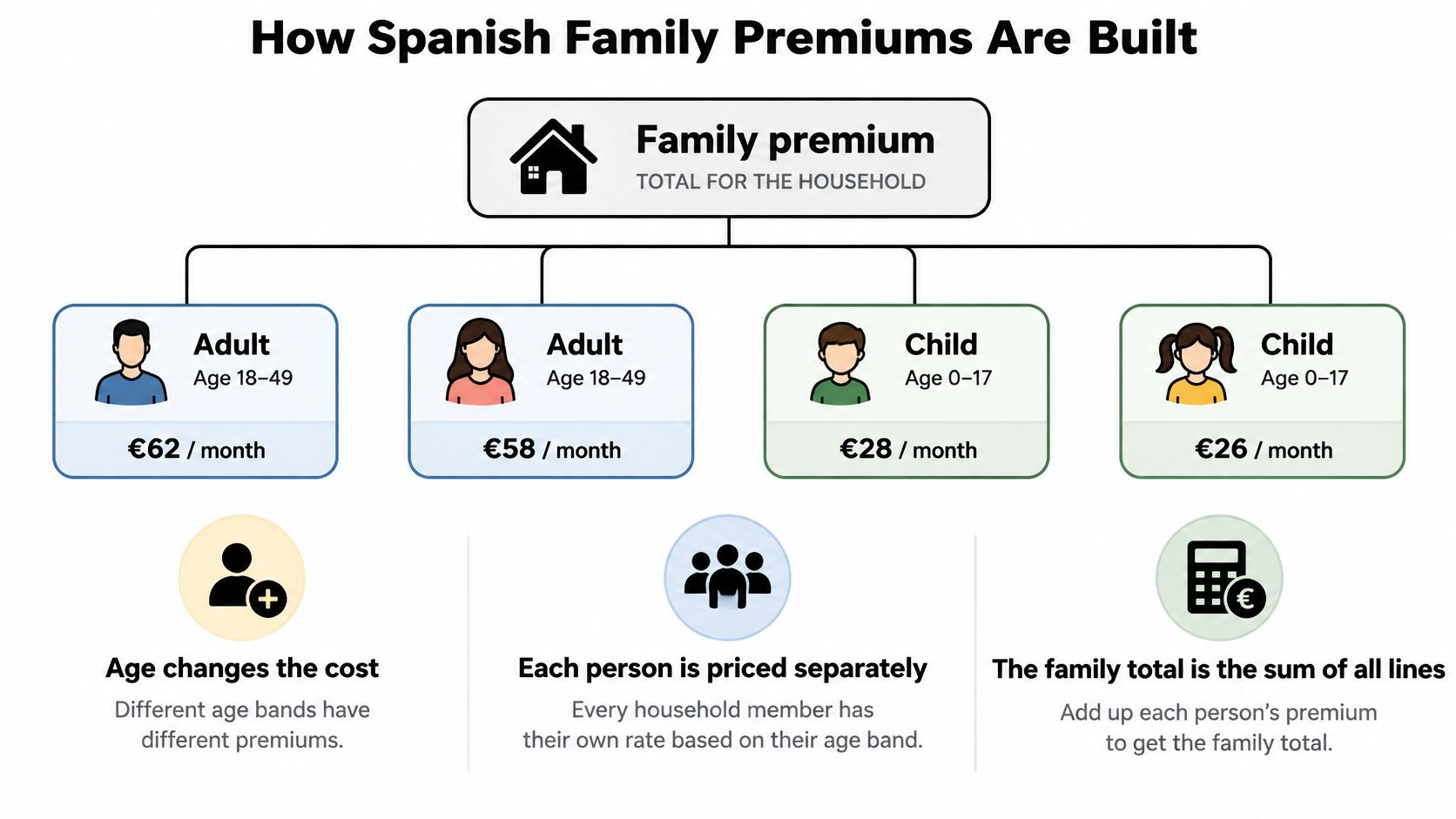
Think of a family premium as a household budget with a separate line for each insured person, followed by adjustments for the contract you choose. The first line to examine is age. Insurers generally price adults by age band, so an older parent can affect the total more than adding a young child. The exact result depends on the insurer and plan.
The number of people matters too, but a child isn't priced as another adult. Children change the contract and may be subject to different co-payment rules or family discounts. Ask how the insurer has priced every member rather than relying on a per-person figure in an advert.
Cover level and how you use care
A basic Spanish network plan can cost less, but it limits you to the insurer's cuadro médico, its directory of doctors and hospitals. A fuller national network may give you more choice within Spain. An international or reimbursement plan can suit families who want access beyond one insurer's network, though wider choice may come with a higher premium.
An excess or co-payment changes the balance between the monthly bill and the cost of using care. A copago means you pay a stated amount when you use particular services; an excess may leave you responsible for eligible expenses up to a defined level. These arrangements can lower the premium, but they increase what you pay at the point of care. If a visa application requires a policy without co-payments or an excess, choosing the cheaper arrangement can create a costly paperwork problem.
Location also matters. The same household and cover level can be priced differently across provinces, partly because plans may use different hospital networks. Finally, check add-ons rather than assuming they're included: dental, optical, maternity, mental-health services, repatriation and travel cover can each change what the policy provides and what you pay.
Read a quote as a set of line items. If the insurer can't explain what's driving the total, ask for a clearer comparison before deciding.
Age Bands That Move a Family Price
Insurers price each family member separately, then add the results. That is why the headline average is a weak guide. A Spanish comparison-site picture for full cover in 2025 put the average at about €74 a month, yet the age spread behind it is wide: under-25s averaged about €59, people aged 35–44 paid around €77, the 45–54 band averaged €91 and those 55 and over averaged €125. (ThinkSpain's guide to private health insurance costs in Spain)
| Age band | Approximate monthly premium | What it means for a family quote |
|---|---|---|
| Under 25 | €59 | A younger adult's indicative price, not a universal child or family rate |
| 35–44 | €77 | A useful reference for a parent in this age range |
| 45–54 | €91 | A higher reference band that can shift the household estimate |
| 55 and over | €125 | A substantially different line from a young adult's |
Here is how the age mix works in practice. Say one parent sits in the 35–44 band, the other in 45–54, and a younger family member falls under 25. A sensible paper check adds the three reference figures, roughly €227 a month, rather than multiplying the €74 average by three. Treat that sum as a starting range only. Underwriting, postcode, co-payments, how children are included and the choice between a Spanish network and international cover can all move the final quote away from it.
Price a normal year, a bad year and renewal
A monthly figure tells you what a quiet year costs. It says nothing about the other two scenarios you should budget for. In a normal year you pay premiums plus the occasional co-payment. In a bad year, when someone needs surgery or ongoing treatment, the excess and excluded services come into play. The same 2025 data put Spanish households' health-related out-of-pocket spending at about €576, covering care their policies did not pay for.
Renewal is the third scenario. Premiums get repriced as your family's age mix shifts, so a parent crossing into the next band raises the household total even when nothing else changes. Ask any insurer for the per-person age-band breakdown and a view of how the price moves at renewal. When we run family quotes, that breakdown and the forward projection are the first two things we request, because a cheap first year can hide an expensive fifth.
Single Cover Versus One Family Plan
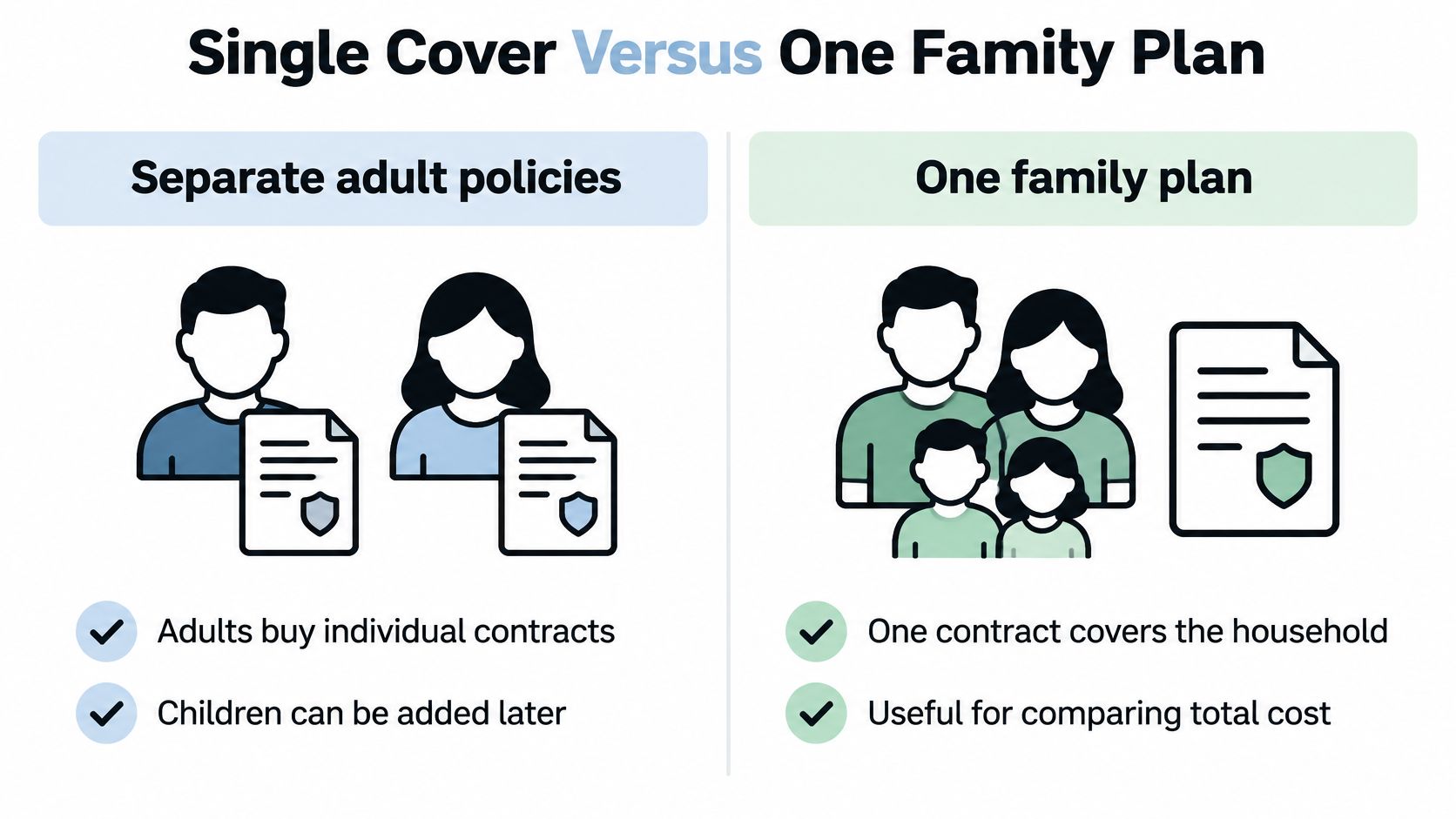
Separate adult policies and one family contract can both make sense. The right choice depends on how your family uses care, whether children need to join the same network and how much admin you want to manage. Compare the terms, not just the combined monthly price.
| Separate adult policies | One family plan |
|---|---|
| Adults hold individual contracts, with the option of adding children later | One contract covers the household |
| Each adult can choose a different cover level or network | One set of policy terms may make benefits and administration easier to track |
| A parent's age-band change may affect their policy separately | The quote shows the family's combined price in one place |
| You may manage different renewals and waiting-period rules | One renewal and a shared hospital network may simplify paperwork |
For newcomers handling visa or NIE applications, having one contract can make it easier to keep policy details and renewal information together. But it doesn't automatically mean better value. Check whether paediatric care is available on the chosen network, whether children have co-payments and whether a family discount changes the actual quoted total.
For help assessing benefits as well as premiums, use this guide to comparing health insurance plans. Ask the insurer to show what's included for every family member and whether waiting periods differ by person or service.
A US employer benchmark offers scale, not a Spanish price guide. KFF reported that employer-sponsored family cover averaged $26,993 a year in 2025, nearly 2.9 times the average for single coverage, while employers paid most of the family premium. (KFF's 2025 employer health benefits survey) That employer subsidy isn't a direct comparison for a private buyer in Spain. The lesson is simpler: family cover isn't necessarily the single rate multiplied by the number of people.
Stay with separate policies if adults need different networks or cover and the children's arrangements are clear. Ask for a family contract when you want to compare one household total, keep administration together or make sure everyone can use the same network. Before choosing, compare the full terms and the expected cost of using care.
Sample Family Costs Beyond the Monthly Premium
A family's age mix gives you a starting point, but the plan's cost-sharing and exclusions determine what happens when somebody needs care. The following examples don't assign invented insurer prices. They show how to organize a quote into three pots: the premium, predictable care spending, and a heavier-use year.

A couple in their thirties with two young children
Start with the premium the insurer quotes for each adult and each child. Then list predictable expenses such as co-payments, medicines, dental visits and optical care. In a heavier-use year, check whether a specialist appointment, mental-health service or treatment outside the network carries a limit or isn't covered.
A lower-cost Spanish-network plan may fit well if its paediatricians and hospitals are convenient. If the family would rather choose doctors outside that network, an international or reimbursement plan may cost more in premiums while offering broader access. Compare the trade-off with the hospitals you'd use.
A parent in their mid-forties with school-age children
For this household, don't assume the children determine the premium on their own. Price each person according to the insurer's quote, then separately estimate routine use and a year with more specialist care or medicines. Check dental and optical benefits too, because families can easily mistake an add-on for full cover when it has limits.
At renewal, ask how the premium changes if a family member's birthday moves them into another age band. A policy that fits today's budget still needs to make sense when its price is reviewed.
An adult aged 55 or over with a dependent
The older adult's quoted premium can carry more weight than the dependent's, so ask for a person-by-person breakdown. Add regular medicine and co-payment costs to the normal-year pot. For a bad year, ask what happens if care involves a specialist limit, a mental-health cap or treatment excluded by the policy.
If you're considering cover without copayments, compare the terms against the higher monthly premium rather than assuming one structure is always cheaper. This guide to no-copayment health insurance can help you identify what to check. The personal question is: what will we spend in a normal year, a bad year and at renewal?
How to Get a True Family Quote and Pay Less
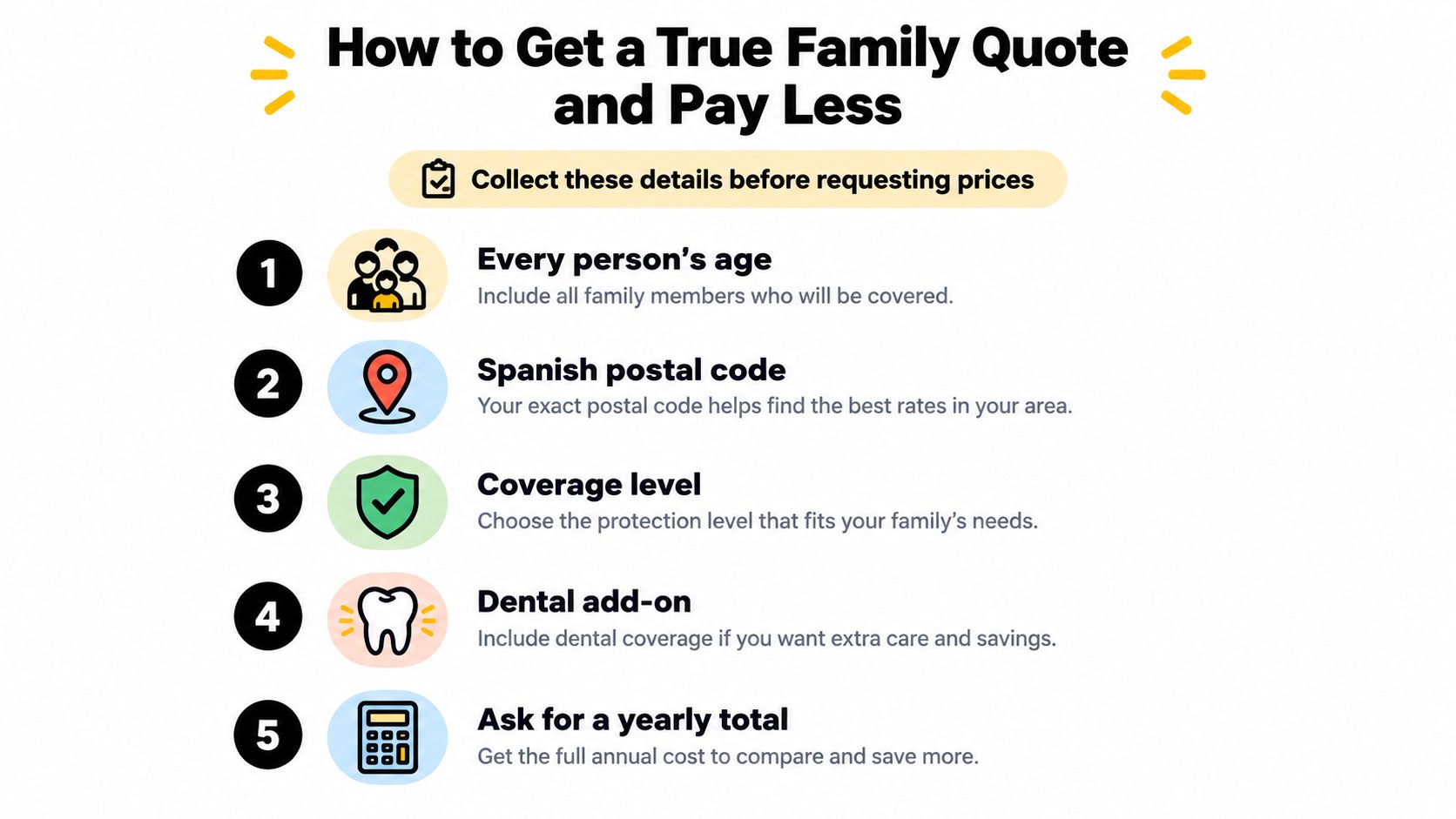
An accurate quote starts with accurate household details. Gather the information below before requesting prices, and give the same details to every insurer or broker so you can compare like with like.
- Every person's age: Include each adult and child. Don't ask for one generic family rate.
- Spanish postcode: The insurer needs to know where you live to check the available network and pricing.
- Visa or NIE requirements: Say clearly if your application requires full cover without co-payments or an excess.
- Current cover and renewal date: This helps you discuss continuity, timing and any switch.
- Medicines and care needs: Mention regular prescriptions and the services you want to use.
- Must-have hospitals and languages: Name the providers your family wants and say which languages matter.
Then ask the questions that reveal the terms behind the premium. What waiting periods apply? Are maternity, dental and optical included, and what limits apply? Are mental-health services restricted? Does the plan include repatriation? What excess or co-payments would you face during routine appointments and a hospital stay?
Reduce the bill without buying the wrong cover
A lower premium is useful only if the arrangement still works for your family. If your visa doesn't rule them out, consider whether sensible co-payments suit your likely use of care. If you already pay a clinic for dental treatment, check whether you need a dental add-on. Match the hospital network to the city where you live, and review add-ons at renewal instead of letting them roll on without checking.
A premium calculator can help you prepare a starting estimate, but it can't replace a written quote with the policy terms. For context on planning for other family financial needs alongside healthcare, see this resource on protecting young families with term insurance.
Bsure Health Brokers is an independent, DGSFP-registered brokerage based in Marbella and serving families across Spain. The team compares Spanish and international insurers for English-speaking families and handles policy setup, paperwork, renewals and ongoing support without charging the family a fee. Use the health insurance premium calculator as a starting point, then request a comparison based on your family's actual ages, location and cover needs.
Your Next Step to a Family Premium That Fits
The useful rule is simple: your family's premium combines different ages and a chosen network, while your annual spending also includes the bills the policy doesn't pay. A monthly advert alone can't show whether a plan is affordable for your household across routine care, a difficult year and renewal.
Write down the ages of everyone to be insured, your Spanish postcode and the benefits you can't compromise on. Add any visa deadline, the hospitals you want to use and the expenses you expect the policy to leave with you. Send that note with your request for a compared quote, rather than asking for the cheapest headline price.
Bsure Health Brokers can compare suitable Spanish and international options and explain the trade-offs in plain English. The service is free to the family, and the team typically responds within 24 hours. Share your family's details and ask for a clear recommendation, rather than trying to price every policy yourself.
For a family quote that reflects your ages, area of Spain, visa requirements and preferred hospitals, contact Bsure Health Brokers. The team can compare Spanish and international plans, explain what each policy leaves out and help you choose a premium that fits your household.