
You're sitting at the kitchen table in Spain, renewal email open, doing the maths twice because the new monthly figure doesn't fit the budget you set last year. You haven't made a big claim. Your cover looks the same on paper. So why is it suddenly more expensive, and should you pay it, trim it, or walk away?
Table of Contents
- When Your Spanish Health Insurance Renewal Gets More Expensive
- How Insurers Price Private Health Cover
- What Drives Health Insurance Premium Increases
- Reading a Renewal Notice Line by Line
- What Premium Changes Mean for Expats in Spain
- Comparing Premiums Without Paying More for Less
- How to Review, Reduce, or Switch Your Cover
- Make a Confident Decision at Renewal
When Your Spanish Health Insurance Renewal Gets More Expensive
That moment is familiar for expats across Spain. You bought a policy that worked for your visa, your family, or your move into retirement. Twelve months later the insurer sends a new price, usually with very little explanation. Your first instinct might be that the company has made an error, or that one specialist visit last spring personally pushed your premium up.
Neither assumption is reliable. A renewal notice is a diagnostic document, not just a price alert. Your job is to work out what changed before you react to the number itself.
Consumer guidance for Spain explains that renewal prices may be recalculated because of age, medical inflation, and claims frequency, which means your increase can be independent of general consumer price inflation. That's why your groceries can feel broadly stable while health insurance premiums going up at a noticeably faster pace doesn't automatically signal a mistake.
What the New Price Is Really Telling You
A private plan is repriced around the insurer's forecast for the whole covered group, not around your personal experience alone. The company is estimating what people like you, on a policy like yours, will likely cost in the year ahead. If that forecast rises, your premium rises with it, even if you never saw a doctor.
That doesn't mean you should accept the figure without question. It means you need to separate the increase into parts you can influence and parts you can't.
- Structural changes: medical prices, treatment costs, and an ageing insured population push everyone's price in the same direction.
- Personal changes: you've moved into a new age band, added a dependant, or your claims pattern has shifted.
- Benefit changes: the insurer has altered copayments, networks, limits, or covered services behind the headline number.
A higher premium doesn't prove you're getting better cover, and a lower one doesn't prove you're getting a better deal. Judge what the price buys, not the price alone.
The right question isn't just whether the premium rose. It's whether the financial risk you're handing to the insurer for that money still makes sense for your household. Sometimes the honest answer is to pay it. Sometimes it's to strip out extras you never use. Sometimes it's to switch, carefully, to an equivalent policy. You can't choose well until you've worked out which of those three situations you're really in.
How Insurers Price Private Health Cover
Think of your policy as a shared household pot, just a very large one. Every member pays in. The insurer then has to predict how much will come out of that pot over the next year, in consultations, scans, operations, and hospital stays. Your premium is your share of that prediction, plus the cost of running the scheme and the margin the insurer needs to stay viable.
That prediction has two separate parts, and confusing them causes most renewal frustration.
Frequency and Severity Work Differently
Frequency is how often members use covered services. Severity is how expensive each use turns out to be. A year with the same number of claims can still cost the insurer far more if each claim involves pricier diagnostics, newer medication, or longer hospital care.
Insurance Europe identifies population ageing and rising prices for medical services, equipment, and treatment inputs as continuing pressures on European insurance, with inflation amplifying the cost of healthcare delivery. When severity climbs across the whole pool, the insurer reprices everyone in that pool. That's why a member with no claims at all can still face a sharp rise, while someone who claimed heavily doesn't automatically see a matching one for one increase.
Where Your Choices Enter the Equation
You do control parts of the maths. When you raise your excess or accept copayments, you're agreeing to absorb the first slice of each claim yourself. The insurer's expected payout falls, so the premium falls too. But the underlying cost of your care hasn't changed. You've just moved it from a predictable monthly payment into charges you meet at the point of treatment.
The same logic applies to networks. A narrower list of hospitals and clinics usually means the insurer has negotiated lower rates with fewer providers, which cuts its expected cost. Richer benefits, wider access, and higher reimbursement limits all do the opposite.
If you want a rough sense of how those levers interact before you call anyone, run your details through a health insurance premium calculator and watch what happens when you change the excess or the benefit level. You'll see quickly that the premium is an output of design choices, not an arbitrary figure.
Once you read a quote that way, you stop treating it as a verdict on your own health. It's a forecast about a group, shaped by the cover you've chosen. Your renewal decision is about whether that forecast, and that cover, still fit you.
What Drives Health Insurance Premium Increases
Several forces usually stack on top of each other in a single renewal. Treating them as one unexplained rise is how people end up either overpaying or cutting cover they need.
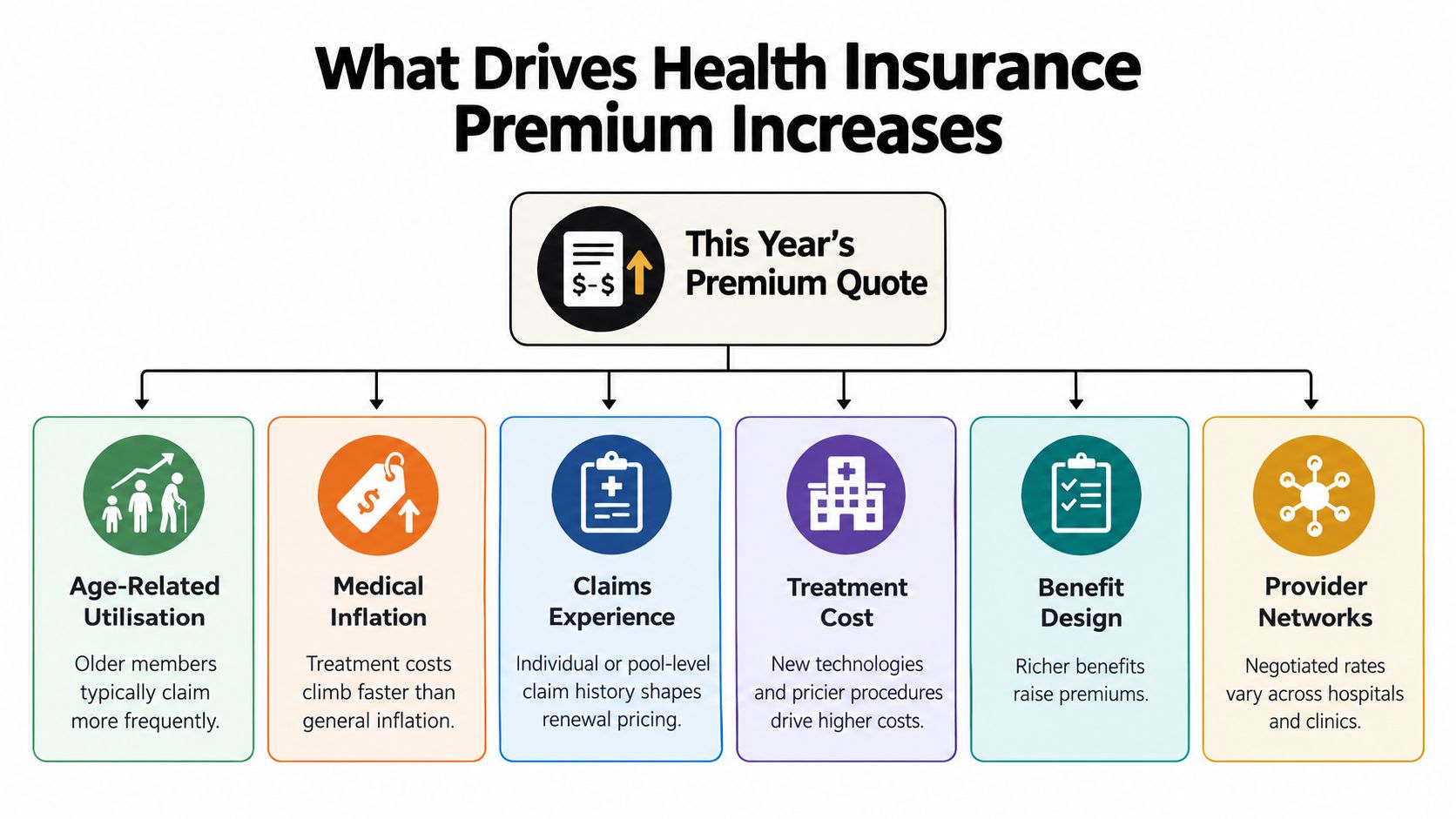
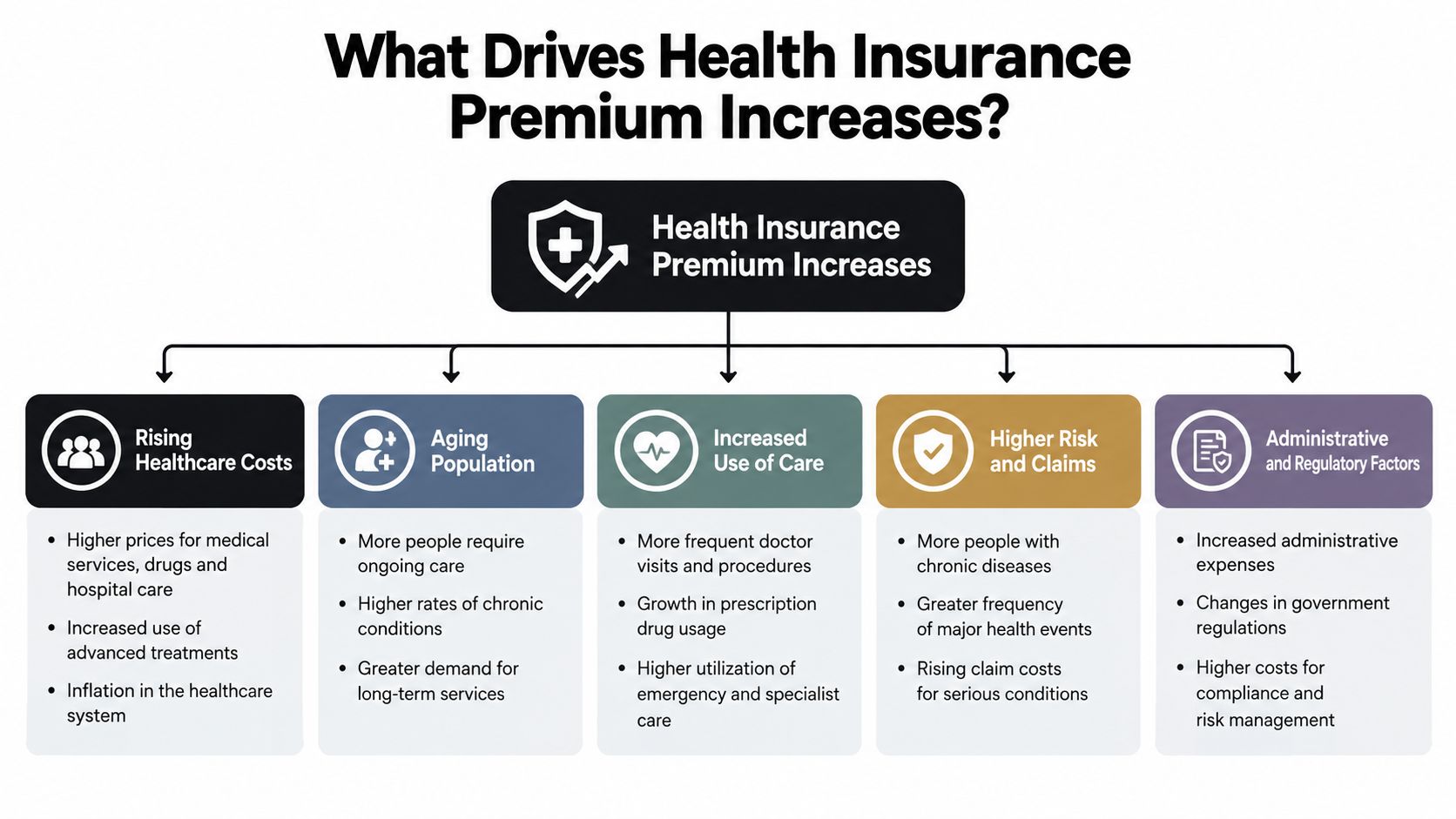
Age related utilisation is often the biggest personal driver. As people get older, they typically consult specialists more often, need more diagnostic testing, manage chronic conditions, and face higher chances of hospital admission. Insurers price that expected pattern into age bands. A Spanish academic model found that the premium difference between a 60 year old and a 40 year old could reach 170%, illustrating how strongly expected utilisation and claim severity shift across those bands. Crossing into a new band can feel abrupt, because your health didn't change overnight even though your pricing group did.
The Pressures You Cannot Negotiate Away
Medical inflation runs on its own track. Clinics pay more for staff, equipment, energy, and supplies. Newer treatments and more advanced imaging tend to cost more than what they replace. Insurers build an expected medical trend into renewal pricing, and that trend can outpace the inflation figure you see in headline news. It isn't a promise that your individual policy will rise by a set amount. It's the background pressure every insurer is pricing against.
Claims experience matters at pool level most of all. If members on similar policies claim more frequently or for costlier treatment than expected, the next renewal round absorbs that reality. Your own history can matter too, depending on the policy terms, but it rarely explains the whole increase on its own.
Don't fall into the trap of thinking that claiming successfully proves your policy is poor value, or that not claiming proves you're being overcharged. Insurance is priced for the year ahead, not as a refund or penalty for the year behind you.
The Parts You Can Actually Influence
Two drivers sit partly in your hands. Benefit design is the first. Dental extras, worldwide cover you never use, or reimbursement levels above what you'd realistically claim all inflate the premium without improving your core protection. Removing unused features is legitimate savings.
Provider networks are the second. Access to a broad list of private hospitals costs the insurer more than a tighter regional network. If the hospitals you'd attend sit in a narrower plan, you may not be giving up anything you value.
Finally, there's the insurer's own commercial repricing. Companies periodically reset prices across a product line to protect margins or reposition a plan. You can't control that decision. You can only test whether a competitor prices equivalent cover more keenly. Sort your increase into structural, personal, and design driven parts, and you'll know which levers are worth pulling.
Reading a Renewal Notice Line by Line
Put your current policy schedule and the renewal notice side by side. Read them as two contracts, because that's what they are. The common mistake is comparing only the monthly figure and assuming everything underneath stayed identical.
Work through the terms in a fixed order so nothing slips past you.
| Pressure | What It Affects | What to Check |
|---|---|---|
| Age rating | Your pricing band and expected claims | Whether you've crossed into a new age band at renewal |
| Medical inflation | Cost per consultation, test, and procedure | Whether limits and reimbursement levels still match real prices |
| Claims experience | Pool level and possibly personal pricing | Any clause linking renewal terms to claims frequency |
| Benefit design | What the policy actually pays for | Excess, copayments, exclusions, waiting periods, and network changes |
| Commercial repricing | The insurer's margin across the product | Whether equivalent cover elsewhere is priced differently |
Price Rise or Quiet Benefit Change
A headline increase sometimes hides a worse problem. The premium may have risen modestly while the excess jumped, a copayment appeared where none existed, or your usual hospital dropped out of the network. In that case you're paying more for less, and the monthly figure alone won't reveal it.
The reverse happens too. A larger rise sometimes accompanies unchanged, still full terms in a year when treatment costs climbed across the market. Context helps you judge which story you're in. In the United States, KFF reported that average employer sponsored family premiums reached $26,993 in 2025, rose 6% in one year, exceeded general inflation and wage growth, and were 53% higher than in 2015. Those are American employer market figures, not Spanish prices or Spanish policy rules. They matter here only because they show the wider mechanics clearly. Health premiums can outrun both inflation and wages for years at a time, so a renewal that feels disproportionate against your pension or salary isn't automatically an error.
Questions to Put to Your Insurer
- Ask for the reason in writing: request which factors drove your specific increase, including any age band change.
- Confirm what's unchanged: get explicit confirmation on excess, copayments, limits, exclusions, and network.
- Check future pricing: ask how premiums are reviewed in later years, not just this one.
- Verify cancellation timing: note the exact notice deadline before you shop elsewhere.
One warning before you decide anything. If you've been diagnosed with something since you took out this policy, switching can trigger fresh medical underwriting, new exclusions, or new waiting periods with another insurer. Never cancel first and investigate later. The existing policy, even at a higher price, may be protecting treatment access that a replacement won't offer on the same terms.
What Premium Changes Mean for Expats in Spain
The same increase lands very differently depending on why you're insured in Spain and what stage of life you're in. Generic advice to shop around ignores that completely.
Retirees and Older Newcomers
If you're arriving in Spain in your mid sixties or seventies, age isn't a minor pricing factor. It's often the decisive one. Insurers expect more frequent and more complex care, and they price accordingly from day one. That makes the renewal rules as important as the starting quote. Before you accept any policy, ask how the price is expected to move at later age bands, whether there's an upper age for renewal, and what happens to your terms as you grow older. A cheap first year that becomes unaffordable exactly when you need care most is not a bargain.
Be equally careful comparing a Spanish domestic plan against an international one. Compare on an equivalent basis, hospital access, specialist routes, diagnostics, reimbursement limits, and excesses, not on the monthly figure alone.
Families and Visa Applicants
Families should always convert monthly prices into an annual total for the whole household. Small per person differences compound across two adults and children, and copayments multiply quickly when several people use services in the same year.
If your policy supports a visa or NIE application, you have an extra constraint. You must preserve whatever full terms your immigration process requires. Downgrading to a basic plan with copayments or limited cover to escape a premium rise can jeopardise compliance. Check the requirement first, then optimise within it.
People With Existing Conditions
If you're living with diabetes, a cancer history, or another serious condition, approach any cheaper replacement with particular caution. A prior diagnosis doesn't automatically make cover or negotiation impossible. It can, however, change underwriting decisions, exclusions, premiums, and waiting periods significantly between insurers.
Practical rule: for anyone with a serious pre-existing condition, a switch is a suitability decision, not a price comparison. Usable cover for your actual condition beats a lower premium on paper every time.
This is also where honest expectations matter. Real negotiation usually isn't demanding last year's price back. It's a discussion grounded in your age, health history, actual needs, and what underwriters will accept. Sometimes the achievable win is equivalent cover at a better price. Sometimes it's keeping your current insurer and removing extras. Occasionally it's accepting the increase because your existing terms are hard to replace. Knowing which outcome is realistic for your situation is worth more than any headline discount.
Comparing Premiums Without Paying More for Less
Two quotes can look far apart monthly and still cost you similar amounts over a year. To see why, stop comparing premiums and start comparing total annual healthcare cost under three scenarios, a quiet year, a moderate year with specialist visits and diagnostics, and a heavy year involving hospital treatment.
In a quiet year, the lower premium plan with a high excess or copayments usually wins. You pay less each month and barely use services, so the charges you'd absorb yourself stay small. In a moderate year, the gap narrows fast. Repeated copayments for consultations and tests eat the monthly saving. In a heavy year, the broader policy often wins outright, because the excess, uncovered services, and out of network costs on the cheaper plan arrive all at once, precisely when you're least able to deal with surprises.
Reported Spanish market figures show how wide the spread is by cover level and age, with average monthly prices of about €46 for basic cover, €74 for comprehensive cover, and approximately €125 for comprehensive policies for people over 55 in 2025. Treat those as market context, never as a personal quote. Your price depends on your age, location, health history, and chosen benefits.
Accepting a higher excess is sensible if you can comfortably self fund routine charges and you're really buying protection against major bills. It's a poor trade if you expect ongoing diagnostics, specialist management, or a likely admission. The saving isn't free either way. It's a transfer of cost from the insurer to you, and you should only accept that transfer with your eyes open.
Older readers weighing options across different systems sometimes ask about cover outside Spain too. Resources such as Medicare enrollment help for seniors can be useful context if you're comparing how another system handles enrolment and coverage checks, but it doesn't replace checking Spanish policy terms line by line. For a structured way to weigh Spanish plans against each other, work through a guide on comparing health insurance plans on an equivalent benefits basis and score each option on premiums plus likely copayments, uncovered treatment, prescription costs, and hospital access together.
How to Review, Reduce, or Switch Your Cover
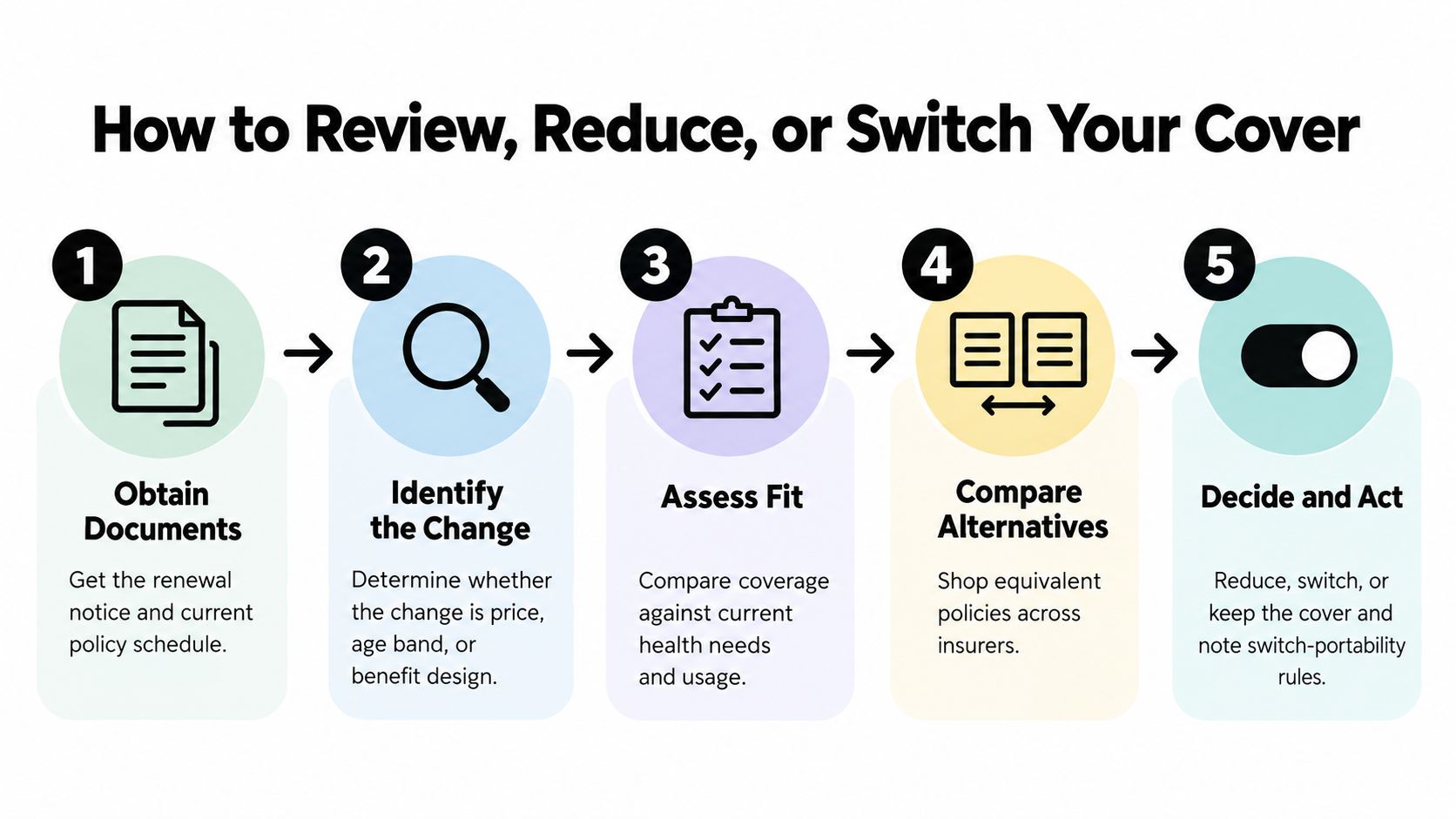
Handle renewal as a sequence, not a scramble in the week before your cancellation deadline. Each step gives you information the next one depends on.
Step one, gather the documents. Pull the renewal notice, your current schedule of benefits, and the terms showing excesses, copayments, exclusions, and waiting periods. Add a short note of your actual healthcare use over the past year and what you expect to need in the next one.
Step two, identify what changed. Treat the renewal notice as a diagnostic document. Break the increase into its parts: a structural repricing driven by medical inflation, an age band move, a claims-related loading, a benefit redesign, a network change, or a mix of these. A pure price rise and a benefit redesign can look identical on the first line of the letter and demand completely different responses.
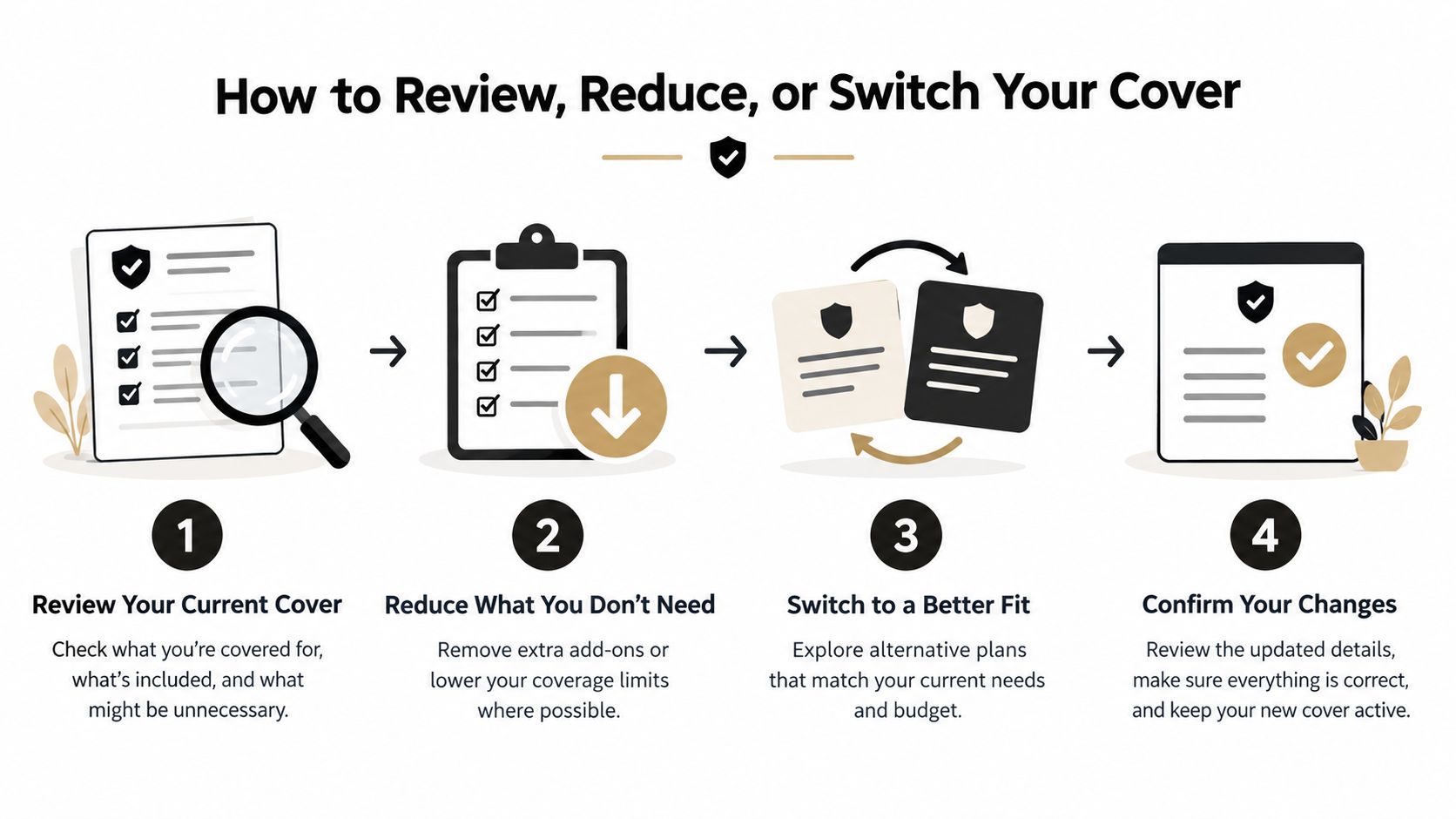
Step three, remove what you don't use. Strip out duplicated or unused extras before you touch core treatment access. Cutting an optional add on you never claim is painless. Cutting hospital cover, accepting copayments you'll hit monthly, or trading down to a narrower hospital network is a different decision entirely, and the wrong call there costs more than the premium saves.
Step four, get equivalent quotes. Ask for national and international options priced against the same benefit schedule, the same excess, and the same health information. Quotes built on different assumptions can't be compared accurately. If you're changing insurer, follow the practical steps for changing health care providers without a gap in cover so your cancellation and start dates line up properly.
Step five, take an independent view before you cancel anything. A broker working from your complete health and cover information can compare the market, explain exclusions and waiting periods in plain language, negotiate where insurers allow it, and handle the administration. Bsure Health Brokers, for example, is an independent, DGSFP-registered broker covering Spanish and international insurers, setup and renewals, and it reports meaningful savings for many clients.
Be realistic about the limits. No broker can promise savings for every client or abolish the effects of age and medical inflation. Anyone who guarantees that isn't being straight with you. And if you have a serious pre-existing condition, insist that the replacement policy's exclusions and waiting periods are confirmed in writing before your current cover ends. Sequence matters. Diagnose, trim, compare, verify, then switch only if the new cover is confirmed suitable.
Make a Confident Decision at Renewal
Use one decision rule. Accept the increase when it's a genuine repricing of cover that still fits your needs, and you've properly tested the market without finding equivalent terms at a better total cost. Grumbling while paying is fine. Paying blindly isn't.
Review and adjust when something specific changed, an excess, a copayment, a network restriction, or an optional benefit that no longer matches your household. That's where targeted changes recover value without weakening the protection you'd rely on in a hospital corridor at midnight.
Switch only after comparing equivalent schedules and checking new underwriting, exclusions, waiting periods, visa compliance, and continuity of care. The lowest headline premium can hide higher out of pocket exposure and materially weaker access. The highest premium can be just as poor value if most of what you're buying sits unused year after year.
Prepare one document bundle and use it for every quotation. Include your policy schedule, the renewal notice, your health history, your expected care needs, and your preferred budget. Consistent information produces comparable quotes, and comparable quotes produce a decision you can defend.
That's the whole discipline behind dealing with health insurance premiums going up. Diagnose the increase, price the total cost accurately, and protect usable cover before you chase a lower monthly number.
If your renewal has landed and you'd rather not work through the diagnosis alone, Bsure Health Brokers offers free, impartial, end to end help comparing Spanish and international policies against your current schedule, health history, and budget. Send over your renewal notice and policy documents, and you'll get a clear view of whether to keep, adjust, or replace your cover before your cancellation deadline forces the decision.