
You can read a policy brochure in perfect English and still miss the one line that matters most. For expats, that's often the line about lifetime health insurance limits, because “no limits” can sound reassuring right up until a serious diagnosis turns the fine print into real bills.
That gap is especially risky in Spain and in international plans sold to expats. A plan can look generous on the surface, yet still hide caps on specific treatments, therapies, or conditions, and those limits can shape what happens when care gets expensive.
Table of Contents
- Why Lifetime Health Insurance Limits Matter
- Defining Lifetime Health Insurance Limits
- Comparing Lifetime Annual and Per Condition Limits
- Lifetime Limits in Spanish and International Plans
- Real Scenarios with Retirees and Pre-existing Conditions
- Managing Risks and Workarounds When Limits Loom
- Checklist and Questions for Choosing Policies
- Next Steps and How Bsure Can Help
Why Lifetime Health Insurance Limits Matter
A retired couple moves to Spain, feels relieved to have private cover, then learns a major surgery has eaten through most of the policy's allowance. The brochure never screamed “cap,” but the policy still had one, and the bill that followed changed every conversation about treatment.
That's why lifetime health insurance limits matter. They decide whether your insurer keeps paying when care gets expensive, or whether you suddenly become responsible for the rest.
For expats, the danger is bigger than a single number. You may be comparing a Spanish local plan, an international policy, or a visa-compliant option, and each one can describe limits differently. A headline like “no lifetime limit” can still hide smaller ceilings on certain therapies, so the essential question is always what the plan covers, and what it ceases to cover.
Practical rule: never judge a plan by the marketing phrase alone, read the limit language beside the benefit list.
The safest habit is simple. Match the policy's limits against the type of care you're most likely to need over time, not just the care you'd expect this month.
Defining Lifetime Health Insurance Limits
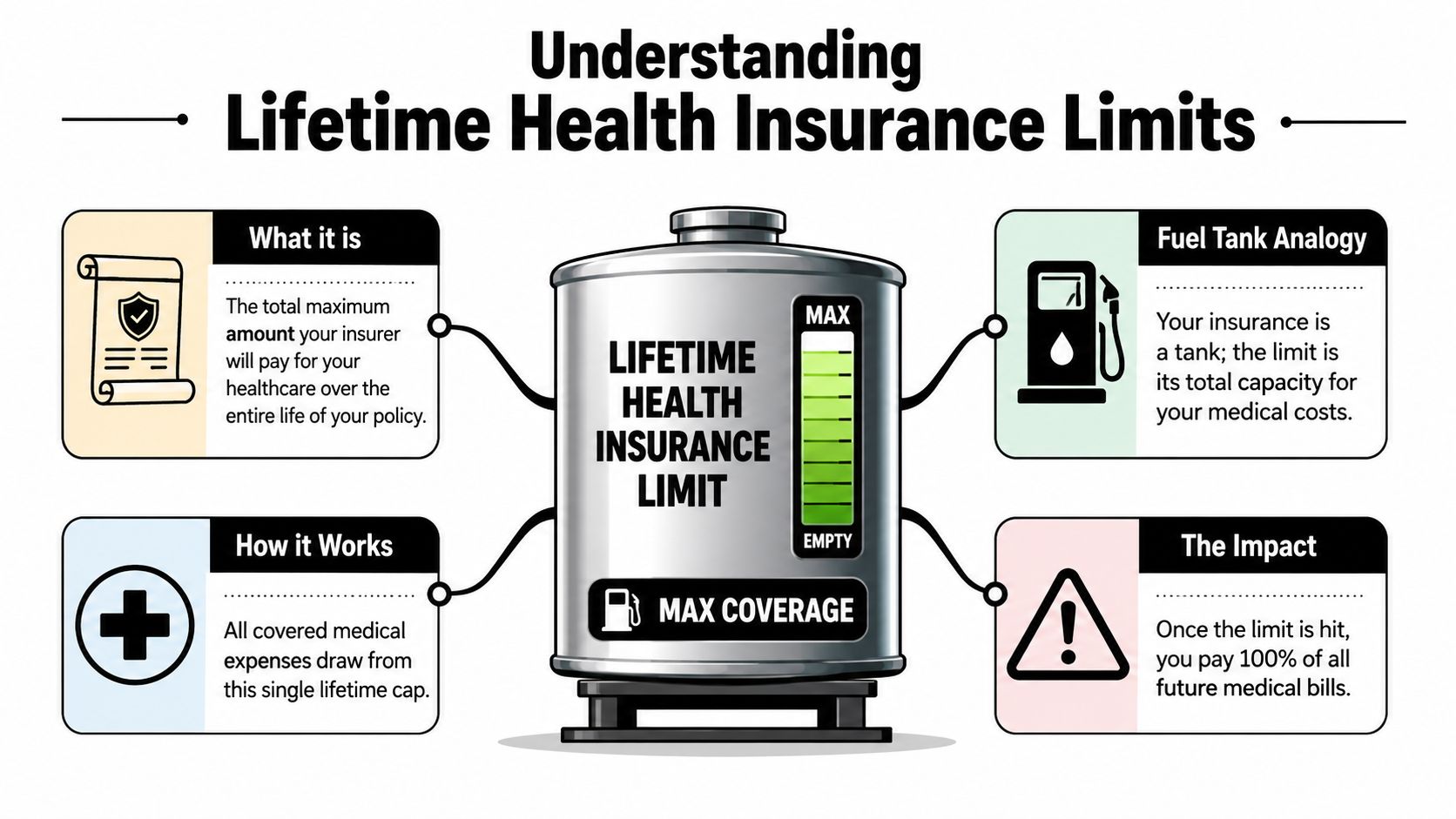
Think of your policy like a fuel tank. The insurer agrees to keep filling medical costs until the tank reaches its maximum capacity, and then the fuel is gone.
That's the basic idea behind a lifetime limit. It's the total maximum your insurer will pay over the life of the policy for covered services, or for a specific covered category, depending on the plan design.
How the cap actually works
Some plans use a global ceiling. Others use a narrower cap for a service like a transplant, rehabilitation, or another high-cost benefit. The structure matters because the cap can sit on the whole policy, or only on one slice of care.
Historically, insurance education materials often used a $1 million lifetime cap as a common benchmark, meaning the plan would pay up to that amount and then stop for the capped benefit IG Living. That number isn't a rule for every policy, but it helps explain the mechanism.
Why insurers use limits
Insurers use limits to control exposure to unusually expensive claims. From their point of view, the cap is a way to define the outer edge of what the policy will absorb.
For you, the cap defines risk. Once the ceiling is reached, further covered care tied to that limit can become your responsibility. In ACA-compliant U.S. plans, the core rule changed for essential health benefits, but outside that framework, caps can still exist, so buyers need to read the benefit schedule line by line HHS.
A policy can sound broad and still hide a narrow ceiling in one benefit category.
Comparing Lifetime Annual and Per Condition Limits
A lot of confusion comes from the word “limit” itself. People assume every limit works the same way, but it doesn't.
| Limit Type | Scope | Frequency | Typical Cap |
|---|---|---|---|
| Lifetime limit | Entire life of the policy or benefit category | One time, until exhausted | Fixed maximum, often expressed as a dollar ceiling |
| Annual limit | Coverage resets each policy year | Repeats yearly | Yearly maximum for covered services |
| Per-condition limit | One illness or treatment category | Can apply over a period or lifetime | Sub-cap for that condition or service |
A lifetime limit is the harshest if you need long-term or catastrophic care, because it doesn't reset. An annual limit can be less damaging if your care needs are spread over time, since the ceiling may refresh with a new policy year. A per-condition limit sits in the middle, and it can catch people off guard because the rest of the plan may look generous.
The hidden trap in “no lifetime limit”
The phrase “no lifetime limit” sounds complete, but it doesn't always mean unlimited coverage. Consumers often overlook that risk through per-condition caps or limits on non-essential benefits HealthCare.gov.
That's where expats get surprised. A plan may avoid a global cap but still restrict a specific therapy, a specialty drug, or a rehabilitation service. In practice, that can feel like a ceiling even when the policy advertises protection.
If you're comparing options, look for the type of limit first, then the size of the limit. A small sub-cap on the one service you're most likely to use can matter more than a much larger cap on benefits you may never need.
Lifetime Limits in Spanish and International Plans
Spanish and international plans often sound broader than they are. That's because the most important detail is not just whether a plan has a limit, but what kind of service the limit applies to.
In ACA-style regulated coverage, essential health benefits can't have dollar lifetime limits, but services outside that framework can still carry lifetime or annual dollar limits, including elective or specialized care HealthCare.gov glossary. For expats, that distinction becomes the key to reading a policy from Spain or from an international carrier.
Why the service list matters more than the headline
A policy that says “no lifetime limit” may still contain carve-outs for non-EHB services, niche therapies, or elective procedures. That means the essential question isn't only whether the plan has a cap, it's whether the benefit you need falls inside or outside the capped part.
The process of comparing plans often gets messy. Spanish private insurance brochures often lead with hospital access, but the limit language can live in a separate benefit table or exclusions schedule. International plans can be even harder to read because they may split coverage by region, provider type, or medical category.
For expats who want a deeper comparison framework, this guide on international health insurance options in Spain is a useful companion when you're checking how broad the coverage really is.
What to watch for in practice
Look for three things. First, whether the plan limits a whole benefit class. Second, whether it limits a specific condition or therapy. Third, whether the plan is built around a local network or a wider international design.
Those details matter because “unlimited” can mean very different things from one product to the next. A policy can be valid for visa purposes and still be weak for long-term chronic care if the service you need sits behind a hidden ceiling.
Real Scenarios with Retirees and Pre-existing Conditions
A retired man in Spain picks a policy that looks simple and affordable. Years later, after a hip replacement and follow-up care, he finds that the plan has run down the service category he uses most, and the remaining visits and procedures are left for him to pay.
That kind of outcome is why lifetime limits still matter, even when the brochure sounds reassuring. A plan can look solid on the surface and still hide a ceiling inside a specific service class, like a hallway that seems open until you reach a locked door.
A retiree's mistake
The retiree assumed a foreign private plan would work like a broad hospital guarantee. It didn't. The policy put a limit on the service category he needed most, so the issue was not the hospital network, it was the benefit ceiling.
Older adults often need repeated specialist visits, surgery follow-up, and rehab, so a plan has to be read with that pattern in mind. A useful companion when comparing age-related care needs is health insurance for elderly parents, because the right question is whether the policy still holds up after the first round of treatment is over.
A pre-existing condition example
A woman with diabetes chooses a plan that appears broad, but the policy includes a cap on a category of specialist treatment related to her condition. Routine care still works, yet the service-level ceiling changes the picture once her treatment becomes more intensive.
That is why readers should review the brochure together with pre-existing conditions health insurance. The goal is not to panic about every limit. The goal is to see whether the limit touches the exact care you are most likely to use, especially when a condition needs ongoing attention rather than a one-time visit.
Bottom line: the most dangerous limit is often the one buried inside the service you need most.
Managing Risks and Workarounds When Limits Loom
If a policy cap is close, timing matters. Start by asking the insurer or broker, in writing, which services count toward the limit and whether the plan offers riders, upgrades, or a different benefit tier.
A cap on paper can still be manageable if you know what part of the care path it touches. A ceiling on hospital stays is different from a ceiling on rehab, specialist visits, or another service category. For expats, that detail often matters more than the headline benefit amount.
If the current plan cannot be improved, changing plans before the limit is reached is usually safer than waiting. Switching without checking the fine print can create a new problem, especially if the replacement plan excludes the same condition or adds a tighter service-level limit.
Practical steps that reduce exposure
- Map the limit to the treatment. Ask about the exact service you use, not only the overall policy maximum.
- Check renewal timing. Some plans reset benefits on a schedule that affects when a cap matters.
- Ask about supplemental cover. A short-term layer may help cover a single high-cost treatment period.
- Review exclusions early. Hidden exclusions often explain why a limit feels smaller than it first appears.
- Use a broker when the wording is unclear. A broker can ask for written clarification and compare alternatives side by side.
A hidden cap can also sit inside a service category rather than at the policy level. That is the part many expats miss, especially in Spanish and international plans where the brochure looks broad but the treatment line is narrow. The quickest way to spot that risk is to compare the limit against the care you expect to use, not against the plan summary alone.
Before the ACA's ban on most lifetime limits, once a cap was reached, patients could face 100% out-of-pocket costs for further covered services HHS analysis. That is the outcome you want to avoid by acting early and checking the wording before treatment starts.
For a broader shopping framework, our guide on how to compare health insurance plans can help you test limits against exclusions, networks, and renewal terms before you sign.
A final check is especially useful if you rely on equipment or recurring treatment. For example, if oxygen therapy is part of your care, compare the policy's service ceilings with a practical reference like DME Superstore's 2026 oxygen concentrator guide, then ask whether the plan treats that kind of support as a covered benefit or a separate capped service.
Checklist and Questions for Choosing Policies
The fastest way to avoid a bad surprise is to read the policy like a risk manager, not like a brochure reader. That means checking the limits, the exclusions, and the treatment categories that matter to your own health profile.
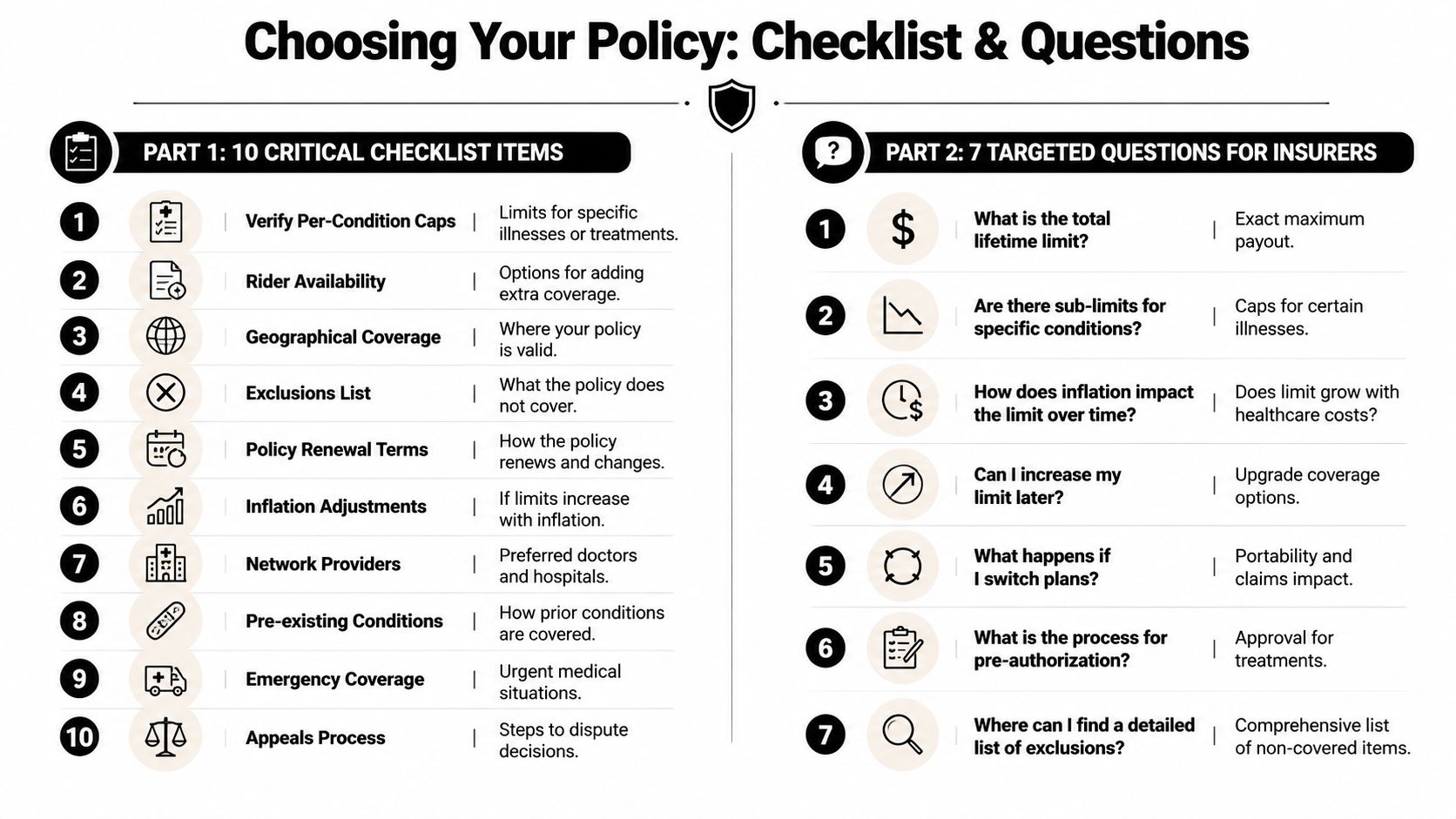
10 critical checklist items
- Verify per-condition caps. Look for limits tied to one illness or therapy.
- Rider availability. Ask whether you can buy extra protection later.
- Geographical coverage. Check where the plan works.
- Exclusions list. Read what the policy does not cover.
- Policy renewal terms. Confirm how renewals change benefits.
- Inflation adjustments. See whether caps rise over time.
- Network providers. Check which doctors and hospitals are included.
- Pre-existing conditions. Confirm how prior conditions are treated.
- Emergency coverage. Make sure urgent care is covered clearly.
- Appeals process. Know how to challenge a denial.
7 questions to ask before signing
- What is the total lifetime limit?
- Are there sub-limits for specific conditions?
- How does inflation affect the limit over time?
- Can I increase my limit later?
- What happens if I switch plans?
- What is the pre-authorization process?
- Where can I find the detailed exclusions list?
For a real-world example of how benefit design affects equipment and long-term care, the DME Superstore oxygen concentrator guide is a helpful reminder to check how medical needs map to coverage rules before you buy.
If a plan can't answer these questions clearly, don't assume the coverage is generous.
Next Steps and How Bsure Can Help
Start with your current policy and compare it against the checklist above. If the limit wording is vague, or if the capped service is one you might realistically need, don't wait for a claim to expose the gap.
Bsure Health Brokers works as an independent brokerage in Spain, comparing Spanish and international plans and helping with paperwork, renewals, and policy changes. For expats who want a clear read on lifetime health insurance limits, that kind of side-by-side review can save time and reduce the chance of buying the wrong benefit structure.
The smartest next move is simple. Pull out your policy, mark every cap, and ask for a review before your next renewal date.
A CTA for Bsure Health Brokers.