
Spain's private health-insurance premiums rose 12.16% year over year in the first quarter of 2025, roughly nine times the general consumer-price average. That means the monthly quote you see today is only the starting point of the true cost.
An individual health insurance plan that looks affordable at sign-up can become a very different financial commitment after renewals, age-band changes, copayments, deductibles, and altered medical needs. Premium comparison sites usually show the first-year price. They rarely show how that price behaves after several Spanish repricing rounds.
A policyholder can therefore choose the cheaper quote and still spend more over time. The sensible comparison includes the premium, deductible, copayments, maximum out-of-pocket exposure, provider network, exclusions, and renewal terms, not just the figure displayed beside the monthly payment.
Table of Contents
- What Individual Health Insurance Really Costs in Spain
- Understanding the Parts of a Health Insurance Price
- Factors That Drive Your Premium Up or Down
- Comparing Plan Types and What They Cost
- Why Your Premium Will Not Stay the Same
- Practical Ways to Lower Your Health Insurance Cost
- Choosing the Right Plan for Your Situation
What Individual Health Insurance Really Costs in Spain
An expatriate couple in Spain recently compared two apparently similar policies. Both offered private hospital access, specialist appointments, and documentation suitable for their residency plans. One quote appeared cheaper each month, so it seemed like the obvious choice.
It wasn't.
The less expensive policy applied copayments to routine consultations, used a narrower provider network in their province, and offered less flexibility if they later wanted treatment outside Spain. The higher quote included broader access and fewer charges at the point of use. Without reading the renewal conditions and cost-sharing rules, the comparison was little more than a comparison of two marketing prices.
Spain's private insurance market has already shown why this matters. Private health-insurance premiums increased 12.16% year over year in the first quarter of 2025, while reporting based on national price data placed health-insurance inflation at roughly nine times the overall consumer-price average. ICEA's 2025 health-insurance data makes the practical point clearly: medical costs and insurer repricing can move much faster than the general prices consumers notice in everyday life.
The first-year quote is not the full price
When you ask what individual health insurance plans cost, you need to separate three questions:
- What will I pay when the policy starts?
- What will I pay when the insurer renews it?
- What will I pay when I use the cover?
The first answer comes from the quotation. The second depends on renewal behaviour, age bands, claims experience, medical-provider tariffs, and the insurer's pricing decisions. The third depends on copayments, deductibles, uncovered services, and whether your preferred doctors and hospitals belong to the network.
Age is particularly important. Insurers commonly price applicants in bands, and the premium can move more sharply when the policyholder enters a higher band. A retiree over 65 or 75 needs a different assessment from a younger expat, even when both want the same hospital access.
What a proper comparison should reveal
A useful quote should show the annual premium, not only the monthly instalment. It should explain whether the price is introductory or standard, how renewals are handled, whether medical underwriting applies, and what happens if you change provider later.
It should also identify the cost of:
- outpatient consultations and diagnostic tests;
- hospital treatment and surgery;
- prescription-related services, if included;
- dental, travel, or international extensions;
- family members added later;
- care outside the insurer's Spanish network.
The rest of the decision comes down to trade-offs. A national cuadro médico policy may suit someone who lives permanently in Spain and wants predictable access through a local network. An international policy may justify a higher premium for someone who spends substantial time abroad. A family policy may reduce the average cost per person, but only if its conditions work for every family member.
The right question isn't “Which quote is cheapest?” It's “Which policy is least likely to become expensive or unsuitable when my circumstances change?”
Understanding the Parts of a Health Insurance Price
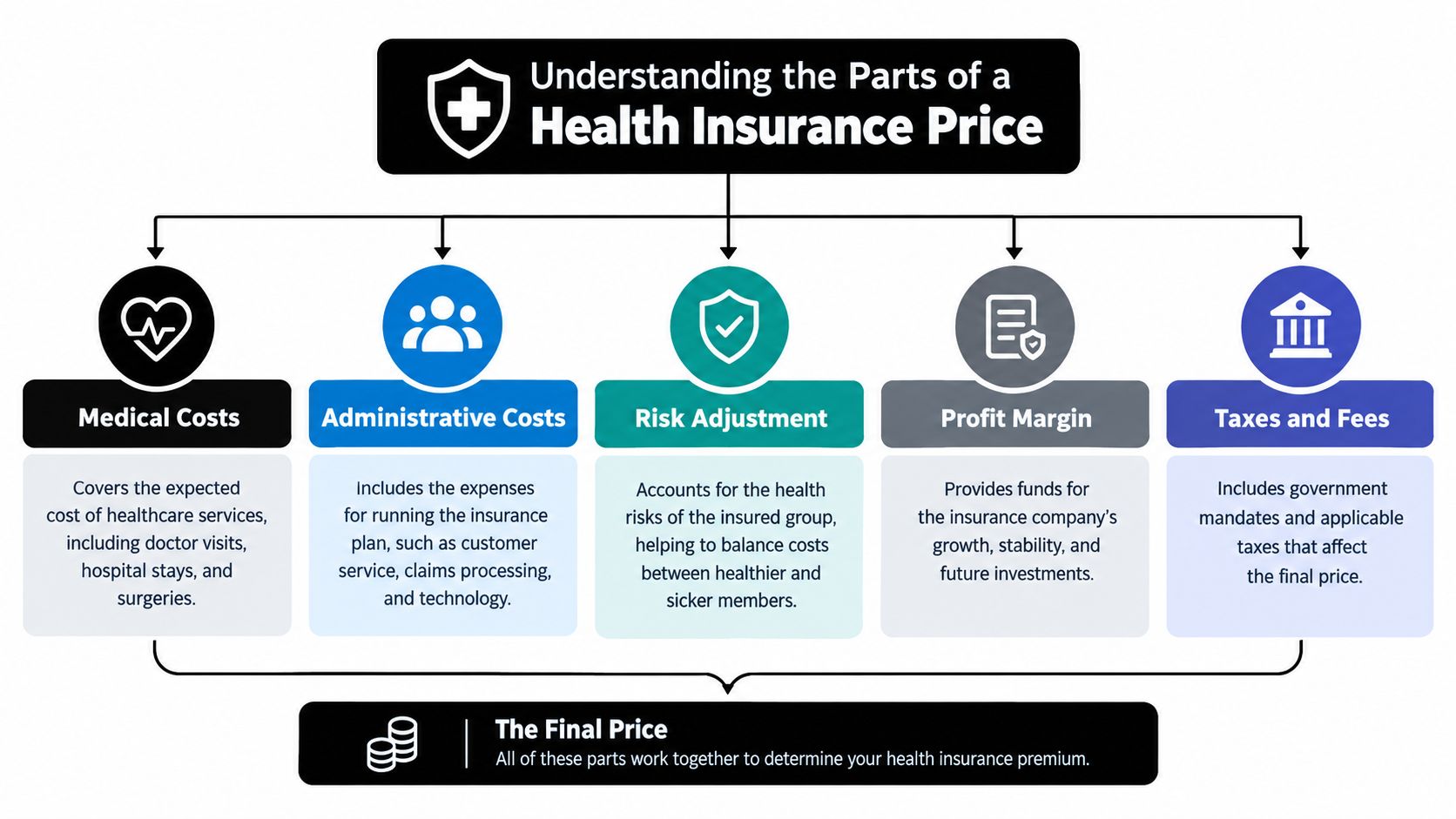
A Spanish health-insurance quotation becomes easier to assess when you treat it like a household budget rather than a single product price. The monthly premium is only one line. The other lines determine how much the policy costs when you use it.
Think of a gym membership. One membership charges a higher monthly fee and includes every class. Another charges less each month but adds a fee for every session. If you attend often, the cheaper membership may cost more by the end of the year. Health insurance works in much the same way.
Read the quotation line by line
The base premium is the recurring amount charged for the selected cover. It reflects factors such as age, residence, underwriting, benefits, and the insurer's pricing model. A monthly figure can make comparison easy, but the annual total gives a more accurate starting point.
Age-band pricing changes the base calculation as the policyholder enters a different band. Ask the insurer or broker how the relevant bands work and whether the quotation already reflects the applicant's current age. Don't assume today's price will remain the same merely because the benefits haven't changed.
Copayments, or copagos, are charges made when you use certain services. A plan with copayments may have a lower recurring premium, but frequent consultations, tests, or specialist visits can increase the annual cost.
A deductible or excess is the amount you agree to pay before the insurer contributes to an eligible claim or service. It can reduce the premium, but it transfers more financial responsibility to you when you need treatment.
The maximum out-of-pocket exposure limits, or fails to limit, what you could pay outside the premium. Some policies define clear caps for particular services. Others apply separate rules to different benefits. Read the wording rather than assuming that “full” means unlimited.
Practical rule: Compare the premium, deductible, copayments, and maximum out-of-pocket exposure together. The headline price is not an affordability test.
Turn the components into an annual comparison
Create a simple comparison sheet with one row for each policy and columns for the annual premium, deductible, copayment schedule, network restrictions, exclusions, and renewal wording. Add your realistic pattern of use, not an optimistic assumption that you'll never need care.
For example, someone with a chronic condition may prefer a higher premium with low or no copayments. Someone who rarely visits doctors may accept a deductible if the maximum exposure is affordable. The cheaper structure depends on how you expect to use the cover.
You can also use the Bsure Health Spain premium calculator to obtain an illustrative starting point, then verify every assumption in the policy documentation.
Cost comparisons aren't unique to health insurance. If you're researching care budgets in another market, this guide to NDIS nursing costs offers useful context on how service frequency, care requirements, and pricing structure can affect the final amount. The same discipline applies here: identify the recurring charge, usage-based costs, limits, and conditions before choosing.
Factors That Drive Your Premium Up or Down
Insurers don't price every applicant from the same starting point. They assess the expected cost of providing cover, the scope of benefits requested, and the risk that the policy will be used heavily. Understanding those levers helps you challenge a quote instead of accepting it as a fixed market price.
Age and underwriting
Age is one of the clearest drivers. Premiums generally rise through age bands, with particularly important pricing considerations around 60, 65, and 75. A retiree entering a new band may see a different quotation even if the requested benefits are unchanged.
Medical history adds another layer. Diabetes, previous cancer, cardiovascular conditions, ongoing medication, or recent treatment can lead to exclusions, loading, a postponement, or a refusal depending on the insurer and the details disclosed. Never hide a diagnosis to obtain a lower starting price. An incomplete declaration can create problems precisely when you need the policy most.
The same condition can produce different outcomes with different insurers because underwriting rules vary. Someone with a cancer history should seek a specialist assessment of available markets rather than submitting casual applications to multiple companies. The same applies to diabetes and other long-term conditions.
Cover and provider choice
Broader cover costs more because the insurer accepts more potential claims. Hospital-only cover sits at one end of the spectrum. A policy including outpatient consultations, advanced diagnostics, maternity, dental, psychological services, and international treatment carries more benefits to price.
Network size also matters. A Spanish cuadro médico policy can be economical when your preferred hospitals and specialists are nearby. A larger network or reimbursement arrangement gives you more choice, but that flexibility usually costs more and may involve claim administration.
Region influences the practical value of the network. A plan that works well in Madrid may be less useful if you live in a smaller coastal town and must travel for treatment. Check the actual hospitals and specialists available near your home, not merely the insurer's national brand recognition.
Add-ons and contract design
Dental benefits, travel assistance, repatriation, and international treatment options can all alter the price. Add-ons aren't automatically poor value, but buying them without a clear need makes the policy more expensive and harder to compare.
Run this checklist before accepting a quote:
- Age: Will a new band apply soon?
- Medical history: Has every relevant condition been declared?
- Benefits: Are you paying for services you won't use?
- Network: Can you reach suitable providers from your home?
- Cost sharing: What will each visit, test, or claim cost?
- Renewal: Does the documentation explain future repricing?
A low quote that fails this checklist isn't cheap. It's incomplete.
Comparing Plan Types and What They Cost
Most individuals in Spain choose among three broad routes. A national network policy, an international plan, or a policy that adds family members to existing cover. Each can be suitable, but they solve different problems.
| Plan type | Typical cost level | Strengths | Trade-offs | Best for |
|---|---|---|---|---|
| National network plan | Lower to moderate relative to broader international cover | Spanish cuadro médico, local hospitals, simpler access within Spain | Less flexibility outside the network or country | Residents who live and receive care mainly in Spain |
| International plan | Higher relative to a Spain-focused policy | Cross-border cover, broader international access, support for mobile policyholders | Higher premium, more conditions to check, possible reimbursement administration | Expats who travel frequently or require care across countries |
| Family add-on plan | Often lower per person than separate policies, subject to insurer terms | One arrangement for the household, simplified administration, potential family pricing | A plan must fit children, adults, and older members alike | Families seeking coordinated cover and a shared renewal process |
National network policies
A Spanish insurer with a cuadro médico can be the sensible choice for someone who lives in Spain full time, wants local specialists, and doesn't need routine treatment abroad. It can also be appropriate for applicants who need clear Spanish private cover for a residency or visa process, subject to the specific requirements of the relevant authority.
Check the network by location. A large national list doesn't help if your preferred hospital is excluded or if the nearest suitable specialist is inconveniently far away. Also check whether the policy requires authorisation before scans, surgery, or specialist procedures.
International policies
International cover may suit an executive who divides time between Spain and another country, or a family that wants access beyond the Spanish network. English-language service can be valuable, but it isn't a substitute for reading the contract. Confirm territorial limits, emergency rules, reimbursement percentages, currency treatment, and exclusions.
A broader plan isn't automatically better. If you rarely leave Spain, you may pay for flexibility that you don't use. If you regularly need cross-border care, however, choosing a purely local plan to save on the initial quote can create inconvenience and additional costs later.
Family additions
Adding a partner or children can be more economical per person than buying separate policies, but compare the whole household rather than applying a simple average. One member may have different age-band pricing, medical underwriting, or benefit needs.
Families should ask whether every member shares the same copayment schedule, hospital network, renewal date, and cancellation conditions. A child may need frequent consultations, while an adult may value hospital access and international assistance. One policy can simplify administration, but only if its structure works for everyone.
The guide to comparing health insurance plans is useful when you need to put these plan types beside one another and assess benefits as well as price.
Why Your Premium Will Not Stay the Same
A low first-year quote can conceal a much higher renewal path. Spanish insurers reprice policies as medical-provider costs, negotiated tariffs, claims frequency, and portfolio experience change. They may also revise pricing strategy even when your own health remains unchanged.
Spain's 2025 premium movement shows why renewal deserves close attention. Private health-insurance premiums rose 12.16% year over year in the first quarter, while health-insurance inflation was reported at roughly nine times general consumer inflation. ICEA's published figures show that ordinary inflation alone does not explain every increase.
Test the renewal path before you buy
Price the policy across three renewals, five renewals, and ten renewals. Each horizon exposes a different risk:
- Three renewals show whether the introductory quote has already given way to the insurer's current rates.
- Five renewals bring age-band changes and evolving healthcare use into the calculation.
- Ten renewals test the value of continuity against the possibility that switching later may be harder.
These horizons are budget stress tests, not forecasts of a particular premium. Ask the insurer how age bands, copayments, annual repricing, and network changes affect renewal. Then model conservative, moderate, and high paths from the quotation and the insurer's documented approach.
A cheap policy can become expensive through repeated repricing, higher service charges, or a network that no longer suits your needs. Compare the likely five-year cost, not only the first monthly payment.
Switching has a cost
Changing insurer may lower the premium, but it can restart waiting periods, require fresh medical underwriting, or remove access to familiar doctors and hospitals. A serious condition developed after joining can also make equivalent terms harder to obtain elsewhere.
Review the renewal notice early. Compare equivalent benefits, copayment schedules, exclusions, age-band rules, and provider networks. Ask whether a replacement policy accepts your medical history without exclusions, and never cancel existing cover until suitable replacement insurance is active.
International comparisons need careful interpretation. OECD data shows that private health insurance financed an average of 9.8% of current health expenditure across OECD countries in 2019, compared with approximately 8% in 2005. Its role differed sharply by country, representing about one-third of health spending in the United States, nearly one-half in Switzerland, and around 60% in the Netherlands. The OECD analysis supplies context, not a Spanish renewal quotation. Spanish contract terms and the insurer's repricing rules should decide your purchase.
Practical Ways to Lower Your Health Insurance Cost
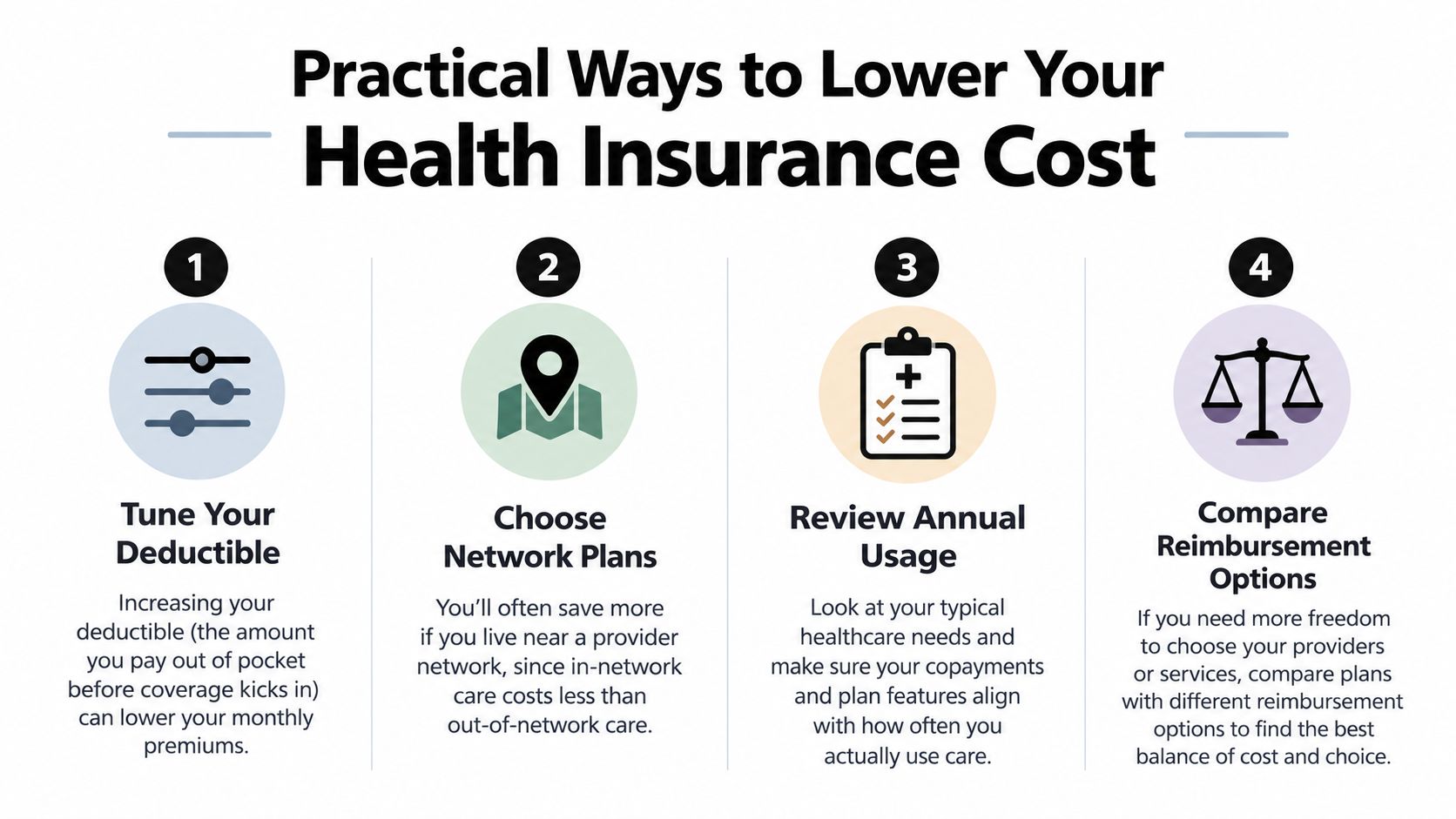
Lowering the premium is sensible. Stripping away benefits you may need is not. Use the following tactics in order, starting with the parts of the policy that change the balance between monthly cost and out-of-pocket exposure.
Tune the deductible to your finances. A higher excess can reduce the recurring premium, but only choose it if you can pay it without delaying treatment. The saving is false if one claim creates financial stress.
Match copayments to your expected use. Someone who rarely visits a doctor may accept modest charges per service. Someone managing diabetes, regular specialist appointments, or continuing treatment should be cautious. A lower monthly price can become expensive through repeated use.
Choose a network plan when the network works locally. If your preferred hospital and specialists are included near your home, a Spain-focused cuadro médico policy may provide the access you need without paying for broad international flexibility. Confirm the network before signing.
Remove unused extras. Dental, travel, maternity, and international treatment benefits can be worthwhile, but don't retain them automatically. Review each add-on against your actual life, travel pattern, and healthcare priorities.
Compare before the renewal deadline. Don't wait until the new premium has already been charged. Request alternative quotations early enough to review underwriting, exclusions, waiting periods, and network access before making a decision.
Compare equivalent benefits. A cheaper policy isn't a saving if it removes your preferred hospital, adds a large deductible, or limits specialist access. Put the annual premium and usage costs beside the benefits, not beneath them in small print.
Use an independent broker for difficult cases. A broker can compare insurers, explain underwriting outcomes, and manage the paperwork involved in a change. Bsure states that it can often save clients up to 40% by matching cover and insurer, although any saving depends on the applicant and the policies available. Its service includes setting up policies, handling renewals and changes, and supporting clients with referrals, specialist access, and emergencies.
Keep evidence of your cover and correspondence. Save the policy schedule, renewal notice, underwriting decisions, and authorisations. These documents make it easier to challenge an error or compare a replacement policy accurately.
For broader context on how public and private supplementary cover can differ, the Guide complémentaire santé solidaire explains another health-cover model. It isn't a substitute for Spanish policy advice, but it reinforces the importance of checking eligibility, benefits, exclusions, and the actual contribution required from the policyholder.
Choosing the Right Plan for Your Situation
A young expat applying for visa-compliant cover should prioritise accepted benefits, territorial scope, exclusions, and a reliable Spanish provider network. Don't choose solely by the lowest quote.
A family should compare the household's total annual cost, not just the per-person figure. Check whether children, adults, and any older relatives can use the same network and cope with the same copayment structure.
A retiree over 65 or 75 needs early advice on age-band pricing, underwriting, continuity, and future affordability. Someone with diabetes, a cancer history, or another serious condition should compare insurers before cancelling existing cover.
For a practical explanation of the role of an independent adviser, see what a health insurance broker does.
Key points: Compare annual cost, not just monthly premium. Check copayments and deductibles. Test the renewal path. Verify the network. Protect continuity of care before switching.
Since 1989, Bsure Health Brokers has supported expats and residents in Spain with DGSFP-registered, independent advice, including retirees, families, applicants with pre-existing conditions, and people choosing between national and international cover.
Bsure Health Brokers compares Spanish and international policies, explains renewal and cost-sharing terms, and manages applications, paperwork, renewals, and changes from start to finish. Visit Bsure Health Brokers to request a personalized comparison before accepting your next premium or cancelling your existing cover.