
What does it mean to be covered if your insurer can reject the claim, your visa certificate can be refused, or your planned treatment abroad requires approval you never requested?
That question exposes the gap between owning a policy document and having usable protection. In Spain, conditions for coverage are shaped by the contract, medical underwriting, exclusions, waiting periods, territorial rules, and, for many expats, immigration requirements. A policy can look complete on paper while leaving a serious illness outside its practical protection.
The right approach is to test the policy before you buy it. Read the certificate, schedule, general conditions, special conditions, and underwriting decisions together. Then check whether the wording works for your health history, residence status, treatment needs, and intended use of care.
Table of Contents
- The Hidden Reality of Insurance Eligibility
- Regulatory and Legal Conditions for Coverage
- Pre-Existing Conditions Versus Chronic Illness
- Understanding Waiting Periods and Exclusions
- Visa Compliance and the No-Exclusion Requirement
- The Importance of Written Underwriting Reservations
- Cross-Border Care and Geographic Conditions
- Practical Disclosure and Documentation Guide
- Summary Checklist for Policy Evaluation
The Hidden Reality of Insurance Eligibility
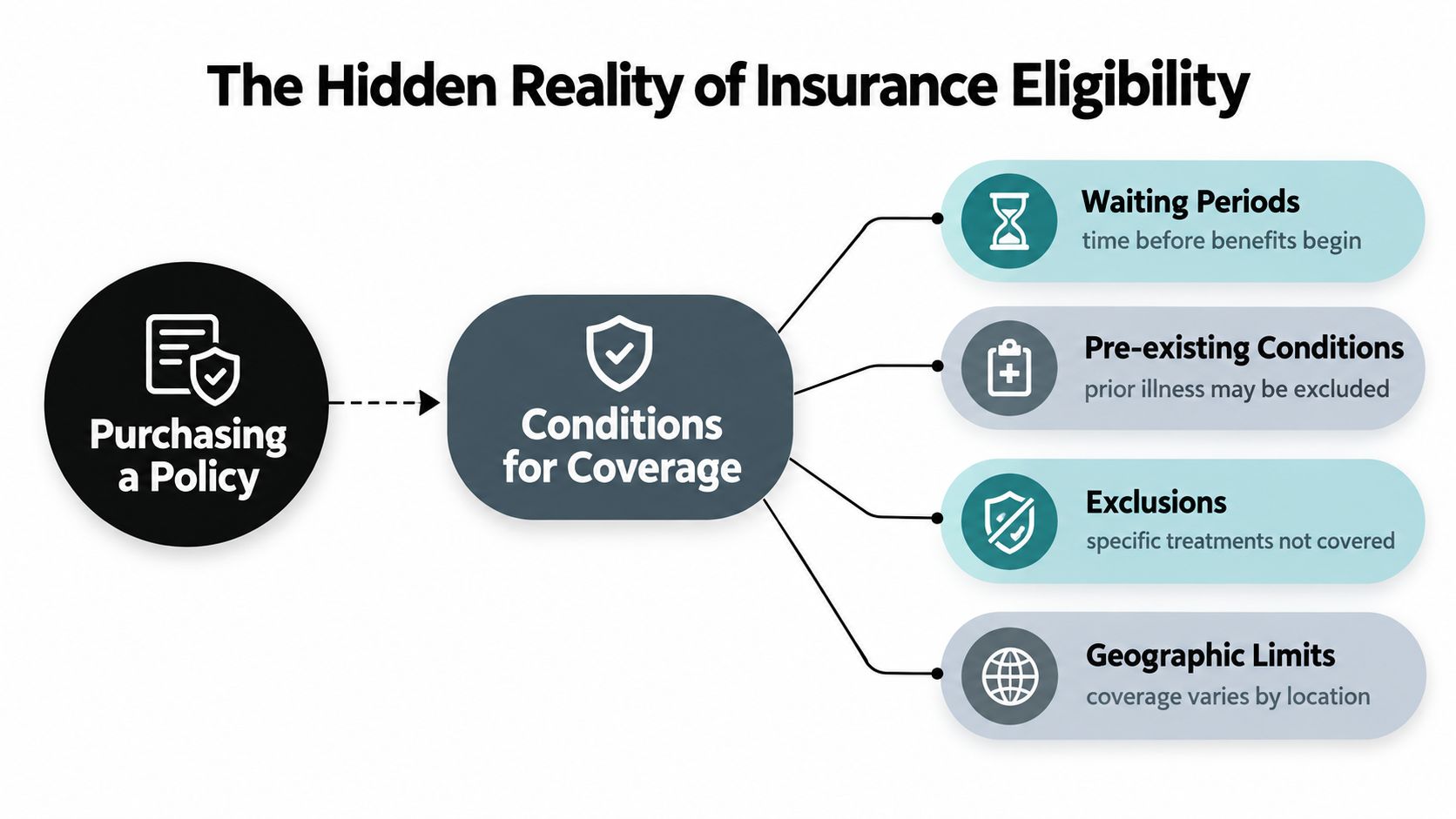
Buying a health policy doesn't automatically mean every future medical problem is covered. Insurance is a contract, and the insurer's promise operates only within defined conditions for coverage. Those conditions can relate to your medical history, the timing of treatment, the type of service, the provider you choose, and where care takes place.
The first distinction is between the insurer's marketing language and its contractual commitment. “Full coverage,” “international,” and “private healthcare” describe a product at a high level. They don't answer the questions that decide a claim: Was the condition present before the policy began? Has a waiting period expired? Is the treatment excluded? Did you obtain prior authorization? Is the provider within the approved network?
The terms that change the outcome
A pre-existing condition generally refers to an illness, symptom, diagnosis, or medical circumstance that existed before the policy started. A chronic illness describes a condition that may require continuing monitoring or treatment. The two concepts can overlap, but they aren't interchangeable. A chronic diagnosis may be accepted, excluded, subject to a reservation, or covered under special terms.
Insurers also distinguish between declared and undeclared information. If you disclose a diagnosis and the insurer accepts you with a written exclusion, the dispute is usually about the scope of that exclusion. If you fail to disclose relevant medical history, the insurer may question whether the policy was issued on accurate information.
Practical rule: Never assess coverage from the policy name alone. Assess the exact condition, service, provider, location, and authorization requirement that would apply when you need care.
A usable policy therefore has two features. It meets the legal or visa requirements that apply to you, and its wording gives you a realistic route to treatment when illness occurs. If either part fails, the document may be valid while the protection remains inadequate.
Regulatory and Legal Conditions for Coverage
Spanish insurance contracts are governed by formal documentation requirements, not only by sales explanations. Under the Spanish Insurance Contract Act, general policy conditions must be supplied in the policy or an accompanying document, signed by the insured, and cannot be unfairly harmful to the policyholder.
That makes the written paperwork decisive. The policy schedule identifies the insured person, dates, product, and selected benefits. The general conditions explain how those benefits operate. Special conditions and underwriting reservations can narrow, modify, or exclude protection for an individual applicant.
What authorization means in practice
If you're buying cover for residence in Spain, check that the insurer is authorized to operate in Spain. This isn't a cosmetic detail. Authorization connects the policy to the Spanish regulatory framework and gives you a clearer basis for assessing contractual rights, complaints, and claims handling.
Ask for the complete set of documents before paying:
- Policy schedule: Confirm your name, effective dates, territory, product, and selected options.
- General conditions: Read definitions, exclusions, authorization rules, claims procedures, and renewal provisions.
- Special conditions: Look for personal exclusions, medical reservations, surcharges, limits, and other departures from standard wording.
- Underwriting record: Check that the information submitted about your health matches what the insurer assessed.
- Provider rules: Establish whether direct billing, approved networks, referrals, or pre-approval apply.
A verbal assurance from a salesperson can help explain a clause, but it shouldn't replace the clause. If an insurer says a diagnosis is covered, ask for that conclusion in writing and keep it with the application and certificate.
Spanish regulation also recognizes circumstances in which an insurer generally can't later deny benefits solely because of an earlier illness when a medical examination was performed or full rights were expressly acknowledged, unless the policy records a health-related reservation in the particular conditions. That doesn't eliminate the need to disclose accurately. It reinforces the importance of identifying what the contract states.
Pre-Existing Conditions Versus Chronic Illness
A resolved operation and an ongoing diagnosis can produce very different underwriting decisions. A past surgery may be treated as a historical event if recovery is complete and no follow-up remains. Diabetes, hypertension, asthma, cancer, or another chronic illness may require continuing medication, monitoring, or specialist care, so an insurer may assess the condition and its possible complications more broadly.
The critical question isn't just whether you have ever been ill. It's what the insurer has accepted, excluded, limited, or deferred in writing.
| Condition Type | Definition | Typical Coverage Outcome |
|---|---|---|
| Resolved past surgery | A prior procedure with no continuing symptoms or treatment | May be accepted, reserved, or reviewed individually |
| Ongoing chronic illness | A continuing diagnosis requiring monitoring, medication, or treatment | May be accepted with a surcharge, exclusion, or specific reservation |
| Declared pre-existing condition | A known condition disclosed during application | Underwritten according to the insurer's written decision |
| Undeclared condition | Relevant prior illness or symptoms not disclosed | Can create a dispute over eligibility or claim validity |
| New condition after inception | A condition first arising after cover begins | May be covered if no waiting period, exclusion, or authorization rule applies |
Declared versus undeclared history
A complete declaration should include diagnoses, symptoms, medication, investigations, specialist consultations, operations, and ongoing monitoring where the application asks for them. Don't assume that a condition is irrelevant because it feels minor or because treatment ended years ago. Answer the actual questions asked, and keep a copy of your answers.
For self-employed applicants, work status can add another layer to the decision. A practical resource on coverage options when you're self-employed can help frame the financial and medical questions before you approach an insurer.
The Spanish pre-existing conditions insurance guide is also useful for understanding why insurers may offer acceptance with a surcharge, acceptance with exclusions, or a moratorium arrangement where the contract permits it.
The mistake I see most often is treating a chronic illness as a label rather than a claims pathway. Ask whether the reservation covers the diagnosis itself, related complications, routine monitoring, recurrence, medication, or only a specified treatment. Those distinctions matter far more than the product brochure.
Understanding Waiting Periods and Exclusions
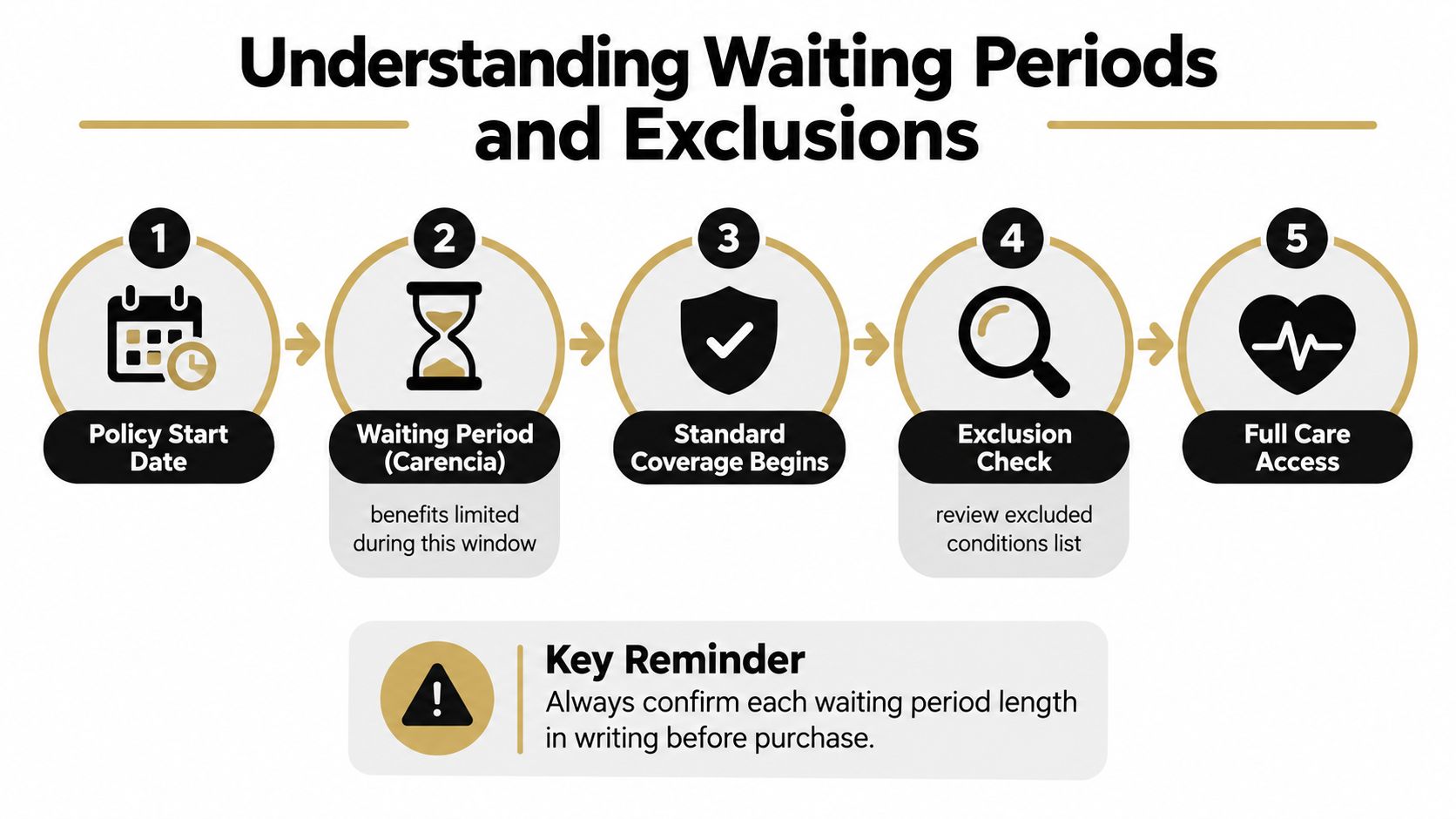
A waiting period, or carencia, delays access to a benefit after the policy begins. It isn't the same as a permanent exclusion. If the waiting period expires and the service remains within the contract, cover may become available. An exclusion removes a condition, treatment, service, or circumstance from cover unless the insurer later changes the contract in writing.
Read the timing clause as a claims instruction
Start with the effective date, then identify each benefit with a separate waiting period. Don't assume that outpatient consultations, hospitalization, surgery, diagnostic tests, maternity care, or specialist treatment share the same timing rule. The contract may also define exceptions for accidents, emergencies, or treatment authorized under a particular pathway.
A simple review works well:
- Mark the policy start date. Use the date the insurer confirms, not the date you first requested a quote.
- List each carencia. Match the waiting period to the exact service it affects.
- Check the exception wording. Determine whether emergencies, accidents, or transfers from another insurer change the rule.
- Separate temporary delays from exclusions. Record whether the restriction ends or remains permanent.
- Request confirmation. Ask the insurer to confirm the interpretation in writing.
The Spanish medical insurance waiting period guide provides further context for reviewing carencias before selecting a plan.
Claims-stage test: If you needed treatment tomorrow, could you identify the clause that permits or prevents it?
Visa applicants need particular care because official requirements can demand no waiting period at all. A policy that offers broad benefits later may still fail the immediate eligibility test if the certificate or conditions contain a carencia. The same applies to exclusions. A temporary delay and a permanent medical reservation have different consequences, and the consulate or claims department may examine the wording rather than the sales description.
Visa Compliance and the No-Exclusion Requirement
For Spanish visa and residence applications, private health insurance must satisfy a specific legal and documentary purpose. Official consular guidance says a qualifying policy must be issued by an insurer authorized to operate in Spain and cover the risks included in Spain's public health system for the full authorization period.
The required cover includes medical, hospital, outpatient, preventive, diagnostic, treatment, rehabilitation, and urgent medical transport services. The policy must have no waiting period, copayment, or monetary coverage limit, and travel insurance isn't accepted. The official Spanish consular guidance for telework visa insurance sets out these requirements.
Why medical underwriting creates a visa problem
Standard private insurance underwriting may accept an applicant while excluding cancer, diabetes, a prior operation, or related complications. That may be a normal commercial outcome, but it can be incompatible with a consulate's requirement for full qualifying cover. The San Francisco consulate's guidance for the non-lucrative visa states that the policy must not contain a deficiency or exclusion due to pre-existing conditions, alongside its requirements for active cover, no copayments, and no coverage limits. Review the consulate's non-lucrative visa insurance requirements before relying on a certificate.
This creates two separate risks:
- Visa-document risk: The certificate or policy wording may be rejected because it contains a prohibited exclusion, waiting period, limit, or cost-sharing feature.
- Medical-claims risk: Even if the document is accepted for an application, the insurer may later apply a medical reservation under the contract.
A cheaper policy with a major exclusion isn't a bargain if it fails the immigration requirement or leaves the illness that motivated you to seek cover outside protection. Applicants dealing with a separate immigration route can consult a specialist resource such as this H-1B transfer guide for general document-planning principles, but Spanish insurance compliance must be checked against the responsible consulate's own wording.
The Importance of Written Underwriting Reservations
Underwriting reservations define the boundary between accepted risk and excluded risk. They should appear in the schedule, special conditions, endorsement, or another document that forms part of the contract. If the insurer has assessed cancer, diabetes, heart disease, or another serious condition, don't rely on a broker's verbal summary of the result.
Ask the insurer to answer four questions in writing:
- Is the diagnosis covered?
- Are complications, recurrence, and monitoring included?
- Does the reservation apply to all treatment or only named services?
- Does it affect related medication, investigations, referrals, or hospital care?
Broad wording needs a second look
An exclusion that names a diagnosis may be wider than it appears. For example, a reservation concerning a heart condition might extend to associated investigations or complications if the wording defines them broadly. Another reservation might apply only to a particular operation. Those outcomes are materially different.
Spanish insurance law requires general conditions to be supplied and protects policyholders against unfairly harmful wording, but that protection doesn't make every disputed claim automatically payable. The practical safeguard is to obtain the complete contract and identify every personal reservation before inception.
If a medical examination was performed or the insurer expressly acknowledged full rights, an earlier illness cannot generally be used alone to deny benefits unless the policy expressly records a health-related reservation in the particular conditions. Keep the medical questionnaire, examination result, acceptance email, schedule, and final certificate together. That file can become important if the claims department later interprets the history differently from the underwriting decision.
Cross-Border Care and Geographic Conditions
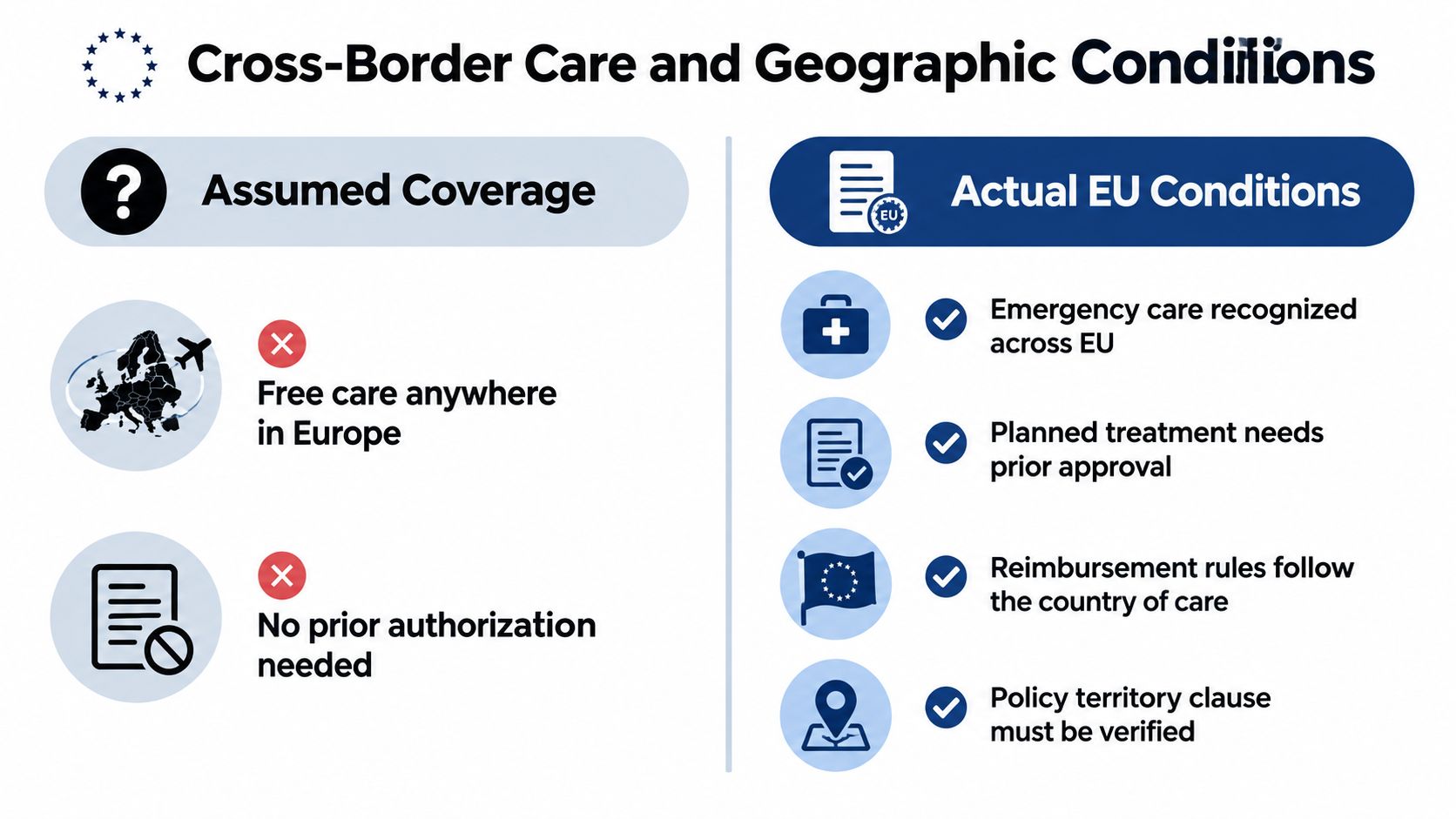
“International cover” doesn't necessarily mean unrestricted treatment anywhere in Europe. Geographic scope is only one part of the arrangement. You also need to know whether the treatment is planned or emergency care, whether authorization is required, which providers are recognized, how reimbursement is calculated, and whether you must pay first.
EU cross-border healthcare rules generally give citizens rights to receive healthcare in another EU country and seek reimbursement from their home country, but the applicable national system and treatment rules determine what happens. The European Court of Auditors reported that almost half of the EU population held a European Health Insurance Card and that more than 2 million reimbursement requests were made annually in its cited material. These figures appear in the European Court of Auditors cross-border healthcare report.
Ask operational questions, not geographic ones
A European Health Insurance Card supports access to medically necessary, state-provided care during a temporary stay. It doesn't automatically provide private hospital access, planned treatment, repatriation, or payment of every cost incurred abroad. Private insurance may offer broader benefits, but its contract still controls.
For planned hospital care lasting more than one night, high-cost treatment, and specialist procedures, prior authorization can be required under EU arrangements. Before accepting a referral abroad, confirm:
- Who authorizes treatment: The Spanish insurer, public authority, assistance company, or overseas provider.
- How payment works: Direct billing, reimbursement, deposits, or patient payment in advance.
- What territory applies: Spain only, selected countries, Europe, or a wider region.
- What continuity means: Whether oncology care, chronic monitoring, second opinions, and follow-up remain coordinated.
- What transport includes: Emergency repatriation, medical escort, and transport to an appropriate facility.
Retirees should also examine the practical air ambulance cost and insurance rules, because emergency transport can involve separate authorization and assistance procedures. Wider geography can provide less usable protection if network restrictions, reimbursement ceilings, or approval delays prevent access when you need it.
Practical Disclosure and Documentation Guide
A strong application begins with an accurate medical file, not a rushed form. Gather diagnosis letters, medication lists, operation records, specialist reports, test results, and dates of relevant treatment. Then answer the insurer's questions precisely, using the wording in your records rather than relying on memory.
Consider an applicant with a previous cancer diagnosis who reports only that treatment is “finished.” That answer may be incomplete if the insurer asks about the diagnosis, follow-up, recurrence, medication, or monitoring. A better submission states what happened, when treatment ended, what follow-up remains, and whether a specialist has confirmed the current position.
A defensible disclosure process
- Read every health question carefully: Don't answer a narrower question than the one asked.
- Disclose relevant history: Include diagnoses, symptoms, investigations, surgery, treatment, and monitoring requested by the form.
- Keep evidence: Save the completed questionnaire and supporting documents.
- Request the underwriting result: Obtain any exclusion, surcharge, moratorium, or acceptance condition in writing.
- Compare the final policy: Make sure the certificate matches the terms you accepted.
Applicants preparing Spanish residence paperwork may also need a Spanish visa medical certificate guide to understand how medical documentation fits into the wider process. A certificate doesn't replace insurance underwriting, but consistent records reduce avoidable contradictions.
Summary Checklist for Policy Evaluation
A policy review should finish with evidence, not reassurance. The document must fit your health history, visa objective, expected treatment, and geographic needs. If one of those elements is unclear, ask the insurer to resolve it before the policy begins.
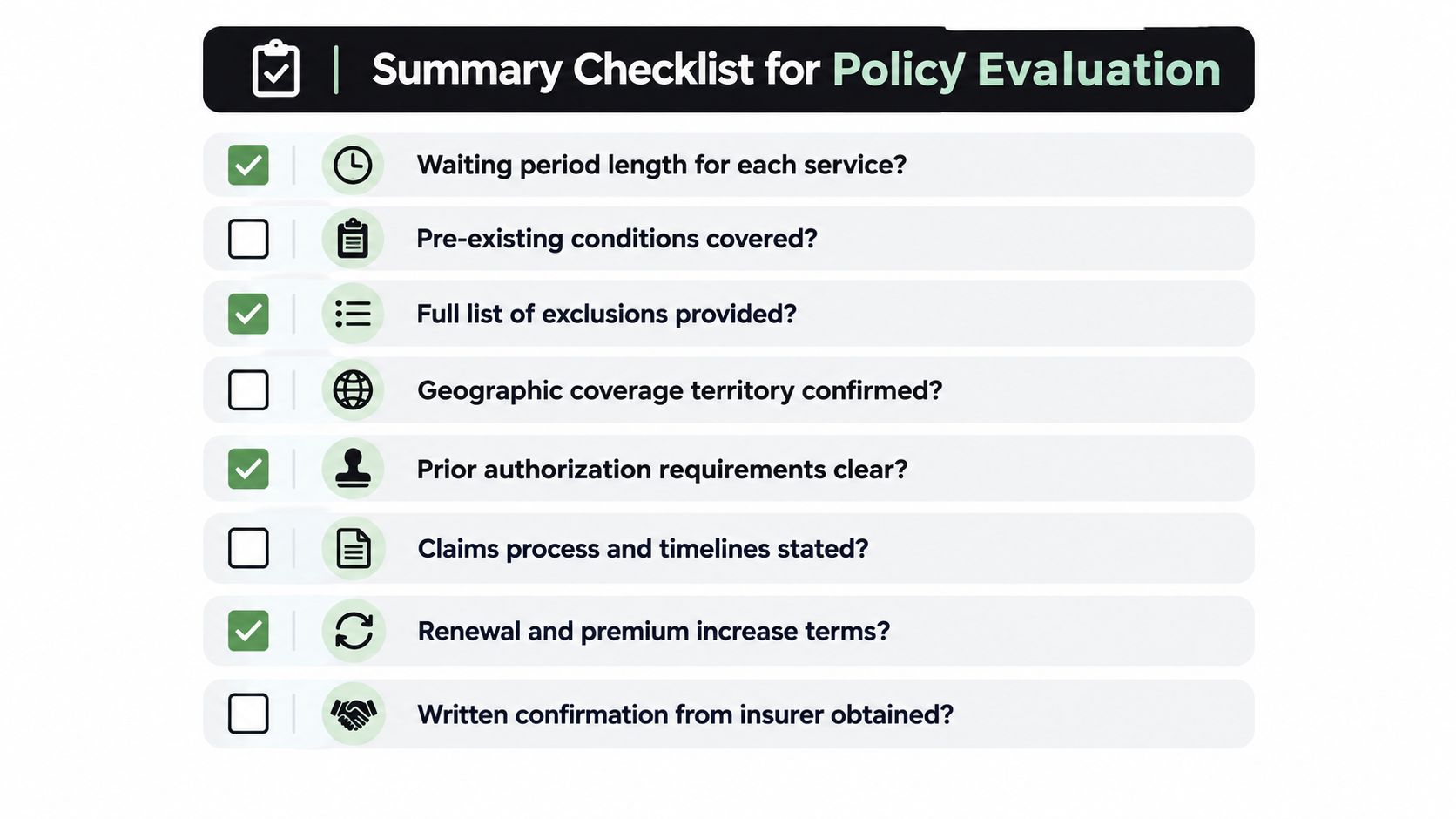
Use this checklist during the quote and acceptance process:
- Authorization: Is the insurer authorized to operate in Spain?
- Waiting periods: Is the length for every relevant service stated clearly?
- Medical history: Are your pre-existing conditions accepted, excluded, deferred, or subject to another written reservation?
- Exclusions: Have you received the complete list, including condition-related and treatment-related exclusions?
- Visa wording: If you need a visa, does the policy have no prohibited waiting period, copayment, monetary limit, or pre-existing-condition exclusion?
- Geographic scope: Does the territory include the countries where you may seek care?
- Prior approval: Do planned hospital treatment, specialist procedures, referrals, repatriation, or high-cost care require authorization?
- Claims process: Do you know how to notify the insurer, which documents are required, and whether payment is direct or reimbursed?
Then check the less visible contractual points. Review renewal terms, premium changes, provider-network rules, referrals, and the treatment of ongoing care. A policy that works for a routine consultation may not work for a planned operation abroad or a recurrence of a previously declared illness.
Bsure Health Brokers compares Spanish and international health plans and helps applicants review options involving pre-existing conditions, visa requirements, retirees, families, and cross-border needs. Visit Bsure Health Brokers to discuss the wording before you commit, not after a claim exposes the gap.