
Yes, you can technically switch health insurance while pregnant in Spain, but the new insurer will almost always apply a fresh maternity waiting period of roughly 8 months, meaning delivery and caesarean cover are usually excluded for the current pregnancy even when the application is accepted. That's the gap most expats miss. They ask if a switch is allowed, hear yes, and assume the birth itself transfers with them.
It doesn't work that way here. Acceptance as a member, access to prenatal care, and payment for the delivery are three separate decisions inside one policy. If you're already pregnant, you need to judge each one before you cancel anything.
Table of Contents
- A Common Situation for Expats in Spain
- How Spanish Maternity Waiting Periods Actually Work
- What a New Insurer Will Cover and What It Will Not
- Underwriting and Disclosure Rules During Pregnancy
- Staying, Switching Within the Same Group, or Starting Fresh
- Using Continuity of Cover to Shorten the Wait
- Why the Safest Move Is Usually to Wait
- Your Maternity-Safe Switch Checklist
A Common Situation for Expats in Spain
Laura lives in Málaga and she's well into her second trimester when two things land in the same week. Her renewal premium jumps sharply, and the gynaecologist who's been following her pregnancy tells her she's moving to a different insurer's network. Laura starts shopping that evening, finds a cheaper policy with the right hospital on its list, and almost signs.

Her situation is textbook for expats. Many people bought their first Spanish policy quickly, often for a visa or residency file, and only read the maternity clauses once they're pregnant. By then the policy no longer feels right, but the pregnancy is already a known fact that a new insurer will price, exclude, or delay.
The Three Questions Behind Every Switch
Laura isn't really asking one question. She's asking three, and they have different answers.
- Can I switch at all: Yes, you can apply, and a new insurer may accept you for general healthcare.
- Will the new insurer pay for my delivery: Usually not for this pregnancy, because maternity benefits sit behind a waiting period that restarts on a new contract.
- Will I create a gap: You will if you cancel the old policy before the new one is accepted in writing with a confirmed start date.
That third question matters more than many realise. A gap doesn't just mean a few uncovered weeks. It can also break the continuity record you'd need if you later ask an insurer to recognise your previous cover.
Don't cancel an existing policy on the strength of a verbal quote. Verbal quotes don't pay hospital bills.
If you recognise Laura's position, treat this as a broker would. You're not shopping for a cheaper premium. You're deciding whether to trade a policy that may already cover your birth for one that almost certainly won't, and you need that trade in writing before you move.
How Spanish Maternity Waiting Periods Actually Work
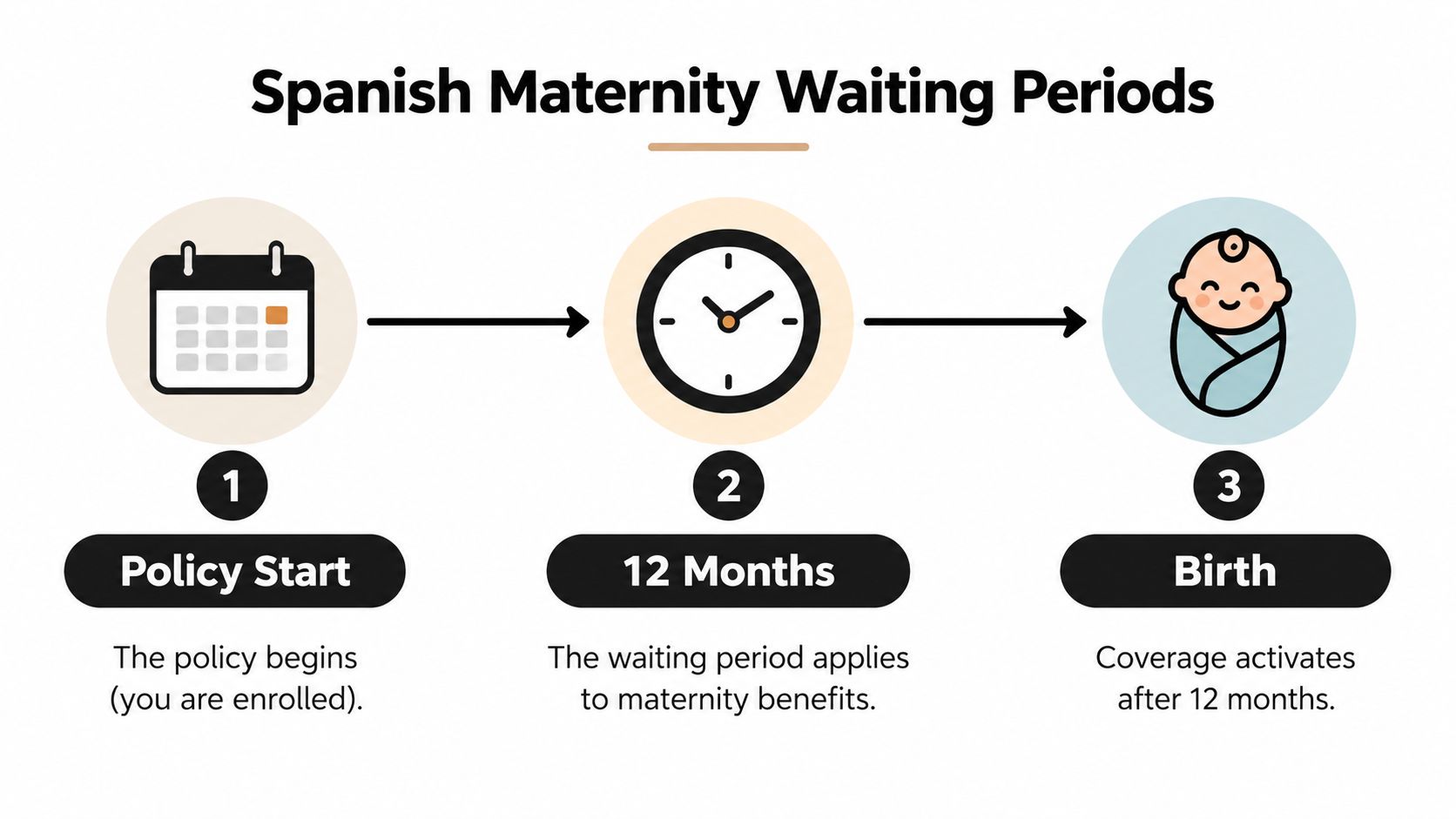
Spanish policies use waiting periods called carencias. A carencia is a contractual delay between the policy start date and the moment a specific benefit becomes payable. It isn't a judgement about your health. It's a calendar rule written into the contract, and it runs whether you feel well or not.
Maternity carries one of the longest carencias in the contract. Major Spanish insurers commonly specify an 8-month waiting period for childbirth or caesarean delivery, and Sanitas states that this applies except for premature birth before 37 weeks, as set out in the policy terms on waiting periods and transfers.
Why Maternity Behaves Differently
Ordinary consultations and basic tests are often available from the start of a new policy, while planned maternity benefits remain locked until the carencia expires. That's why a switch can feel successful at first. You get a membership card, you book appointments, and only later do you discover that asistencia al parto, the delivery benefit itself, was never part of what you'd bought for this pregnancy.
The clock also starts from the policy effective date, not from conception and not from the day you disclosed the pregnancy. So the maths that matters is brutally simple. Put your expected delivery date next to the new policy's start date and see which comes first. If the birth lands inside the carencia, the insurer doesn't pay for it.
Our guide to medical insurance waiting periods in Spain walks through how carencias apply across other treatments, but maternity is the one expats misjudge most often. People assume that because pregnancy is time-limited and predictable, insurers must make an exception. They don't. Predictability is exactly why the waiting period exists. Without it, everyone would buy cover after a positive test and cancel after the birth.
Where to Find the Clause
Don't rely on a brochure line saying the policy covers pregnancy. Ask for the particular conditions and find the carencias table, then look for childbirth and caesarean wording specifically. If a salesperson can't point you to that clause, you're not ready to sign.
What a New Insurer Will Cover and What It Will Not
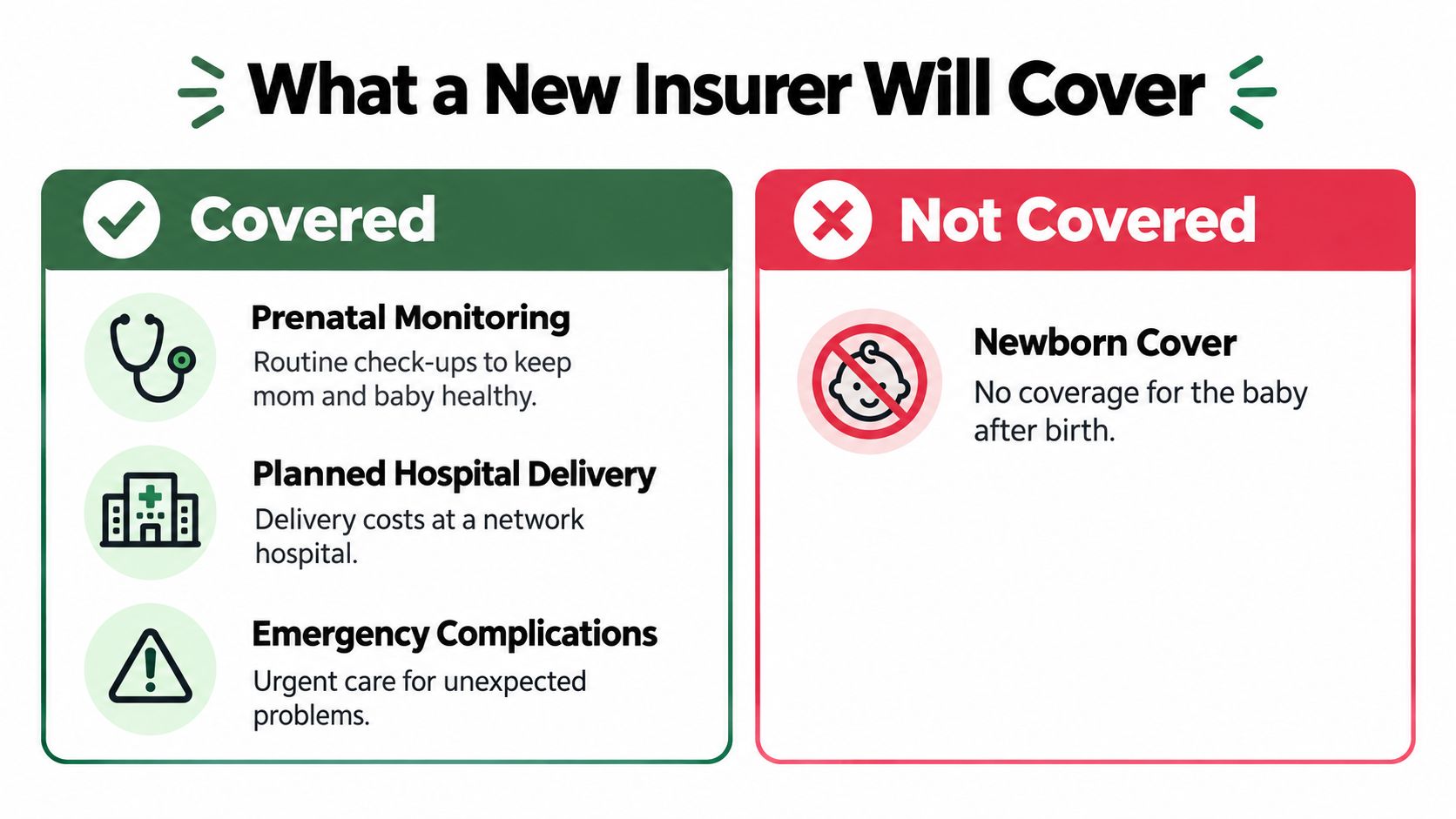
Stop thinking in terms of maternity coverage as a single block. A fresh policy splits your pregnancy into buckets, and each bucket has its own rule. Spain-focused guidance notes that private policies commonly impose maternity waiting periods of roughly 8 to 12 months, so a new policy may cover some routine consultations while excluding the delivery for the current pregnancy, as described in this overview of health insurance for pregnant women in Spain.
Bucket One Prenatal Monitoring
A switch can help. Routine consultations, blood tests, and standard monitoring often sit outside the long maternity carencia, so you may get faster access to a preferred gynaecologist or better scan facilities. Confirm each item anyway, because insurers draw the line between a general consultation and pregnancy-specific monitoring in different places. Our breakdown of health cover for pregnancy explains how those benefits are usually structured.
Supportive care sits outside the policy question entirely, and some women explore options such as acupuncture support for expectant mothers for nausea alongside their medical care. That's a personal wellbeing choice, not a substitute for checking what your insurer will authorise.
Bucket Two Planned Delivery and Caesarean
This is the bucket that almost never transfers. A planned hospital birth or cesárea is the exact benefit the maternity carencia is designed to delay. If your due date falls inside that window, expect to fund a private delivery yourself or use the public system, regardless of how warmly the new insurer welcomed your application.
Bucket Three Emergencies and the Newborn
Emergency obstetric care and complications can be treated differently from a planned delivery, but differently doesn't mean generously. Ask specifically how the policy handles an urgent admission, a premature birth, and neonatal care, because each can carry its own conditions. Newborn cover is separate again. Your baby isn't automatically insured the moment they're born, and enrolment deadlines apply, so get that process confirmed before the birth, not from a hospital bed.
Underwriting and Disclosure Rules During Pregnancy
When you apply for a new policy, you'll complete a health questionnaire. Pregnancy is a material fact on that form, and you must declare it accurately, including how far along you are and any complications your doctor has recorded. This isn't optional paperwork. It's the basis of the contract the insurer is pricing.
What Insurers Do With That Disclosure
Once pregnancy is declared, an underwriter has a few realistic options. They may accept you on standard terms with the maternity carencia doing the work of excluding this birth. They may accept you with specific exclusions. In some cases they may postpone or decline, particularly where complications raise the risk beyond what the product is built for.
None of those outcomes is a personal rejection. Underwriters are matching a known, imminent, expensive event against a product priced for uncertain future events. Expecting them to absorb a delivery they can already see coming misunderstands how private insurance is funded.
Why Hiding a Pregnancy Fails
Some applicants are tempted to submit a clean form and stay quiet. Don't. If a claim is later investigated and the dates don't line up, the insurer can challenge the contract itself, which puts far more than the delivery bill at risk. You could lose cover you'd otherwise have kept.
There's also a simpler reason concealment gains you nothing. The maternity carencia blocks the delivery benefit whether you disclosed the pregnancy or not. Silence doesn't move the calendar. It only adds a disclosure problem on top of a waiting period problem.
Practical rule: Disclose fully, accept the likely maternity exclusion in writing, and keep a clean record you can rely on for everything else.
Ask the insurer to confirm the underwriting outcome in writing, including any exclusions, before you pay the first premium. If the written terms differ from what you were told on the phone, the written terms win. Walk away if they aren't what you agreed to.
Staying, Switching Within the Same Group, or Starting Fresh
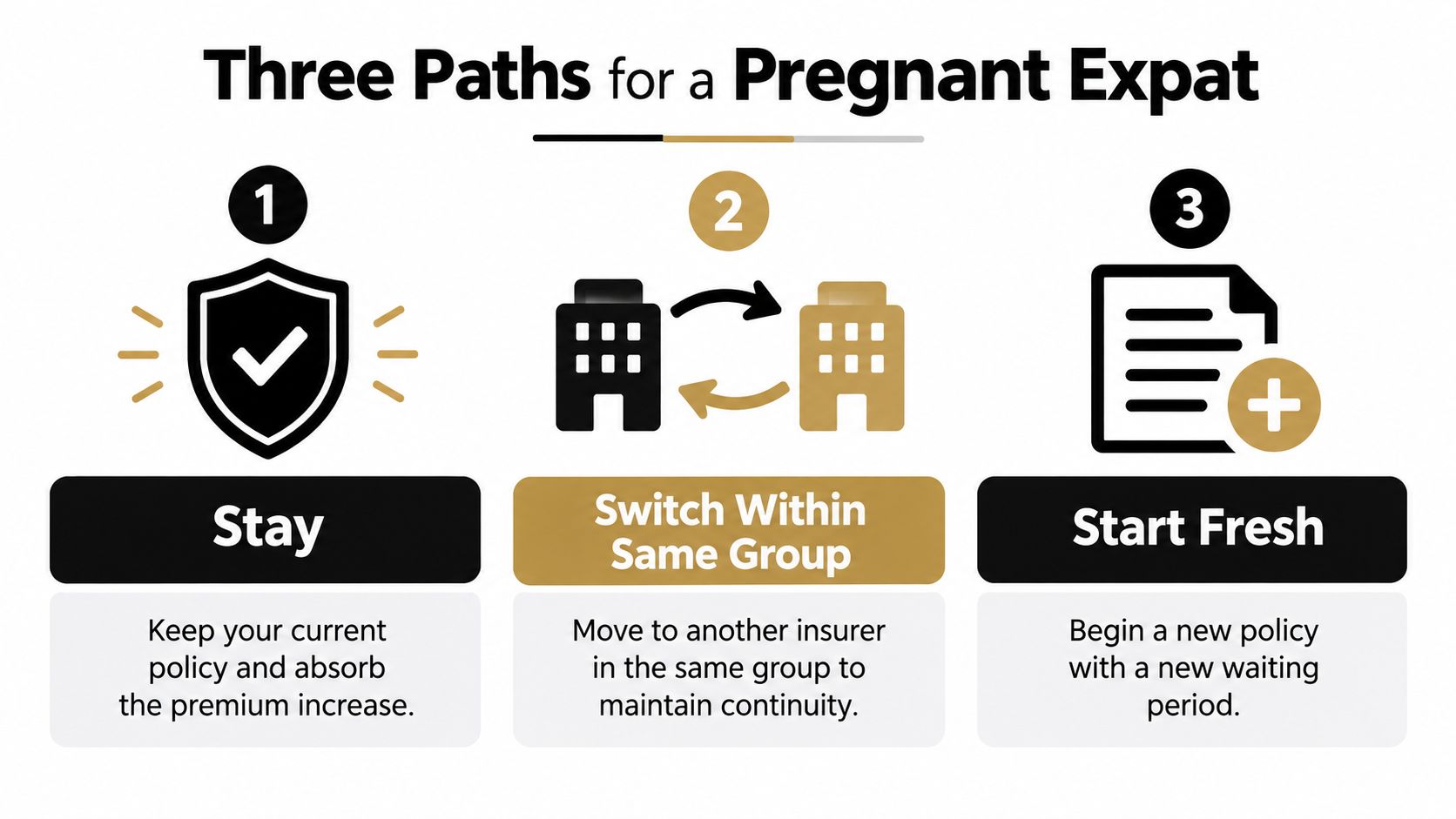
You have three realistic paths, and they aren't equal. Most pregnant expats who call a broker want the third one to work. It usually doesn't, at least not for the birth they're currently planning.
Option One Stay Put
Keeping your current policy means swallowing the premium rise or the network frustration that started this search. In exchange, you keep whatever carencia you've already served. If your existing policy has cleared its maternity waiting period, that accrued time is the most valuable asset in this whole decision, and it's the one thing a cheaper quote can't replace.
Option Two Move Within the Same Group
Switching between sister companies or product lines inside one insurance group sometimes opens a conversation about continuity that a stranger insurer won't entertain. The group already holds your history, which makes recognising your prior cover administratively easier. Easier isn't guaranteed, though. Maternity is still the benefit groups are least willing to backdate, so any continuity promise needs to name childbirth explicitly.
Option Three Start Fresh Elsewhere
A brand new insurer means fresh underwriting and a fresh carencia clock. This path can make sense if you're switching for long term reasons, such as a better hospital network for your family after the baby arrives, and you've accepted that this delivery won't be covered privately. It makes no sense if the entire point of switching is to get this birth paid for.
Comparing Three Realistic Switch Options for a Pregnant Expat
| Option | Premium Effect | Maternity Carencia | Likely Delivery Cover | Paperwork |
|---|---|---|---|---|
| Stay | Renewal increase applies | Already served or running | Covered if carencia cleared | Minimal |
| Same group | May improve modestly | Negotiable, maternity often excluded | Uncertain, needs written proof | Moderate |
| Start fresh | Often lowest headline price | Restarts from day one | Very unlikely for this pregnancy | Full underwriting |
Read that table the way an underwriter would. The cheapest premium is attached to the option least likely to pay your largest upcoming bill. If a switch saves you a modest amount each month but leaves you funding a private delivery yourself, you haven't saved money. You've moved the cost somewhere bigger.
Using Continuity of Cover to Shorten the Wait
Continuity is where experienced brokers earn their fee, because it's the one mechanism that can soften a waiting period rather than restart it. The idea is simple. If you've held comparable cover without a break, a new insurer may credit that time against some of its own carencias instead of making you serve them again.
The catch sits exactly where you'd expect. Policy information from a major Spanish insurer shows that people transferring from another full Spanish policy held for at least 12 months may avoid most waiting periods, but the childbirth waiting period remains an exception, a pattern also reflected in this guide to private health insurance in Spain. Read that again if you're pinning your hopes on a transfer. Most carencias can move. Maternity usually stays locked.
How Spain Compares With Wider Europe
Spain isn't an outlier. European Commission comparative material documents childbirth related waiting periods of up to nine months in some national frameworks, with cover potentially available only when the insured event falls after the waiting period or when conception occurred after the contract began, as set out in the Commission material on waiting periods in insurance contracts. Wherever you are in Europe, private maternity cover is bought in advance or not at all.
Documents That Support a Continuity Request
If you're going to ask for credit, arrive with evidence rather than a story.
- Certificate of continuity: Ask your current insurer for written proof of your start date and uninterrupted cover.
- Premium payment history: Show the policy stayed in force without lapses.
- Current policy conditions: Prove the cover you're leaving is comparable to the one you're joining.
- Existing exclusions: Disclose any underwriting exclusions already on your record so nothing surfaces later.
Our step by step guidance on changing healthcare providers covers the mechanics of requesting these documents. Submit them before you sign, and get the insurer's answer on maternity specifically, in writing, with dates. A general statement that your carencias are recognised tells you nothing about the one benefit you care most about.
Why the Safest Move Is Usually to Wait
Here's the advice I give most often, and it's rarely what people want to hear. Keep your existing policy running, have your baby under the cover you've already earned, and treat the switch as a project for after the birth. Once the delivery is behind you, you're an ordinary applicant again, free to compare the whole market without a carencia hanging over an imminent claim.
Waiting doesn't leave you exposed, because private insurance isn't your only safety net. The European Commission states that the European Health Insurance Card covers medically necessary treatment connected with pregnancy, including childbirth, during a temporary stay in another EU country, Iceland, Liechtenstein, Norway, or Switzerland, according to the Commission guidance on the European Health Insurance Card. That card isn't a route to a planned private birth abroad, and travelling specifically to give birth can require prior authorisation through an S2 form, but it underlines a key point. Your statutory rights and your private policy are separate systems.
For residents in Spain, that separation works in your favour. A private maternity carencia doesn't remove your access to public maternity care. If a switch leaves your delivery outside private cover, the public pathway remains there, and for many families that's a perfectly sound place to have a baby.
The dangerous move is cancelling early. Cancel before written acceptance elsewhere and you can end up with no private cover, no continuity credit, and a new carencia running anyway. That's the worst of every world, and it's entirely avoidable. Pay the renewal you resent if you have to. It's cheaper than the alternative.
Your Maternity-Safe Switch Checklist
Take this list into any conversation with an insurer or broker, and don't cancel existing cover until every item is answered in writing. This is the same sequence Bsure Health Brokers works through when advising clients on a maternity related switch, comparing policy terms and checking whether prior continuous cover changes the picture.
- Confirm acceptance first: Get written confirmation that the new insurer has accepted your application with the pregnancy disclosed.
- Pin down the carencia: Ask for the exact maternity waiting period and the date it expires, then set it against your due date.
- Split the benefits: Get separate answers for prenatal monitoring, planned delivery, caesarean, emergencies, and neonatal care.
- Test continuity properly: Submit your certificate of continuity and ask whether childbirth is included in any waiver, by name.
- Check your people and places: Confirm your obstetrician and chosen hospital are in the new network for the services you'll use.
- Price the worst case: Work out what you'd pay yourself if labour starts before the waiting period ends.
- Plan the newborn's cover: Ask how and by when your baby must be enrolled, and set a reminder before the birth.
- Cancel last: Only end the old policy once the new start date is confirmed and there's no gap between the two.
If any answer comes back vague, treat that as a no. Insurers who intend to pay a benefit can say so clearly.
If you're weighing up whether Can You Switch Health Insurance While Pregnant applies to your own dates and policy, talk it through before you cancel anything. Bsure Health Brokers will review your current carencias, test whether continuity helps you, and tell you plainly if staying put is the smarter move. Get that assessment in writing first, then decide.