
You're probably in one of three situations right now. You're moving to Spain and the visa paperwork is forcing the insurance question. You already live here and want to stop guessing whether your home-country cover works abroad. Or you bought a cheap policy online, felt organised for ten minutes, and then realised you still don't know what it would pay for if you landed in hospital.
That's where many get this wrong. They ask, what is international health insurance, as if it's one standard product. It isn't. It's a category with moving parts, exclusions, underwriting choices, and pricing traps that can make one plan useful and another nearly worthless for your life.
The market is also big enough that sloppy buying is easy. One industry report estimates the international health insurance market at $31.68 billion in 2025, rising to $34.51 billion in 2026 and projected to reach $48.04 billion by 2030 (international health insurance market report). Plenty of policies exist. That doesn't mean plenty of good fits exist.
Table of Contents
- The Moment You Realise Travel Cover Is Not Enough
- What International Health Insurance Actually Is
- International vs Expat vs Travel Cover Compared
- What Drives the Price of an International Plan
- When You Do Not Actually Need International Cover
- Pre-Existing Conditions and Underwriting Routes
- Common Exclusions and How Claims Really Work
- Choosing the Right Plan and How Bsure Helps
The Moment You Realise Travel Cover Is Not Enough
You buy a low-cost travel policy because you're only “sorting things out” for the first few months. Then real life turns up. A hospital wants a guarantee of payment. The insurer starts checking trip limits, definitions, and exclusions. Suddenly the cheap policy that looked tidy on comparison sites starts looking flimsy.
That gap matters because overseas treatment can get expensive fast. A U.S. government travel advisory warns that a serious injury or illness abroad can lead to evacuation or treatment costing tens of thousands of dollars, and it recommends buying insurance that includes emergency care and medical evacuation (cross-border medical cost warning). That's the reason this product category exists.
If you're relocating, retiring abroad, splitting time between countries, or working remotely for months at a stretch, you need more than a trip policy. You also need to confirm what your existing documents show before you travel or move. A simple check like this guide to insurance coverage verification abroad can save you from assuming you're covered when you're not.
What travel cover usually gets wrong
Three problems show up again and again:
- Trip-length limits: Travel policies are built for temporary trips, not open-ended life abroad.
- Weak ongoing care: They're usually designed around emergency events, not repeat prescriptions, specialist follow-up, or chronic conditions.
- Claims friction: Insurers often scrutinise residency status, return-ticket assumptions, and whether the policyholder was really travelling or effectively living abroad.
Cheap travel cover works well right up to the moment you need it to behave like proper health insurance.
International health insurance is the fix for that mismatch. It's built for people who live outside their home country long enough that healthcare stops being a travel issue and becomes a life admin issue.
What International Health Insurance Actually Is
At its simplest, international health insurance is an annually renewable medical policy built for people living outside their home country. Think of it as a safety net sized to a cross-border life, not a single holiday.
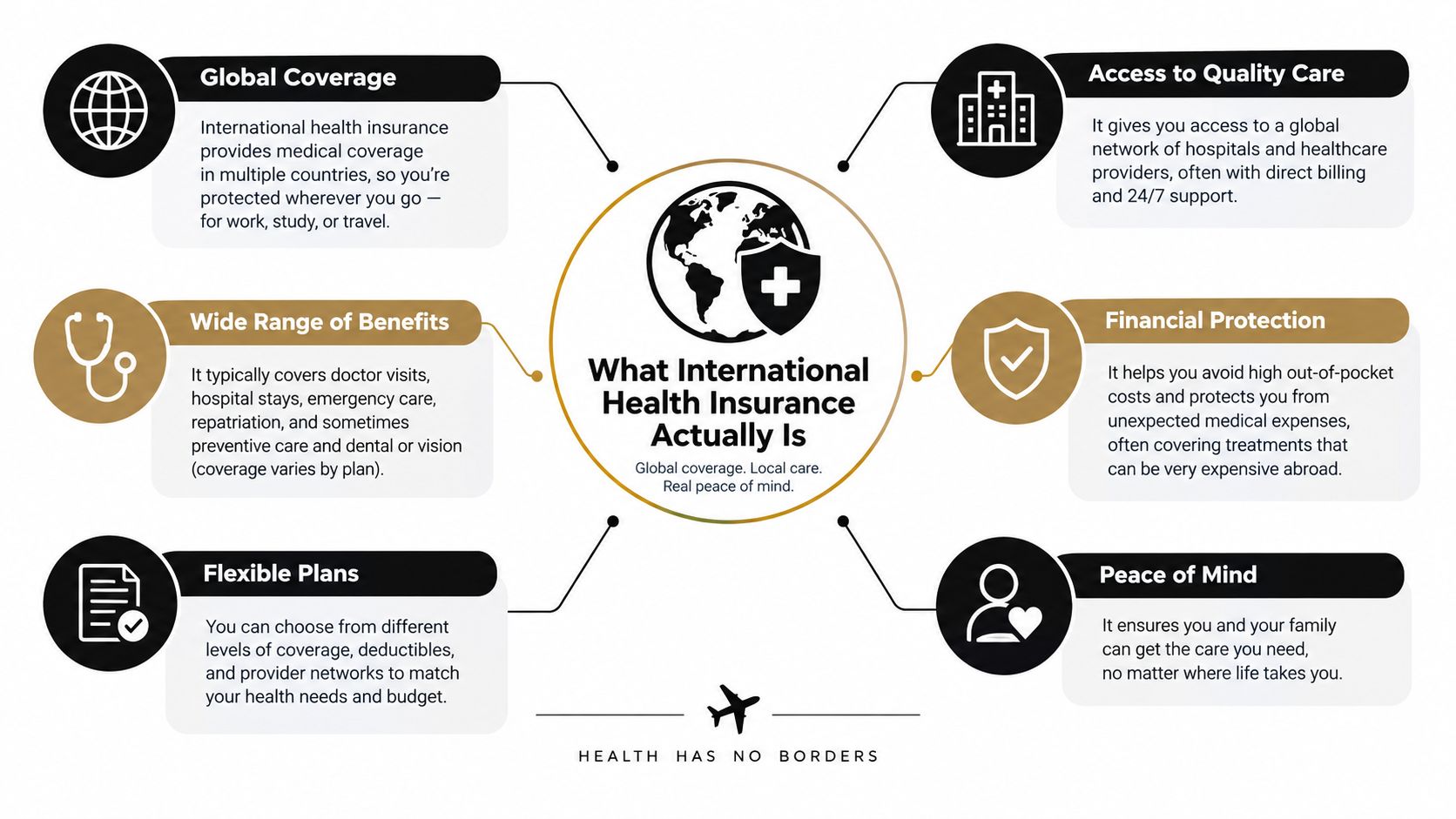
It isn't one vague promise of “global cover”. The policy is usually assembled from four parts that you need to read separately.
Renewable term and service area
First, it's typically renewable each year for people residing abroad, not a one-off trip contract. Second, it comes with a defined geographic area of cover. That may be Europe-only, regional cover, worldwide excluding the U.S., or worldwide including the U.S.
That structure matters because insurers price risk by geography, provider costs, and claim severity. International plans are often sold in tiers, and the highest-cost tier is usually worldwide cover including the United States because U.S. treatment costs push premiums up materially (how international plans are structured).
Benefit package and add-ons
Then comes the actual medical content of the plan. Most international policies separate benefits into modules or levels, such as:
- Inpatient cover: Hospital admissions, surgery, accommodation, and major treatment.
- Outpatient cover: GP visits, specialists, diagnostics, and follow-up outside hospital.
- Emergency evacuation or repatriation: Transport if suitable care isn't available locally, or return arrangements after a major event.
- Chronic-care handling: Wording gets dangerous, because some plans are far thinner than buyers assume.
Optional extras often sit on top:
- Dental
- Maternity
- Wellness or preventive checks
- Mental health extensions
- Vision
Why it exists as a separate product
This type of insurance exists because once you leave your domestic healthcare system, the financial exposure changes completely. Insurers worldwide collected EUR 7.0 trillion in life, property and casualty, and health premiums combined in 2025 according to Allianz's global insurance report, which shows how central health-related protection is in modern insurance systems (global insurance context and cross-border medical risk).
International cover sits in that larger world, but it solves a very specific problem. It protects you when your home system doesn't follow you, when local access is uncertain, and when emergency treatment, hospitalisation, or repatriation could become your bill instead of the insurer's.
This is also why it's different from Spanish public healthcare and different from short-term travel insurance. One is tied to local eligibility. The other is tied to short trips. International health insurance is tied to mobility.
International vs Expat vs Travel Cover Compared
People throw these labels around as if they mean the same thing. They don't. If you buy the wrong column, you either overpay or discover too late that the policy was never designed for your life.
Here's the clean comparison.
International vs Expat vs Travel Cover
| Feature | International | Expat | Travel / Short-term |
|---|---|---|---|
| Best fit | Globally mobile professionals, frequent movers, families split across countries | Long-term residents mainly based in one host country | Tourists, gap-year travellers, people on temporary stays |
| Duration | Usually annual and renewable | Usually annual and renewable | Usually limited-term |
| Geography | Regional or worldwide, often with or without U.S. | Often centred on host country or region, with some portability | Trip-based or short-term geographic cover |
| Routine care | Often available, depending on plan tier | Commonly available | Usually limited or absent |
| Chronic conditions | Possible, depending on underwriting | More relevant for settled long-term use, still subject to underwriting | Commonly excluded or restricted |
| Pre-existing conditions | Handled through underwriting routes | Handled through underwriting routes | Usually weakly covered or excluded |
| Evacuation | Often available as core or add-on | Often available | Common in emergency-only form |
| Maternity | Usually optional or higher-tier | More likely to matter for settled families | Rare |
| Visa suitability | Sometimes yes, sometimes no | Often more suitable if matched properly | Often fails visa requirements |
| Portability | Strong | Moderate to strong | Weak for long-term living abroad |
Expat cover is often just a narrower practical version of international cover. It suits someone settled mainly in Spain, Portugal, or another host country who still wants private care and some portability. Travel cover is different altogether. Even when sold with a longer validity period, it usually remains emergency-focused.
The easiest way to place yourself
Use this rule:
- Choose international if your life spans more than one country.
- Choose expat-style cover if you live mainly in one country and want private access there.
- Choose travel cover only if you're travelling, not relocating by stealth.
If you want a deeper breakdown of where the boundary sits, this guide on international health insurance vs travel insurance is useful because it focuses on the practical use case rather than marketing labels.
If you need repeat medication, specialist follow-up, or visa-compliant cover, don't try to force a travel policy to do a resident policy's job.
What Drives the Price of an International Plan
Most buyers ask the wrong question first. They ask, “What's the cheapest plan?” The better question is, “Which parts of this policy are making it expensive?”
Recent pricing summaries show broad dispersion. Some guides describe standard international plans at roughly €2,600 to €4,300 per year, while broader market reporting puts average annual cost near $6,900, with some plans under $500 and others above $10,000 depending on geography and U.S. cover (international plan pricing ranges). That spread tells you one thing. Price is driven by design choices.
Premium Drivers at a Glance (2026 Estimates)
| Premium Driver | Low Option | High Option | Price Impact |
|---|---|---|---|
| Geographic area | Regional or worldwide excluding U.S. | Worldwide including U.S. | Often the biggest swing factor |
| Benefit level | Core inpatient-focused cover | Broad inpatient and outpatient with extras | Higher benefits usually raise premium |
| Deductible | Higher deductible | Low or no deductible | Lower deductible usually means higher premium |
| Add-ons | No dental or maternity | Dental, maternity, wellness, richer extras | Each add-on increases cost |
| Health history | Cleaner underwriting outcome | Exclusions, loadings, or restricted acceptance | Can change eligibility and value |
| Residency pattern | Mostly one region | Frequent multi-country use | More portability often costs more |
The four biggest cost levers
The first is geography. If you include the United States, the premium usually jumps hard because expected claim costs jump hard.
The second is benefit depth. A basic inpatient plan can be sensible for someone who's happy to self-fund routine care. A plan with outpatient, diagnostics, and add-ons is more convenient, but you pay for that convenience every renewal.
The third is deductible. Many buyers ignore this and stare only at monthly premium. That's backward thinking. A higher deductible can make sense if you live somewhere with manageable private consultation costs and you mainly want protection for bigger events.
The fourth is underwriting outcome. If the insurer sees medical history it doesn't like, the issue isn't just price. It may be exclusions, delayed cover, or refusal.
If you want to sense-check what those choices do to a quote before you apply, a health insurance premium calculator is a sensible starting point. Just don't confuse a calculator with a final underwriting decision.
My blunt pricing advice
Buy for the risks that would hurt, not the conveniences you can self-fund.
- Keep U.S. cover only if you need it: If you don't spend meaningful time there, strip it out.
- Use deductible strategically: Don't pay extra to insure small bills you could comfortably handle.
- Add maternity or dental only if relevant now: “Maybe one day” is an expensive reason to inflate a premium.
When You Do Not Actually Need International Cover
This is the part many brokers won't say clearly enough. International cover is not automatically the smart choice just because you live abroad.
If your life is now mostly in Spain, your treatment will mostly happen in Spain, and you don't need broad portability, a Spanish private policy or the public system may be the cleaner solution. International plans earn their price when you use their international features.
Situations where local cover often wins
A long-term resident with stable life in one autonomous community may get little value from paying for broad regional or worldwide access they rarely use. The same goes for a family whose consultants, hospitals, and follow-up care are all local.
Retirees are another obvious case. If you qualify for local arrangements such as the Convenio Especial, the numbers can look very different from an international private plan. Recent guidance puts that at around €60 to €157 per month in 2026 depending on age band and terms in force, which makes it a very different proposition from a portable international contract.
A practical decision test
Ask yourself four plain questions:
- Where will most treatment happen: If the answer is “Spain, almost always,” local cover deserves first look.
- Do you move between countries: If not, portability may be wasted money.
- Do you need immediate visa-compliant private cover: If yes, international or Spanish-compliant private cover may still be necessary.
- Would local hospitals and specialists be enough for your needs: For many residents, the answer is yes.
Practical rule: If your healthcare life is local, buy local first and only pay for international features you'll actually use.
The mistake isn't buying international insurance. The mistake is buying it by default.
Pre-Existing Conditions and Underwriting Routes
The cheerful sales language usually falls apart. People ask what international health insurance is, but the sharper question is this: what will this specific policy still refuse to cover after I tell the truth about my history?
Pre-existing conditions can include prior illness, injury, symptoms, diagnosis, treatment, or medication before the policy starts. Coverage depends heavily on the underwriting route, and that distinction is too often glossed over (how pre-existing conditions are defined in international plans).
The three underwriting doors
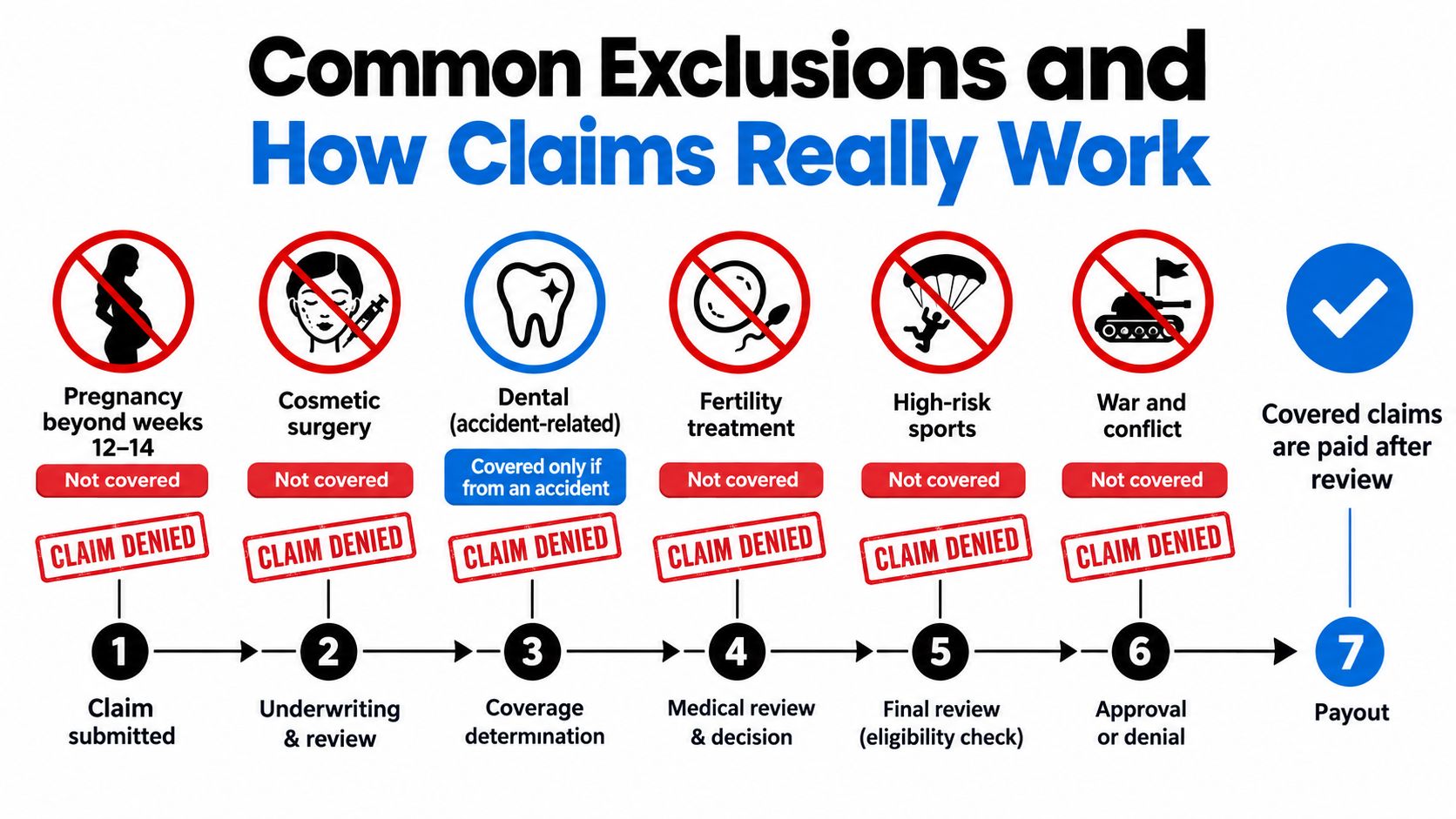
Full medical underwriting means you disclose everything up front. The insurer reviews your history, then tells you what it will cover, what it will exclude, and whether it will accept you at all.
That's the most honest route. It can be painful, but at least you know where you stand on day one.
Moratorium underwriting works differently. In international products, insurers commonly use look-back windows of 2 to 5 years, and a stable, symptom-free period of about 24 months can allow a condition to move from excluded to potentially coverable under moratorium terms (international underwriting approaches). Buyers love moratorium because it feels simpler. The trap is uncertainty. If symptoms, medication changes, or treatment crop up during that period, the insurer may keep the condition outside cover.
Continuation terms can work well if you already have comparable cover and switch without a break. In the right case, they preserve cover status already earned under the prior policy instead of forcing you back to square one.
Two real-world style examples
Take a person in remission after early-stage breast cancer several years ago. Under full medical underwriting, the insurer may accept the application but exclude cancer-related recurrence, monitoring, or complications. Under moratorium terms, there may be a path to future cover only if the policy wording and symptom-free history line up exactly. Under continuation, prior cover history becomes critical.
Now take a person with well-controlled Type 2 diabetes. Full medical underwriting may produce a diabetes exclusion from the outset. Moratorium usually won't magically solve that if treatment and medication are ongoing, because ongoing management often means the condition never clears the waiting logic. Continuation can be the most valuable route if the previous insurer already covered it.
If this is your issue, don't guess. Get the underwriting route identified first. Then compare policy wording. A specialist guide to pre-existing conditions health insurance can help frame the right questions before you apply.
Common Exclusions and How Claims Really Work
A policy can look generous until you read the denial triggers. That's why exclusions matter more than brochure summaries.
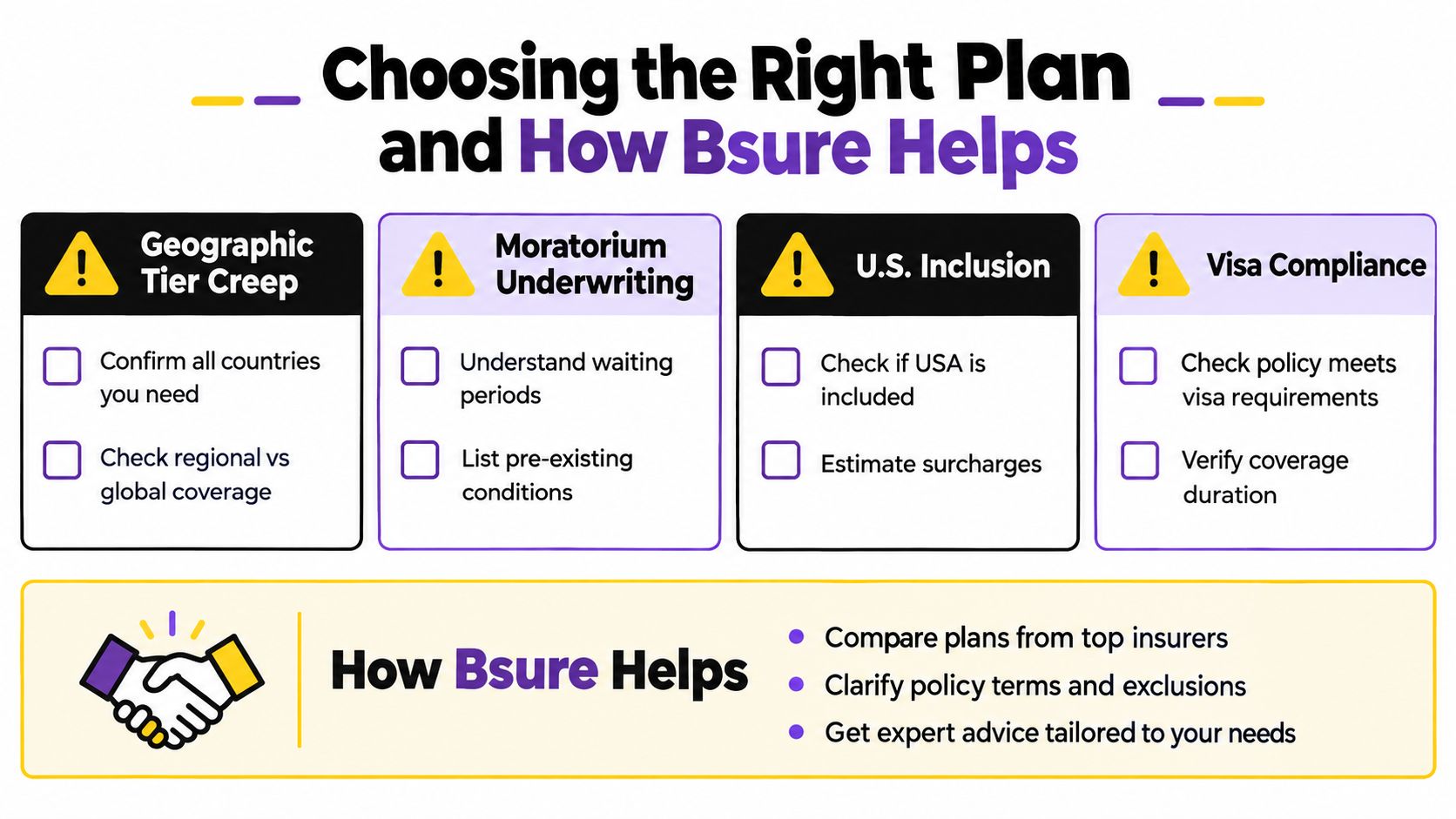
Exclusions that keep showing up
These are the ones that catch people most often:
- Pregnancy limits: Cover may exclude maternity unless specifically added, and some policies restrict late-entry pregnancy claims.
- Cosmetic treatment: If the procedure is elective and not medically necessary under the wording, expect a rejection.
- Dental limits: Many plans cover dental only if it results from an accident, not standard treatment.
- Fertility treatment: Often excluded unless expressly included.
- High-risk sports: Skiing off-piste, motorsport, diving, or similar activities can sit outside standard cover.
- War and civil unrest: Treatment in conflict-linked situations is commonly excluded.
- Out-of-network or self-referral issues: If the plan requires pre-authorisation or network use and you skip it, reimbursement can shrink or disappear.
- Pre-existing conditions during waiting or moratorium periods: This is a classic denial ground.
How claims actually move
For inpatient treatment, many international insurers want pre-authorisation unless it's an emergency. If they approve and the hospital accepts direct settlement, the insurer may pay the provider directly. If not, you pay first and claim back.
For reimbursement claims, insurers commonly ask for:
- Medical report or doctor's notes
- Itemised invoice
- Proof of payment
- Policy details
- Travel or residency evidence if relevant
Submission windows vary by policy wording, so don't sit on paperwork. If you're dealing with a Spanish document pack or a bilingual hospital file, accurate translation can help avoid misunderstandings. A service such as Translators USA insurance policy translation can be useful when the insurer, the hospital, and the policy language don't match cleanly.
Call the insurer before elective treatment. That one phone call prevents more grief than any “claims guide” you'll ever read.
What usually stalls reimbursement
The worst delays tend to come from ordinary admin failure:
- Missing itemisation: A lump-sum receipt often isn't enough.
- No proof of payment: The insurer wants evidence you paid.
- Unreadable reports: Blurry scans and half-complete forms waste time.
- No original timeline: If dates of travel, treatment, and symptoms don't line up, the insurer starts digging.
Keep originals. Keep scans. Keep your policy schedule handy. Boring habits beat angry appeals.
Choosing the Right Plan and How Bsure Helps
Most bad international health insurance decisions come from one mistake. People compare premiums before they compare fit.
The right way to buy is to filter every quote through four traps. Geographic tier creep. Moratorium underwriting. U.S.-inclusion surcharge. Visa-compliance exclusions. If you don't pin those down first, the quote comparison is theatre.
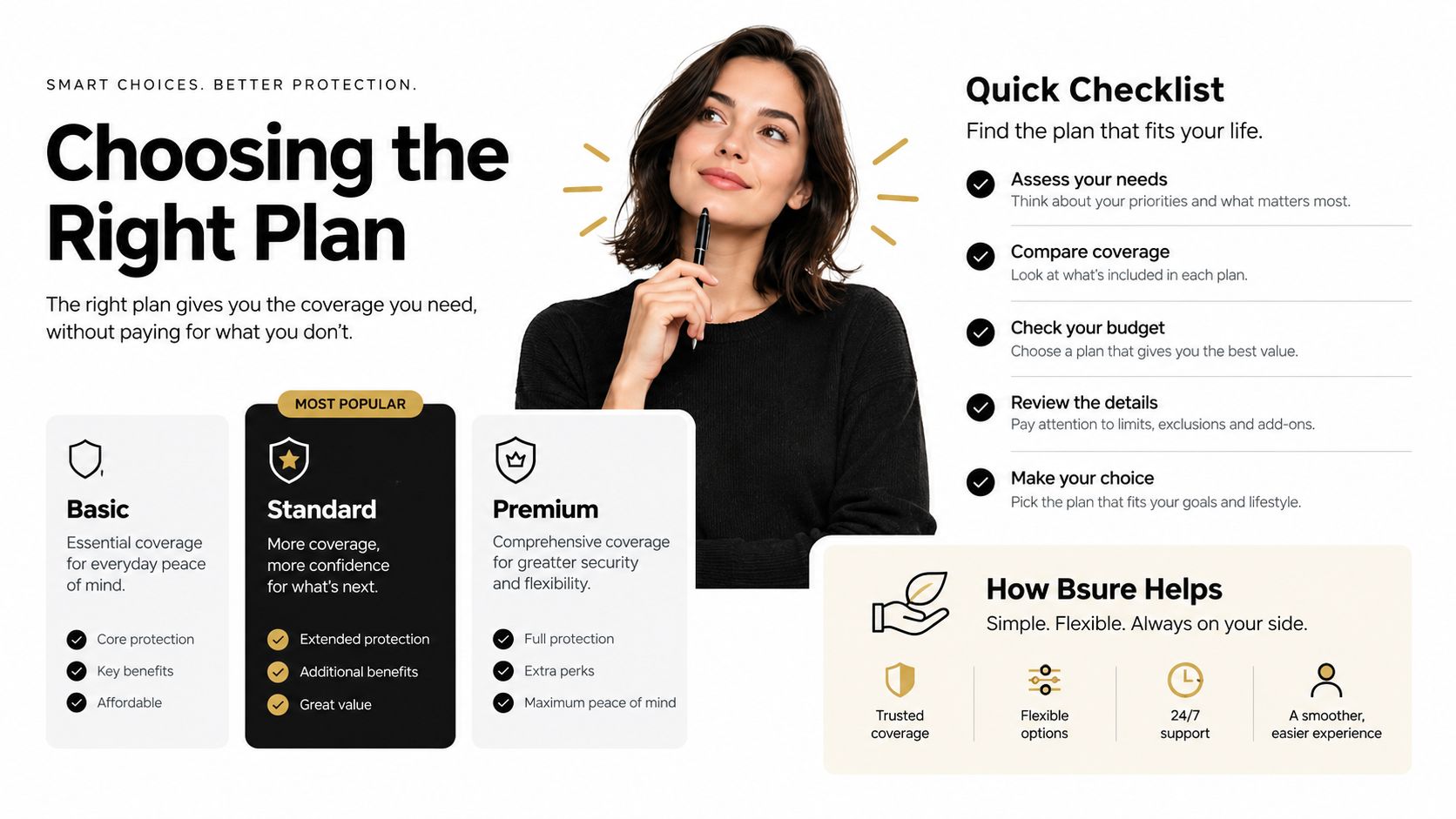
The decision checklist I'd use with you
Start with these filters, in this order:
- Residency and visa status: If the policy must satisfy a Spanish visa or residency process, confirm that first. Don't assume “international” means compliant.
- Country list: Write down where you'll live, travel, and receive treatment. Not where you might go once every few years.
- Hospital expectation: Decide whether you want broad private hospital access, emergency-only protection, or something in between.
- Pre-existing conditions: Identify your underwriting route before you compare price.
- U.S. inclusion: Keep it only if your travel pattern justifies the extra cost.
- Core benefits: Inpatient only, or inpatient plus outpatient and diagnostics.
- Add-ons: Dental and maternity only if they're relevant now.
- Budget tolerance: Premium, deductible, and likely out-of-pocket need to work together.
Where broker help actually pays off
This is one of the few insurance categories where good advice can save both money and claim disputes because the wording matters as much as the brand. A broker comparing multiple insurers can screen out plans that fail your visa needs, hide a weak underwriting route, or charge for geography you don't need.
That's also where Bsure Health Brokers fits in practical terms. They compare Spanish and international options, flag exclusions line by line, and help buyers who need cover that works for Spain-based residency, family life, or ongoing medical issues rather than just sounding global on page one.
The best policy isn't the broadest one. It's the one that matches your actual countries, actual health history, and actual paperwork requirements.
Three sensible next steps:
- Request a side-by-side comparison based on your real country list.
- Disclose medical history early so the underwriting route is honest from the start.
- Review the policy before signing with someone who reads exclusions for a living.
If you want help sorting the difference between true international cover, Spain-based private insurance, and visa-compliant options, Bsure Health Brokers can compare policies, explain the fine print in plain English, and flag the traps before you commit. If you've got pre-existing conditions, U.S. travel, or a Spanish visa deadline, that kind of review is worth doing before you sign anything.