
You've found the apartment, booked the padrón appointment, and perhaps even paid a deposit on a private health policy. Then a doctor recommends surgery, maternity care, or an expensive diagnostic test, and the insurer tells you the benefit isn't available yet. The policy is active, but the treatment is still behind a contractual clock.
In Spain, that clock is called a carencia, or waiting period. It can determine whether your policy is merely acceptable for everyday care or truly suitable for your visa, your medical history, and the treatment you may need. A cheap policy with six months of surgical exclusions can be the wrong choice for a Non-Lucrative Visa application, even if the brochure says “complete cover.”
I've worked with expats in Marbella and across Spain since 1989. My view is straightforward: waiting periods are not always a fixed barrier. Prior continuous cover, careful switching, underwriting choices, and the correct visa documentation can change the outcome.
Table of Contents
- Why Waiting Periods Catch Expats Off Guard
- What a Waiting Period Actually Means in Spanish Health Insurance
- Typical Waiting Periods by Treatment Type
- Waiting Periods and Pre-Existing Conditions Explained
- Practical Ways to Reduce or Waive Waiting Periods
- Waiting Periods and Spanish Visa Compliance
- Urgent Care, Emergencies and When Waiting Periods Do Not Apply
- Putting It All Together and Choosing the Right Policy
Why Waiting Periods Catch Expats Off Guard
A British retiree in Marbella had been settled into a new private health policy for three months when his orthopaedic consultant recommended the hip replacement he'd been postponing. He booked the hospital, attended the pre-operative appointments, and assumed the claim would proceed normally. The operation went ahead, but the insurer later rejected the hospital costs because the policy's surgical carencia had not expired when the treatment was authorised.
The surprise wasn't that the insurer had a waiting period. The surprise was that the policy had been described as full-featured from the start, while the important benefits had separate effective dates. The same problem appears with maternity care, advanced diagnostics, dental implants, and planned hospital admissions.
Broker's rule: A policy can be active without every benefit being payable.
Spanish private health contracts separate the policy start date from the date on which particular benefits become available. You may be able to book a GP consultation immediately while still waiting for surgery or complex imaging. The insurer collects the premium from the effective date, but it pays claims according to the benefit-specific terms in the policy conditions.
The wording that causes trouble
Expat buyers often focus on phrases such as “full cover,” “no exclusions,” or “access to a wide hospital network.” Those descriptions don't answer the question that matters most: which treatments have a carencia, and when does each clock start?
The relevant documents are the policy schedule and the full contractual conditions, not only the sales summary. Ask for the terms in writing before you cancel existing cover or schedule treatment. If the policy is intended for a visa application, ask for a certificate that states whether coverage is immediate and whether any waiting periods apply.
A carrier may also treat your medical history separately from the general waiting-period calendar. If underwriting adds a specific exclusion, waiting for the standard carencia to expire won't necessarily restore cover for that condition. That's why expats switching providers should disclose previous cover and obtain a written decision from the new insurer before assuming continuity has been recognised.
Buying early is often the simplest solution, but it isn't the only one. The practical opportunity lies in matching the policy to your likely treatment needs and negotiating from your existing coverage position.
What a Waiting Period Actually Means in Spanish Health Insurance
A waiting period in insurance, known in Spain as a carencia, is the time between the policy's effective date and the date a particular benefit becomes payable. It normally applies to a named service, not to the entire policy. Your cover may therefore operate for consultations or emergencies while surgery, maternity, or advanced diagnostics remain temporarily restricted.
Consider how rental-car insurance functions. You can drive the vehicle from the moment the rental begins, but a particular damage waiver may operate under separate conditions. Health insurance follows the same pattern: the policy can be live while individual benefits run on different clocks.
Read the policy as a set of clocks
The standard Spanish market pattern often places ordinary benefits in a three-to-six-month range, with planned surgery and hospital admission commonly using a 180-day period. Maternity products may use longer periods, while complex diagnostics can sit on their own timetable. These are market patterns, not guarantees. Sanitas, Adeslas, DKV, Asisa, and international insurers can write different terms for similar-looking products.
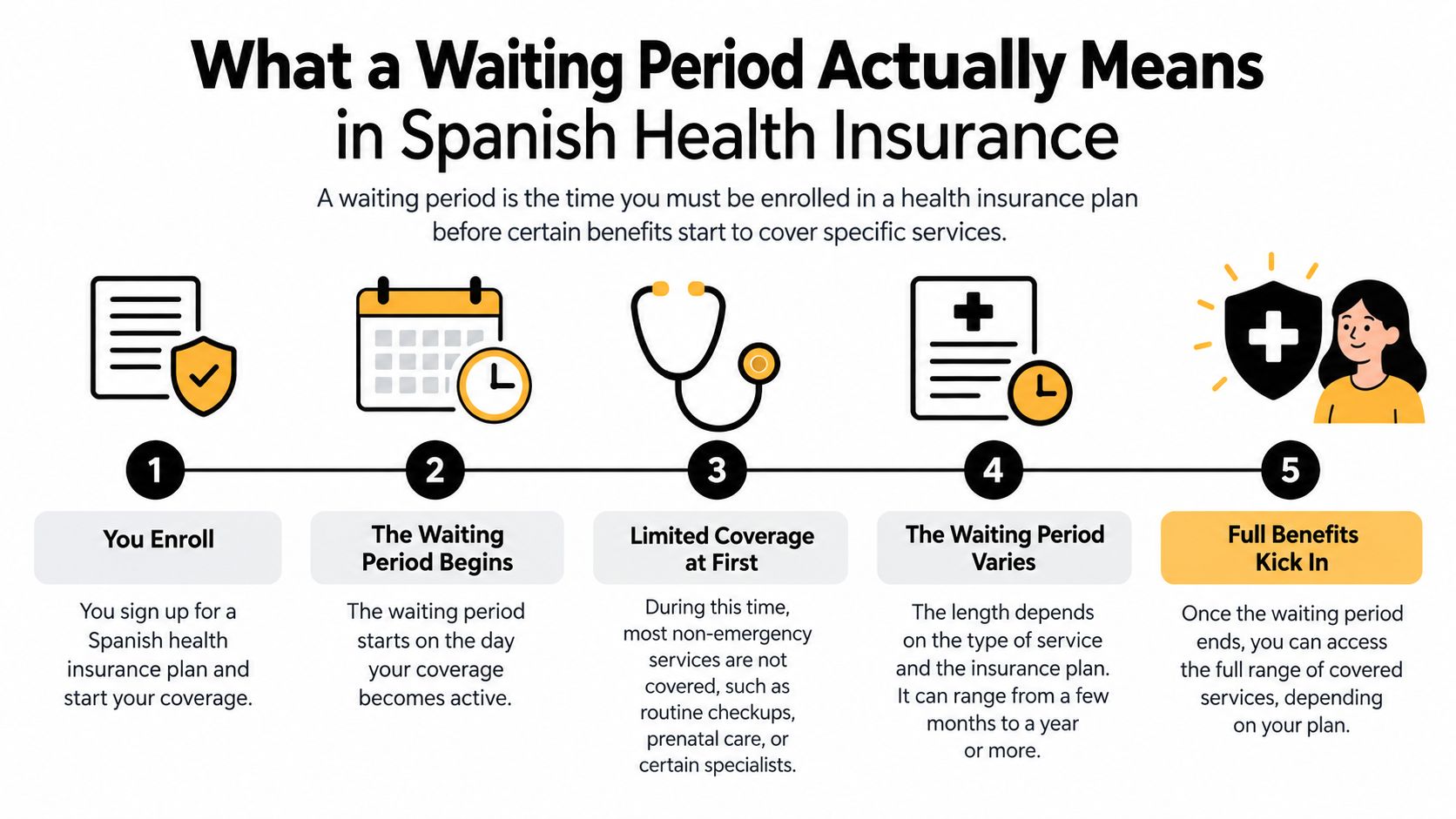
Start with five questions:
- When does the policy become effective? Confirm the exact date, not just the month in which you paid.
- Which benefits have carencias? Look separately at hospitalisation, surgery, maternity, diagnostics, dental, and rehabilitation.
- When does each clock begin? Some terms refer to the policy date, while others depend on eligibility or authorisation.
- What is covered during the carencia? Emergency treatment and unrelated care may remain payable, subject to the contract.
- Can prior continuous insurance remove the delay? Ask before cancelling an existing policy.
This distinction matters because a shorter general waiting period doesn't mean chronic-condition treatment starts sooner. The technical effect can be a temporary exclusion of condition-specific claims rather than a complete suspension of cover, a structure described in Zurich Kotak's explanation of pre-existing disease waiting periods.
Typical Waiting Periods by Treatment Type
Spanish insurers normally separate carencias according to cost, clinical complexity, and the risk of someone joining only after treatment becomes likely. That's why a plan can provide primary care quickly but delay elective hospital treatment. The exact terms must always come from the individual policy, especially when you're comparing Sanitas, Adeslas, DKV, Asisa, Cigna, or IMG.
| Treatment Category | Typical Waiting Period | Notes |
|---|---|---|
| Accidents and urgent emergencies | Often no waiting period | Immediate treatment usually follows the policy's emergency pathway, subject to contractual definitions. |
| Primary care | Often no waiting period | GP access may begin when the policy becomes effective. |
| Specialist consultations and basic diagnostics | Commonly around 3 months | Check whether the restriction applies to the consultation, the test, or both. |
| High-tech imaging and therapeutic procedures | Commonly around 6 months | MRI, CT, PET, and similar services may have separate authorisation rules. |
| Surgery and hospital admission | Commonly 180 days | Planned procedures are the classic source of denied claims. |
| Maternity and assisted reproduction | Often 8 to 12 months | Pregnancy-related benefits require especially careful date checking. |
| Dental implants and orthodontics | Often 6 to 12 months | Dental policies may also limit procedures through annual or treatment-specific terms. |
These ranges are a comparison tool, not a promise. A product can waive one category while retaining another. A “no waiting period” headline may refer to routine access, not maternity, hospitalisation, or an advanced procedure.
Compare the treatment, not the brochure
If pregnancy is a realistic possibility, ask for the maternity carencia and the newborn rules separately. The relevant details may include prenatal monitoring, delivery, hospital accommodation, complications, and the child's enrolment. A useful starting point is this guide to health cover for pregnancy in Spain, but the insurer's policy conditions still control the claim.
For surgery, request written confirmation before arranging a date. Ask whether the clock runs from the policy effective date, whether prior cover can be credited, and whether a pre-authorisation request can be submitted before the carencia expires. Hospitals and insurers may use different administrative dates, so keep the policy schedule, authorisation, and appointment records together.
Waiting Periods and Pre-Existing Conditions Explained
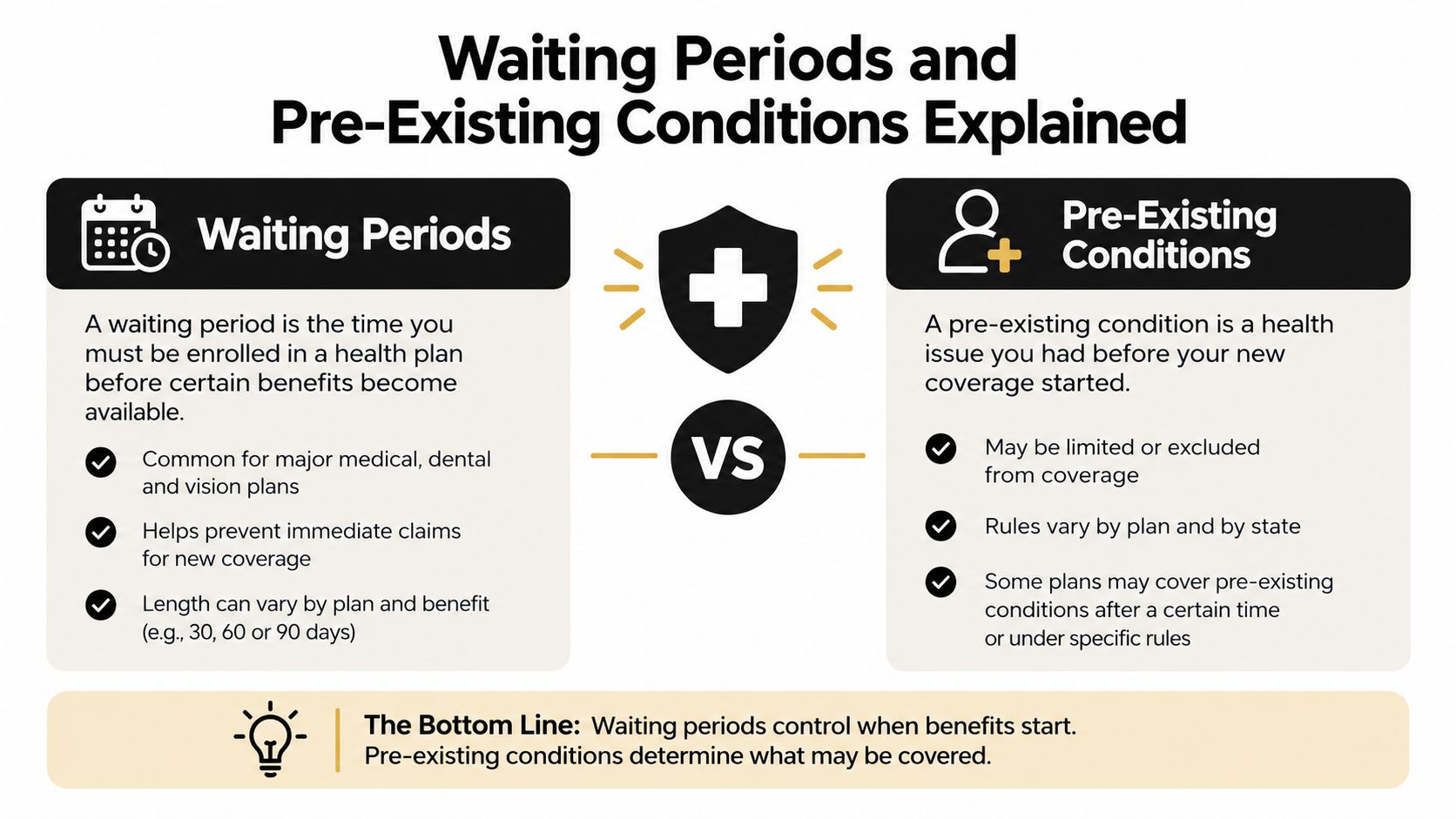
A carencia and a pre-existing-condition exclusion are not the same thing. A carencia is a timed restriction on a benefit that may become payable later. An exclusion removes a condition, treatment, or related claim from cover unless the insurer later changes that decision in writing.
The simplest analogy is a door with a timer compared with a locked door. A waiting period opens when the clock expires. An exclusion may remain closed indefinitely.
Three medical-history situations
Consider a previously controlled condition that later relapses. If the insurer accepts the condition but applies a waiting period, the clock may eventually open. If underwriting lists the condition as excluded, the relapse and related treatment may remain outside cover.
A diagnosed but symptom-free illness creates a different issue. You may feel well, but the insurer assesses the medical history and the likelihood that future care relates to that diagnosis. The questionnaire must be answered accurately. Omitting a diagnosis can create a separate dispute about non-disclosure.
A condition disclosed after inception is more serious. The insurer may investigate whether symptoms, consultations, tests, or treatment existed before the policy began. A standard carencia doesn't erase the underwriting record, and a new declaration can lead to an exclusion, a revised offer, or a request for further medical evidence.
Ask how the clocks interact
Some insurers run a general carencia and a condition-specific decision in parallel. Others apply a stipulated condition that overrides the ordinary calendar. A plan may cover unrelated care while excluding treatment connected to a previous pathology.
Spanish insurers commonly ask about medical history over a five-year lookback period, but the exact questionnaire and wording vary. Don't assume that a condition is irrelevant because it was controlled, symptom-free, or treated outside Spain. Ask the broker to explain whether the carrier is offering:
- Standard acceptance: The condition is covered under the ordinary contract terms.
- A surcharge: You pay more, but the insurer accepts the relevant risk.
- A specific exclusion: Related treatment is removed from cover.
- A revised waiting period: The insurer delays access to a defined benefit.
- Declined cover: The carrier won't offer the policy on those terms.
Before applying, review pre-existing conditions and health insurance in Spain with the exact medical facts available. The right objective isn't to hide a condition and hope the clock protects you. It's to obtain a written offer that makes the trade-off clear.
Practical Ways to Reduce or Waive Waiting Periods
Treat carencias as a negotiation asset, not an immovable wall. The insurer wants accurate risk information, while you may have evidence that you've maintained private cover and haven't created a sudden anti-selection risk. That evidence can improve your position.
Use this order of attack:
Present continuous prior cover first. Ask the new carrier to recognise uninterrupted private insurance from another EU provider or Spanish insurer. Provide the current policy schedule, renewal certificates, claims history if requested, and the cancellation or transfer letter. Success depends on the insurer's rules and whether the previous policy offered comparable benefits. The extra cost may be none, but the new premium can change after underwriting.
Switch without a coverage gap. Work around the existing policy's annual renewal date and ask the new insurer to confirm the effective date before cancellation. A gap can cause the new carrier to treat you as a fresh applicant. The cooling-off period may help with an unsuitable new policy, but don't rely on it as a universal right to preserve every accrued benefit.
Accept underwriting on the known condition. You may obtain immediate access to unrelated benefits while the insurer excludes the condition that prompted concern. This is often more realistic than demanding full cover for a diagnosed problem. The financial cost may be an exclusion rather than an added premium, so compare the medical trade-off carefully.
Offer a co-payment arrangement. Some products allow a higher excess or co-payment structure instead of selected carencias. Ask for the precise treatment categories affected and the amount payable per service. Never accept “day one” verbally without seeing the amended schedule.
Request a day-one module. Certain products or insurer options are designed to remove waiting periods for an additional premium. Compare that premium with the cost and timing of the treatment you expect, and verify that the module applies to the benefit you need.
Use bundled cover where appropriate. Employer, relocation, or visa-focused policies may arrive with selected carencias waived. Check the certificate, policy schedule, and cancellation terms. A visa certificate that says “immediate cover” is useful only if the underlying policy supports that wording.
| Lever | Success Likelihood | Documents Required | Extra Cost |
|---|---|---|---|
| Continuous prior cover | Case-dependent | Prior policy, renewal proof, transfer or cancellation letter | May be none, subject to revised underwriting |
| Gap-free provider switch | Often worth pursuing | Existing schedule and new effective-date confirmation | Depends on the new premium |
| Condition-specific underwriting | Frequently available in some form | Completed health questionnaire and medical reports | May mean an exclusion or revised premium |
| Co-payment alternative | Product-dependent | Quote showing co-payment terms | Varies by product |
| Day-one module | Product-dependent | Endorsement or amended policy schedule | Additional premium may apply |
| Visa or employer bundle | Depends on scheme | Certificate, schedule, and eligibility evidence | Usually built into the quoted premium |
Don't ask only, “Can you waive the waiting period?” Ask, “Which exact benefits become payable from the effective date, and what remains excluded?” That wording forces a useful answer.
Waiting Periods and Spanish Visa Compliance
Visa compliance comes before convenience. A policy that works well for ordinary resident healthcare may fail an initial visa application if it leaves hospitalisation, surgery, or other core benefits behind a carencia. For applicants, the certificate must match the consulate's requirement, not merely the insurer's marketing language.
For Non-Lucrative Visa, Digital Nomad Visa, Student Visa applications exceeding 90 days, Golden Visa, and Family Reunification cases, applicants should expect the authorities to scrutinise whether private cover is complete and valid from the start. Requirements can vary by consulate and may change, so confirm the current checklist with the relevant Spanish mission or immigration professional.
What “no waiting period” needs to mean
A standard Spanish policy with a surgical waiting period of 180 days should not be treated as automatically visa-safe. Ask the insurer for a Spanish-language certificate that explicitly states “sin carencias” or “cobertura inmediata”, where that wording accurately reflects the policy.
Prepare a document pack containing:
- The insurer's certificate: It should identify the insured person, policy validity, scope of cover, and immediate activation.
- The policy schedule: Check that the effective date and listed benefits match the certificate.
- The premium receipt: Demonstrate that the policy has been paid and activated.
- A sworn translation: Arrange one when the filing authority requires translated documents for an application submitted outside Madrid or Spain.
The practical question is not whether the insurer has hospitals in Spain. It's whether the exact certificate says what the officer needs to see. A useful guide to obtaining Spanish health insurance quickly can help you organise the application, but it can't replace the consulate's current instructions.
Renewal creates another risk
Annual policies need active renewal management. If a policy lapses and the new contract treats you as a fresh applicant, the carencia clock may start again. That can affect people relying on ongoing cover for residence renewals, including TIE-related paperwork.
Set a renewal reminder well before the payment date. Obtain the renewed certificate before submitting your residency documents, and don't cancel the old policy until the replacement is active and its waiting-period position is confirmed in writing.
Urgent Care, Emergencies and When Waiting Periods Do Not Apply
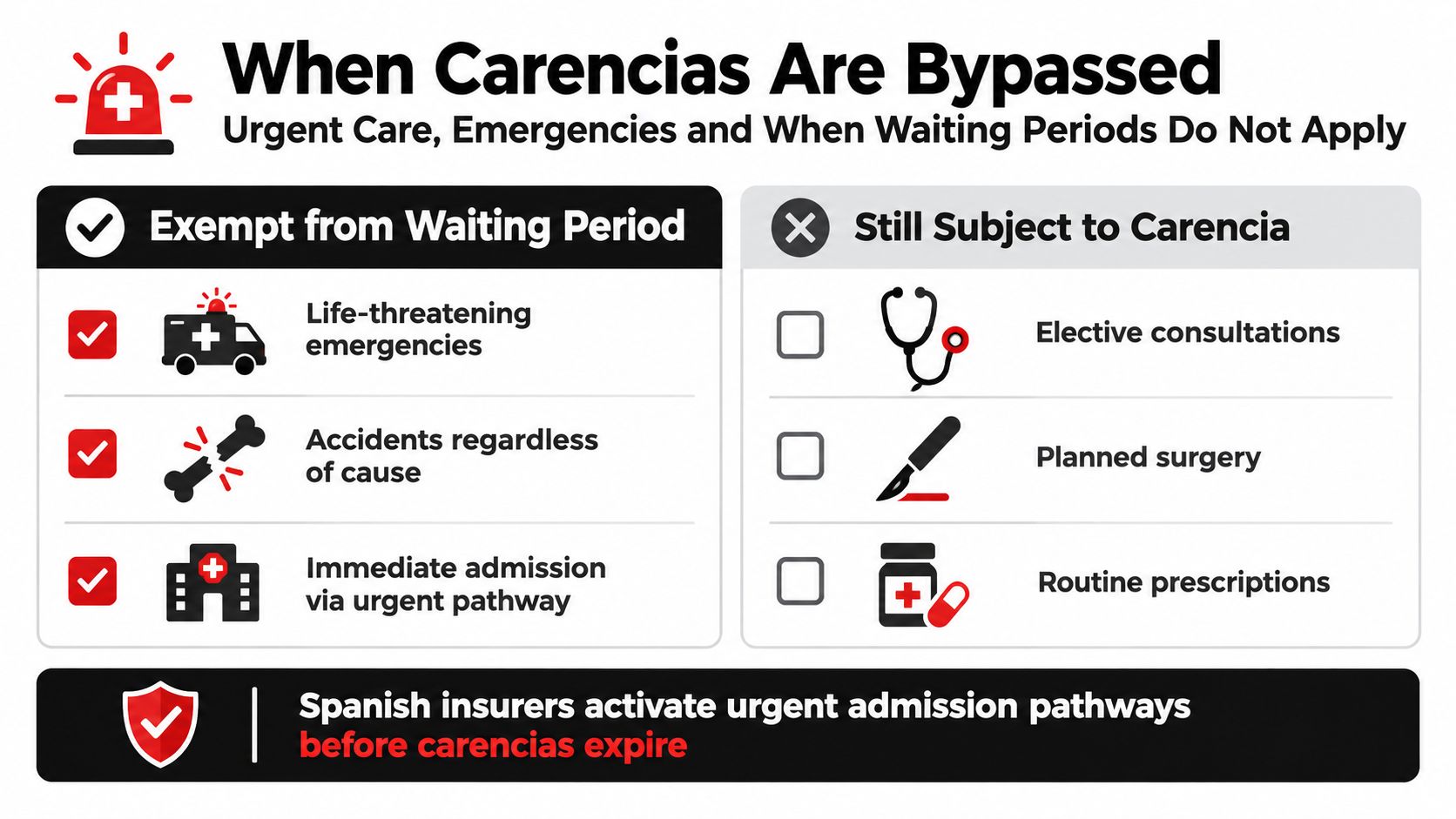
Waiting periods usually target planned use, not genuine immediate danger. Accidents and life-threatening emergencies are commonly handled through an urgent admission pathway, but the policy still defines what counts as an emergency and what authorisation process applies.
At the hospital entrance, present your insurer card or policy number and contact the insurer's authorisation hotline. Tell admissions staff that the episode requires urgent assessment and ask the attending doctor to record whether it qualifies as “urgencia vital”, or a life-threatening emergency.

Use precise language at admission
Say:
“Please contact the insurer's emergency authorisation line and record whether the doctor classifies this as urgencia vital. I need the authorisation reference and the policy terms that apply.”
Keep the authorisation reference, the emergency report, and the discharge paperwork. If the insurer refuses direct billing, ask for the refusal in writing and follow the claim procedure immediately.
A planned MRI remains planned even if you're worried about the result. A scheduled admission, elective surgery, outpatient physiotherapy course, and routine prescription may still fall under a carencia. Feeling anxious or uncomfortable doesn't automatically convert a booked service into an emergency.
Repatriation cover is separate. An emergency clause may pay for urgent treatment in Spain while repatriation depends on geographic limits, medical necessity, prior authorisation, and transport conditions. Check those terms before travelling, especially if you divide your time between Spain and another country.
Putting It All Together and Choosing the Right Policy
The right policy starts with your visa category and medical timetable, not with the lowest monthly quote. A Non-Lucrative applicant needs documentary certainty from day one. A Digital Nomad applicant may prioritise immediate access and portability. A student may need a compliant certificate for the full study period, while a retiree switching providers may have valuable continuous-cover evidence.
Bring these questions to your broker:
- Which benefits have carencias?
- What is the exact effective date?
- Does the policy state “sin carencias” or “cobertura inmediata”?
- Can my prior continuous cover be credited?
- What evidence does the underwriter require?
- Which conditions are excluded, surcharged, or accepted?
- Can co-payments replace selected waiting periods?
- Is the hospital network suitable for my province and preferred doctors?
- What happens if I change provider at renewal?
- Which certificate and translations will my consulate or immigration adviser require?
Make the decision before treatment is urgent
Request the full policy conditions, not only a quote. Mark every relevant date in a calendar, including the policy start, maternity or surgical eligibility date, renewal date, and visa appointment. If you're already insured, obtain the replacement policy's written continuity decision before cancelling the current one.
Life events create fresh negotiation opportunities. Pregnancy planning, a new diagnosis, relocation, retirement, and a change in visa status can all justify an annual review. The most useful broker conversation is candid about what the insurer will cover, what it won't, and what evidence could alter that position.
Bsure Health Brokers has advised expats from Marbella since 1989, comparing Spanish and international policies and helping clients manage applications, switches, renewals, and documentation. Matching the policy to the visa first, then to your lifestyle and treatment plans, is the most reliable way to avoid waiting-period surprises.
Contact Bsure Health Brokers to compare visa-compliant policies, review whether your prior continuous cover can reduce carencias, and obtain the correct Spanish-language certificate. Ask for a written benefit-by-benefit timeline before you cancel existing cover or book planned treatment.