
You've found a private health policy that appears to satisfy your Spanish visa requirements. The premium looks manageable, the insurer is familiar, and the online application takes only a few minutes. Then the consulate asks whether the policy has copayments, your insurer applies a waiting period to treatment you assumed was covered, or a renewal quote forces you to confront the fact that changing providers could reopen your medical history.
That's the point at which many expats ask, should I use a health insurance broker in Spain? My answer is yes if your visa, age, family circumstances, hospital preferences, or medical history make a wrong decision expensive. A broker shouldn't merely find a lower premium. The useful one protects continuity, checks administrative compliance, and explains the clauses that become important when you need care.
Table of Contents
- The Expat Dilemma of Navigating Spanish Healthcare
- Understanding the Role of an Independent Broker
- Evaluating Public Versus Private Coverage Options
- Overcoming Medical Underwriting and Visa Hurdles
- The Hidden Risks of Switching Providers for a Lower Premium
- Securing Ongoing Support and Claims Administration
- How to Choose the Right Professional for Your Needs
The Expat Dilemma of Navigating Spanish Healthcare
A couple relocating to Spain may start with a straightforward plan: obtain private insurance, submit the policy with their residency application, and move on to housing and paperwork. The trouble starts when the policy they bought online includes cost-sharing, limited hospital access, or wording that doesn't match the administrative requirement being applied to their application. A policy can be perfectly legitimate insurance and still be unsuitable for a particular visa route.
The same problem appears after arrival. An English-speaking resident may receive a policy document full of terms such as carencias, exclusions, authorisation requirements, medical questionnaires, and renewal conditions. They may understand the monthly payment but not the consequences of declaring an old diagnosis, choosing reimbursement instead of direct billing, or using a specialist outside the approved network.
Practical rule: Treat health insurance as part of your relocation risk plan, not as another utility contract.
A direct purchase can work for a healthy applicant with a simple situation and enough time to read every document carefully. It becomes less attractive when a family needs particular hospitals, a retiree is applying after the usual entry age, or an applicant has diabetes, a previous cancer diagnosis, ongoing medication, or another condition that may trigger underwriting.
The broker's role is most valuable at the points where Spanish administration and medical insurance overlap. They can help identify whether a policy is suitable for the intended residency application, ask insurers how they will handle medical disclosures, and compare the practical meaning of restrictions that look minor in a sales summary.
That doesn't remove your responsibility. You should read the final policy wording, confirm what the insurer has accepted in writing, and keep copies of medical declarations and correspondence. But you shouldn't have to decode the contract alone, especially when a mistake could delay a visa, leave a family member uninsured, or make switching providers impossible later.
Understanding the Role of an Independent Broker
Spain has a large, regulated insurance distribution market. The Spanish Directorate-General for Insurance and Pension Funds sector report recorded 57,467 registered insurance distributors as of 31 December 2023, including approximately 3,400 registered insurance brokers. Those figures show why the word “broker” shouldn't be treated as proof of independence by itself.
A direct insurer sells its own products. A single-company agent generally acts within one insurer's product range. An independent broker should work from the client's needs and provide advice based on an objective and personalised analysis of a sufficiently large number of contracts. That distinction matters when your requirements include visa compliance, no copayments, international cover, a particular hospital group, or acceptance of a medical history.
Registration is the first filter
Ask the intermediary for their legal trading name and registration details, then verify them through the DGSFP register. Don't rely on a website describing a company as independent. Registration confirms that you're dealing with a recognised professional, but it doesn't automatically prove that the intermediary compares every insurer or has access to every product.
Ask these questions before sharing detailed medical information:
- Market access: Which Spanish and international insurers can you quote?
- Comparison method: How do you compare benefits, exclusions, networks, renewability, and underwriting?
- Remuneration: Does the commission differ between insurers, and are there client fees?
- Medical cases: What happens when an insurer accepts a condition with an exclusion, loading, or special term?
- Aftercare: Who helps with authorisations, claims, renewals, and provider-network questions?
A broker who avoids clear answers is not giving you independent advice. Nor is a person who presents a single policy as the only realistic option without explaining what was excluded from the comparison.
The regulatory structure gives consumers a useful benchmark, but the practical test is transparency. You should receive a comparison that explains why a policy fits your profile, not a price table that encourages you to select the cheapest line.
Evaluating Public Versus Private Coverage Options
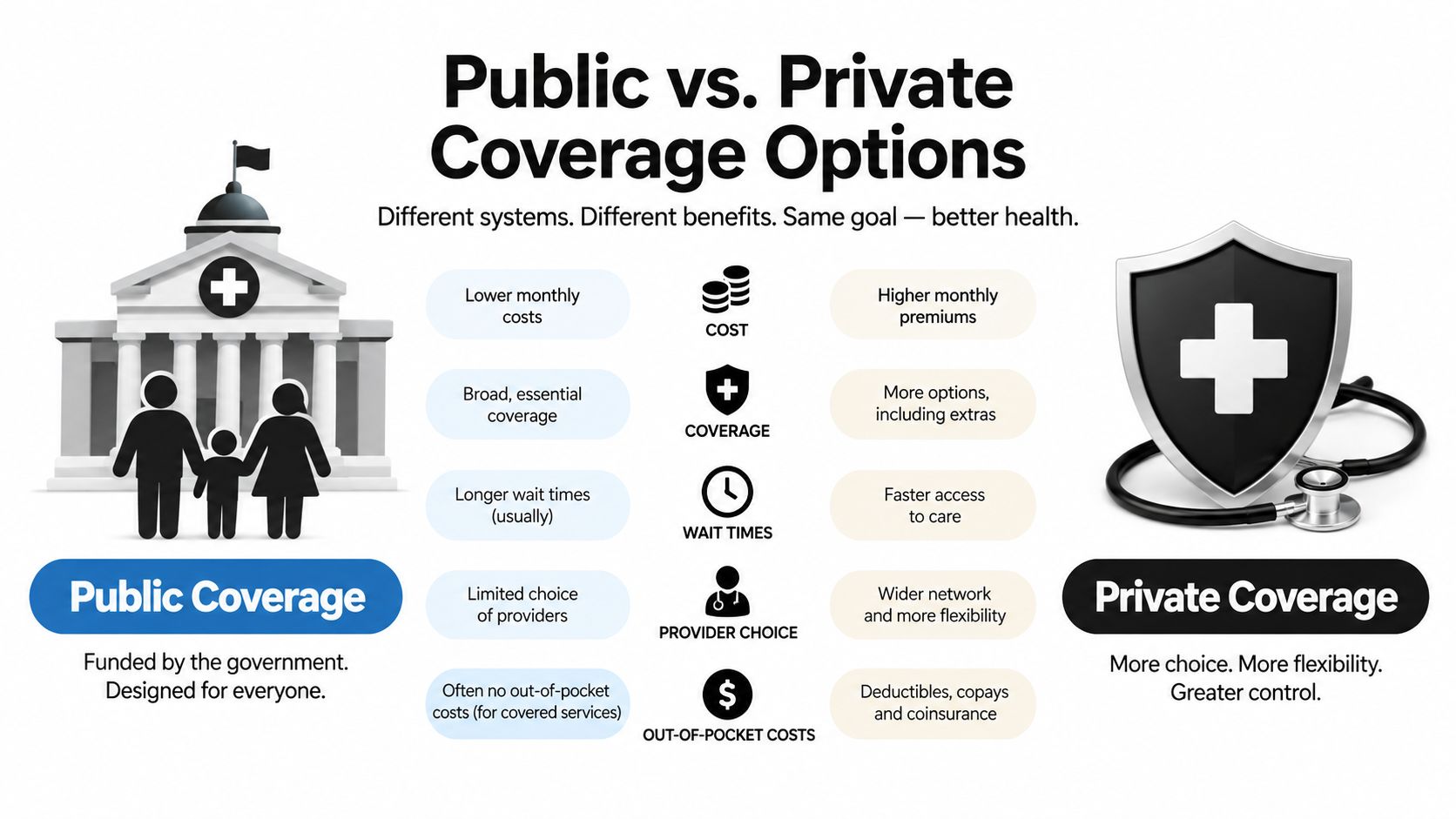
You can make the wrong choice here even with a cheap premium and a clean quote. Expats get caught when they compare Spain's public system and private insurance as if both solve the same problem. They do not. One may cover your day to day healthcare well enough. The other may be the document your visa file depends on. Start with the job the cover must do, then compare cost.
Spain's public healthcare system still does the heavy lifting for many residents. If you qualify through work, contributions, or another recognised route, public cover may handle most of your actual medical needs. Private insurance can still make sense if you want quicker access for routine specialist care, private hospitals, English-speaking administration, or a second route when the public system is slow.
If you do not yet qualify for ordinary public entitlement, check whether the convenio especial is open to you. It can be a useful access route, but treat it as an administrative option to verify, not a shortcut. The fee is usually fixed and rises sharply after age 65, and the current rate and conditions depend on the authority involved. Check the latest terms before relying on it. More importantly, do not assume it will satisfy an immigration requirement that specifically calls for private insurance with the right wording.
Use a practical decision tree
If your application requires private cover, ask for a policy built for that purpose and check the certificate before you pay. Confirm copayments, reimbursement terms, validity in Spain, hospital access, exclusions, and whether the insurer's wording matches what the consulate or immigration office expects. A low price does not protect you from a rejection.
If you already have access to public healthcare, compare that route against selective private cover, not automatically against the richest private policy you can buy. Many families do better with public entitlement as the foundation and private insurance chosen for speed, hospital choice, or easier administration. Match the setup to where you live, how often you expect to use care, and how much bureaucracy you are willing to handle yourself.
If medical or neurodevelopmental needs matter, read the exclusions and authorisation rules before enrolling. That matters just as much as the headline benefit list. For a useful outside example of the questions that come up around specialist cover and paperwork, navigating ADHD and autism claim processes highlights the kind of detail you should clarify in advance, even though the Spanish policy terms remain the only terms that count.
If you plan to use both systems, decide in advance who handles emergencies, referrals, prescriptions, and planned treatment. A private policy is poor value if the network is impractical, or if it only reimburses care after you pay upfront.
A good broker earns their fee here by stopping expensive mistakes. They should compare public eligibility, private policy design, and visa fit in one recommendation, so you do not end up switching later, losing continuity, or discovering too late that the policy solved the wrong problem.
Overcoming Medical Underwriting and Visa Hurdles
The standard online quote assumes a relatively simple applicant. Real families rarely fit that profile. Age, prior treatment, medication, planned procedures, and declared diagnoses can change the insurer's decision, the exclusions attached to a policy, or whether the applicant can obtain cover at all.
A broker can't force an insurer to accept a condition. They can, however, prevent you from making the situation worse by submitting incomplete or careless information. Medical underwriting relies on what you disclose, and a vague answer today can create a dispute when you make a claim later.
Follow the underwriting trail
- Prepare a complete medical summary. List diagnoses, treatment dates, medication, hospital stays, and ongoing monitoring. Don't hide a condition because it seems resolved.
- Ask how the insurer will assess it. The outcome may involve acceptance, an exclusion, a premium adjustment, a waiting period, or a refusal. Get the result in writing.
- Separate waiting periods from exclusions. A carencia delays access to a covered benefit. An exclusion removes a condition or treatment from cover. They aren't interchangeable.
- Check network and authorisation rules. A policy may cover treatment in principle but require prior approval or restrict you to named providers.
- Confirm visa documentation. The certificate, payment evidence, copayment wording, territorial scope, and validity period must match the current application requirements that apply to you.
A quote engine can show a premium quickly, but it can't replace a written underwriting decision or a careful review of policy wording. The same headline product may be unsuitable for two applicants because their medical declarations and administrative purposes differ.
In a national survey of consumers who received health-insurance enrollment assistance, 94% said the help was very or somewhat useful, with the technical value coming from translating exclusions, waiting periods, and medical underwriting into personal comparisons, as reported by the Kaiser Family Foundation. For Spain-based expats, that translation is often the difference between a policy that looks acceptable and one that works when submitted or claimed.
If your deadline is close, use a structured process for getting health insurance quickly in Spain. Speed matters, but rushed applications still need accurate medical declarations and written confirmation of the terms.
The Hidden Risks of Switching Providers for a Lower Premium
A renewal increase creates an understandable reaction. You search for a cheaper policy, compare the monthly figures, and conclude that staying loyal is costing too much. That conclusion can be wrong when your current policy already covers a medical history that a new insurer will reassess.
Recent reporting noted that premium increases of 10–15% were announced for 2025, while also warning that a switch can reset underwriting, waiting periods, and exclusions, as described by La Vanguardia's coverage of health-insurance renewal risks. For older applicants, the replacement policy may also have narrower entry criteria or less favourable terms.
Compare the cost of losing continuity
Before cancelling, ask your broker to compare the current policy and the proposed replacement across these points:
- Accepted conditions: Which diagnoses and treatments does the existing insurer already cover?
- New underwriting: Will the new insurer reassess your full medical history?
- Waiting periods: Will carencias apply again to hospitalisation, surgery, maternity, or other benefits?
- Renewal security: What does the contract say about continuation and future pricing?
- Provider access: Are your current hospitals and specialists included?
- Administrative purpose: Will the replacement still satisfy the requirements for your residency status?
Then obtain written acceptance from the new insurer before cancelling the old policy. Do not assume that a positive conversation with an adviser is equivalent to a binding decision. Keep the old cover active until you understand the new terms, acceptance, effective date, and payment conditions.
A premium calculator, such as this health insurance premium calculator, can help you examine the price, but price is only one part of the calculation. The true comparison is the premium plus the value of established coverage, hospital continuity, accepted medical conditions, and protection against a difficult future switch.
A cheaper policy is not cheaper if it leaves you uninsured for the treatment you're most likely to need.
My advice is especially firm for retirees and people with established conditions. First test whether the existing insurer can adjust benefits, copayments, or network options without resetting your medical position. Switch only after the replacement policy has been assessed as a genuine improvement, not merely a lower renewal bill.
Securing Ongoing Support and Claims Administration
Buying the policy is the beginning of the practical relationship, not the end. A health insurer may require prior authorisation, a referral, specific documents, or use of an approved provider. A foreign resident who doesn't know which department to contact can lose time even when the treatment is covered.
A useful broker explains the handover clearly. You should know how to find your policy number, which hospitals participate, how direct billing works, when reimbursement applies, and what to do if a claim or authorisation is refused. That guidance is especially valuable during a medical emergency, when searching through a long Spanish policy document is the last thing you need.
What continuing service should include
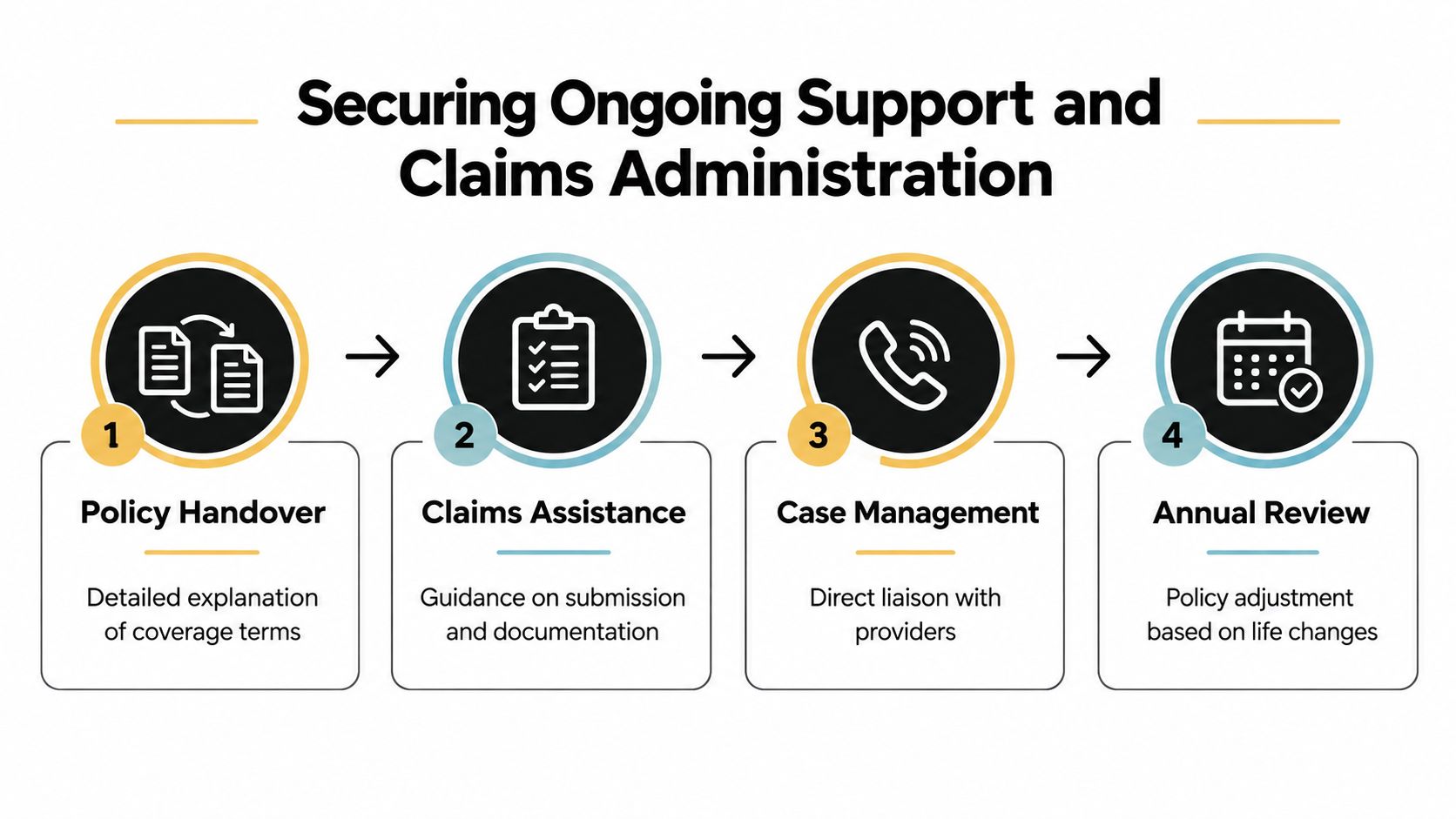
Policy handover should identify exclusions, waiting periods, copayments, renewal terms, and the difference between emergency and planned treatment.
Claims support should clarify what evidence the insurer needs, where to submit it, and how to challenge a decision that doesn't reflect the contract.
Provider coordination matters when you need a hospital, specialist, diagnostic centre, or English-speaking administrator. The broker should help you check network participation rather than rely on an outdated directory.
Annual review should revisit age, residency status, family changes, hospital preferences, and renewal terms. The right advice may be to stay with the current provider, not to replace it.
Research cited in Health Affairs on post-enrollment assistance found that 27% of assisted consumers returned to their adviser with post-enrollment questions, including how to use the insurance and work through provider networks. That reflects a simple reality: policyholders often need help after the sale, when the contract meets an actual appointment or claim.
Some situations also require careful product comparison outside ordinary medical insurance. For example, a specialised product such as a Venus Duo extended cover plan should be assessed for its exact scope, exclusions, duration, and relationship to your main policy. A broker can help you ask whether an additional product fills a real gap or merely duplicates existing cover.
How to Choose the Right Professional for Your Needs
Don't choose a broker because the website has the largest list of insurers or the lowest advertised premium. Choose the person who asks the most relevant questions before recommending anything. Your age, visa route, location, intended hospitals, budget, family structure, and medical history should shape the comparison.
Use this checklist in your first conversation:
- Verify registration. Ask for the legal entity and DGSFP registration details, then check them independently.
- Clarify independence. Find out whether the professional acts as a broker across multiple insurers or represents a single company.
- Demand a meaningful comparison. Ask how the recommendation weighs exclusions, waiting periods, networks, copayments, renewal terms, and underwriting, not only the premium.
- Discuss remuneration. Ask whether commission varies by insurer and whether you'll pay any separate fee.
- Test visa knowledge. Explain your residency route and ask what the policy certificate must show. Confirm the answer against current official requirements.
- Ask about medical cases. Find out how the broker handles diabetes, previous cancer treatment, medication, age restrictions, and declined applications.
- Confirm aftercare. Ask who will help with authorisations, claims, renewals, cancellations, and provider questions.
- Request everything in writing. Keep the comparison, medical declarations, acceptance terms, exclusions, and policy documents together.
The Spanish insurance broker guidance from Bsure Health Brokers is a useful reference when you're assessing the difference between broker advice and direct insurer sales. The important point is not that every broker will suit every applicant. It's that you should be able to see how the recommendation was made and what happens after enrollment.
For most healthy applicants with a simple administrative situation, buying directly may be adequate if they understand the contract. For expats with a visa deadline, complex medical history, older age, family dependencies, or a policy they may need to keep for many years, I recommend using a registered independent broker. The fee or commission question matters, but the bigger question is whether the adviser is protecting your continuity rather than chasing a quick sale.
Bsure Health Brokers compares Spanish and international private health policies for expats, including visa-related cover, retiree applications, pre-existing conditions, exclusions, networks, and renewal risks. Visit Bsure Health Brokers to discuss your circumstances before you buy or switch, and get a policy comparison focused on long-term protection rather than just the lowest premium.