
You've just landed in Spain, or maybe you've been here a while in Marbella, and now the letter from the clinic, the visa deadline, or a new diagnosis has made one thing feel urgent. You need cover, you don't want a hospital visit to turn into a rejection, and you're trying to work out whether senior citizen health insurance without medical check up is real protection or just a marketing phrase.
The honest answer is that it can mean very different things in Spain. One policy may skip a physical exam but still ask detailed health questions, another may accept you through a special rule but limit what it covers, and a third may fit residency needs better than your current private plan. For a clear overview of how health cover works in Spain, this guide on health cover in Spain is a useful starting point, and if you're also helping an older relative at home, a practical resource like find home care news can help you think through the support they may need alongside insurance.
The safest way to read any “no exam” offer is simple. Ask what route you're being offered, what medical questions still apply, and whether the policy is good enough for immediate treatment and visa paperwork, not just for a quick sign-up.
Table of Contents
- Starting Life in Spain After 65 Without a Medical Exam
- How No Exam Cover Really Works for Older Adults
- Why Age and Health History Change Your Options
- Typical Limits Exclusions and Waiting Periods to Expect
- Premiums Entry Ages and Renewal Rules After 65
- Spain Alternatives for Retirees Without Medical Exams
- Choosing Cover You Can Keep and Use With Confidence
Starting Life in Spain After 65 Without a Medical Exam
A lot of couples arrive at this decision point the same way. One of you has already had treatment, a doctor's note has raised more questions than answers, and now the thought of a medical examination feels like another gate in front of care. That's when people start searching for senior citizen health insurance without medical check up, hoping it means they can move forward without being judged on every past ailment.
The real worry behind the search
What many applicants mean is, “Will the insurer turn us away because of age or history?” That's a fair question. In practice, the answer depends on the route into cover, not just the headline on the brochure.
Some policies are built for fast acceptance, but they still use questionnaires, exclusions, or waiting periods. Others are designed around specific rules for older adults or residency status. So the key is not to hunt for a magical policy with no questions at all, it's to find the route that fits your life in Spain, your visa needs, and whether you need treatment soon.
Practical rule: If the policy sounds simple, ask for the written wording before you pay. The brochure is never the contract.
That's where the confusion usually starts for English-speaking retirees. “No medical check-up” sounds like a promise of automatic cover, but the fine print may still ask about medications, surgeries, diagnoses, and recent tests. If you want to compare routes without getting lost in insurance jargon, start with the question, “What kind of acceptance is this?” not “How quickly can I buy it?”
How No Exam Cover Really Works for Older Adults
A no-exam policy is not one thing. It's a family of different acceptance routes, and the differences matter more than the slogan on the front page. Think of it as entering a building. Some doors open fast but only to certain rooms, some ask a few questions before you go in, and some let you in because you fit a protected category.
Three acceptance routes to understand
1. Guaranteed-issue access.
This is the strongest route for acceptance. In the U.S., the clearest example is Medigap during the initial six-month guaranteed-issue window, when insurers can't refuse to sell the policy, exclude pre-existing conditions, or charge more because of medical history during that period (Congressional Research Service data in the Casact reference). That's the model people usually wish every no-exam policy followed.
2. Simplified-issue cover.
This is more common in private senior plans. You might not be sent for blood tests or a physical exam, but you can still be asked health questions. A Spanish senior policy for applicants aged 76 to 85, for example, requires a short medical questionnaire before purchase (BBVA senior policy example). That's still underwriting, just lighter than a full medical work-up.
3. Moratorium or delayed-condition access.
Here, the insurer may ignore a condition only after a symptom-free period, or only after certain contract rules are met. It can be useful, but it is not the same as instant protection for a known illness.
What the questions are really for
If a plan asks about surgery, medication, diabetes, or previous scans, that isn't a trap. It's the insurer deciding whether to exclude a condition, delay cover, or decline the application. If you leave something out, a future claim can be disputed later, even if the policy was sold without a doctor's appointment.
The simplest way to read these products is this, exam-free does not mean risk-free. It means the insurer has chosen a different way to judge risk.
Why Age and Health History Change Your Options
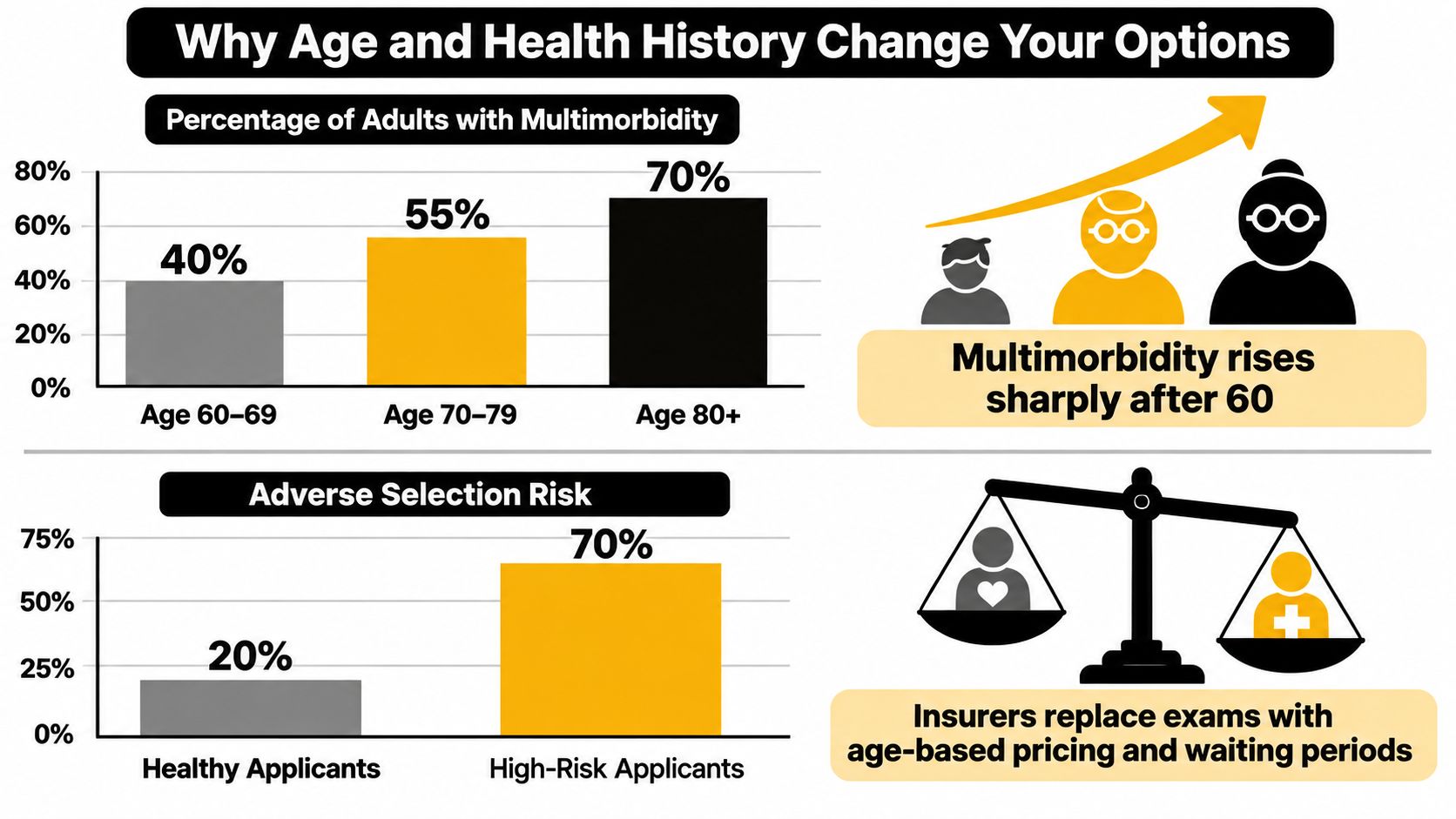
A couple in Marbella can be offered the same “no medical exam” headline and still end up with very different cover. Age, existing conditions, and treatment history all change how an insurer reads the risk, because older applicants usually bring more medication, more diagnoses, and more claims history for the underwriter to review. A large international review in BMJ Open estimated pooled multimorbidity prevalence at 42.4%, with a 95% confidence interval of 38.9% to 46.0% (BMJ Open). Multimorbidity means two or more chronic conditions, and it becomes more common as people get older.
Why insurers replace exams with other controls
Remove the exam, and the insurer usually replaces it with other controls. That can mean exclusion clauses, waiting periods, benefit caps, co-payments, or provider rules. The point is to manage adverse selection, which is what happens when people who expect more treatment are the most eager to apply for easy-acceptance cover.
The clearest example comes from a KFF analysis of Medicare Advantage beneficiaries. It found that 74%, or approximately 20.9 million people, enrolled in Medicare Advantage for the full year in 2023 had at least one pre-existing condition that could potentially lead to a Medigap denial outside guaranteed-issue protections. The same analysis reported common conditions such as peripheral vascular disease at 25%, chronic kidney disease at 24%, coronary artery disease at 21%, and diabetes with related complications at 21% (KFF analysis referenced in the OECD report).
For older couples, the practical lesson is simple. If one of you has diabetes, heart disease, kidney disease, or several diagnoses at once, a no-exam policy may still be available, but day-one treatment for those conditions may be limited, delayed, or excluded.
What matters most: acceptance without a physical exam does not automatically mean full treatment for every existing condition.
The age factor gets sharper with time
Age pushes the risk picture even further. The same KFF data showed that 88% of Medicare Advantage enrollees aged 85 and older had a condition that could trigger denial outside guaranteed-issue protections. That is why insurers look beyond birthdays. They are trying to estimate how likely a claim is, and how soon it may arrive.
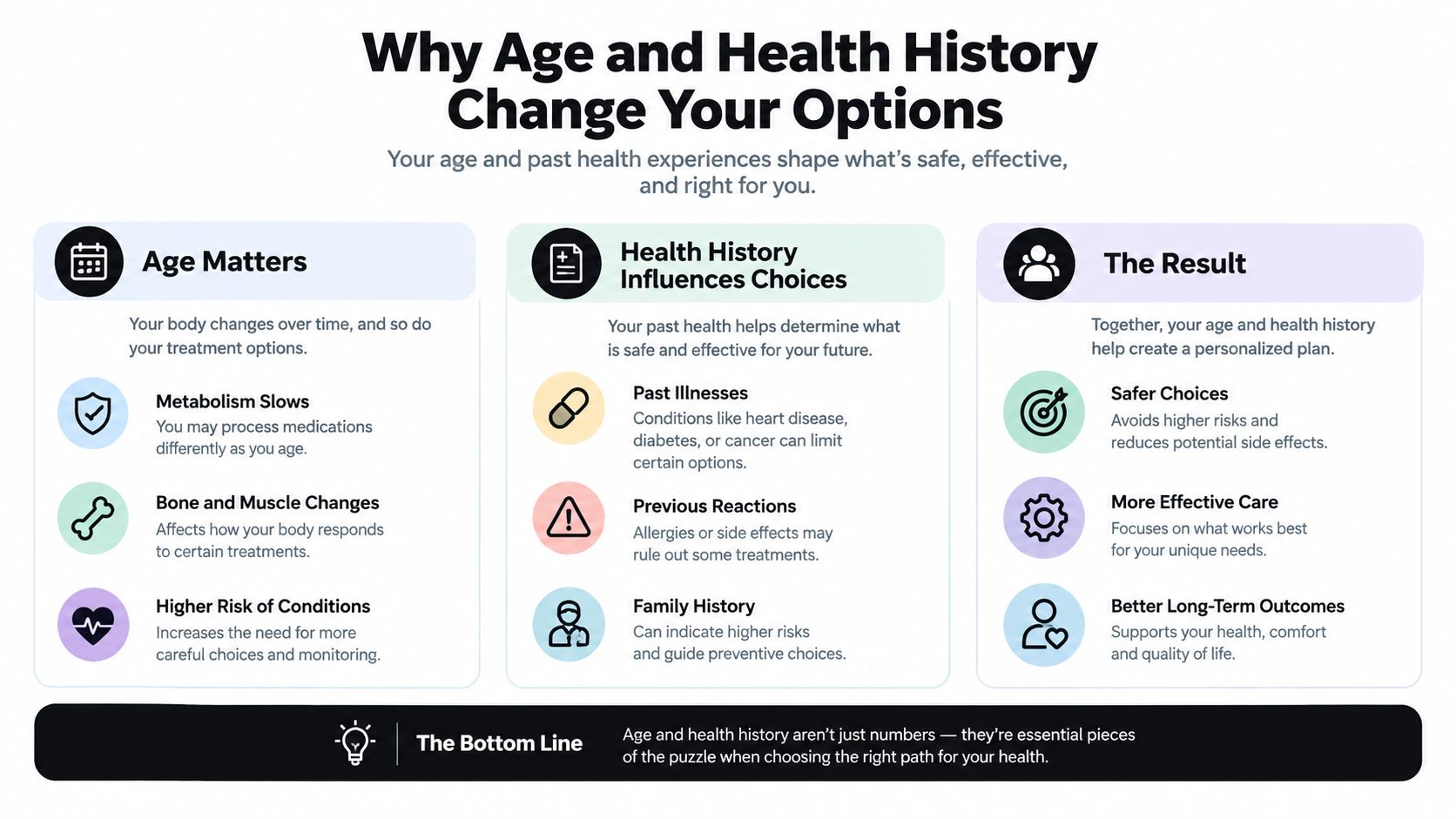
The safest way to read any offer is to ask for a written answer on each condition. "We take seniors" sounds comforting. A written view on diabetes, heart disease, kidney disease, or previous treatment is what tells you whether the policy will work when you need care.
Typical Limits Exclusions and Waiting Periods to Expect
At 70 in Marbella, a policy can accept you without a medical examination and still leave a gap when treatment is needed. Read the contract like a map: it should show which routes are open immediately, which begin later, and which are closed for a particular condition.
What to check before you pay
A private policy may restrict cover in several ways:
- Pre-existing-condition wording, which defines an illness or symptom you had before joining.
- Permanent exclusions, which remove a condition from cover for the life of the policy.
- Benefit caps, which limit what the insurer pays for a service or treatment period.
- Authorisation rules, which require approval before surgery, scans, or hospital admission.
- Waiting periods, which delay inpatient care, diagnostics, or specialist treatment. For a full explanation of medical insurance waiting periods, check how Spanish insurers apply these delays.
- Grace or moratorium periods, which may postpone cover for certain conditions until the stated requirements are met. Read the contract carefully, because the trigger may involve symptoms, treatment, or a symptom-free period.
The route you choose should match the reason you are buying cover. A no-exam policy may suit a new, unforeseen problem. It may offer less help for a condition already diagnosed, particularly if the insurer applies an exclusion, a moratorium, or a waiting period. That distinction also matters when you need evidence of suitable health insurance for residence paperwork. Acceptance alone does not prove that immediate treatment is included.
A quick comparison in plain English
| Feature | What it usually means |
|---|---|
| No exam | No physical test at purchase |
| Questionnaire only | You still disclose your health history |
| Moratorium | A condition may become covered after the required symptom-free period |
| Waiting period | Certain treatments begin only after a set delay |
| Exclusion | The insurer does not cover that condition or service |
Ask for the waiting period on inpatient treatment and diagnostics in writing. Confirm whether it applies to new illnesses only or also to symptoms linked to an earlier diagnosis. Then check whether the wording changes after renewal.
If you are comparing private insurance with public or mixed-care routes, Medicare and assisted living payment options provides useful context on what insurance may not fund later in life.
A no-exam policy can work well when its limits match your health needs, residence requirements, and expected access to care. Read those three points before paying.
Premiums Entry Ages and Renewal Rules After 65
Price matters, but age rules matter just as much. Some plans have entry-age ceilings, often somewhere around retirement age, and that can shut the door later even if you're healthy now. A policy that looks cheap in year one can become expensive in the wrong way if it can't be kept when your health changes.
Why the first premium is not the whole story
Insurers often price older applicants differently because claims risk rises with age and medical history. That means the premium you're offered at 65 may not tell you much about the value of keeping the policy at 70 or 75. If the plan can be renewed but later adjusts pricing after claims, you need to know how that works before you buy.
The better question is not “What's the lowest first-year price?” It's “Can I still keep this policy if I need it?” That matters more once a diagnosis appears, because switching later may be harder than staying put.
What to ask about renewal
- Guaranteed renewal, so the insurer can't drop you after treatment.
- Age-banded pricing, so you know how the premium may change as you get older.
- Claim-related repricing, so you understand whether claims can affect future cost.
- Renewal exclusions, so you see whether new limits can appear later.
- Entry-age limits, so you know whether you can even apply in the future.
Many couples make a costly mistake. They choose the cheapest first premium, then discover that the plan wasn't built for long-term use. If one spouse already has a diagnosis, retaining a policy that keeps renewing can be more valuable than chasing a slightly lower monthly payment elsewhere.
For older residents, the right plan is the one that stays usable. That's the difference between a quote and real cover.
Spain Alternatives for Retirees Without Medical Exams
Spain gives retirees more than one route, and that's good news, because each route solves a different problem. Some are better for residency paperwork, some are better for managing pre-existing conditions, and some are easier to obtain quickly. The mistake is treating them as interchangeable.
Comparing the main routes
| Route | Acceptance without exam | Visa suitability | Best for |
|---|---|---|---|
| Simplified-issue private senior plan | Often yes, but with a questionnaire | Sometimes, if it meets visa rules | Routine private care and fast access |
| Fully underwritten private plan | Not usually, because medical review is deeper | Can be, if the contract meets the visa standard | Stronger tailoring when health history matters |
| Public Convenio Especial | Reported to accept pre-existing conditions without medical questionnaires or exclusions | Not a private visa product by itself | Residents who want public-system access after residency |
The commercial question is whether the policy is easy to buy. The residency question is whether it fits the rules for your permit. Those are not the same thing.
A private policy for a non-lucrative visa can still fall short if it has waiting periods, co-payments, deductibles, or narrow hospital cover. That's why you should not buy based on the phrase “no medical exam” alone. You want to know whether it's visa-compliant, whether it includes hospitalisation, and whether it can be used immediately if you need treatment next week.
For people who want a broader understanding of related planning choices, Medicare coverage for hearing care is a helpful example of how age-related coverage questions can vary a lot by system and by benefit.
The practical difference for real retirees
If you have a clean history and want quick outpatient access, a simplified private plan may be enough. If you have serious pre-existing conditions, you may need a broker to negotiate a better fit or look at a route that doesn't rely on private underwriting in the same way. And if your goal is residency approval, the policy has to satisfy the administrative rule, not just the medical one.
That's the three-way test in Spain, acceptance, visa fit, and immediate treatment access.
Choosing Cover You Can Keep and Use With Confidence
The best choice is usually the one that answers five questions clearly. Can you enter at your age, can you keep the policy, what exactly is excluded, how long are the waits, and does it fit your visa or residency needs? If the insurer can't answer those in writing, the policy isn't ready for a careful buyer.

A calm checklist for older applicants
- Entry age: Check whether you can still apply now, not just whether the plan looks good on paper.
- Guaranteed renewal: Confirm that the insurer won't re-evaluate you out of the policy after a claim.
- Condition exclusions: Ask whether your diagnosis is excluded, limited, or covered with delay.
- Waiting periods: Get the timing for hospital care and diagnostics in writing.
- Hospital network: Make sure the hospitals you'd use are included.
- Annual limits: Verify whether the plan has benefit ceilings that would matter in a bigger illness.
- Visa wording: If you need residency approval, the policy has to fit that purpose too.
For a neutral explanation of how a broker can help compare and document these details, this guide to working with a health insurance broker is a sensible read.
Keep the question simple, can I use this when I'm ill, or only when I'm well?
That's the heart of the matter. A no-exam policy that starts fast but fails when you need treatment isn't a good bargain. A policy that's a little harder to buy, but is written clearly and keeps renewing, is usually far more valuable for a couple in their seventies.
If you're weighing cover for yourself or your spouse in Spain, Bsure Health Brokers can help you compare senior options, check the contract wording, and line up a policy that fits both your health needs and your residency situation. If you want a clear answer on what's available for your age and medical history, visit them and ask for a written review of your case.