
The male glans is the rounded, highly sensitive tip at the end of the penis where the urethra exits. It forms the terminal expansion of the corpus spongiosum and is often covered by the foreskin in uncircumcised males.
Why does a basic question such as “que es el glande masculino” require more than a dictionary definition? Because knowing the structure helps you distinguish ordinary anatomical variation from symptoms that deserve medical attention. The glans has roles in urination, ejaculation, and sexual sensation, so changes in this area can feel worrying even when they're harmless. A calm, practical understanding is the best starting point.
Table of Contents
- What Is the Male Glans and Where Is It Located
- How the Glans Works and Why It Is So Sensitive
- Practical Hygiene and Daily Care for Glans Health
- Normal Variation versus Warning Signs to Watch
- Common Misconceptions About Glans Health and Function
- When to Seek Medical Help and Next Steps
What Is the Male Glans and Where Is It Located
The glans penis is the rounded, bulbous head at the distal, or far, end of the penis. It's distinct from the shaft and is separated from it by the neck, with the corona forming the raised rim around its base. A useful analogy is the rounded cap of a specialized tool. The shaft provides the main length, while the glans forms the shaped terminal part where several important functions meet.
The glans is the terminal expansion of the corpus spongiosum, the erectile tissue that surrounds the urethra. It also caps the distal ends of the corpora cavernosa. At its center is the external urethral meatus, the opening through which urine and semen leave the body. This doesn't mean urine and semen normally pass at the same time. It means the same anatomical exit serves different body functions at different moments. Standard medical anatomy references describe the glans, corpus spongiosum, and urethral opening in these terms.
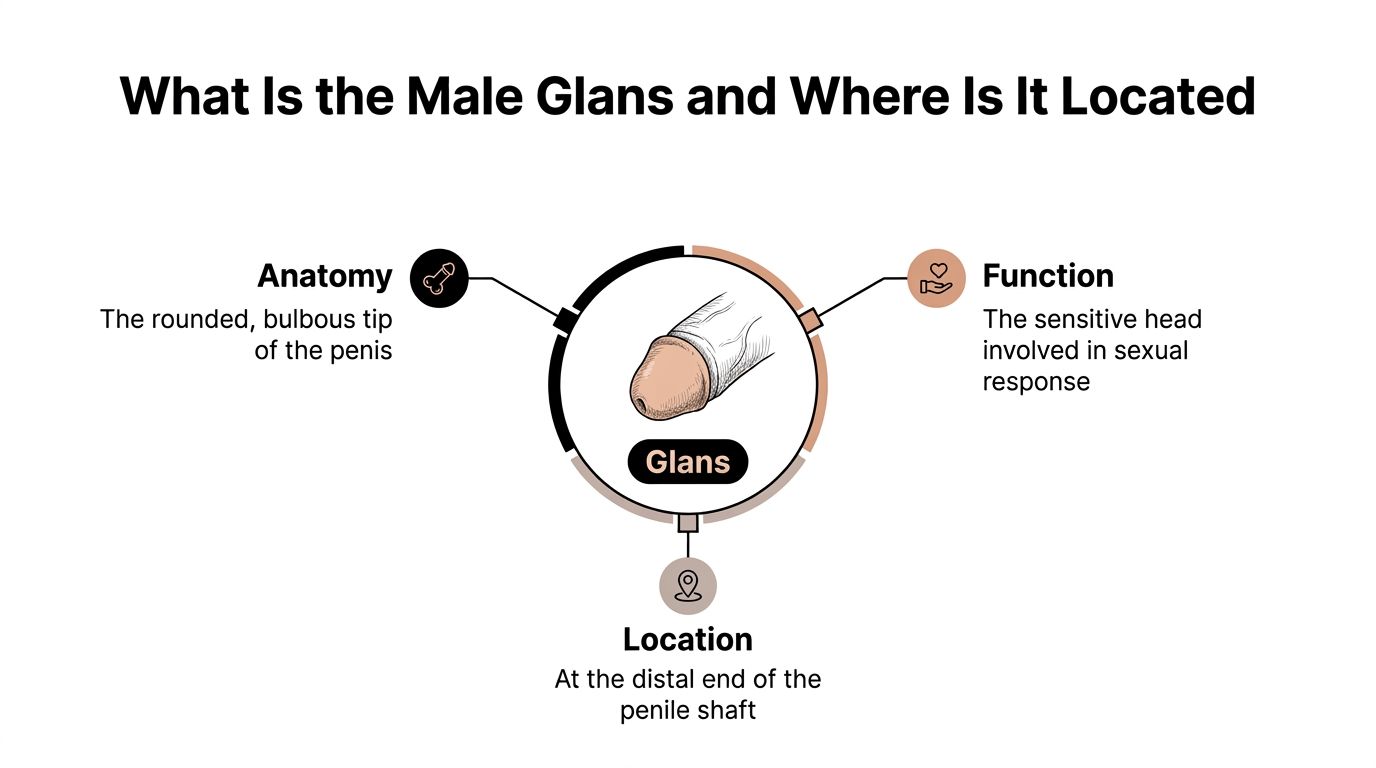
Location and surrounding tissue
In an uncircumcised male, the prepuce, or foreskin, usually covers the glans when the penis is relaxed. It can often be drawn back to expose the head, but movement varies naturally between individuals. In a circumcised male, the glans generally remains uncovered. Neither appearance automatically indicates a health problem.
The word glans comes from the Latin word for “acorn,” reflecting its rounded shape. During fetal development, it forms as the terminal end of the genital tubercle, an early structure involved in the development of the external genitalia. This is why the term refers to a specific anatomical structure rather than meaning “the tip.” Anatomical and historical background is outlined in this overview of the glans penis.
Understanding the correct location makes later decisions easier. If discomfort is on the shaft, at the foreskin, or directly around the urethral opening, those details help a clinician narrow down possible causes. For broader, practical reading about men's health and daily wellbeing, explore this healthy lifestyle guidance.
How the Glans Works and Why It Is So Sensitive
The glans isn't sensitive by accident. Its sensory tissue is organized like a finely tuned biological sensor, allowing physical contact, pressure, movement, and temperature to contribute to sexual sensation. This sensitivity also explains why friction, irritating products, or inflammation can feel disproportionately uncomfortable in this small area.
The dominant sensory structures are free nerve endings. Genital end bulbs are also present, while Pacinian and Ruffini corpuscles appear less commonly. One anatomical source describes a free nerve ending to corpuscular receptor ratio of about 10:1, supporting the glans's role as a highly sensitive structure. The sensory architecture of the glans is discussed in this anatomical pathology review.
From sensation to sexual response
During sexual stimulation, sensory signals from the glans travel through nerves to the spinal cord and brain. The resulting experience depends on more than one body part. Touch, arousal, emotional context, communication, and personal preference all shape sexual response. The glans contributes important sensory information, but it doesn't operate as an isolated switch that determines pleasure by itself.
Its sensory role also connects with the ejaculatory reflex. Stimulation can contribute to the reflex pathways involved in ejaculation, although sexual response differs considerably among individuals. Some people experience strong sensitivity from light contact, while others prefer firmer or more sustained stimulation. Variation alone doesn't indicate disease.
Practical rule: Sensitivity is normal, but pain is a signal to pause and investigate, especially when it persists after the apparent irritation has stopped.
Because the glans contains exposed or readily accessible sensory tissue, rough handling can cause discomfort even without visible injury. Lubrication, communication, and stopping when pain occurs are sensible ways to reduce unnecessary friction. If sensitivity changes suddenly, becomes painful, or occurs with visible skin changes, hygiene adjustments alone may not solve the problem.
Practical Hygiene and Daily Care for Glans Health
Good glans care is gentle rather than aggressive. The aim is to remove sweat, urine residue, and other buildup without stripping the skin or creating friction. Strong fragrances, antiseptics, exfoliants, and repeated scrubbing can irritate delicate tissue.
For an uncircumcised male, retract the foreskin only as far as it moves comfortably. Rinse the exposed glans with warm water, then return the foreskin to its usual position. For a circumcised male, wash the exposed glans gently during normal bathing. You don't need to force a particular appearance or use specialized products unless a clinician recommends one.
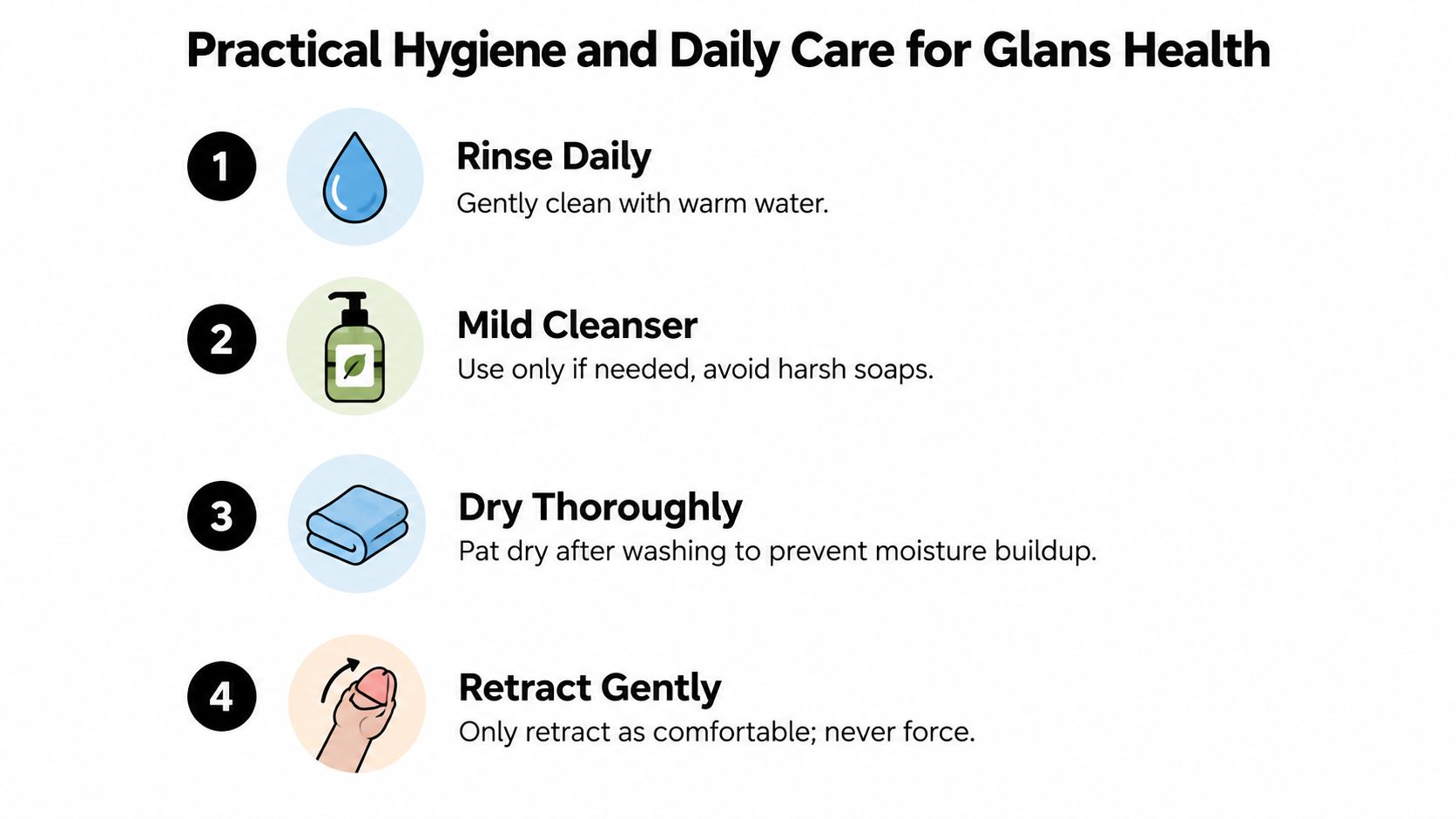
A simple routine
Rinse daily. Use warm water and your hand rather than a rough cloth. Clean gently around the glans and the opening of the urethra, without trying to push water inside.
Use a mild cleanser only if needed. If you use soap, choose a mild, fragrance-free product and rinse it away thoroughly. Stop using any product that causes burning, dryness, redness, or persistent itching.
Dry carefully. Pat the area dry instead of rubbing. If you have a foreskin, moisture trapped underneath can add to discomfort, so allow the skin to dry before replacing it.
Retract gently. Never force the foreskin backward. If it becomes stuck behind the glans and won't return to its normal position, seek urgent medical advice.
Hair removal around the pubic area isn't necessary for glans hygiene. If you choose to groom, review safety-focused easy grooming advice from ArtNaturals, and keep razors, creams, and other products away from the glans unless their instructions specifically allow that use. A cut or chemical irritation can create a problem that careful washing would have avoided.
If you're unsure how to manage irritation or need confidential advice, online health consultations can help you discuss symptoms with a healthcare professional. Don't apply steroid, antifungal, antibiotic, or numbing creams without appropriate guidance.
Normal Variation versus Warning Signs to Watch
A healthy glans doesn't have one universal appearance. Color can vary between people and may look different depending on skin tone, temperature, blood flow, arousal, and whether the glans is covered by the foreskin. The corona may be more pronounced in one person than another, and the foreskin may move freely, partially, or less easily without automatically indicating illness.
Normal variation is usually stable, painless, and familiar to the individual. A new change deserves more attention when it continues, worsens, or interferes with urination, sexual activity, or foreskin movement.
| More likely to reflect normal variation | More likely to need professional assessment |
|---|---|
| A stable difference in color or shape | Persistent pain or tenderness |
| A naturally prominent or subtle corona | Sores, ulcers, or unexplained breaks in the skin |
| Foreskin movement that is comfortable for you | Discharge from the urethra or under the foreskin |
| Mild, temporary sensitivity after friction | Ongoing swelling, burning, or irritation |
The table isn't a diagnosis. It's a decision aid. For example, temporary redness after vigorous friction may settle when the irritation stops, while redness accompanied by swelling, pain, or discharge should be evaluated. The same visible change can have different meanings depending on timing, associated symptoms, and recent exposures.
A symptom becomes more important when it is persistent, painful, recurrent, or accompanied by discharge, sores, swelling, or difficulty urinating.
Medical guidance recommends evaluation rather than self-diagnosis when these warning signs occur. Mayo Clinic's penis-health guidance includes pain, sores, discharge, swelling, and persistent irritation among changes that warrant medical attention. Avoid repeatedly inspecting, scrubbing, or treating the area while guessing at the cause. Those actions can worsen irritation and make the original pattern harder for a clinician to assess.
Common Misconceptions About Glans Health and Function
Myth one, every color difference means infection. The glans can naturally vary in color and may look different when covered or exposed. A new, persistent, painful, or inflamed change is more meaningful than color alone.
Myth two, high sensitivity is automatically a problem. The glans has a dense sensory architecture, so strong sensation can be a normal feature. Sensitivity becomes a concern when it is painful, newly changed, or linked to friction, inflammation, sores, or urinary symptoms.
Myth three, hygiene means scrubbing harder. More pressure and stronger products don't equal better care. Gentle rinsing, careful drying, and avoiding forced foreskin movement are safer principles than aggressive cleaning.
Myth four, a glans concern is always embarrassing or sexually transmitted. Irritation can follow many everyday causes, including friction or a reaction to a product. At the same time, sexual exposure can matter, so a clinician may recommend appropriate testing rather than relying on appearance alone.
The glans has a wider health role
The glans also matters in sexual-health assessment beyond basic anatomy. A 2026 review of high-risk HPV in men reports that penile swabs including the glans, shaft, and coronal sulcus have higher HPV detection rates, suggesting that sampling location can influence clinical understanding of infection. The review discusses this role of penile sampling in HPV detection.
That doesn't mean every glans change is HPV, or that readers should attempt to diagnose HPV by looking at the skin. It means the area is clinically relevant when a healthcare professional takes a sexual history, examines symptoms, or considers testing. The same review notes that the EAU's 2026 sexual and reproductive health update incorporated new evidence into several male sexual-health sections, reflecting ongoing development in clinical guidance. Seek professional advice rather than letting internet myths decide what a symptom means.
When to Seek Medical Help and Next Steps
Arrange a medical assessment if you have persistent pain, a sore, unexplained swelling, discharge, continuing irritation, painful urination, or a foreskin that becomes difficult to move. Seek prompt help if the foreskin is trapped behind the glans, if swelling is severe, or if urination becomes difficult. These situations need an examination because the appearance alone can't reliably identify the cause.
Before the appointment, note when the symptom began, whether it follows sex, masturbation, washing, grooming, or a new product, and whether it has changed over time. Tell the clinician about recent sexual exposure, previous episodes, medications, allergies, and any urinary symptoms. You don't need to use perfect medical vocabulary. Saying “the skin burns after washing” or “there's discharge from the opening” gives useful information.
A clinician may inspect the glans and foreskin, ask questions about symptoms and sexual health, and decide whether testing or treatment is appropriate. Don't use leftover medication or combine several creams before the visit, because treatment can alter the skin and obscure the clinical picture.
For English-speaking residents and newcomers, understanding the healthcare system in Spain can make it easier to identify whether to contact a primary-care doctor, sexual-health service, urologist, or another appropriate professional. The important step is not choosing the perfect label yourself. It's reporting the change clearly and getting the right assessment.
If you're concerned about glans symptoms or need help finding suitable healthcare access in Spain, Bsure Health Brokers can explain private health-insurance options and help you move through referrals and specialist care. Contact their team to discuss your situation and find practical support without judgment.