
You've just moved to Spain, and you need a specialist appointment within weeks. The policy you're considering lists consultations, scans and private hospitals, but you still can't tell whether it will pay for the appointment you really need.
That's the useful starting point for comparing private medical insurance benefits: not how many services appear in the brochure, but which care remains payable after the insurer applies its rules.
Table of Contents
- What Private Medical Insurance Benefits Cover in Spain
- Why Private Cover Sits Next to Spain's Public System
- Outpatient, Inpatient and Network Rules That Decide Access
- How Co-Payments and Cost Sharing Change Your Bill
- Dental, Maternity and International Add-Ons Worth Checking
- Exclusions, Waiting Periods and Pre-existing Conditions
- Choose Your Benefits Before You Sign
What Private Medical Insurance Benefits Cover in Spain
Private insurance can help with different problems. A policy that gives you access to a private specialist isn't necessarily designed to reimburse prescriptions, dental work or treatment outside Spain.
The OECD's population coverage guide distinguishes complementary insurance for deductibles and co-payments, supplementary insurance for services outside public benefit packages, and duplicate insurance offering faster access or broader provider choice. These are descriptions of what insurance does, not promises that every Spanish policy includes all those benefits.
For an expat, the practical distinction is simple: are you buying another route to care, additional services, or protection against charges you'd otherwise pay yourself?
Typical benefits in a Spanish private policy
| Benefit | What it usually covers | Condition to check |
|---|---|---|
| Outpatient specialist visits | Consultations without hospital admission | Referral and network rules may apply |
| Diagnostic tests | Blood work, X-rays, scans and ultrasound | Pre-authorisation and approved imaging centres |
| Inpatient hospital stays | Room, surgical team and medication during admission | Private hospital network and any excess |
| Surgery and day procedures | Planned operations and day-case treatment | Waiting periods and pre-existing condition exclusions |
| Emergency care | Urgent treatment and ambulance transfer within policy terms | Emergency rules and network hospitals |
| Maternity | Pregnancy checks, delivery and postnatal care | The contractual waiting period and maternity limits |
| Dental | Check-ups, cleaning and specified basic treatment | Included services, treatment charges and any capped add-on |
| International cover | Eligible treatment abroad and specified repatriation services | Separate level or add-on, territory and trip restrictions |
Treat this table as a map of possible benefits, not a standard package. Dental, maternity and international protection may require a different policy level or an additional premium.
A listed benefit isn't the same as an approved claim. Before relying on any row, establish whether it applies to your medical history, chosen provider and intended treatment date.
Why Private Cover Sits Next to Spain's Public System
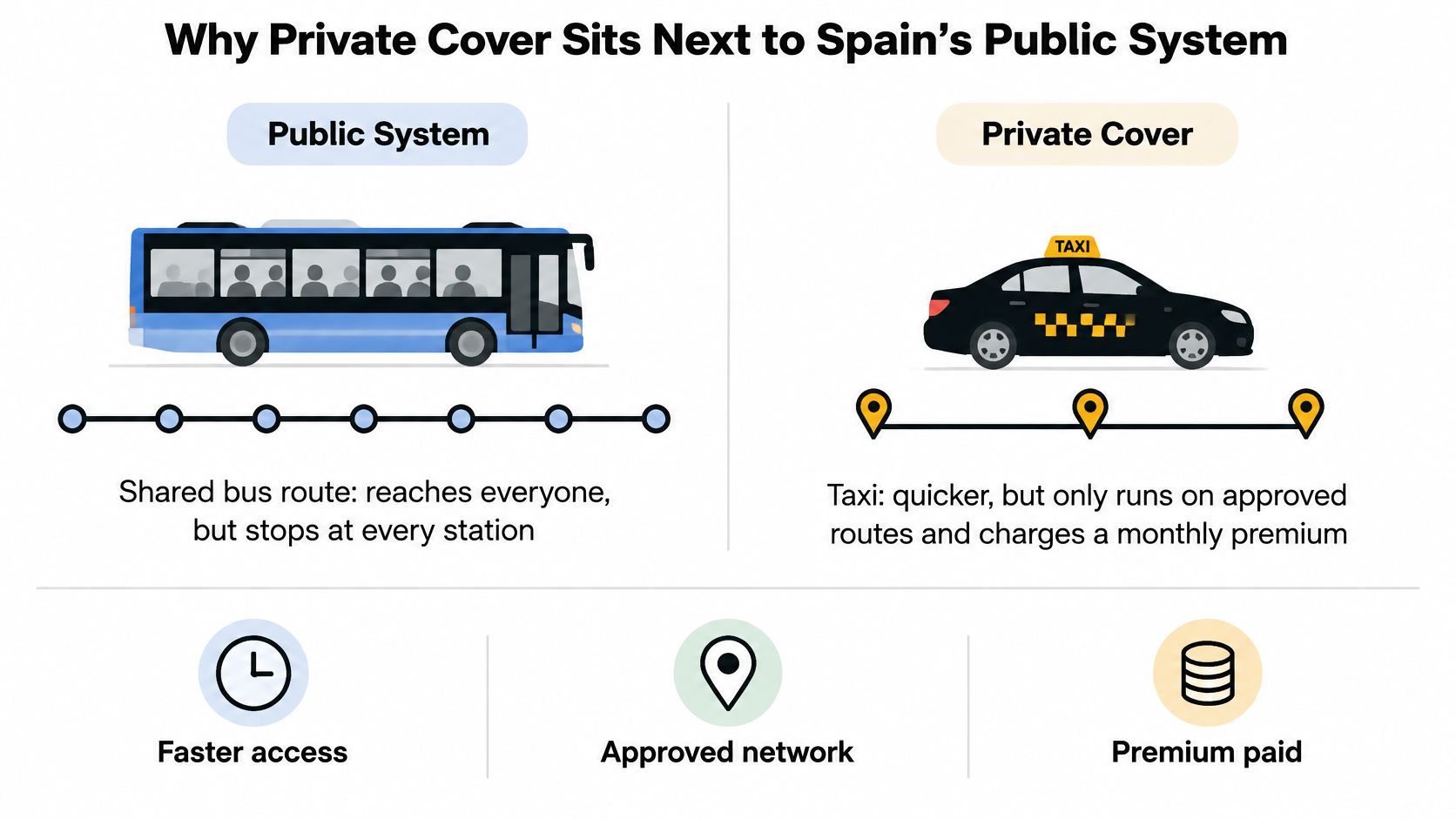
Think of public healthcare as a shared bus route: it serves the community, but you don't control every stop or departure. Private cover is closer to a taxi: you may get a more direct journey, but the insurer only pays for approved routes and agreed extras.
The analogy describes access, not clinical quality. Spain's public system is universal, although your own entitlement and registration still need checking.
What the waiting-time comparison tells you
The OECD Spain country health profile provides the context for these reported 2025 waiting-time comparisons, which distinguish public hospital consultations from first private specialist consultations rather than measuring identical appointment pathways.
| Measure | Public system | Private providers |
|---|---|---|
| Specialist consultation | 94 days on average for a hospital consultation | Roughly 9.8 to 16.5 days for a first specialist consultation |
| Non-urgent surgery | 121 days on average | 24.1 days |
These reported averages aren't appointment guarantees. The availability of a particular dermatologist, surgeon or hospital can be quite different from an overall average.
For someone managing persistent pain or investigating a new symptom, quicker assessment can be valuable. An English-speaking specialist and a convenient clinic may also make it easier to describe symptoms, understand instructions and attend follow-up appointments.
Speed is only useful when treatment is payable
Buying private cover doesn't make every private appointment eligible. You still need a policy that allows the provider, treatment and timing you intend to use.
Nor should you assume that paying privately means you should abandon public care. Maintaining access to both systems can be sensible, especially when your private contract doesn't accommodate an existing illness or a continuing treatment pathway.
The guide to the healthcare system in Spain can help you understand how the routes fit together. Check your registration position separately from your insurance application, rather than treating either as proof of the other.
The value test: Does the likely improvement in access justify the premium and the care you'll still need to fund yourself?
A policy may be worthwhile for convenient specialist appointments without being a complete replacement for public provision. Judge that narrower benefit candidly, against your actual needs.
Outpatient, Inpatient and Network Rules That Decide Access
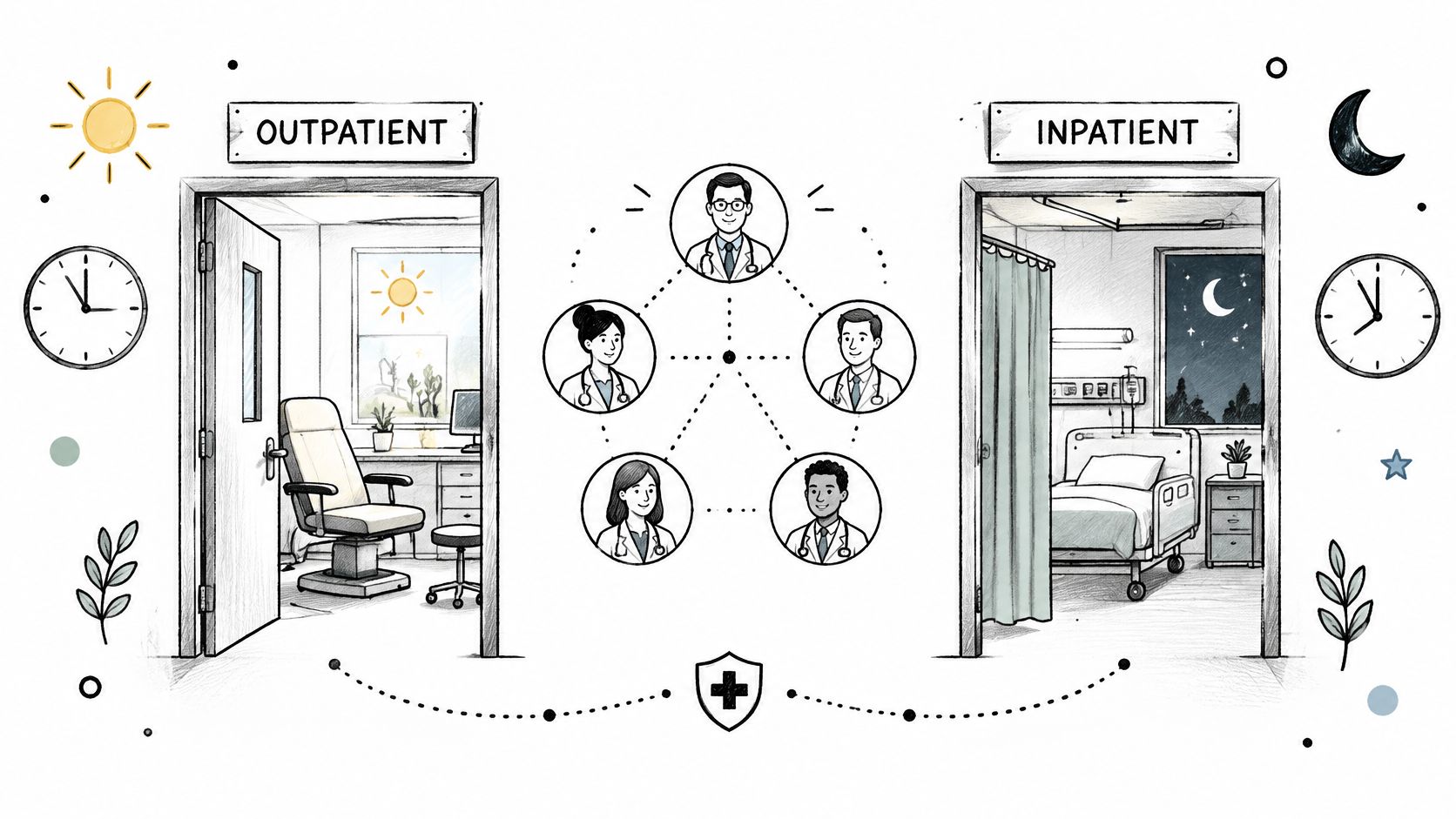
Outpatient care means treatment without an overnight hospital stay, such as consultations and diagnostic appointments. Inpatient care involves admission, with benefits potentially covering the room, clinical team and medication used during the stay.
Day surgery deserves a separate check. Although you may go home the same day, an insurer can administer it under surgical or hospital benefits rather than ordinary outpatient cover.
Verify the provider, not just the hospital name
A provider network is the set of doctors, clinics and hospitals available under your contract. Outside that network, the policy may offer partial reimbursement or no payment at all.
A hospital's appearance in a directory doesn't necessarily establish that every consultant or service there is covered. Ask about the named specialist, treatment location and procedure, not just the building.
Before buying, work through these checks:
- Nearby hospital: Find the facility you could realistically reach from home, including its emergency department.
- Named specialists: Search the insurer's current medical directory, often called the cuadro médico, and confirm that the doctor accepts your exact policy.
- Referral route: Ask whether you can book directly or need a GP referral for the specialty.
- Approval process: Establish which scans, therapies and procedures require pre-authorisation, who submits the request and how you receive the decision.
- Network changes: Ask what happens if your doctor leaves the network during ongoing treatment or at renewal.
Follow the whole treatment pathway
Say you book a covered orthopaedic consultation and the doctor recommends an MRI. The consultation's eligibility doesn't automatically make the scan payable.
Before booking the MRI, ask the insurer whether the request needs approval and which imaging centre you can use. Keep the approval reference and check that it covers the prescribed examination, not merely another consultation.
A referral and an authorisation serve different purposes. The clinician recommends care; the insurer confirms whether the contract will fund it.
Also establish how payment works. A direct-billing policy may let the provider charge the insurer, while reimbursement cover may require you to pay first and submit invoices and medical documents.
Practical rule: A usable local network matters more than a long national hospital list.
For an English-speaking household, usability includes communication. Confirm that the clinician can consult in English rather than assuming the hospital's English-language booking service guarantees it.
How Co-Payments and Cost Sharing Change Your Bill
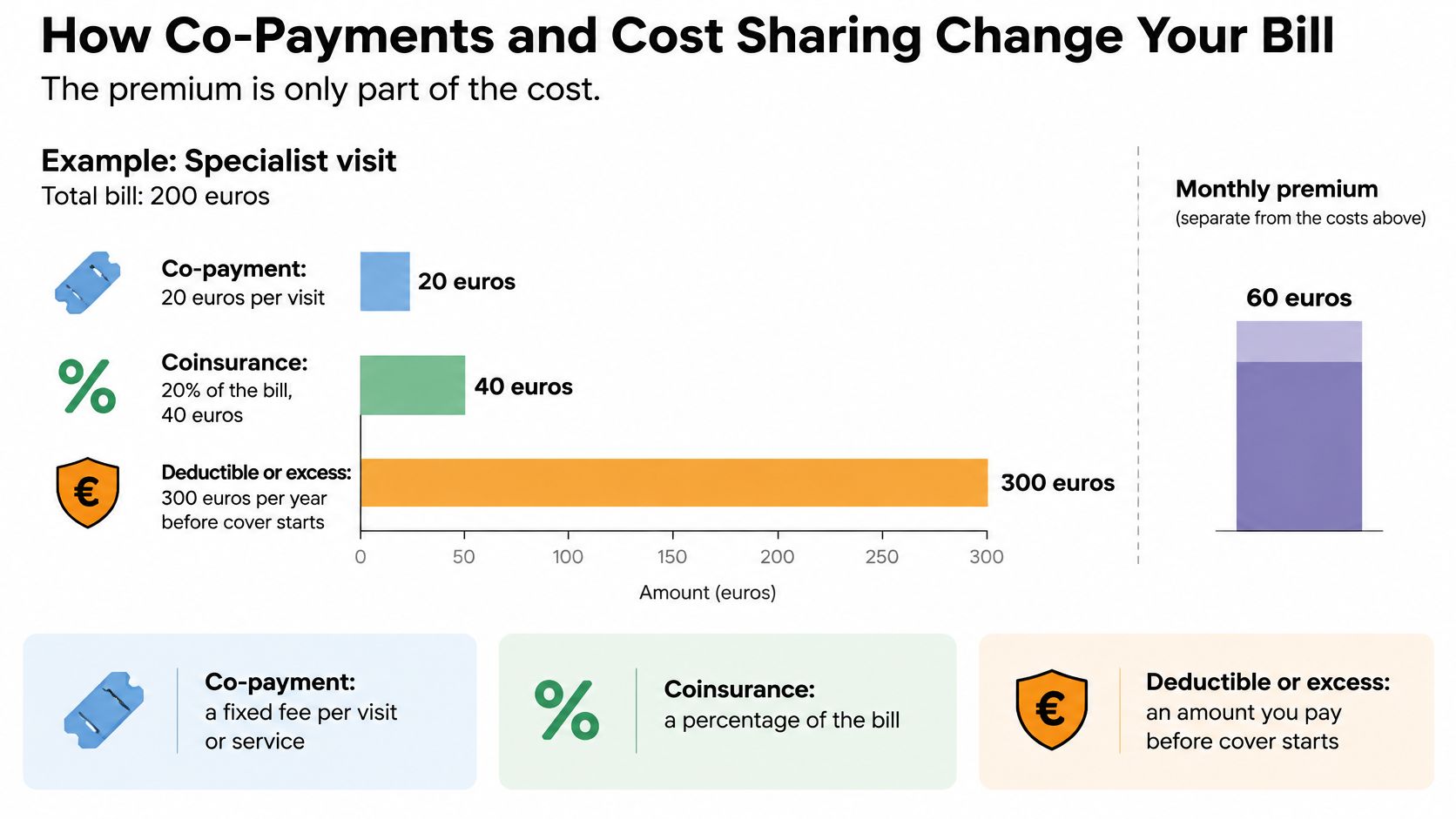
The premium keeps the policy active. The treatment bill is where the actual benefit design shows up, because a service can be covered and still leave you paying part of the charge.
These terms describe what you may pay when you use care:
- Co-payment: A fixed charge for a visit or service.
- Coinsurance: A percentage of an eligible medical bill.
- Deductible or excess: An amount you pay before specified insurance benefits contribute. Check whether it applies annually, per admission or another way.
- Out-of-pocket maximum: A contractual ceiling on specified patient charges, if the policy provides one. Premiums, excluded care and other charges may sit outside it.
What cost sharing changes
The RAND Health Insurance Experiment found approximately 20% lower medical spending under 25% coinsurance and 30% lower spending under 95% coinsurance, while coinsurance participants overall made approximately one to two fewer physician visits annually and had about 20% fewer hospitalisations than participants receiving free care.
| RAND comparison | Result compared with free care |
|---|---|
| Medical spending under 25% coinsurance | About 20% lower |
| Medical spending under 95% coinsurance | About 30% lower |
| Physician visits across coinsurance participants | About one to two fewer visits a year |
| Hospitalisations across coinsurance participants | About 20% fewer |
That pattern shows cost sharing can change behaviour, which is different from proving a policy is good value. A lower bill can mean smarter buying, postponed care, or both, so read the charge next to the benefit rather than treating any patient payment as automatic savings.
Compare the annual total
Take a simple annual model: a €1,000 policy that charges €30 for each of 20 visits costs €1,600 for the year, while an otherwise equivalent €1,400 policy with no visit co-payments costs €1,400. The lower premium can cost more once routine care is frequent enough.
That model only works if the €30 charge applies to every visit and nothing else changes the total. Your own premium depends on age, household composition and the selected excess and co-payment structure, so request personal quotes and model routine appointments, expected tests and a possible admission separately. Then check whether each charge accumulates towards any contractual maximum.
A guide to no-co-payment health insurance helps you compare that payment structure against a co-payment design. Zero co-payment still leaves questions about covered services, exclusions and annual limits, so keep the benefits comparison beside the arithmetic.
Dental, Maternity and International Add-Ons Worth Checking
An add-on is worthwhile when it closes a specific gap at an acceptable cost. Buying the broadest package without checking how you'll use it can leave you paying for benefits that don't match your circumstances.
Read the schedule of included services rather than relying on the add-on's name. Dental access can mean discounted treatment, for example, rather than reimbursement of the whole bill.
Dental cover and treatment charges
- Check what's included: Identify whether examinations, cleaning, fillings and X-rays are included without further payment or charged at agreed rates.
- Price the treatment you expect: For implants, crowns or orthodontics, request a written treatment plan from an eligible dentist. Compare the actual patient charge with the premium and any annual cap.
- Buy when the benefit is usable: The add-on makes sense when the participating dentist is accessible and the included care or price reduction justifies its cost.
The guide to health insurance with dental cover in Spain offers a starting point for checking those distinctions. Don't assume a dental logo means major restorative work is paid in full.
Maternity timing and newborn arrangements
- Check the relevant dates: Ask for the contractual waiting period and whether eligibility turns on conception, delivery or the particular service being claimed. Don't assume antenatal appointments and delivery share identical rules.
- Confirm the delivery team: Check the obstetrician, hospital, anaesthetist and arrangements for complications. Ask how newborn treatment is handled if the baby needs additional care.
- Arrange the baby's cover: Establish whether enrolment is automatic or requires an application within a contractual deadline. Get the process in writing before delivery.
- Buy when the timeline works: Maternity benefits only help a planned pregnancy if the policy's timing and eligibility rules fit your circumstances.
International benefits and travel
- Separate the services: Emergency treatment abroad, planned overseas treatment, medical evacuation and repatriation of remains are different benefits. Ask which are actually included.
- Check territory and duration: A policy suitable for living in Spain may not fund routine care during visits to the UK or another home country. Confirm trip restrictions and whether advance assistance approval is necessary.
- Buy for the risk you need covered: Routine dental use can be anticipated; evacuation cannot. Judge international protection by the financial exposure you want to transfer, not by whether you expect to claim soon.
Exclusions, Waiting Periods and Pre-existing Conditions
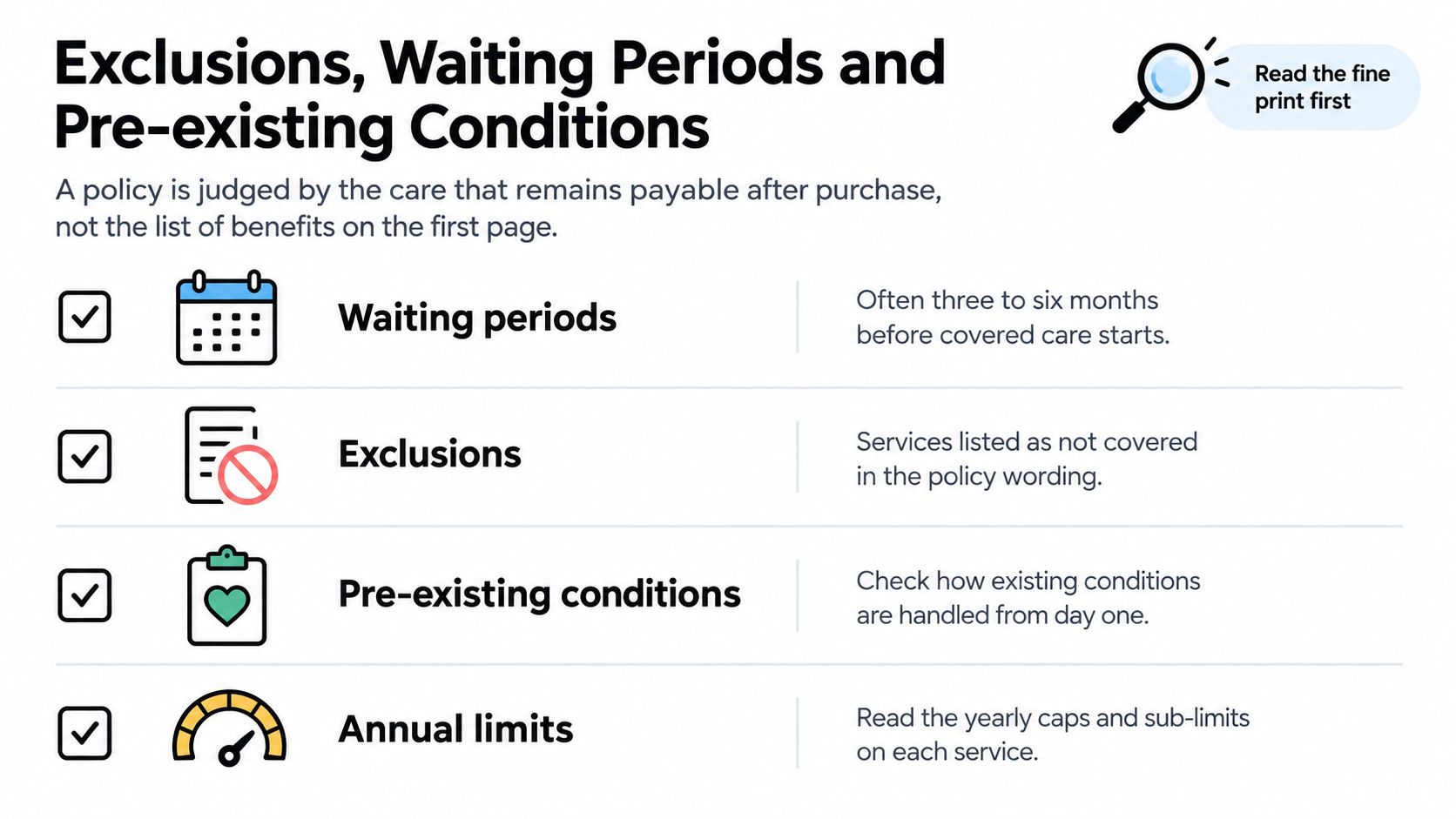
A policy should be judged by the care that remains payable after purchase, not the list of benefits on its first page. A contract that looks thorough can still leave your most important treatment outside cover.
Which?’s consumer guidance identifies pre-existing conditions as a common exclusion in private health insurance. That makes the insurer's written underwriting decision more useful than a general assurance that a policy covers specialist care.
Time restrictions aren't medical acceptance
A waiting period delays eligibility for a specified benefit after the policy starts. Completing it doesn't remove a separate exclusion.
An exclusion identifies care the contract won't pay for. Underwriting is the insurer's assessment of your medical history when deciding whether to offer cover and on what terms.
A disclosed condition may be accepted, permanently excluded or covered at a higher premium; the insurer may also decline the application. Don't assume that paying premiums for longer will change that decision.
A moratorium, where offered, follows contractual rules about previous conditions and qualifying periods. It isn't interchangeable with either a standard waiting period or an unconditional promise of future cover.
Prepare a complete disclosure file
Use the application's questions carefully, and ask for clarification rather than deciding that a symptom or prescription is too minor to mention.
- Declare conditions and medication: Include ongoing treatment, relevant previous diagnoses and information the application requests about symptoms or investigations.
- Gather supporting records: Prepare specialist reports, discharge letters, medication details and relevant test results.
- Clarify related complications: Ask whether an exclusion affects only the named condition or also consequences and associated treatment.
- Get the outcome in writing: Request the individual terms, not just a sample policy booklet.
- Check continuation terms: Ask how renewal works, whether exclusions can be reviewed and whether age affects eligibility or future terms.
- Consider alternatives: If broad private cover is unavailable, assess what limited cover would really add alongside other care arrangements.
Cancer, diabetes and cardiovascular disease deserve particularly careful review because consultations, medication, monitoring and complications may be treated differently under the contract.
Non-disclosure can put claims and the policy itself at risk. If you notice an omission after applying, contact the insurer promptly and request written confirmation of any revised terms.
The question isn't whether you can buy a policy, but what care will remain payable after you do.
Also read annual limits and service-specific sub-limits. Acceptance of a condition doesn't mean unlimited funding for every treatment connected with it.
Choose Your Benefits Before You Sign
| Profile | Benefits to prioritise | Check before buying | Typical trade-off |
|---|---|---|---|
| Families with children | Paediatric cover, maternity timing and dental cap | Maternity waiting period and per-child premium | Higher premium for broader family cover |
| Retirees aged 65 and over | Outpatient specialists and inpatient cover | Age-related premium changes and renewal terms | Potentially higher premium for the desired access |
| People with pre-existing conditions | Continuity of treatment, medication and referrals | Underwriting outcome and condition exclusions | Possible higher premium or condition exclusion |
These profiles are starting points, not insurer eligibility categories. A healthy retiree and someone receiving continuing treatment may need very different contracts, even if they're the same age.
The useful comparison begins with the care you expect to need, then tests whether each quote can fund it.
A family planning a pregnancy
Consider a hypothetical family of four moving in January and planning another child. Their immediate priorities might be a nearby paediatrician and practical access to routine appointments, but maternity timing could decide which policy is suitable.
They should ask the insurer to check their intended timeline against the contract before paying. They also need to distinguish the mother's delivery benefits from the baby's enrolment and treatment arrangements.
A lower family premium won't compensate for a delivery that falls outside eligibility. If the timing doesn't work, the family needs a realistic alternative care and funding plan.
A retiree managing diabetes
Take an illustrative 67-year-old with type 2 diabetes. The first question is whether the proposed policy will pay for the diabetes care they use in practice, rather than whether it advertises endocrinology.
They should obtain written answers about monitoring, consultations and outpatient medication. The specialist's network status matters, but it won't overcome a condition exclusion.
For budgeting, compare the quoted premium, the rules for future premium changes and the patient charges that remain payable. Any out-of-pocket ceiling needs careful reading because excluded treatment may not count towards it.
An applicant with a previous cancer diagnosis
Consider a hypothetical 45-year-old who has completed cancer treatment. Before applying, they should gather the diagnosis, treatment summary, follow-up plan and recent specialist reports.
They need to know whether surveillance, recurrence and related complications would be accepted or excluded. Renewal questions should address the actual proposed terms rather than seek a general promise that the policy will always stay the same.
If switching insurers, don't cancel existing protection before the new insurer has issued acceptable written terms and confirmed the start date. A fresh application may produce a different underwriting outcome.
Make the comparison manageable
- List your most likely expenses. Start with the consultations, investigations and treatment your household expects to need.
- Test each expense against the contract. Check the provider, timing, patient charges and applicable benefit limit.
- Complete the disclosure checklist before applying. Resolve unanswered medical-history questions and retain the insurer's written decisions.
You can request quotes directly from insurers or use an independent broker to organise the comparison. Whichever route you choose, keep the policy wording, benefit schedule and individual underwriting terms together so you can judge the whole agreement.
Bsure Health Brokers can compare private medical insurance benefits against your household's needs and help with policy set-up, paperwork and renewals. Visit Bsure Health Brokers to discuss the care you want covered and get help checking which policy terms would apply to you.