
For a younger adult in Spain in 2026, private health insurance can cost around €35–€90 per month with copays, or roughly €60–€120 for no-copay, visa-compliant cover. The cheapest premium can become the more expensive choice if you use doctors, tests, or specialists frequently, while costs often rise sharply after 65–75.
You may be sitting at a kitchen table in Spain with two figures in front of you: the monthly rent and the insurance quote needed for your visa, renewal, or residency paperwork. The quote looks manageable until you notice the copay rules, exclusions, waiting periods, and age-related pricing hidden in the policy wording. Then the simple question, “How much does private health insurance cost per month?” becomes much harder to answer.
A realistic budget needs more than a national average. It should reflect your age, medical history, household size, cover level, territorial scope, network, copays, and visa status. A policy for a healthy young resident who rarely visits a doctor is a different product from cover for a retiree, a family, or an applicant who needs full cover with no copay.
Spain remains substantially less expensive than the U.S. private market. For context, the U.S. average private health insurance premium reached $7,151 per person in 2024, or approximately $595 per month, compared with $4,008 in 2011, according to the figures described by Yale News through its private health insurance cost reference. UK pricing is lower than the U.S. average but still varies by age and benefits, with a 2026 analysis placing the average single-adult premium at £79.59 per month and a sampled quote range from £32.81 for a 30-year-old with core cover to £177.66 for an 80-year-old (UK private health insurance cost analysis).
This guide translates the Spanish market into practical budgeting terms, so you can compare the monthly sticker price with the amount you're likely to spend using the policy.
Table of Contents
- Introduction to Private Health Insurance Costs in Spain
- What Your Monthly Premium Covers
- Key Factors That Drive Your Monthly Price
- Typical Monthly Costs With Real Life Examples
- Smart Ways to Lower Your Monthly Premium
- Visa and NIE Health Insurance Requirements That Affect Cost
- Finding the Right Cover With Confidence
Introduction to Private Health Insurance Costs in Spain
An English-speaking couple is preparing a move to Málaga. One partner needs insurance documents for a residency application, while the other is arranging cover for the household. Their decision depends on more than the lowest quote. The policy must meet the application requirements, suit their likely healthcare use, and remain affordable at renewal.
That is why the premium is only the first line of the monthly cost. A copay policy may have a lower starting price, but consultations, diagnostic tests, and specialist appointments can increase the household's total outlay. A no-copay policy generally costs more upfront, yet offers steadier budgeting for someone expecting regular care.
Why Spanish averages can mislead
One “average price” cannot represent a 30-year-old professional, a family with children, and a retiree aged over 75. It also conceals the difference between Spain-only medical cover and a plan offering wider European or international protection. The quote may change with the insurer's network, benefit limits, underwriting decision, and payment structure.
A useful Spanish pricing guide is therefore a range rather than one universal figure. Younger adults are often quoted around €35–€90 per month for entry-level copay plans, while no-copay or visa-compliant cover commonly falls around €60–€120 per month, according to Spain-focused private health insurance pricing guidance. Older applicants can face considerably higher premiums or fewer available options, particularly in later age bands.
Age-band pricing matters because insurers assess risk over time. A policy that looks affordable at one stage may cost more after renewal as the insured person moves into a new band.
Practical rule: Treat the monthly premium as the price of access and protection. Treat copays, exclusions, and waiting periods as the conditions that determine what the policy feels like in real life.
What this guide helps you decide
The following sections explain how insurers build the price, which features raise or lower it, and how visa compliance affects the available choices. They also show how to estimate your likely total monthly outlay, rather than comparing sticker premiums alone.
The aim is not to promise a quote without knowing your circumstances. It is to help you recognise whether a policy fits your needs before you commit.
What Your Monthly Premium Covers
A private health policy can resemble a mobile phone plan. One option costs more each month and lets you use covered services without a charge at the point of use. Another keeps the monthly fee lower but adds a small payment when you attend an appointment or use a service.
The monthly premium keeps your policy active and provides access to the benefits stated in the contract. Your real monthly outlay also depends on how often you use those benefits, so the sticker price alone does not show the full cost.
Copay and no-copay plans
A copay, or copago, is a fee paid when you use certain medical services. The insurer can offer a lower monthly premium because you contribute each time you attend an appointment or use covered treatment. This arrangement may suit a healthy adult who wants private access and expects to need care only occasionally.
A no-copay policy usually has a higher premium, with no service charge for covered use. That makes monthly budgeting more predictable. It can be useful for families, people managing ongoing conditions, or applicants seeking visa-compliant cover.
The lowest premium may not produce the lowest monthly outlay. Someone attending appointments regularly can accumulate several small copayments. Compare the premium with your expected use, rather than comparing headline prices in isolation.
Excess, network, and waiting periods
An excess, also called a deductible, is another form of cost-sharing. Under defined circumstances, you contribute an amount before the insurer pays according to the policy terms. A wider hospital and specialist network can raise the premium because it gives you more choice of providers.
Waiting periods, known in Spain as carencias, restrict access to certain benefits for an initial period. They can apply to planned procedures, maternity, or other specified services. The policy schedule should identify the affected benefits and state when cover begins.
Visa applicants need to check these details before choosing a low-cost plan. Full cover with no copay and no waiting period is commonly required for visa-compliant private medical insurance. A policy with usage fees or carencias may therefore fail to serve the purpose for which it was purchased.
The contract matters more than the label
The label can mean different things between insurers. Check whether the policy includes outpatient consultations, hospitalisation, surgery, diagnostics, cancer care, emergency treatment, prescription arrangements, exclusions, and geographical limits. Request written confirmation of any condition connected with your visa or residency application.
A monthly quote has meaning only when you know what it buys. Two policies with similar premiums can feel very different in practice if one has a narrower network, significant exclusions, or charges whenever you use care.
Key Factors That Drive Your Monthly Price
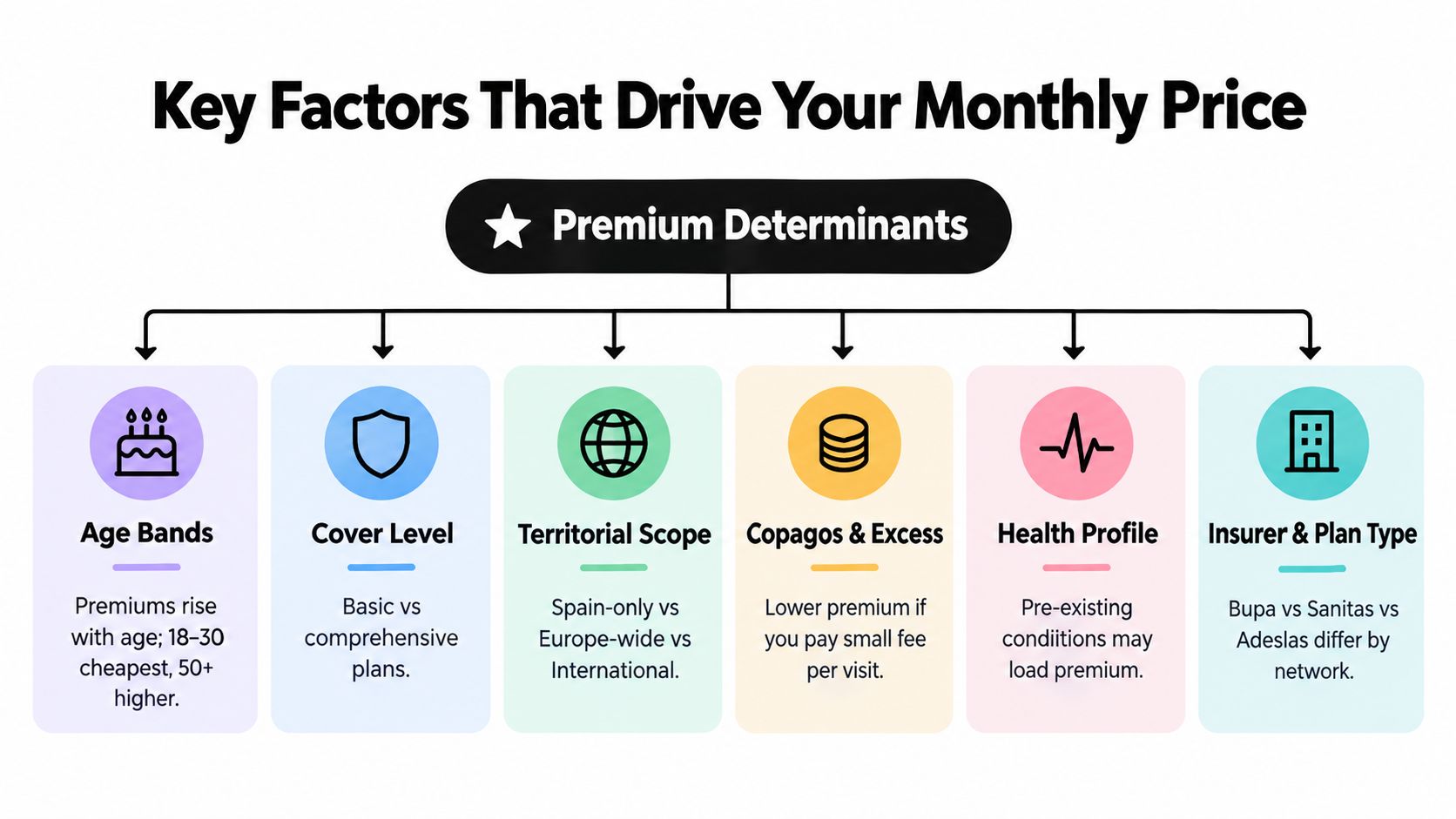
A quote can look affordable until you add the costs of using the policy. In Spain, the monthly outlay is the premium plus any copays, while age, medical history, and visa requirements shape what insurers will offer. Understanding these moving parts helps you compare like with like.
Age bands
Age is one of the strongest pricing influences. Insurers generally expect healthcare use to increase as people get older, so premiums often rise across age bands. A 30-year-old and a 75-year-old seeking similar protection should not expect similar prices.
Spanish market guidance reports sharply higher pricing or restricted availability for older applicants, particularly after 65–70 (Spain private health insurance cost guidance). Retirees should ask early about upper entry-age limits, renewal conditions, and age-related changes written into the policy. A low initial quote is less useful if the insurer cannot accept the applicant or later changes the terms significantly.
Cover level and territorial scope
Spain-only cover usually costs less than a policy with broader benefits, a larger hospital network, or treatment outside Spain. Europe-wide or worldwide access expands the insurer's potential exposure, so it can raise the premium.
UK market guidance illustrates this relationship. Adult cover was quoted at £55–£80 per month, rising to £90–£135 when EU or worldwide travel cover was added. International private medical insurance for an EU-based expatriate was quoted at approximately £180–£320 per month (territorial scope and private medical insurance pricing). These are not Spanish quotations, but they show how geographical scope changes the price.
Copays and excess
Copays move part of the cost from the monthly premium to each eligible appointment or service. That arrangement may suit someone who rarely uses private healthcare. Regular consultations, tests, or monitoring can make the total monthly outlay higher than the advertised premium suggests.
Spain-focused guidance places younger-adult entry-level pricing around €35–€90 with copays, compared with roughly €60–€120 for no-copay or visa-compliant cover (copay and no-copay Spanish insurance ranges). Compare the likely pattern of use before choosing. A lower premium may provide poor value if frequent appointments create repeated charges.
Health profile and underwriting
Insurers may ask about previous diagnoses, ongoing treatment, medication, and planned care. A pre-existing condition can result in exclusions, a higher premium, medical review, or refusal of a particular product. The result depends on the insurer and the condition's details.
Answer every health question accurately. Omitting relevant information can cause difficulties when treatment is requested. A transparent application gives the insurer a clearer basis for confirming what the policy does and does not cover.
Household structure, region, and insurer
Covering several people increases the total premium, although a household quotation may differ from adding individual policies together. UK analysis placed average monthly premiums at £79.59 for one adult, £145.77 for a couple, and £166.52 for a family of four (household private health insurance pricing). These figures are not Spanish averages, but they demonstrate why household composition belongs in the calculation.
Location and insurer strategy also matter. Sanitas, Adeslas, DKV, international providers, and other insurers may differ in networks, underwriting, exclusions, and renewal terms. A health insurance premium calculator can provide a starting estimate. Then request a personalised quote and check the policy schedule, including copays and any visa-related conditions.
Typical Monthly Costs With Real Life Examples
A healthy 30-year-old using private care occasionally may receive a lower quote than a retiree or a family. The monthly premium is only the starting figure. Copays, expected appointments, age, medical declarations, and visa requirements can change the total monthly outlay.
The profiles below are budgeting illustrations based on the Spanish ranges already discussed, not guaranteed quotations. They show why “What is the private health insurance cost per month?” has no single answer.
| Profile | Copay Plan per Month | No-Copay Visa Compliant per Month | Key Note |
|---|---|---|---|
| Single adult in their 30s | Around €35–€90 | Around €60–€120 | Copays may suit light use, but visa applications generally require no-copay cover |
| Couple in their 40s | Higher than one adult | Higher than one adult | Price reflects two people, ages, benefits, and underwriting |
| Family of four | Household quote required | Household quote required | Family pricing depends on ages, children, network, and policy design |
| Retiree around 65 | Often higher than younger-adult pricing | Usually higher than younger-adult pricing | Medical history and insurer entry rules become especially important |
| Retiree aged 75 or older | Sharply higher or limited | Sharply higher or limited | Availability and underwriting may matter as much as price |
| Applicant with diabetes or another chronic condition | Personalised assessment | Personalised assessment | Exclusions, loading, or acceptance terms must be confirmed in writing |
The younger professional
For occasional use, a copay policy may appear affordable for a healthy adult in their 30s. Each consultation or service can add to the monthly outlay, so compare the likely usage cost with the fixed premium. A low sticker price may not remain low during a month with several appointments.
The same applicant may need no-copay cover for a visa application. A policy suitable for ordinary residence may not meet a consulate's full-cover conditions. Paying more for the correct policy from the start can be less disruptive than replacing cover later.
The couple and family
A couple in their 40s should request a joint quotation instead of doubling one person's price. The insurer will assess both applicants, including age, medical declarations, benefits, network preferences, and any underwriting terms.
Families should estimate use for every member. Children may need frequent consultations, making copays more noticeable over time. A household quote can therefore be more useful than comparing only the lowest individual premium. For more detail on household budgeting, see this guide to family health insurance cost per month.
The practical comparison is the expected monthly total: premium plus copays for the care the household is likely to use.
The retiree
A retiree around 65 may have several available options, but acceptance rules and medical underwriting need careful review. At older ages, the price can rise sharply, and availability may become as important as the premium itself. The age band used by an insurer can affect both the quote and whether an application is accepted (age-related pricing and availability in Spain).
Ask how renewal pricing works, whether cover can continue at older ages, and whether nearby hospitals and specialists are included. A policy that fits the first year may need a different budget later.
The applicant with a chronic condition
Someone with diabetes or another ongoing condition needs an individual assessment rather than a generic online estimate. The insurer may accept the application with added terms, exclude related treatment, or offer another product.
Read the decision in writing. The important question is whether the cover matches the care the applicant expects to need, not whether the initial premium is low. A plan with a modest premium may create a larger outlay if expected treatment is excluded or subject to copays.
Smart Ways to Lower Your Monthly Premium
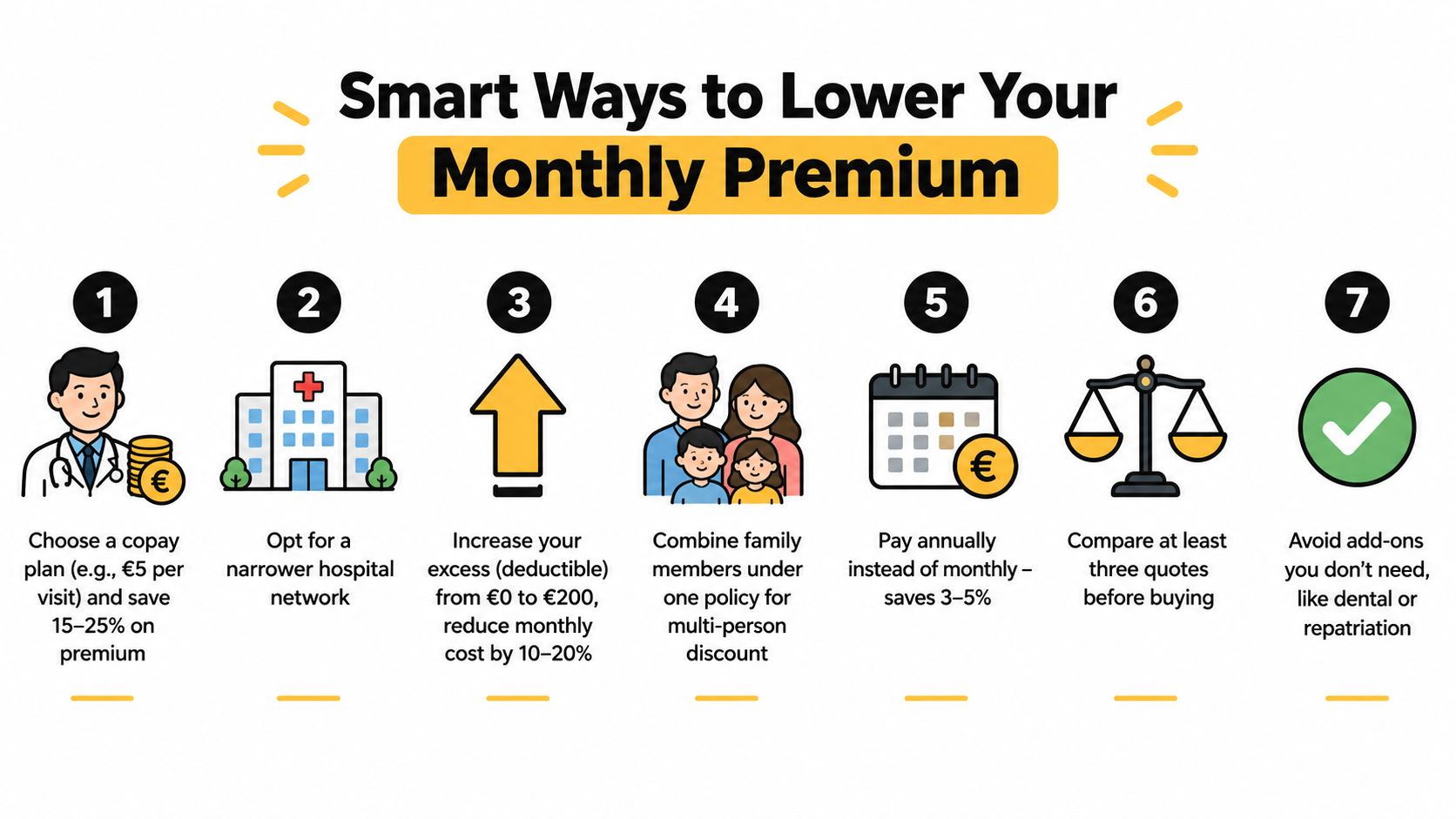
A lower premium can help, but only if the policy still works when you need care. Removing a benefit without checking the consequence may create a false saving, particularly if you later need a specialist, diagnostic test, or hospital service. Judge the monthly cost as a likely total outlay, including copays and other usage charges, rather than by the sticker premium alone.
Start with the largest trade-offs
A copay plan usually lowers the fixed monthly price. It may suit someone who rarely visits a doctor, provided each usage fee remains affordable. Someone managing a chronic condition may prefer no copays, because the higher premium can make regular healthcare spending easier to predict. Compare both parts of the cost against your expected pattern of care.
A narrower hospital network may also reduce the premium. Check the included hospitals, clinics, and specialists before accepting that restriction. A small network can work well if it includes the local providers you prefer. It becomes costly when you discover the limitation only after moving or needing treatment.
Adjust protection, not necessary access
You may be able to remove optional benefits, reduce territorial scope, or choose a different room and hospital arrangement. Keep the protection that fits your circumstances, especially where private insurance forms part of residency documentation.
Changing insurers can sometimes reduce the price, but confirm acceptance into the new policy first. A new application may involve fresh underwriting, exclusions, or waiting periods. Cancelling the existing policy too early can interrupt access to benefits and leave you without the cover you expected.
Compare the total annual experience
Ask each provider to show the premium, copays, excess, waiting periods, exclusions, renewal approach, and provider network in writing. Three quotes with different structures tell you more than three similar prices. The right comparison is the likely annual experience, not the amount leaving your bank account each month.
Bsure Health Brokers can compare Spanish and international options, assist with paperwork, and handle policy changes and renewals. Its published company information states that the service is free and that responses are typically available within 24 hours.
A cheaper monthly premium is a good result only when the policy still works at the doctor's office, the hospital, and the consulate.
Visa and NIE Health Insurance Requirements That Affect Cost
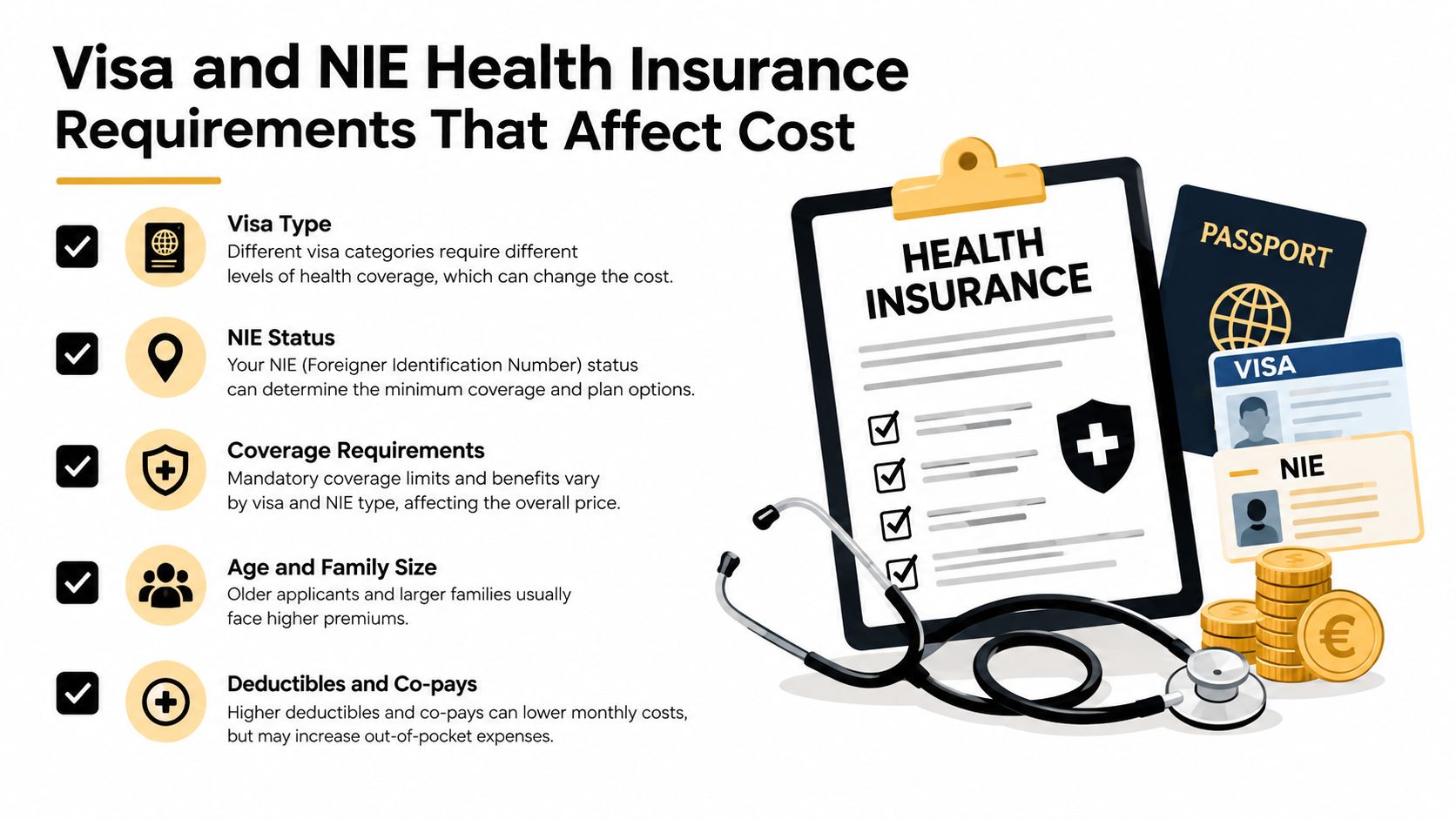
A policy can look affordable and still fail a visa application. For many expats, the first question is whether the cover satisfies the application, not whether it has the lowest premium. Non-Lucrative Visa, Digital Nomad, and other residency routes may require private medical insurance with particular features. Requirements can differ by application and consulate, so confirm the current wording with the relevant authority or an experienced broker.
A practical compliance checklist
Before paying, request documents confirming:
- No copays: Where full-cover wording is required, covered services should not require payment each time you use them.
- No waiting periods: Ask whether carencias apply to benefits listed on the certificate.
- Full medical cover: Check that the document describes private medical insurance, rather than travel assistance alone.
- Valid territorial protection: Confirm that the policy applies in Spain and meets the relevant application requirement.
- Correct policy documents: Names, dates, policy numbers, and wording must match the application.
Travel insurance and a GHIC do not replace the private medical insurance required by many Spanish residency applications. They may help with temporary or reciprocal arrangements, but they do not automatically provide the no-copay structure an application demands.
Why compliance raises the monthly price
Visa-compliant cover removes features insurers often use to reduce premiums, particularly copays and waiting periods. The premium therefore tends to sit toward the no-copay range of roughly €60–€120 per month for younger adults, as described in the Spanish pricing guidance cited earlier. For your real monthly outlay, also consider how often you expect to use care, because a policy with no copays can make costs steadier even when its premium is higher.
Do not rely on a sales page that says “visa suitable.” Ask for a certificate and policy wording you can submit. If a consulate rejects the documents, replacing the policy may delay the application and create a second expense.
Finding the Right Cover With Confidence
A suitable private health insurance cost per month reflects your expected use, age, health profile, and legal purpose. For example, someone who rarely visits a doctor may accept copays, while a family expecting regular appointments may prefer steadier monthly budgeting with no copays. That higher premium can also fit a visa application more easily, provided the policy documents meet the stated requirements.
Begin with a short checklist: Spain-only or international cover, preferred hospitals, likely medical use, family members, existing conditions, and any certificate required by a consulate. Then compare the policy wording, exclusions, waiting periods, and payment rules alongside the advertised premium.
Insurers can differ in age acceptance, underwriting, hospital networks, and application wording. A guide to what a health insurance broker does explains how professional help may support comparisons, paperwork, renewals, or a deadline.
Your budget should include two parts: the amount paid every month and the possible cost of using care. A suitable quote should show both clearly, while confirming that the cover works for your healthcare needs and visa purpose.
Bsure Health Brokers compares Spanish and international options, including family, retiree, and pre-existing-condition cover, and can help with policy wording and paperwork.