
You're probably doing this the hard way right now. Ten browser tabs are open. One insurer says sin copago, another says con copago, another promises “complete” cover but buries exclusions in Spanish legal wording. Meanwhile, your visa or NIE paperwork is waiting, and you're trying to work out whether the cheapest quote is compliant or just cleverly presented.
That stress is normal. English-speaking expats in Spain run into the same problem again and again. The market looks simple from a distance, but it isn't. Spain has a strong public system and a busy private market running alongside it, and that overlap creates confusion. The OECD notes that health expenditure in Spain reached 10.7% of GDP in 2021, close to the EU average of 11.0%, which helps explain why many residents want clearer ways to compare public and private options through tools that cut through the noise (OECD Spain country health profile).
A health plan comparison tool can help. Used well, it gives you a fast read on pricing, coverage style, and insurer differences. Used badly, it pushes you toward the wrong plan for your visa, your age, or your medical history.
If prescription access is one of your biggest worries, it also helps to understand how policies handle drugs and formularies before you compare plans. This medication insurance coverage guide is a useful companion read because medication rules are often where “good value” plans stop looking like good value.
Table of Contents
- Navigating the Maze of Spanish Health Insurance
- What Is a Health Plan Comparison Tool
- A Step-by-Step Guide for Expats in Spain
- Common Pitfalls and Red Flags When Using Tools
- When to Trust an Expert Over a Tool
- Real-World Scenarios and Your Final Checklist
- Your Smart Path to the Right Health Plan in Spain
Navigating the Maze of Spanish Health Insurance
The usual pattern is easy to recognise. Someone moves to Spain for work, retirement, or a non-lucrative visa. They assume health insurance will be a straightforward admin step. Then they discover that two plans with similar names can behave very differently regarding copayments, waiting periods, hospital access, and acceptance of pre-existing conditions.
Spain's system adds to that confusion because public and private care sit side by side. Many expats are eligible for some form of public healthcare access later on, but still need private cover now for immigration, speed of access, wider provider choice, or English-language support. That's where the confusion starts. People aren't just buying “health insurance.” They're trying to buy the right type of health insurance for a legal and personal situation that a generic website rarely understands.
Why expats get stuck
A comparison page usually looks reassuring at first. It offers clean columns, prices, and a few tick boxes. But an expat's real questions are rarely simple:
- Will this policy be accepted for my visa application
- Does no copay mean fewer surprise costs
- Can I apply if I've had cancer, diabetes, or ongoing treatment
- Will I be restricted to a network that looks fine on paper but fails in my area
Those are not small details. They're the details that decide whether the policy works.
The best plan for a Spanish national already settled in the system may be the wrong plan for a new arrival who needs immediate compliance and predictable access.
Where a tool helps
A good health plan comparison tool gives you a starting framework. It lets you narrow the market, spot pricing differences, and identify plans worth a closer look. It saves time, and it can stop you from overpaying for a badge or brand name.
But it only works if you understand what it cannot do. It won't automatically know your consulate's documentation standards. It won't catch a vague underwriting answer you should challenge. It won't warn you that a “full cover” label means very little without checking conditions and exclusions.
That's why the smart approach isn't blind trust. It's disciplined comparison.
What Is a Health Plan Comparison Tool
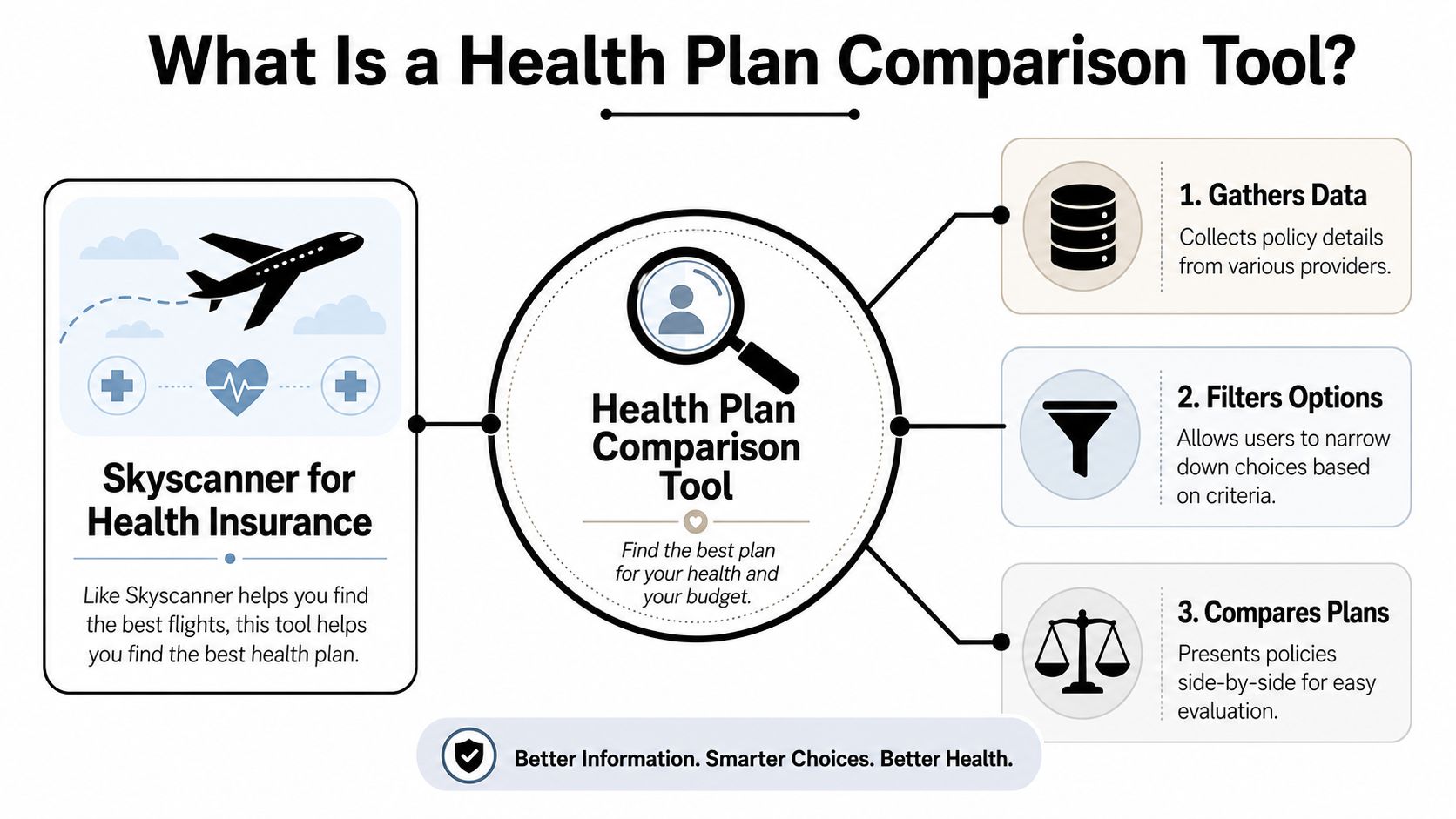
A health plan comparison tool is basically Skyscanner for health insurance. Instead of comparing flights, it gathers plan data from insurers or intermediaries, standardises the main features, and lets you sort options by what matters most to you.
That matters more in Spain than many expats expect. According to Selectra, the average monthly cost for a complete private health insurance plan with no copay ranges between €55 and €80, while plans with copay average €26 to €50 per month. The same source also notes that private health insurance for expats can range from €35 to €200 per month depending on age, gender, coverage level, and health needs, and that comparing policies can help clients save up to 40% compared with standard market rates (private health insurance costs in Spain).
The two versions you'll meet online
Not all tools are doing the same job.
| Tool type | What it usually does | What to watch for |
|---|---|---|
| Lead form disguised as a comparison tool | Collects your details, then passes you to a salesperson or one insurer | Limited visibility, sponsored results, weak detail |
| Actual comparison platform | Lets you review multiple plans side by side | Still needs manual checking of wording, exclusions, and underwriting |
The first type isn't useless. It can still open the conversation. But if the site won't show you enough detail before requesting your phone number, treat it as a sales funnel, not a research tool.
What a strong tool should help you compare
A useful tool should help you line up more than price:
- Premium structure: monthly cost and whether copays apply
- Coverage style: hospitalisation, specialists, diagnostics, emergency care
- Access rules: waiting periods, authorisation requirements, outpatient pathways
- Practical fit: provider network, policy wording, language support
If you want a rough starting point before speaking to anyone, a health insurance premium calculator can help frame the market and show how quickly prices shift once age and coverage preferences change.
Practical rule: Use the tool to create a shortlist, not to make the final decision in one click.
Why comparison beats guessing
Expats often compare only the headline monthly payment. That's how they get trapped. A cheaper plan may be cheaper because it shifts costs into copays, limits access, or excludes what matters in your situation. A more expensive plan may be expensive because it removes friction and uncertainty.
The point of the tool is not to find the lowest number. The point is to find the plan that remains suitable after the paperwork, underwriting, and real-life use begin.
A Step-by-Step Guide for Expats in Spain
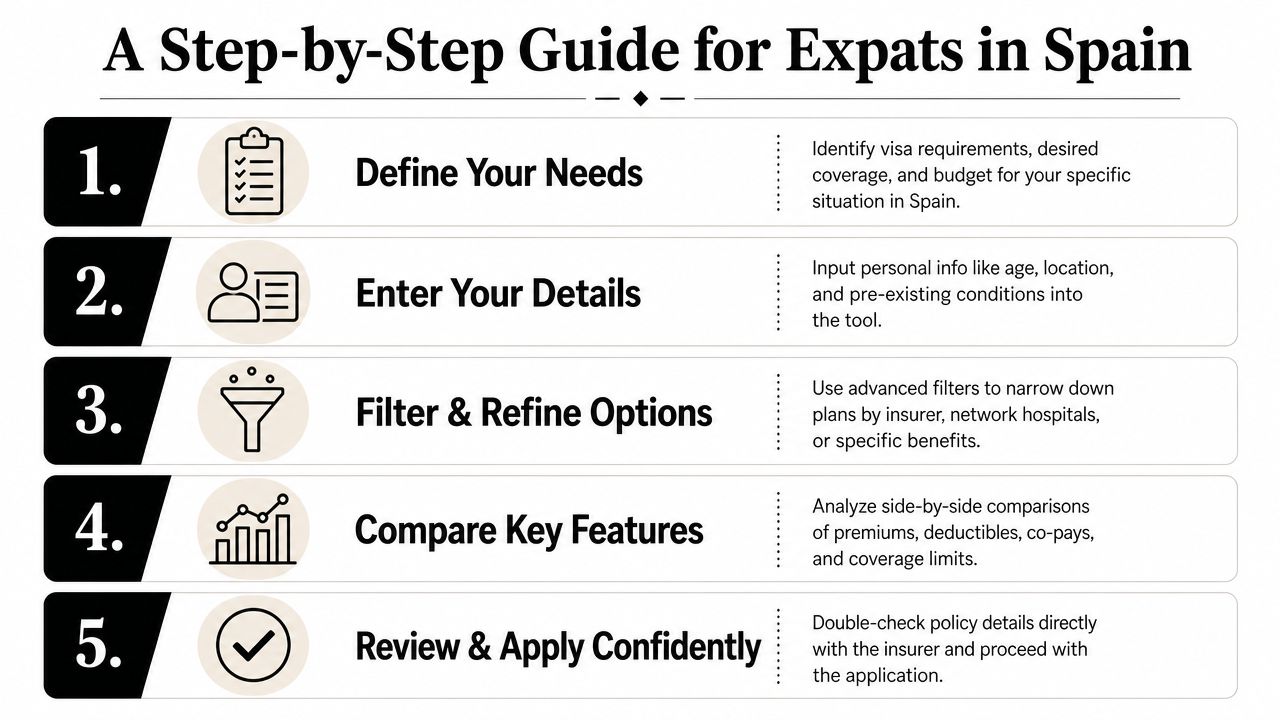
The right workflow is simple. Focus on your must-haves, enter your details carefully, then test every quote against real-life use in Spain. That's the difference between browsing and buying intelligently.
For anyone planning the broader move at the same time, a practical guide to living in Spain helps put insurance choices in context with residency, housing, and day-to-day setup.
Filter for visa and residency fit
One should begin here, though many postpone it until the conclusion.
If your policy is meant to support a visa or residency process, filter for plans that match the documentation standard you need. In practice, expats often look for policies described as no copay and with wording around immediate or suitable access rather than plans that leave room for argument at the application stage.
What you're checking is not just price. You're checking whether the insurer's policy structure fits your legal use case.
A quick working list:
- No copay: often preferred when you need predictable, full cover on paper and in practice
- Waiting periods: check whether key services are delayed at the start
- Policy certificate wording: make sure the insurer can issue the documentation needed for your application
- Effective date: line this up with your arrival, visa filing, or residency timeline
If you want a practical framework for narrowing options, this guide on how to compare health insurance plans is useful as a decision checklist.
Read the quote like an underwriter would
Once the shortlist is on screen, slow down. The quote isn't the policy. It is a summary.
Read for friction points:
- Hospital network quality: Is there a sensible choice near where you'll live?
- Specialist access: Do you need referrals, approvals, or pre-authorisation?
- Emergency treatment: How clearly is it described?
- International movement: If you travel often, does the plan help or leave gaps?
- Repatriation or assistance clauses: Sometimes these matter more than buyers expect
One of the easiest mistakes to make is assuming a plan offering extensive benefits means broad freedom of use. It may not. Some plans are only good if your preferred hospitals and specialists are already in network.
If the provider list is hard to find, badly translated, or vague by region, that's a warning sign.
Declare pre-existing conditions properly
This is the step people rush because they're afraid of the answer.
Don't. If you understate, omit, or soften a medical history issue, the problem usually surfaces later, when you require care. Comparison tools can collect basic health information, but they rarely guide you on how to present it properly for underwriting.
Be specific and orderly:
- List diagnoses clearly
- Include past treatment and current medication
- State whether the condition is ongoing, monitored, or resolved
- Keep supporting records ready in case the insurer asks
If your records are scattered across apps, paper files, and old emails, this guide to effective medical record organization is worth reviewing before you apply. Good record organisation speeds up underwriting and reduces mistakes.
Check age-related restrictions early
Retirees often lose time by comparing plans that were never realistic options.
Once you're in the older age brackets, underwriting becomes more selective. Plan availability narrows. Exclusions become more important. Terms around chronic conditions, specialist care, and ongoing medication deserve more scrutiny than the homepage summary gives them.
This is the stage where a health plan comparison tool still helps, but only as a filter. It can tell you which insurers might be relevant. It cannot tell you how a particular insurer is likely to approach your profile once full medical disclosure lands on the desk.
A good expat workflow in one view
| Step | What to do | Why it matters |
|---|---|---|
| Start with legal fit | Match the plan to visa or residency purpose | Stops wasted applications |
| Compare structure, not just cost | Look at copays, access, and conditions | Prevents false bargains |
| Disclose medical history fully | Be accurate from the start | Reduces later disputes |
| Check local usability | Review hospitals and specialists near you | Makes the policy workable |
| Confirm before applying | Verify wording directly with insurer or broker | Catches last-minute gaps |
Common Pitfalls and Red Flags When Using Tools
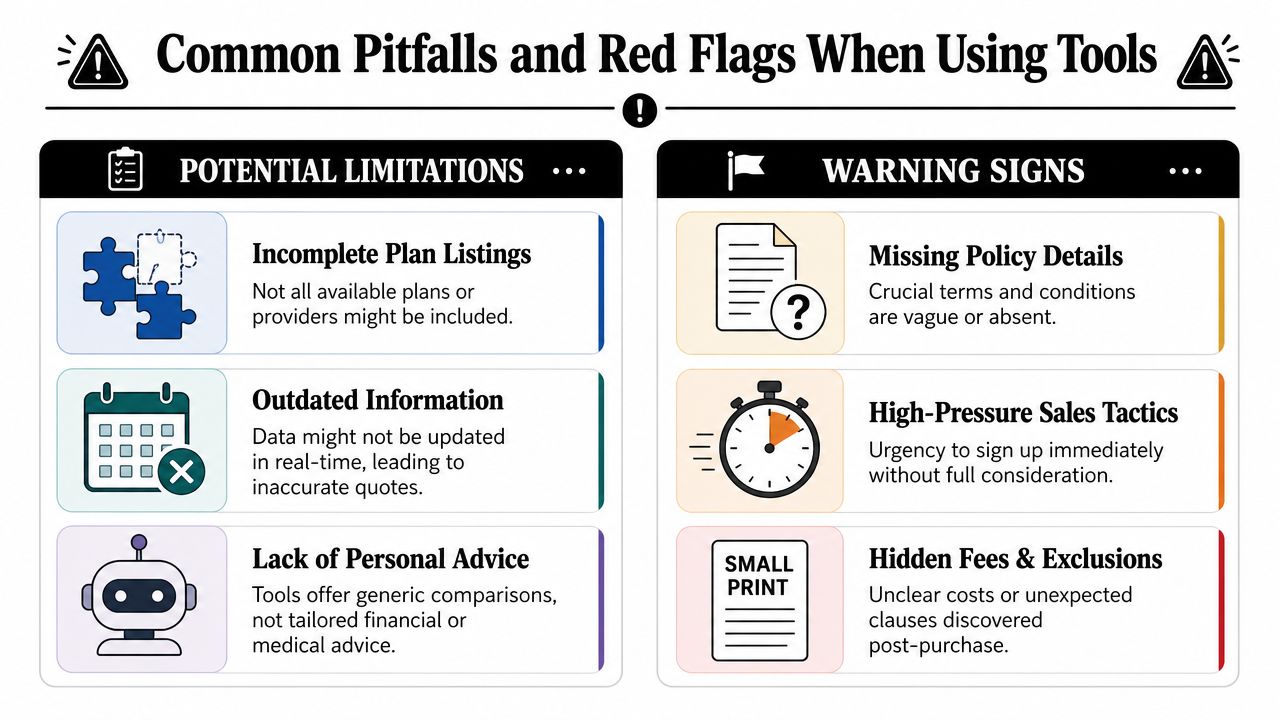
People trust comparison tools too quickly because the interface feels neutral. It isn't always neutral. Some tools are excellent. Some are thin marketing pages with just enough data to create false confidence.
The biggest technical problem is simple. Best-practice comparison tools use actuarial data to estimate total annual cost, not just premiums. Many free tools don't do that, which means they fail to show how a lower-premium plan can produce a higher total cost because of the way benefits are structured (Checkbook best practices for health plan comparison tools).
The premium is not the total cost
This is the trap.
A quote may look attractive because the monthly figure is low. But if the plan relies on copays, approval bottlenecks, weaker networks, or more restrictive benefit design, the “cheap” option can become the frustrating one very quickly.
A better way to look at any tool result is to ask:
- What will I probably pay when I use this plan
- Which benefits trigger extra spending or delays
- What happens in a bad year, not just a quiet year
That mindset is far more useful than sorting by lowest monthly premium.
Signs the tool is serving the seller, not you
Some warning signs are easy to spot once you know them.
- Sponsored first, detail later: if the first results are glossy but the exclusions are hard to find, be cautious
- Tiny quote summaries: if “full cover” is doing all the work and the policy detail is missing, keep digging
- Pressure to buy fast: urgency is useful for sales teams, not for insurance decisions
- Weak local network information: a policy with poor practical access is not a good deal
A compliant-looking policy can still be a bad purchase if it's difficult to use where you live.
The hidden problem with “no copago”
Expats often assume no copago automatically means better value. Sometimes it does. Sometimes it just means you're paying more upfront for a plan whose practical value still depends on access, exclusions, and underwriting.
“No copay” removes one kind of friction. It does not remove all the others.
That's why a tool should help you identify plan type, but your final judgment should come from reading the actual conditions and checking how the insurer handles people like you.
When to Trust an Expert Over a Tool
A tool is strong at sorting. It is weak at judgement.
That becomes obvious in any case involving a pre-existing condition, advanced age, unusual visa timing, or a family where each person needs something different. The comparison screen may still show options, but the options are often incomplete, misleading, or based on assumptions that break once the application goes to underwriting.
The biggest gap is medical complexity. Checkbook Health notes that most health plan comparison tools fail to provide personalized out-of-pocket cost estimates for users with serious pre-existing conditions like cancer or diabetes, which creates a serious problem for expats and retirees who need specific cover and often need specialist guidance (Checkbook Health observations on plan comparison limitations).
Cases where automation falls short
These are the situations where relying only on a health plan comparison tool is risky:
- You have a serious pre-existing condition: the tool may collect your profile, but it usually won't model the practical underwriting outcome
- You're older and need robust long-term cover: age changes what's available and how conditions are handled
- You need visa-safe documentation fast: timing, wording, and insurer responsiveness matter as much as the product
- You're buying for a couple or family: one plan may suit one person and be poor for another
A screen can't negotiate nuance. It can only display what it has been programmed to display.
What human guidance changes
An experienced broker or adviser does three things a tool cannot do well.
First, they challenge the assumptions behind the quote. They ask whether the policy is suitable for your exact legal and medical situation, not just whether it appears on a comparison page.
Second, they handle the communication loop. That matters when underwriting questions come back, when documents need clarification, or when an insurer's wording is technically correct but practically unhelpful.
Third, they reduce avoidable mistakes. If you want a plain-English overview of that role, this explanation of what a health insurance broker does is a useful place to start.
Good guidance doesn't replace comparison. It turns comparison into a decision you can live with.
Real-World Scenarios and Your Final Checklist
Advice sticks better when you can see yourself in it. These are the kinds of situations that come up repeatedly with expats in Spain.
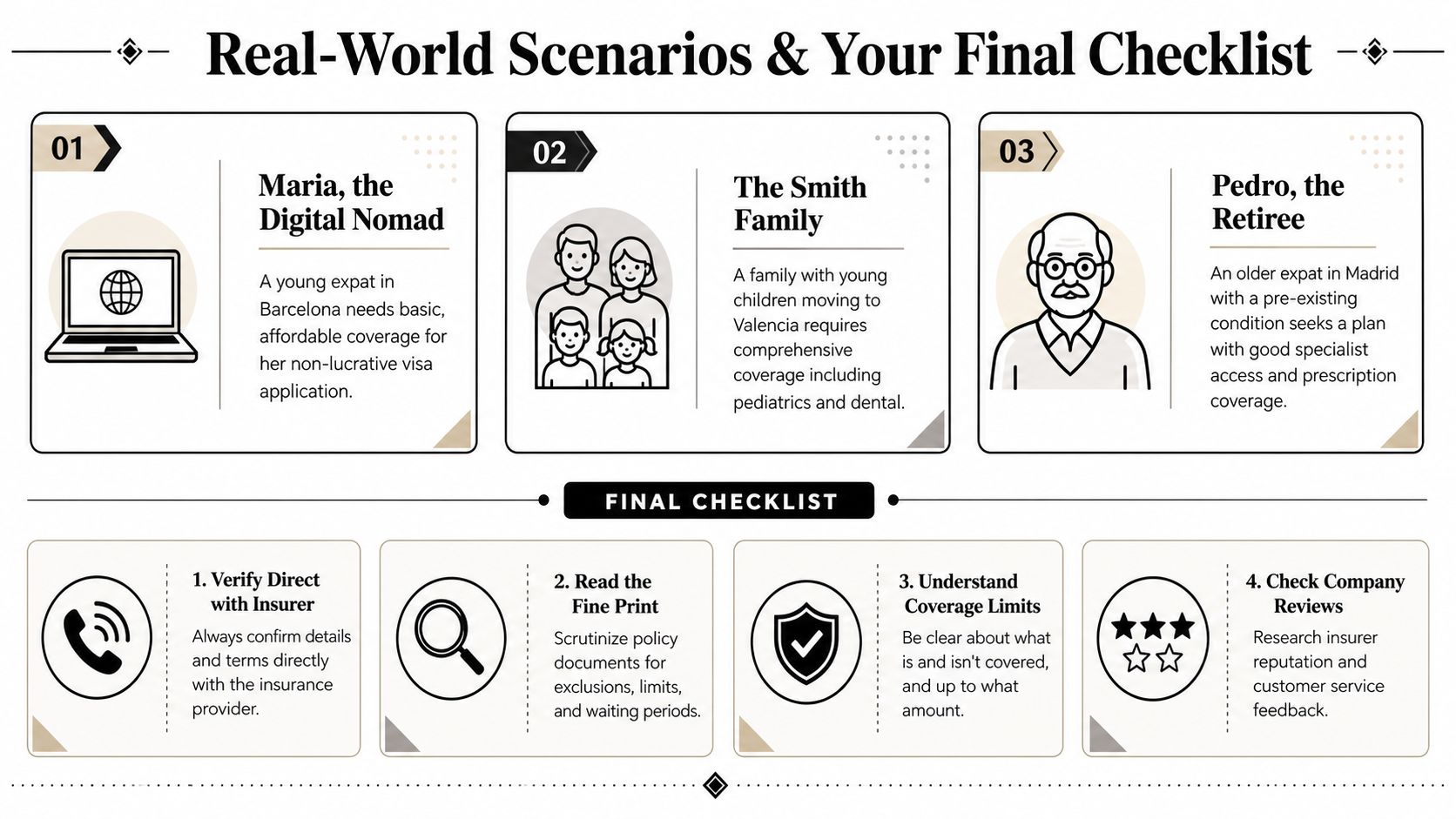
Three situations I see all the time
Maria, the digital worker relocating to Barcelona
Maria needs a plan quickly for residency paperwork. She starts with a comparison tool and sorts by lowest price. That gives her a shortlist, but the cheapest result turns out to be the wrong kind of policy for her purpose because the documentation and benefit structure don't match what she needs.
Her better move is to start with compliance filters, then compare only plans that fit that use.
John and Susan, retiring to the Costa del Sol
John is straightforward to insure. Susan has a history that needs careful disclosure. A generic tool treats them like one household profile and makes the options look simpler than they are. In reality, the decision depends on how each insurer will assess Susan's medical information and what exclusions might follow.
Their mistake would be assuming the couple quote on screen tells the whole story.
David, already in Spain and thinking of switching
David has insurance, but he rarely uses it and suspects he is overpaying. A comparison tool is perfect for this first step. It helps him see whether his current premium still looks competitive and whether equivalent plans exist. But before switching, he still has to inspect waiting periods, continuity issues, and hospital access near home.
Your final checklist
Before you buy, run through this list:
- Verify with the insurer directly: confirm the policy wording, start date, and key conditions
- Read the exclusions carefully: especially anything linked to pre-existing conditions or specialist care
- Check the local network: a broad national list means little if your area has weak options
- Match the policy to the reason you're buying it: visa compliance, family use, retiree access, or regular specialist care
A comparison tool helps you narrow. It does not remove the need to verify.
Your Smart Path to the Right Health Plan in Spain
The smart use of a health plan comparison tool is simple. Use it to understand the market, narrow the field, and spot pricing or plan structure differences quickly. Don't use it as the final judge of visa compliance, pre-existing condition handling, retiree suitability, or practical access in your part of Spain.
For straightforward cases, a good tool can save time and help you avoid overpaying. For anything with medical complexity, age-related restrictions, or immigration pressure, human review matters. That's where expensive mistakes usually happen, and where careful guidance earns its keep.
If you approach the process in that order, first compare, then verify, then apply, you'll make a much calmer and more reliable decision.
If you want help comparing Spanish health insurance properly, Bsure Health Brokers can guide you through the options, explain the small print in plain English, and help you find cover that fits your visa, budget, age, and medical situation without the usual confusion.