
You've found a policy, the price looks reasonable, and the insurer says it's full cover. Your visa appointment is approaching, but the certificate doesn't clearly say whether there are waiting periods, whether your partner is insured, or whether the cover is valid for your particular Spanish visa.
That's the point to stop and check. Choosing health insurance for a visa application starts with the visa route, not the premium. A policy can be suitable for a short visit and unsuitable for residence, while an appropriate policy can still create problems if its certificate leaves the consulate guessing.
Table of Contents
- Spain Visa Health Insurance Requirements by Route
- Choosing a Policy and Building Your Certificate
- Real Cases for Retirees, Students and Families
- Pitfalls That Get Applications Rejected
- Confirm Your Policy Matches Your Visa Before You File
Spain Visa Health Insurance Requirements by Route
Which policy does your visa route need? Start with the distinction between Schengen travel medical insurance and insurance used to support a Spanish residence application. They aren't interchangeable.
Minimum health insurance requirements by visa route
| Visa route | Policy type | Minimum cover | Validity | Travel insurance accepted |
|---|---|---|---|---|
| Schengen short stay, including visits, tourism and business | Travel medical insurance | Emergency treatment, hospital care and repatriation, subject to the minimum below | Entire intended stay across all Schengen states | Yes, if compliant |
| Non-lucrative residence | Comprehensive private health policy from an insurer authorised in Spain | Full expense coverage equivalent to the required public-system risks, without cost-sharing, waiting periods or monetary limits | Full initial authorisation period | No |
| Work residence | Confirm the applicable insurance or healthcare evidence with your responsible Spanish consulate | Obtain the route-specific benefit requirements | Obtain the required coverage dates | Obtain written confirmation before purchase |
| Student residence | Confirm the policy required for your precise study authorisation | Obtain the study-route coverage requirements | Confirm the period the certificate must cover | Obtain written confirmation before purchase |
| Family residence | Confirm the evidence required for your particular family route | Obtain requirements for each accompanying applicant | Confirm the required period for all beneficiaries | Obtain written confirmation before purchase |
| Digital nomad residence | Confirm the accepted healthcare or insurance evidence for your circumstances | Obtain the applicable coverage requirements | Confirm the required start date and duration | Obtain written confirmation before purchase |
Short visits need Schengen-wide protection
For short-stay applications, Spain's consular Schengen guidance requires at least €30,000 for urgent healthcare, emergency hospital treatment and repatriation for medical reasons or death, valid throughout the participating Schengen states for the entire stay. The amount is a minimum liability threshold, not an estimate of what your treatment will cost.
A policy described as European travel insurance still needs documentary scrutiny. Its certificate must establish the territory, dates and medical benefits, rather than relying on the product name.
If you're still determining whether your trip requires a visa, you can check Spain visa requirements with HeyLocals. Use that as an orientation tool, then obtain the insurance checklist for the application you'll submit.
Residence requires a route-specific answer
Non-lucrative applicants need genuine private medical insurance, not a travel product with a larger emergency limit. The practical distinction is full healthcare during residence rather than protection principally designed for an unexpected emergency abroad. The non-lucrative visa health insurance guide provides additional context for that route.
For work, student, family and digital nomad applications, contact the visa section of the Spanish consulate responsible for your place of legal residence. That is the relevant office to name in your enquiry, not whichever consulate has the easiest checklist to find online. Without your place of residence, naming a particular city's consulate would risk directing you to the wrong authority.
Send the exact visa category and explain whether you're applying alone or with dependants. Ask which healthcare evidence is accepted and what period it must cover.
Buying rule: Match your application to its route before comparing quotes. A cheaper policy in the wrong category isn't a saving.
The routes requiring confirmation aren't permission to buy a generic residence policy and hope. Once the consulate identifies the applicable standard, the certificate must still demonstrate compliance in its wording and supporting documents.
Choosing a Policy and Building Your Certificate
| Check | Spanish insurer policy | International insurer policy | Verify before buying |
|---|---|---|---|
| Insurer authorised to operate in Spain | Confirm the issuing legal entity, even for a familiar brand | International availability doesn't establish Spanish authorisation | Check the relevant Spanish insurance-register records |
| Claims settled directly with providers | Network-based treatment may offer direct settlement | May combine direct billing with reimbursement | Obtain the settlement arrangements in writing |
| Reimbursement-based cover accepted | A Spanish brand doesn't make reimbursement acceptable | Worldwide benefits don't establish visa acceptance | Confirm acceptance for your route, particularly non-lucrative residence |
| Wording in Spanish or sworn translation | Request the actual Spanish certificate before filing | Request Spanish documentation or establish translation needs | Arrange an official or sworn translation where required |
National and international policies on consulate checks should be compared at product level, not by brand nationality. A Spanish insurer can sell products with different copayments and waiting periods. An international insurer can offer extensive medical benefits without issuing the evidence your consulate requires.
The Spanish Consulate in Los Angeles' non-lucrative visa instructions require an authorised insurer, coverage equivalent to the specified Spanish public-system risks, 100% of medical, hospital and outpatient expenses, and no deductible, copayment, waiting period or coverage limit. Those instructions also establish an important documentary distinction: an insurance card isn't accepted, and the policy must be in Spanish or accompanied by the required official or sworn translation.
Compare practical access, not just acceptance
A Spanish medical-network policy may be a straightforward option if you intend to receive routine treatment near your Spanish home. Check the hospitals, specialists and outpatient facilities you'd use. Visa compliance won't make an inconvenient provider network more useful.
An international policy can be attractive if you divide your life between countries or want cross-border treatment options. The trade-off is that broader geographic benefits don't necessarily solve Spanish authorisation, reimbursement or certificate-wording issues. Don't pay for worldwide flexibility until you know the product is acceptable for the application.
Direct settlement and reimbursement are different arrangements. With direct settlement, the insurer pays participating providers under its arrangements. With reimbursement, you may have to pay and claim the money back, subject to the policy terms.
For a non-lucrative application, don't assume a reimbursement product qualifies because it promises generous benefits. At Bsure Health Brokers, we ask clients key questions to identify the most suitable policy, including how they expect to use healthcare and what evidence their application needs.
Build the documentary file in the right order
Confirm the exact route and responsible consulate.
Save the current checklist with your application documents. If the wording is unclear, send a focused question quoting the relevant requirement and naming your proposed policy. Ask whether the attached terms satisfy that requirement, rather than asking whether the insurer is generally accepted.Identify the insurer behind the product.
Check the issuing legal entity against the relevant Spanish insurance-register records. A broker's trading name, an international assistance company and the actual underwriting insurer aren't necessarily the same entity. Keep the insurer's formal name consistent across the quotation, policy and certificate.Buy the correct category of cover.
For non-lucrative residence, use genuine private medical insurance rather than travel insurance. For other residence routes, settle any uncertainty about accepted private cover or alternative healthcare evidence before purchasing. An emergency-only product shouldn't be treated as equivalent to ongoing healthcare without explicit confirmation.Make every beneficiary identifiable.
Ensure each applicant appears as an insured person, including a partner and children. The person paying the premium may be the policyholder without every family member being insured. Compare names with passports and resolve discrepancies before documents go to translation.Set the policy period against the application.
The Spanish Consulate in Montreal's non-lucrative guidance supports coverage for the full initial authorisation period, commonly one year, together with medical, hospital and out-of-hospital benefits. Ask for explicit start and end dates rather than leaving the consulate to interpret an annual-renewal description.Request an explicit certificate.
For the non-lucrative standard, the document should establish full medical, hospital and outpatient cover, with no deductibles, copayments, waiting periods or monetary coverage limits. Read the schedule and endorsements too. A certificate shouldn't promise broader benefits than the binding policy truly provides.Arrange the required Spanish documentation early.
Establish whether the insurer can issue suitable Spanish wording or whether an official or sworn translation is needed. Translate the final documents, not a draft that may change after underwriting. Keep the original and translated versions together so the application reviewer can identify what corresponds to what.Audit the certificate against the checklist.
Put the consular requirements beside the certificate and mark the wording that answers each requirement. If you can't identify the supporting text, request clarification or a corrected document. Don't write missing insurance terms onto the certificate yourself.
Resolve timing and medical questions before payment
Ask the consulate for its current processing information in writing, then work backwards from your intended travel date. Allow room for underwriting questions, corrected documents and translation. Don't assume that paying the premium means the final certificate is immediately ready.
Disclose medical history accurately during the application process. If an insurer proposes an exclusion or special condition, establish both what it means for treatment and whether it conflicts with the visa requirements. A certificate's broad description doesn't erase a restrictive endorsement.
The Spanish visa medical certificate guide is also useful for distinguishing the separate medical-certificate paperwork from insurance evidence. A doctor's certificate and an insurer's certificate serve different purposes, so don't let similar terminology cause a missing document.
The certificate should prove the contract you bought, not improve it on paper.
Before committing, obtain the cancellation and amendment terms as well. You need to know what happens if travel dates change, the application takes longer than expected, or the insurer must reissue documents. Don't assume a visa refusal automatically triggers a refund.
Real Cases for Retirees, Students and Families
Consider these hypothetical applicants. Each starts with a reasonable purchase idea, but the application route changes what counts as suitable evidence.
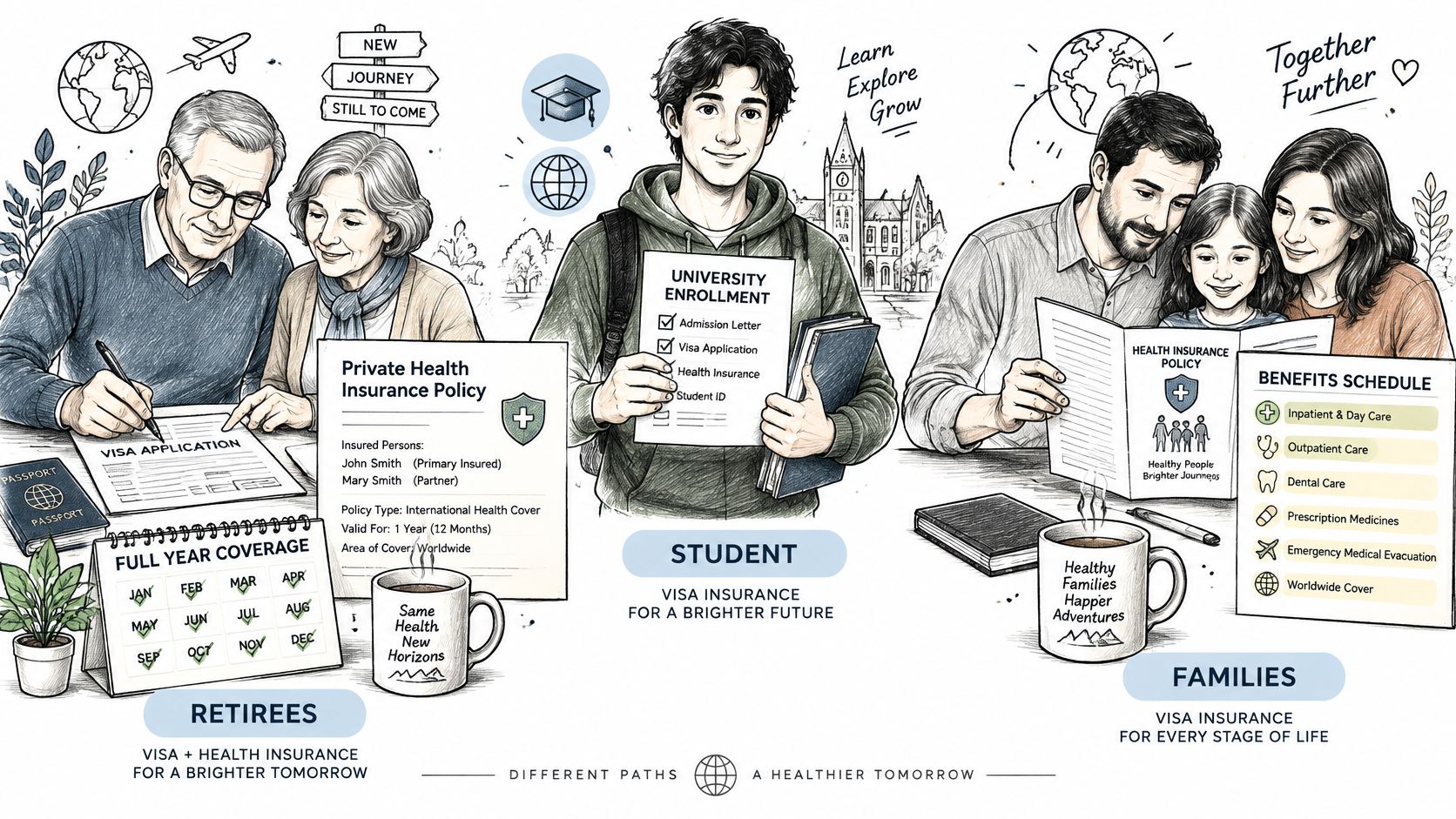
The retired couple choosing non-lucrative residence
A retired couple chooses a joint private policy and assumes the payment receipt proves they're both covered. Their draft paperwork, however, identifies only the partner who arranged payment.
The fix is to obtain evidence showing both as insured beneficiaries before submitting their separate applications. They also resolve a mismatch between the sales summary and the policy's waiting-period endorsement. Shared payment doesn't establish shared insurance, and attractive benefits don't cancel a restrictive condition.
Their decision isn't only whether the premium is affordable. They need a contract suitable for residence and documents that accurately demonstrate each person's protection.
The student attending a short course
A student accepted onto a short course nearly buys a residence-oriented policy because the trip is for education. After confirming that the application is a short-stay Schengen application, the student chooses the relevant travel medical product instead.
The European Commission's Schengen visa material describes short-stay travel medical insurance with a minimum EUR 30,000 benefit for emergency treatment, hospitalisation and medically necessary repatriation, covering the intended stay across Schengen member states. That threshold belongs to the short-stay framework, not a general test for Spanish residence insurance.
The student adjusts the start date so there's no uninsured arrival day. The important lesson is that being a student doesn't, by itself, identify the insurance category. Someone pursuing a residence-based study authorisation must obtain that route's requirements instead; the international student health insurance guide can help frame the questions.
The family travelling together
A family buys cover through a parent's account and receives documents in separate emails. A child's endorsement has a different effective date from the rest of the household.
They assemble the documents by applicant rather than by email, making the discrepancy visible. The correction is straightforward before filing, but leaving it unresolved would force the reviewer to question that child's coverage.
For work, digital nomad and other family-related routes, confirm the applicable requirements with the responsible consulate. Don't copy another household's insurance arrangement unless the visa category and relevant circumstances match.
Which applicant resembles your situation? Identify the corresponding route-table row, then decide whether you have a settled requirement or still need a consular answer before buying.
Pitfalls That Get Applications Rejected
A high coverage limit doesn't guarantee that insurance evidence will be accepted. The consulate evaluates whether the documents satisfy the applicable conditions, not whether the policy sounds generous.
The Spanish Consulate in Washington's Schengen instructions require insurance for the whole intended stay and Schengen area; for multiple-entry applications, coverage must include at least the first planned trip, with an undertaking to insure later journeys. That final distinction matters: covering the first journey isn't defective, but treating it as protection for all future travel is.
Common pitfalls and how to fix them before filing
| Pitfall | Why It Fails | Fix Before Filing |
|---|---|---|
| Insurance card submitted instead of a certificate | A card doesn't demonstrate the required terms and isn't accepted under the cited non-lucrative instructions | Obtain the required policy evidence and certificate, with Spanish documentation or the required translation |
| Reimbursement-based policy on a non-lucrative residence file | The payment arrangement may not satisfy the required direct private cover | Resolve acceptance in writing or replace it with compliant cover |
| Copayment or deductible in the schedule | The non-lucrative standard excludes this cost-sharing | Select a compliant version of the product, not merely a revised sales summary |
| Waiting period in the fine print | Required benefits may not apply when cover begins | Obtain binding confirmation that the relevant waiting periods don't apply |
| Policy starts after arrival or ends early | Part of the declared stay lacks required protection | Correct the effective period before submission |
| Cover limited to Spain | Spain-only territory doesn't satisfy Schengen-wide short-stay requirements | Obtain the required territorial wording |
| Repatriation missing from Schengen wording | A required short-stay benefit hasn't been demonstrated | Obtain explicit evidence of the applicable repatriation protection |
| Multiple-entry visa with only the first trip covered | First-trip insurance doesn't remove the undertaking to insure future journeys | Cover the first trip and undertake to arrange cover for later journeys |
Separate a paperwork defect from a policy defect
A missing sentence and an excluded benefit aren't the same problem. If the contract includes the required protection but the certificate omits it, the insurer may be able to issue clearer evidence. If the contract excludes the protection, a better-looking certificate won't make the product compliant.
That distinction should guide your response to a request for further documents. Don't send another copy of the same insurance card or a marketing brochure. Establish precisely what the reviewer couldn't verify and supply evidence that answers it.
Before filing: Correct the contract when the cover is wrong. Correct the certificate when the evidence is incomplete.
Don't treat these pitfalls as a ranking of refusal frequency. Each is a concrete compliance risk, but the result depends on the relevant route, binding terms and consular assessment. If a row describes your policy, resolve it before submission rather than relying on the reviewer to interpret it favourably.
Confirm Your Policy Matches Your Visa Before You File
The buying decision is complete only when the insurance and its documentary evidence fit the application. A low premium, a familiar insurer or a reassuring sales email can't replace that match.
Final check: Use the pitfalls table to confirm the route, relevant insurer authorisation, required benefits, coverage dates, named applicants and translation readiness.
For the rest of your application bundle, the My Global Trips visa checklist can help organise supporting documents. Keep the responsible Spanish consulate's route-specific instructions as the controlling checklist, rather than treating a general travel checklist as an insurance acceptance decision.
Get help where the choice is genuinely difficult
Pre-existing conditions, ongoing medication, older-age underwriting or an unclear visa route deserve attention before you commit to a policy. A broker can compare the relevant options and help distinguish a medical exclusion from an administrative problem. Neither should be hidden beneath a generic label.
At Bsure Health Brokers, we're an independent Spanish brokerage, and we find health insurance plans that meet Residency-Visa requirements. We ask key questions about your circumstances to narrow the options, rather than starting with an unexplained product recommendation.
A policy that looks comprehensive can still fail the documentary test if the certificate doesn't demonstrate the required cover.
We handle policy setup and paperwork, but you should still check the final certificate against the pitfalls table before filing. You know who is applying, what dates you've declared and which route appears on your application. Those details need to match the documents you submit.
Gather your exact visa category, the responsible consulate's checklist, passport details and validity dates, intended travel dates, and relevant medical information. Having those ready makes a quote more useful and helps identify unanswered questions before you pay.
Bsure Health Brokers helps applicants find health insurance that meets Residency-Visa requirements and supports the policy paperwork. Visit Bsure Health Brokers with your visa route, passport details and intended travel dates to request a no-obligation quote.