
For Spain in 2025, budget about €46 a month for basic private cover, about €74 for full cover and about €125 for people over 55, after premiums rose around 19% during 2025, and if you need no-copay visa cover, treat €125 as a floor, not a quote. That is the short answer on health insurance for early retirees cost, but it hides the question that catches many out.
If the average is €46, why does a healthy 61-year-old get told to pay well over €125, and why can the cheaper policy be refused at a consulate? Because the average mixes young local buyers, copay plans and thin hospital lists with the very different policy an early retiree often needs. The price you'll really pay is the visa-compliant, renewable premium after underwriting. Everything below builds toward that figure, step by step.
Table of Contents
- Monthly Prices Early Retirees Should Budget
- What Pushes an Early Retiree Premium Up
- Visa Rules That Raise the Real Cost
- Three Early Retiree Cost Pictures
- Ways to Lower the Premium Safely
- Checklist Before You Accept a Quote
- Request a No-Fee Quote Before You Apply
Monthly Prices Early Retirees Should Budget
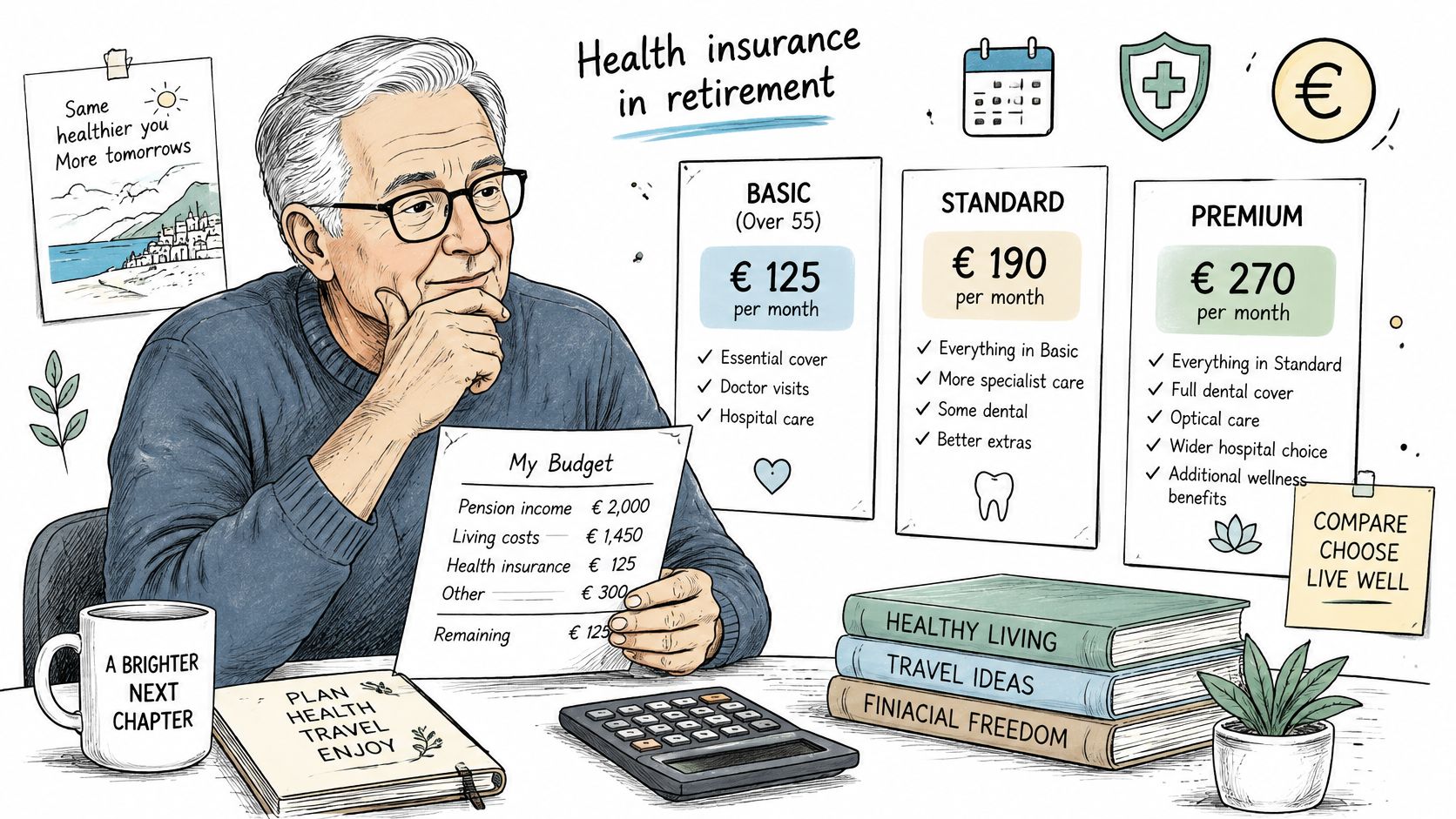
Start with the only published anchors you have before a personal quote. The ThinkSpain guide to private health insurance costs in Spain reports 2025 averages of approximately €46 per month for basic private cover and €74 for full cover, while policies for people over 55 averaged about €125 per month, and premiums reportedly rose around 19% during 2025. Read those as market averages, not promises for your age, province or medical history.
Spanish private cover averages for early-retiree planning
| Plan type | Typical monthly figure | Who it usually fits | Limit for an early retiree |
|---|---|---|---|
| Basic private cover | About €46 | Light local cover | Often has copays and may fail a visa |
| Comprehensive private cover | About €74 | Standard outpatient and hospital | Still may include copays and waiting periods |
| Policies for people over 55 | About €125 | Early retirees 55 and older | Age loading; acceptance is not guaranteed |
| Visa-style no-copay full cover | Above local averages | Non-lucrative and residency applicants | Must usually have no excess and include repatriation |
| Cover with a declared condition | Above local averages | Diabetes, cancer history, hypertension | May be loaded, excluded or declined |
| International portable plan | Above local averages | Retirees who travel often | Can cost more than a Spain-only residency policy |
Why the cheapest row rarely fits you
If you're retiring between roughly 55 and 74 and moving to Spain, you're usually buying primary private cover for your first period here. Public healthcare and the Convenio Especial aren't available on day one for most new arrivals, so you can't price your landing year as if they were. That alone pushes you away from light local cover.
Basic cover looks cheap because it shares costs back to you. Copayments, called copagos, mean you pay a fee each time you see a doctor, have a test or use a service. An excess works in a similar way, and waiting periods delay access to parts of the cover. Any of those features can make a policy unsuitable for a residency application, even if the monthly number looks attractive.
Planning floor: Use about €125 a month per person as your starting line if you're over 55, then expect the bill to move with age, region and medical history.
Don't treat the table above the €125 line as a shortlist. Treat it as context. A no-copay residency policy, cover after you've declared diabetes or prior cancer, and an international plan don't have a single published euro figure in that table because the insurer sets the price after it sees your details. Marking them as above the local averages is more honest than inventing a quote.
You can test how age and cover level change the starting point with a health insurance premium calculator for Spain, but a calculator can't underwrite you. It won't tell you if a condition will be excluded, if renewal stops at a set birthday, or if the hospitals near your new home are in network. Those answers come from a written quote, and they're what turn an average into a usable budget.
What Pushes an Early Retiree Premium Up
Think of your premium as a stack, not a single age number. Insurers add layers for age, health, cover level, cost sharing and place. Remove a layer and the price falls, but sometimes the policy stops working for the reason you bought it.
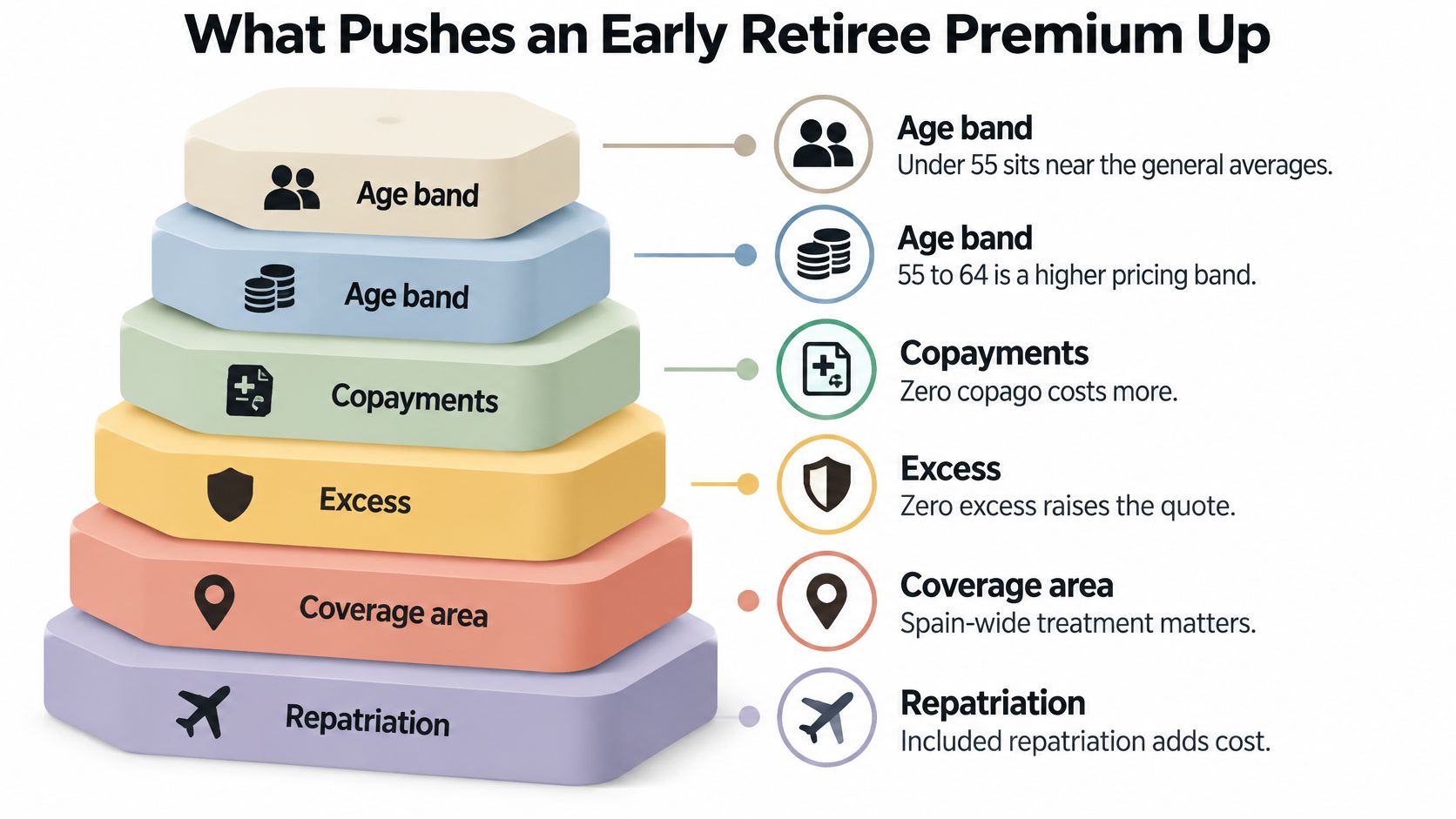
Cost drivers for early retirees in Spain
| Cost driver | How it changes the premium | What to check |
|---|---|---|
| Age band | Rises after 55 and again toward 65-75 | Maximum age for new business and renewal |
| Medical underwriting | Can load, exclude or decline | Full honest questionnaire |
| Pre-existing conditions | Cancer, diabetes or hypertension may be excluded or loaded | Moratorium versus full medical underwriting |
| Cover level | Hospital-only is cheaper than full outpatient | Whether specialists and tests are included |
| Excess or copay | A higher excess lowers the premium | Whether the policy is zero copago |
| Region | Madrid, Barcelona, Costa del Sol and islands often cost more | Hospitals you would actually use |
Age bands work in steps
Under 55, many buyers sit closer to the general averages. From 55 to 64, the over-55 figure becomes your useful floor because you're in a higher pricing band. From 65 to 70, insurers often add a further loading, and choice narrows. From 70 to 75, some insurers stop taking new applicants or stop renewing, so the question changes from price to availability.
That last point confuses people. A quote at 71 is not just a higher quote at 61. It may come with a renewal age that ends cover a few years later, right when you value it most. Always ask for two ages in writing, the last age for joining and the last age for renewal.
Health answers change the result
Most applicants complete a medical questionnaire. The insurer can accept you at standard rates, add a loading (a percentage increase), exclude a body system or condition, or decline. Prior cancer, diabetes, high blood pressure and several medicines taken together aren't an automatic refusal, but they aren't a guaranteed acceptance either. Each file is negotiated on its facts.
Honesty matters here. If you don't declare a condition and later claim for it, the insurer can dispute the claim. Our guide to health insurance with pre-existing conditions in Spain explains how declarations are handled, and you should read the exclusion wording before you pay. A lower premium that excludes the condition you have isn't cheaper in any useful sense.
Cover level, copays and place
Hospital-only cover looks lean because it leaves out much of what retirees use week to week, such as specialists, scans and outpatient tests. Full cover costs more because you'll use it more. Copays and an excess pull the sticker price down by moving cost to the day you need care, and zero copago costs more for the opposite reason. Region adds the final layer. Private hospitals in Madrid, Barcelona, busy parts of the Costa del Sol and the islands commonly sit in dearer networks than inland provinces, so the same person can pay more after choosing a coastal city address.
If you're comparing this with a United States retirement budget, healthcare budgeting for federal retirees from Federal Benefits Sherpa is a useful reminder to budget healthcare as its own line rather than burying it in general living costs. In Spain, that line is set by the six layers above, and some of them can't be stripped out if a visa is involved.
Visa Rules That Raise the Real Cost
A residency or non-lucrative visa doesn't give you a discount. It filters the market. Consulates commonly want private cover with no copayments, no excess, treatment across Spain and repatriation of remains, so many low-priced local policies are the wrong product from the start.
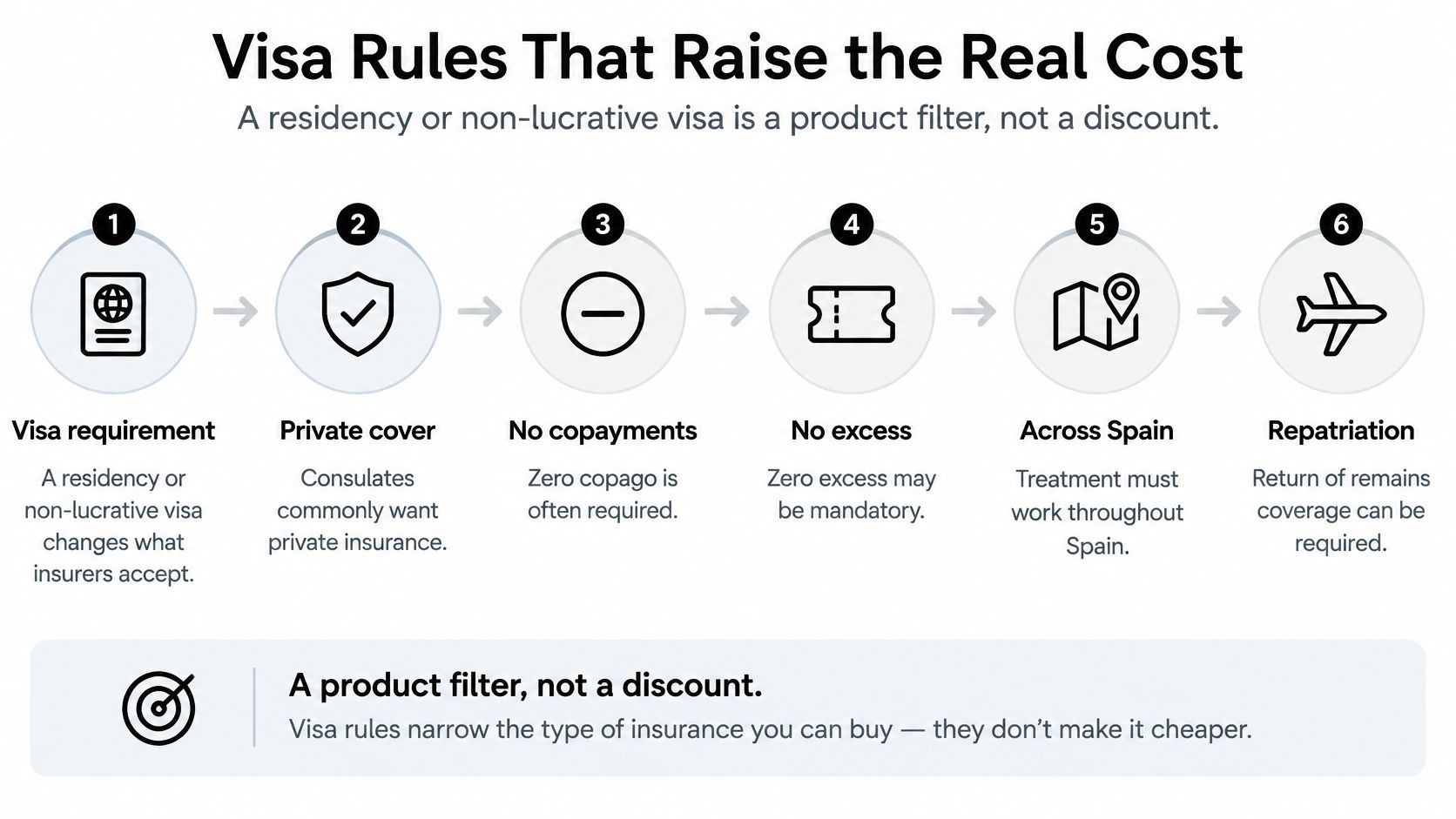
Clauses your certificate usually has to show
- Zero copago: You don't pay a fee per visit, test or treatment under the policy terms.
- Zero excess: The insurer doesn't ask you to pay the first slice of a claim before cover starts.
- Spain-wide treatment: Cover works across Spain, not only in one town or through a very short hospital list.
- Repatriation: Return of remains is included, a clause often missing from basic local cover.
Visa clauses that change the premium
| Requirement | Effect on cost | What usually fails |
|---|---|---|
| No copayments | Removes cheap basic cover from the shortlist | About €46 basic cover with copays |
| No excess | A higher excess cuts the sticker price but can fail the visa | Policies sold with an excess |
| Spain-wide treatment | A thin local network is not enough | Cover limited to one town or a short hospital list |
| Repatriation of remains | Often missing on a low local premium | Basic private cover |
| Waiting period | About three to six months of cash fees for specialists, tests and surgery | A policy that will not waive carencias |
| GHIC, EHIC or travel cover | Does not replace private residency insurance | Using them as the visa policy |
| Convenio Especial | Cannot price the landing year | Assuming it is available on arrival |
| Name and dates | A mismatch delays the visa or NIE file | A certificate in a different name |
Travel insurance isn't residency insurance. A GHIC or UK EHIC doesn't replace the private policy a consulate asks for either. They're useful for visitors, but they don't prove you have thorough private cover as a resident.
Waiting periods, called carencias, are the quiet cost. A policy may delay specialists, complex tests and surgery for a set period after the start date. Unless you buy a zero-waiting option or a new insurer recognises carencias you've already served with a previous Spanish insurer, you could pay cash during those first months. Private speed is part of why people buy cover, but public waiting times don't turn public cover into a visa substitute.
The Convenio Especial is a later option after a period of legal residency, commonly discussed after the first year. It can't price your arrival year. Your NIE paperwork and insurance certificate also need to match your name and dates exactly, because a small mismatch can delay a file.
We find health insurance plans that meet Residency-Visa requirements, we offer Insurance For Residence, and we help people who need health cover for a Visa or NIE. The detailed requirements are set out in the non-lucrative visa health insurance guide for Spanish residency compliance. Stripping out copays, excess and waiting periods is what lifts a compliant premium above the headline average.
Three Early Retiree Cost Pictures
Averages become useful when you apply them to a person, a place and a health record. These three pictures don't invent personal quotations. They show how the over-55 planning floor moves once real life is added.
Three early retiree budgets from the over-55 floor
| Profile | Planning figure | What moves the bill |
|---|---|---|
| Healthy couple around 60, Costa del Sol, non-lucrative visa | About €125 each, then above that floor | Coastal network, zero copay, zero waiting; couple discount is the lever down |
| Single resident aged 67 in Madrid with managed high blood pressure | Above €125 | Age and capital network; a stable declared condition may add a loading |
| Applicant aged 72 with prior cancer needing renewal past 75 | Above €125, if cover is offered | Acceptance, any exclusion for the history, and the maximum renewal age |
A healthy couple around 60 on the Costa del Sol
Say a couple are both around 60, in good health, and applying for a non-lucrative visa to live on the Costa del Sol. Their age puts them at the over-55 floor, about €125 per person as a planning start. The visa then moves them above that floor because they need a zero-copay certificate, and they'd be wise to avoid restarting waiting periods if they want cover they can use soon after arrival.
The coastal hospital network also points up. Their main lever down isn't adding copays they aren't allowed to have. It's asking whether a couple or family arrangement prices better than two separate policies. Their budget question isn't whether they can find the basic average. It's how far above the floor the compliant version lands.
A single resident aged 67 in Madrid
Now take a single resident aged 67 in Madrid with managed high blood pressure. Age points up from the floor, and the capital's hospital network points up again. The declared condition doesn't automatically end the conversation. If it's stable and controlled, an insurer may accept with a loading rather than refuse, but the result must be confirmed in writing.
For this person, outpatient cover matters. Blood pressure care involves reviews, tests and specialists, so a hospital-only saving could leave routine costs in cash. The useful comparison is between full-cover quotes that state the loading plainly.
An applicant aged 72 with prior cancer
For a 72-year-old with prior cancer who needs renewal past 75, the basic and average figures are the least useful on the page. The cost depends on whether an insurer accepts the application, excludes conditions related to the history, or stops coverage at a birthday soon after joining. A cheap first year that cannot renew is a poor retirement plan.
We provide quotes for serious health preconditions and compare options from top insurers, and we arrange cover and give advice for prior cancer, diabetes, high blood pressure, and multiple conditions and medication. That specialised comparison is a negotiation, not a website dropdown. Customer Eric said Bsure has taken care of all his insurance for the past 12 years, and they are professional, independent, and responsive. In each picture, budget the compliant premium, not the basic row.
Ways to Lower the Premium Safely
You can lower health insurance for early retirees cost without breaking the rules that make the policy usable. The test for every tactic below is simple. Does it keep zero copago and zero excess where your visa needs them?
- Buy the compliant level first, then trim geography. Secure no-copay, no-excess cover, then drop a worldwide zone if you'll live in Spain all year. You keep the consulate clauses and stop paying for treatment areas you won't use.
- Choose Spain-only unless you travel often. Compare a national plan with an international plan only when regular travel makes portability worth paying for. For a settled resident, the local plan is usually the better residency price, provided you check the hospitals near home.
- Ask for a couple discount before you pay twice. Two separate over-55 premiums can add up quickly. When we choose a company, we consider family discounts, international cover, low wait times, and the cover required for residency in Spain, so ask for the joint price on the same quote sheet.
- Transfer waiting periods you've already served. If you already hold Spanish cover, we help people who already have cover to switch provider. Ask the new insurer to recognise carencias already served instead of restarting months of waits for specialists, tests and surgery. You save cash fees without weakening the certificate.
- Remove optional modules, not core protection. Don't lower the premium with a high excess or copago when your visa needs zero copago. Look instead at optional dental or wellness modules you didn't ask for and won't use.
- Pick the province with open eyes, then review at renewal. Madrid, Barcelona, the Costa del Sol and the islands price above many inland networks. You may still choose them for lifestyle or hospitals, but budget for it, and review the renewal rather than letting it roll forward unchecked.
A lower quote that excludes cancer, diabetes or hypertension you actually have is not a saving. It's a gap with a monthly payment attached.
An independent broker whose fee sits inside the insurer premium can shop compliant plans at the same price as buying direct. We state that we can save customers up to 40%, but the saving that matters is on a like-for-like policy. Compare the same hospitals, the same waiting periods and the same underwriting result, or the cheaper line is just a smaller product.
Checklist Before You Accept a Quote
Print two or three written quotes and mark them side by side. You're not looking for the lowest number first. You're looking for the lowest number that passes every tick your situation requires.
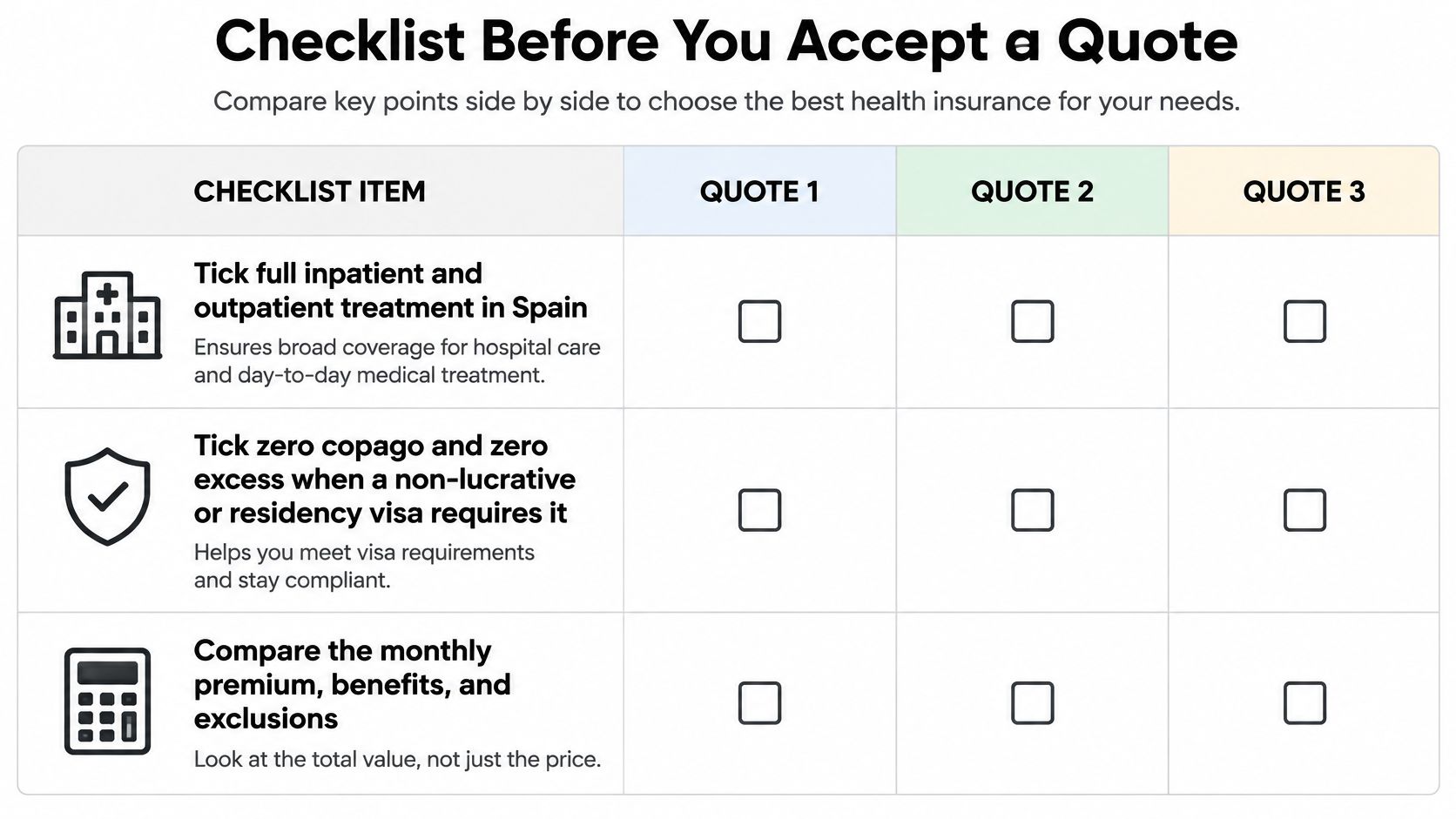
Nine ticks to mark on each PDF
- Full treatment in Spain: Tick inpatient and outpatient treatment, including specialists and tests you'll realistically use.
- Zero copago and zero excess: Tick both when a non-lucrative or residency visa is involved.
- Repatriation of remains: Tick it as included, not assumed.
- Your hospitals: Tick the hospitals near your town by name, not a national logo on the cover page.
- Waiting periods in days: Tick the wait for specialists, tests and surgery, and whether served carencias transfer from your current Spanish insurer.
- Underwriting result in writing: Tick standard rate, the loading percentage, a named exclusion, or a decline. Don't accept a verbal summary.
- Age limits: Tick the last age for new business and for renewal, especially if you're over 65 or approaching 75.
- Requested extras only: Tick dental, drugs and evacuation only if you asked for them, so a module isn't mistaken for core cover.
- Certificate details: Tick that the name and dates match your visa or NIE file exactly.
Put one line per insurer on a single sheet, with monthly price, any loading and renewal age side by side. Discard the cheapest line if it fails a tick. A low premium with the wrong hospital list or an exclusion for your main condition will cost you later, either in cash or in a delayed application.
We have access to the entire health insurance market and only use insurers we trust, we ask clients key questions to find the most suitable policy, and we have long-term relationships with the insurance providers we offer. We can collect those lines and discuss a loading with an insurer, but you should still mark the PDF yourself. When every surviving quote passes the ticks, price becomes a fair final test.
Request a No-Fee Quote Before You Apply
Once you know your visa date or renewal month, stop budgeting from averages. They're a starting map, not your bill. Four steps turn the planning floor into a personal figure you can act on.
- Send the four facts that set the price. Give your age, province, visa type if you have one, and declared conditions such as cancer, diabetes or high blood pressure. Without them, any number is a guess.
- Ask for one written comparison. Request policies that already meet no-copay, no-excess, Spain-wide treatment and repatriation rules where your application needs them. We offer a no obligation quote on request.
- Require the same fields on every line. Each option should show the monthly premium, any loading or exclusion, the waiting period in days, and the maximum renewal age. Missing fields hide the full cost.
- Bring your checklist ticks. Drop a cheap plan that fails a clause before the call ends, rather than discovering the problem at a consulate appointment.
We don't charge a fee because our service is included in the price of the policy, which is the same price as buying direct. Email healthcover@bsureinsurance.com with the four facts above, and keep the reply in writing. Get that compliant price confirmed before you pay a consulate fee or cancel an existing plan, so you're never left between policies.
If you're pricing early retirement in Spain, send us your age, province, visa type and any conditions to declare, and we'll return a written, no-obligation comparison of compliant plans that shows the premium, waiting periods and renewal age on each line. Visit Bsure Health Brokers to start that request before you book your consulate appointment or cancel cover you already hold.