
You've entered your details into a health insurance cost estimator, selected your Spanish postcode, and found a policy that appears affordable. The monthly premium looks manageable, so you start preparing your visa application or planning your move. Then the policy wording raises uncomfortable questions: does it include copayments, are your existing medical conditions accepted, will the insurer cover the hospitals you need, and does the certificate satisfy your visa requirements?
That gap between a displayed premium and your real annual healthcare cost is where many expats make expensive mistakes. An estimator is useful, but it's only a starting point. In Spain, age bands, medical history, regional networks, excesses, exclusions, and immigration requirements can change the practical value of a policy more than the headline price suggests.
Table of Contents
- Why Your Online Estimate Might Be Missing the Full Picture
- How a Health Insurance Cost Estimator Works
- The Factors That Shape Your Premium in Spain
- Using an Estimator Step by Step with Real Calculations
- Practical Ways to Lower Your Health Insurance Costs
- Where Online Estimators Fall Short and When to Call a Broker
- Your Next Steps to Smarter Health Insurance Decisions
Why Your Online Estimate Might Be Missing the Full Picture
An English-speaking couple relocating to Málaga compares two quotes in an online calculator. Policy A costs less each month and appears to offer similar access to private healthcare. They choose it before checking how the policy handles treatment and claims.
Several months later, one partner needs repeated specialist appointments and diagnostic tests. The policy applies copayments, excludes treatment connected with a declared condition, and requires an excess before certain benefits begin. The cheaper quote becomes the more expensive choice because the calculator displayed the premium, not the couple's total annual healthcare cost.

The monthly figure is only one part of the decision
Online calculators collect useful starting details, including age, location, household information, and the preferred level of cover. They rarely show how the policy performs after you use it repeatedly.
The couple's annual spending may include the premium, charges for appointments and tests, payments required before certain benefits begin, and treatment excluded because of a medical condition. A restricted hospital or specialist network can also create practical inconvenience or extra expense when the preferred provider is unavailable.
A low premium can work for a healthy person expecting little medical care. It may offer poor value for someone managing diabetes, needing regular specialist appointments, or wanting a wider choice of hospitals. Two people can receive the same online quote and face very different costs over the year.
Spain adds immigration and underwriting issues
Generic estimators also miss decisions that affect whether the policy works for an expat. A visa applicant may require private cover without copayments or gaps in essential treatment. Age bands can produce different quotes for an older applicant and a younger partner, even within the same household. A serious medical history may lead to an exclusion, a premium loading, a waiting period, or a refusal.
Visa compliance changes the calculation as well. A cheaper policy is not a useful result if its certificate or coverage terms fail the relevant immigration requirement. Check the wording before treating an estimate as a viable option.
Broker's rule: Never choose a Spanish policy from the monthly estimate alone. Read the cost-sharing terms and obtain written confirmation that the cover fits your immigration and medical situation.
Use an estimator to compare plausible options, then test each policy against the care you may need across a full year. Check the premium alongside exclusions, age-related pricing, medical underwriting, network access, and visa documentation. That is how you identify the likely cost of coverage, rather than accepting a headline figure that tells only part of the story.
How a Health Insurance Cost Estimator Works
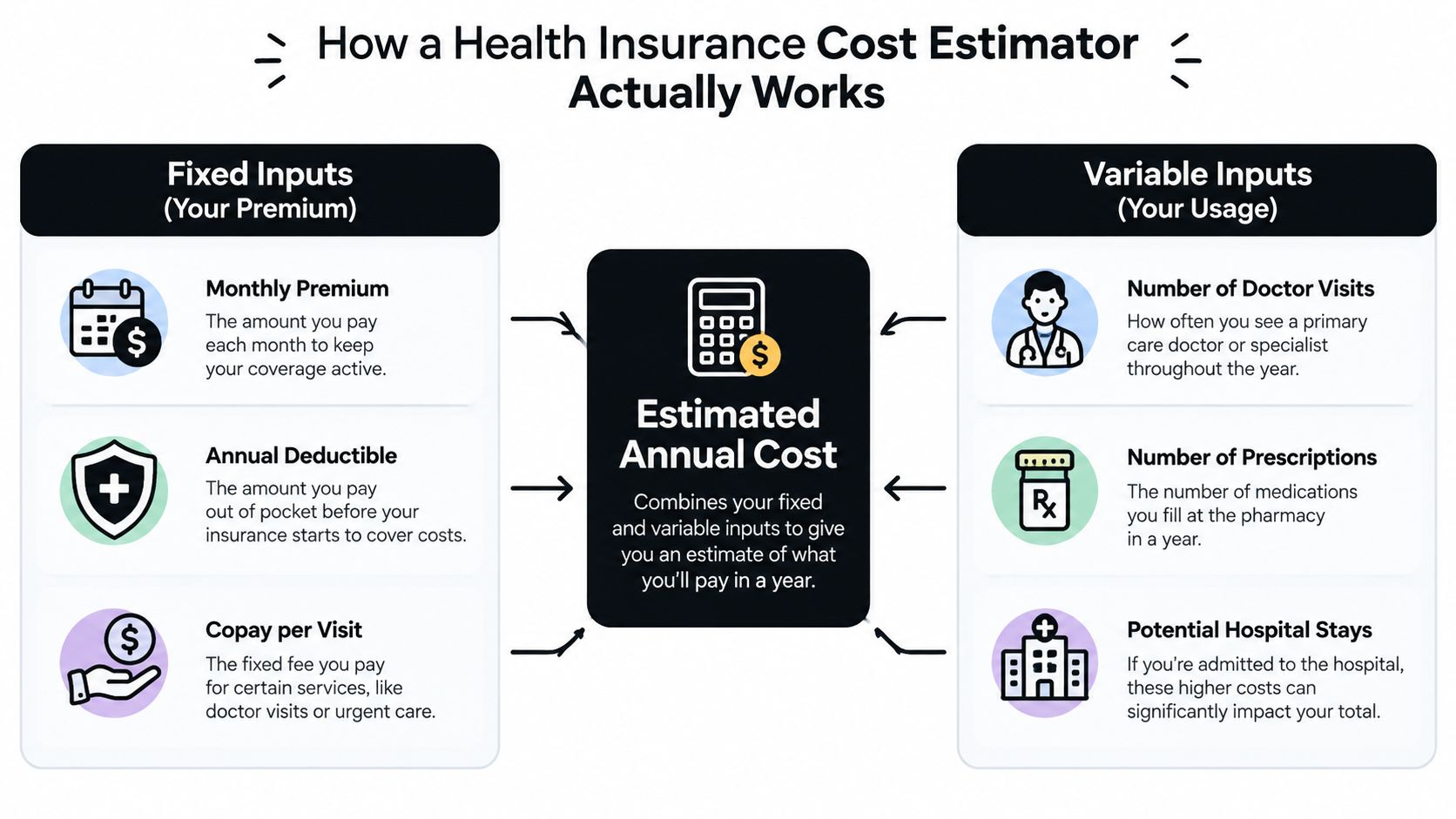
An online quote is only the starting point. A useful estimator separates fixed policy costs from variable healthcare usage, so you can see why two plans with similar premiums may produce very different annual bills.
Health cover works like a mobile phone contract. The base tariff is predictable, while calls, data, and roaming create usage charges. Your premium is the base cost. Visits, tests, prescriptions, hospital treatment, copayments, and excesses determine what you pay after using the policy. A calculator that ignores usage gives you the entry price, not the annual bill.
Start with the fixed inputs
Enter the figures that define the policy's financial structure:
- Monthly premium: Multiply the quoted monthly amount by the number of billing periods in the policy year.
- Annual deductible or excess: Check whether you contribute before the insurer pays for eligible care.
- Copay or coinsurance: Identify the charge attached to appointments, tests, prescriptions, or other services.
- Out-of-pocket maximum: Confirm whether the policy limits eligible personal spending during the year.
Then add expected usage. Doctor visits, laboratory work, prescriptions, imaging, and hospital stays belong on the variable side of the calculation. This health insurance calculator guide explains the same practical approach: estimate annual cost by combining the premium with expected out-of-pocket spending, subject to the policy's maximum.
For an expat in Spain, the displayed result can still miss the total. Age bands may change the quote after the initial form, medical underwriting may add exclusions or restrictions, and a visa-compliant policy may cost more than a basic plan that does not meet the required terms. Treat the estimator as a screening tool, not a final offer.
Build three usage scenarios
One annual estimate is insufficient. Run three versions:
- Healthy year: Routine appointments, limited testing, and no significant treatment.
- Average year: Several consultations, regular prescriptions, and ordinary diagnostic care.
- Worst-case year: Specialist-heavy treatment, substantial testing, or a hospital episode.
These scenarios do not predict your medical future. They show the risk attached to a lower premium. Two policies with similar monthly prices can separate sharply once you add regular consultations or a major treatment pathway.
Check whether the inputs describe you accurately
Use the correct age, location, smoking status where requested, medical history, and intended use of the policy. If you are reviewing general health factors before comparing plans, you can also understand body mass index, although BMI alone does not determine whether a Spanish insurer accepts an application.
Read the contract terms behind each field. This Spanish health insurance terminology guide helps distinguish copayments, exclusions, waiting periods, and excesses before you compare results. Those details decide whether the estimate reflects your likely annual cost.
The Factors That Shape Your Premium in Spain
Spanish insurers price private health cover according to the risk and scope of the policy. Your age matters, but it isn't the only driver. The insurer also looks at medical history, selected benefits, hospital access, payment structure, and the purpose of the policy.
Age and medical history move the quote fastest
Age bands can produce meaningful changes in premiums. Recent estimator logic for some markets shows premiums rising sharply after age 45 and again after age 60, while smoking and pre-existing conditions can add further loading or restrictions. The underlying example and its discussion of estimator gaps are available from Business Insider Markets.
That matters for couples and families. A younger applicant and a partner in a later age band won't necessarily receive proportionate pricing. Retirees should ask specifically whether the insurer accepts applicants over 65 or 75, whether renewal is available, and how future age bands affect the policy.
Pre-existing conditions require full disclosure. An insurer may accept the application while excluding related treatment, applying loading, imposing a waiting period, or requesting medical evidence. A calculator may show an attractive starting price before underwriting has reviewed the condition.
Region and hospital access change the practical value
Your autonomous community and local provider network influence what you can access. A policy focused on a regional network may be cheaper than one offering broader national or international access, but the saving is only useful if the included hospitals and specialists are convenient for you.
Someone based on the Costa del Sol should check access around Málaga, Marbella, Estepona, and nearby areas rather than assuming a national network automatically provides the most useful service. International cover, overseas treatment, repatriation, and emergency assistance can also add cost, sometimes for benefits you may never use.
Plan design determines what the premium buys
A basic plan may provide access to a defined medical network, while a broader plan can add wider hospital choice, more services, stronger assistance, or international options. Copay-free cover usually costs more than a plan that charges at the point of use. A higher excess can reduce the recurring premium, but it transfers more risk to you.
For visa applicants, that trade-off may not be acceptable. Non-Lucrative and Digital Nomad applicants commonly need policy features that demonstrate private cover, and zero-copayment cover can be a critical requirement for the application. Check the current documentary requirements and obtain a certificate that matches them before paying for a policy.
| Factor | Typical impact on premium | Key consideration |
|---|---|---|
| Age band | Often increases as you enter older brackets | Ask about acceptance and renewal for applicants over 65 and 75 |
| Pre-existing condition | May increase pricing or trigger exclusions | Declare conditions accurately and request written terms |
| Region | Can affect network availability and pricing | Confirm local hospitals and specialists |
| Plan scope | Broader benefits generally cost more | Pay for benefits you're likely to use |
| Excess or deductible | May reduce the recurring premium | Budget for the amount you'll pay when claiming |
| Copayments | Can lower the premium but raise usage costs | Check whether the policy meets visa requirements |
| International benefits | Adds broader assistance or treatment access | Don't pay for global access unless you need it |
The cheapest quote is therefore rarely the cheapest complete solution. Compare the premium against the services, restrictions, and financial exposure attached to it.
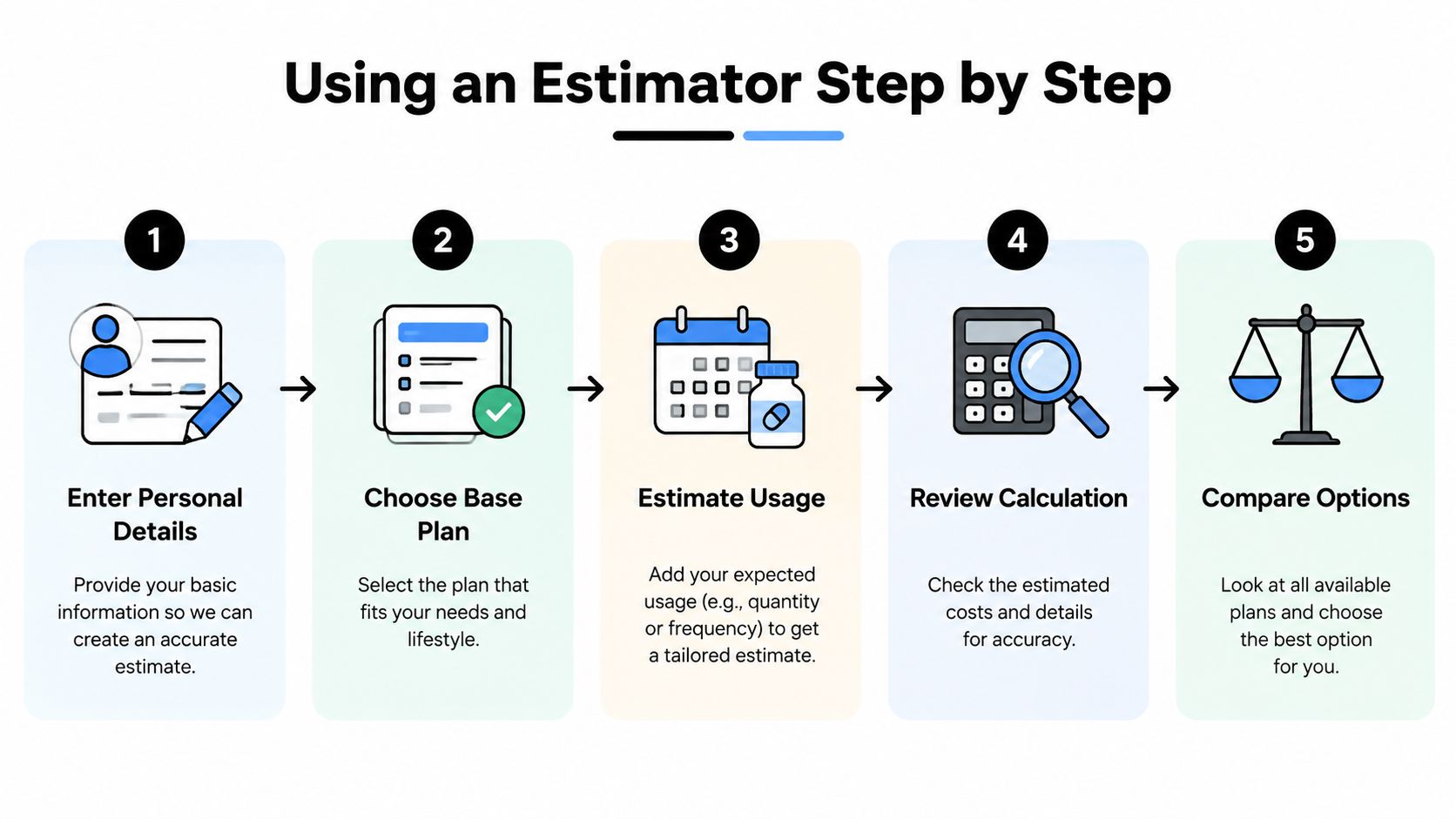
Using an Estimator Step by Step with Real Calculations
A British couple in their late 50s moving to the Costa del Sol can receive an attractive online estimate that says little about their eventual annual exposure. Use the tool to compare scenarios, not to treat the first result as a final Spanish market quote. The calculation below uses an illustrative figure so every step produces a number you can check.
Suppose the estimator returns a combined monthly premium of €180 for both applicants, an illustrative figure rather than a market quote. The annual premium is €180 × 12 = €2,160.
Step one, enter the personal details
Enter both dates of birth, the Costa del Sol location, residence status, smoking information if requested, and intended start date. Declare every known medical condition. Age bands and medical history can change the result materially, while an incomplete application can produce a figure underwriting will later reject.
Do not use a younger age, a different province, or an incomplete medical declaration to force a lower result. The quote may change after medical review, and omissions can create problems when you claim.
Step two, choose the base plan
Run a basic network plan and a standard plan separately. Record each monthly premium, then compare hospital access, specialist availability, outpatient care, diagnostic services, and copayments. A lower headline price is useful only if the network includes providers the couple can reach.
For visa applicants, filter for the required documentation and cover features first. A policy that fails the application standard is the wrong product, regardless of its lower price.
Step three, test the excess and medical history
Run the estimate with no excess, then with each available excess option. If declaring a condition changes the premium or adds an exclusion, record both the price and the underwriting decision. A lower premium with a condition exclusion may cost more overall than a higher premium that pays for the relevant treatment.
Add international coverage only if the couple expects to use it. The core calculation remains:
Annual premium = monthly quoted premium × 12
With the illustrative quote, that is €180 × 12 = €2,160. Add expected excesses, copayments, and treatment excluded from the policy.
Step four, model usage rather than guessing one outcome
Use three scenarios. For a healthy year, assume limited routine care and €100 of expected out-of-pocket spending. The estimated total becomes €2,160 + €100 = €2,260.
For an average year, assume consultations, tests, and medicines costing €600. The total becomes €2,160 + €600 = €2,760. For a worst-case illustration, assume eligible spending of €2,000, including the excess, before exclusions. The total becomes €2,160 + €2,000 = €4,160.
These figures are planning examples, not Spanish tariff data. Replace the usage assumptions with the policy's actual excess, copayments, limits, and exclusions. The three outputs should remain visible:
- Healthy-year total: Annual premium plus limited expected usage.
- Average-year total: Annual premium plus regular consultations, tests, and medicines.
- Worst-case total: Annual premium plus eligible spending up to the applicable limit, alongside excluded treatment.
Step five, compare the output with the contract
Save the quote and request the full policy wording. Compare the estimator's assumptions with the insurer's actual terms, especially age rules, pre-existing-condition decisions, exclusions, renewal terms, and visa documentation. If the tool cannot save the calculation, keep your own record of the inputs and results.
The final decision should answer three questions: can the couple afford the annual premium in a healthy year, can they absorb average usage costs, and would the worst-case exposure damage their finances? If the last answer is yes, the policy is too risky despite its attractive monthly result.
Practical Ways to Lower Your Health Insurance Costs
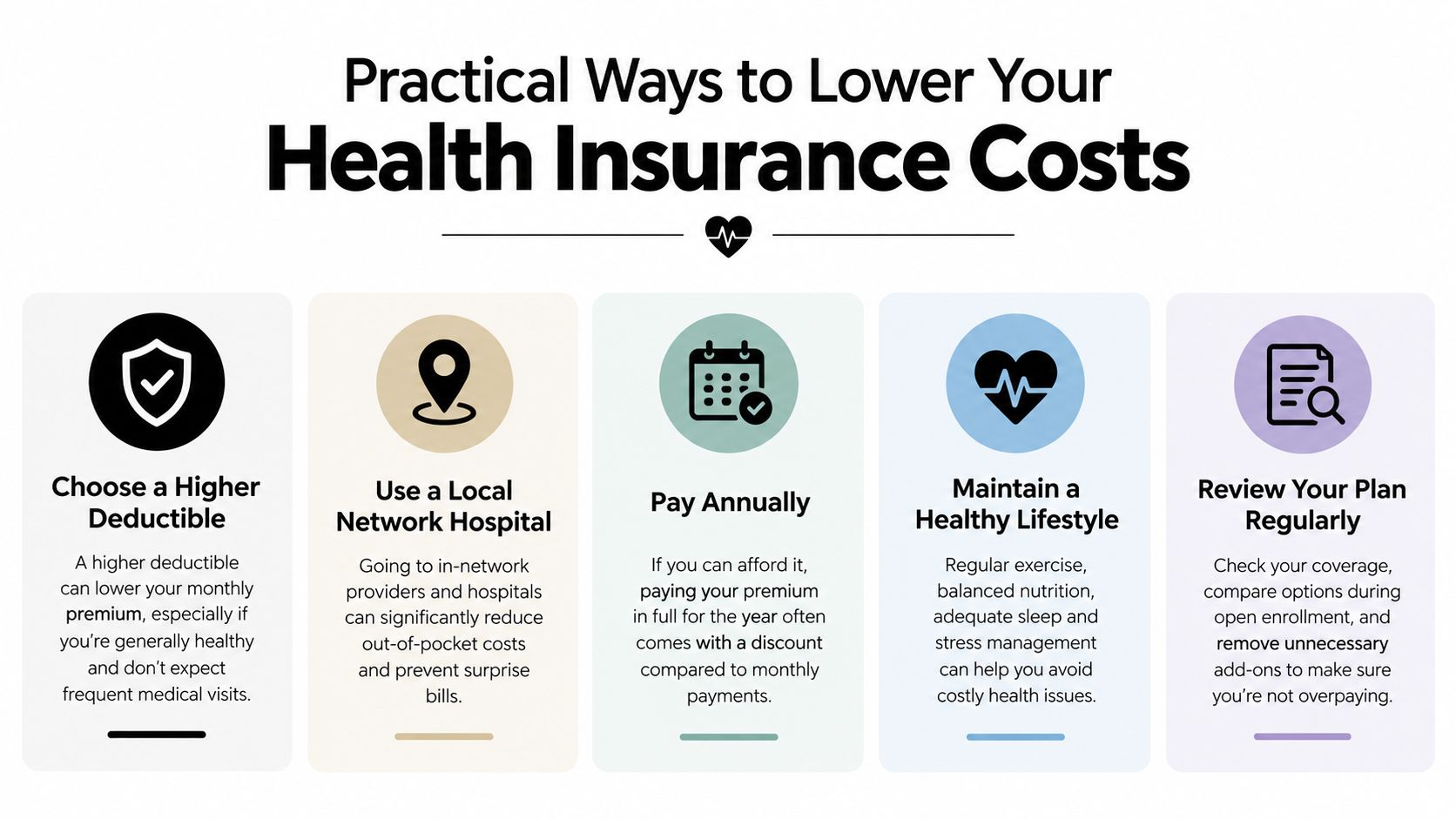
Lowering the premium is possible, but every reduction usually involves a trade-off. The right target is lower total cost for an acceptable level of protection, not the smallest monthly figure.
Choose the cost-sharing structure deliberately
A higher excess can reduce the recurring premium, but you'll pay more when you use the policy. This makes sense for someone with savings, infrequent medical needs, and a clear understanding of the maximum personal contribution. It's a poor choice for someone expecting regular specialist treatment.
Copay-free cover generally gives you more predictable spending after purchase. A copayment plan may look attractive in an estimator, but frequent appointments can erode the saving. Ask the insurer to show the actual charge per service and whether there's an annual limit.
Match the network to your life in Spain
National or international hospital access offers flexibility, but a regional network may be sufficient if you're settled in one area. Check the hospitals you'd realistically use, not just the size of the provider directory.
A Costa del Sol resident should verify nearby private hospitals, English-speaking specialists, emergency arrangements, and referral procedures. Paying for hospitals in locations you won't visit is unnecessary. Choosing a network that omits your preferred local provider is false economy.
Apply before a new age band where possible
Age-based pricing means timing can matter. Don't delay a decision to chase a lower quote, but start comparing before a birthday that may move you into a more expensive band. Ask how the insurer applies age on the application date, renewal date, or policy start date.
For families, compare individual policies with a combined family policy. A single arrangement may simplify administration, but it isn't automatically cheaper or more suitable. Check each person's age, medical history, benefits, and underwriting outcome separately.
Compare underwriting, not just insurers
Two insurers can treat the same declared condition differently. One may exclude related treatment, another may apply a loading, and a third may decline the application. The relevant comparison is therefore the approved cover, not the initial calculator output.
Finally, choose the narrowest plan that still satisfies your purpose. A visa applicant needs compliant documentation and qualifying cover. A settled resident with established public healthcare access may value a different balance between private access, hospital choice, and price. Don't buy global benefits, luxury hospital access, or extras that have no practical use.
Where Online Estimators Fall Short and When to Call a Broker
Online estimators answer a narrow question: what might this policy cost based on the information entered? They often don't answer the more important question: what will this policy cost for you, after underwriting and actual treatment?
Independent research on live member portals found that estimate pages often lack deductible-progress information, educational support, and estimate management. The KFF subsidy calculator research also highlights the broader problem of tools that focus on the displayed estimate without fully supporting users who need to save, revisit, or understand it.
A calculator can't interpret medical underwriting
A form may ask whether you have a condition, but it can't negotiate the meaning of your medical history. It won't tell you whether an exclusion is acceptable, whether a waiting period applies, or whether another insurer might offer a more useful decision.
You should seek advice before applying if you have:
- Pre-existing conditions: Especially conditions requiring ongoing medication, monitoring, or specialist care.
- A mixed-age family: Age bands and medical histories can produce different outcomes for each member.
- Retirement plans: Applicants over 65 and 75 need clear answers about acceptance and future renewal.
- A visa application: The certificate and policy features must match the relevant immigration requirement.
- A planned switch: A new insurer may impose fresh waiting periods or reassess previously accepted conditions.
What a broker adds
A qualified broker can compare the approved terms, not just the initial prices. They can clarify exclusions, identify whether a zero-copayment policy is available, check network access, and explain how changing insurers may affect waiting periods.
Bsure Health Brokers is one option for expats who need help comparing Spanish and international policies, handling paperwork, and managing renewals or claims support. Its service is aimed at English-speaking residents and newcomers, including families, retirees, and applicants with complex medical histories. You can learn more about the role in this guide to what a health insurance broker does.
Decision test: If the quote changes materially after age, medical history, visa requirements, or network preferences are added, stop relying on the calculator alone.
The broker shouldn't replace your judgment. The broker's role is to make the consequences of each choice visible before you commit.
Your Next Steps to Smarter Health Insurance Decisions
Use a health insurance cost estimator to create a shortlist, then verify the policy behind each result. Your decision should reflect annual premium, excess, copayments, exclusions, waiting periods, hospital access, and the maximum amount you could realistically pay during a difficult year.
For a young Digital Nomad Visa applicant, start with compliance, zero-copayment requirements, network access, and certificate wording. For a family, compare paediatric and specialist access against the cost-sharing structure. For a retiree over 65, obtain written confirmation of acceptance, renewal terms, age-band treatment, and the handling of pre-existing conditions before switching or cancelling existing cover.
Use this guide to comparing health insurance plans to record the same details for every quote. Then ask a direct question: which policy gives you the most manageable total annual cost for the care you are likely to need?
An estimator gives you speed. A careful comparison gives you context. Professional advice becomes worthwhile when the cheapest quote carries exclusions, uncertain visa compliance, or financial exposure you can't comfortably absorb.
Bsure Health Brokers can compare suitable Spanish and international policies, explain how age bands and pre-existing conditions affect the terms, and help you obtain documentation for visa or residence needs. Visit Bsure Health Brokers to request a comparison based on your age, location, medical history, and expected healthcare use.