
You're in Spain, the bike lane ends too fast, a scooter cuts across your path, and suddenly you're trying to remember whether your private policy covers the hospital, the physio, the dental work, and the weeks of recovery you didn't plan for. That's the moment most expats discover that health insurance accident coverage is not one simple yes or no question. In Spain, the answer depends on what kind of policy you bought, what the insurer calls an accident, and whether you needed help with treatment, transport, repatriation, or the costs that sit outside the medical bill.
Table of Contents
- What Happens When an Accident Hits Your Spain Health Insurance
- Understanding Accident Coverage in Health Insurance
- Standalone Accident Plans, Add-Ons, and Built-In Benefits
- What Accident Coverage Typically Includes and Excludes
- Filing a Claim and Handling Emergencies in Spain
- Accident Coverage and Spanish Visa or NIE Compliance
- Typical Costs, Choosing Well, and How Bsure Health Brokers Helps
- Frequently Asked Questions About Accident Coverage in Spain
What Happens When an Accident Hits Your Spain Health Insurance
A fractured collarbone in a private hospital feels like the system is working. The operation gets done, the staff are competent, and the immediate crisis is handled. Then the practical questions start. Who pays for the follow-up physiotherapy? What about the dental repair if the impact damaged your teeth? What happens if you can't work for a few weeks, or if you need to be moved closer to family?
That's where expats get tripped up. A Spanish private health plan is usually built to pay for medical care, not the full financial fallout of an accident. If the policy includes emergency care and surgery, that's useful, but it doesn't automatically mean the insurer will cover every later expense tied to the injury.
The other trap is assuming every accident cost behaves the same way. It doesn't. In many markets, accident protection sits in a separate layer as a cash benefit, while the health policy pays the treatment bill. In Spain, the policy language matters more than the marketing brochure. If you don't know whether your plan treats the event as an accident, illness, emergency transport issue, or reimbursement claim, you're guessing in a moment when guessing is expensive.
Practical rule: buy the policy for the emergency you can't control, not for the brochure promise you'd like to believe.
If you're an expat trying to decide what's enough, the rest of this guide is the practical version of that decision. Some readers need visa-compliant medical cover. Others need a clean way to protect against injury-related gaps. A few just want to know whether their current plan will behave in a real emergency. All three groups need different answers.
Understanding Accident Coverage in Health Insurance
Accident coverage isn't one product. It's a structure. In some policies, it's a scheduled cash benefit, which means the insurer pays a fixed amount for a defined event or injury. In other policies, the accident is handled inside the main health policy, so the insurer pays the medical bill itself, subject to the contract terms.
The easiest way to think about it is this. A scheduled indemnity plan behaves like a fixed payout, closer to a pre-set benefit than a bill refund. A reimbursement-based health policy behaves like a repair invoice, where the insurer pays actual eligible medical costs after the claim is processed. Those are not the same thing, and expats often confuse them because both can be called “accident cover.”
The trigger language is what decides whether a claim belongs in the accident bucket. In regulated markets, the event is usually described as a sudden, unforeseen, involuntary incident caused by external and visible means. That wording sounds formal because it is formal. If the insurer thinks the injury came from illness, wear-and-tear, or a condition that wasn't accidental, the claim can shift out of accident cover entirely.
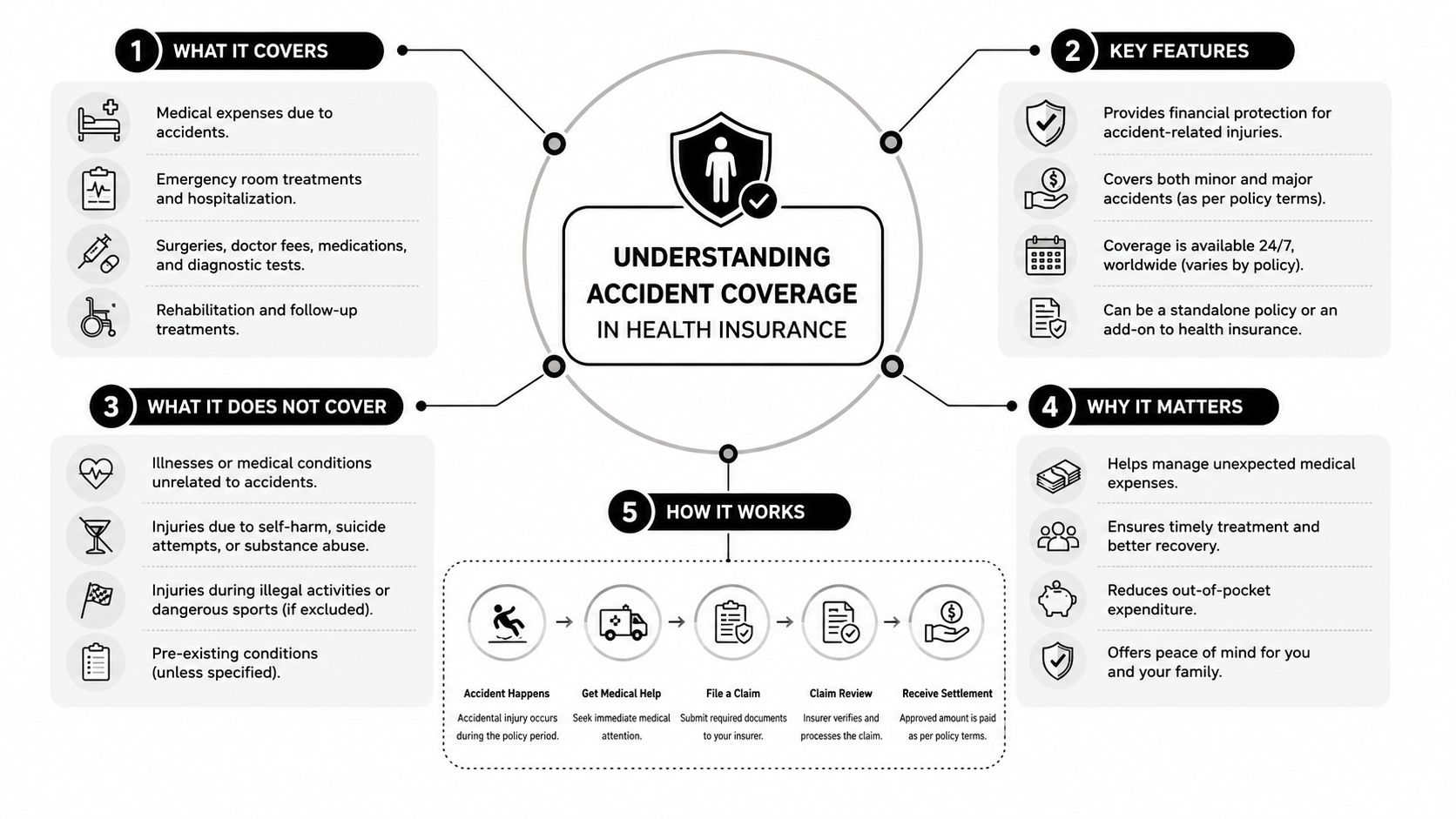
Three ways the money can work
The structure is what matters, not the label on the front page.
- Scheduled indemnity: the insurer pays a fixed benefit for a defined event or injury.
- Accident rider: the main policy stays in place, and the rider adds extra accident protection on top.
- Embedded accident benefit: the health plan itself covers the emergency treatment and hospitalization under its own rules.
A private health plan in Spain usually sits in that third category. The accident is not a separate mini-policy, it's an event the health insurer agrees to treat if it fits the contract. That's why two plans can both sound thorough while one handles transport, surgery, and follow-up better than the other.
Insurer language beats sales language. If the policy schedule doesn't clearly say how accidental injuries are treated, assume the narrow reading will win.
Standalone Accident Plans, Add-Ons, and Built-In Benefits
The cleanest way to compare accident protection is to stop pretending all policies work the same way. They don't. A standalone accident plan is a separate contract that pays cash benefits. An add-on rider sits on top of an existing policy. Built-in accident protection is the version most expats use in Spain, because the private health policy already handles the hospital side.
Standalone accident cover is common in some countries and in some international benefit packages, but it's not the usual shape of Spanish domestic private health insurance. That matters because a standalone cash plan may help with non-medical fallout, yet it won't satisfy a visa applicant who needs proper health cover. A rider can be useful if your base policy is weak on a specific exposure, but it still depends on the underlying health contract doing the heavy lifting.
Compare the structures before you buy
| Structure | How It Pays | Typical Premium Impact | Visa Suitability |
|---|---|---|---|
| Standalone accident policy | Fixed cash benefit for defined events | Separate line item | Usually not enough on its own |
| Add-on rider | Extra benefit layered onto a base policy | Adds cost to the base plan | Depends on the main policy |
| Built-in private health benefit | Pays treatment under the health contract | Usually bundled into the health plan | Usually the practical route |
If you're relocating to Spain, the built-in version is the one you should inspect first. That's the one that can cover emergency care, hospitalization, surgery, and the clinical pathway after an injury. The rider comes second, only if the base policy leaves a gap you need to close.
The mistake I see constantly is people buying “more accident cover” without checking whether they're buying the right kind. A cash payout sounds attractive until you're standing in a hospital asking who authorizes the scan. The hospital needs treatment cover, not a marketing promise.
What Accident Coverage Typically Includes and Excludes
The good policies handle the obvious stuff first. Emergency room treatment, hospitalization, surgery, diagnostic imaging, and acute medication are usually the core items people expect. Follow-up specialist visits are often included too, at least while the injury is still in the active treatment phase.
But people get sloppy. The policy may treat an emergency visit as covered, then cap the physiotherapy later. It may accept the fracture, then limit dental trauma. It may pay for hospitalization, then place strict rules on prosthetics or home modifications. The word “covered” doesn't mean everything connected to the accident is covered.
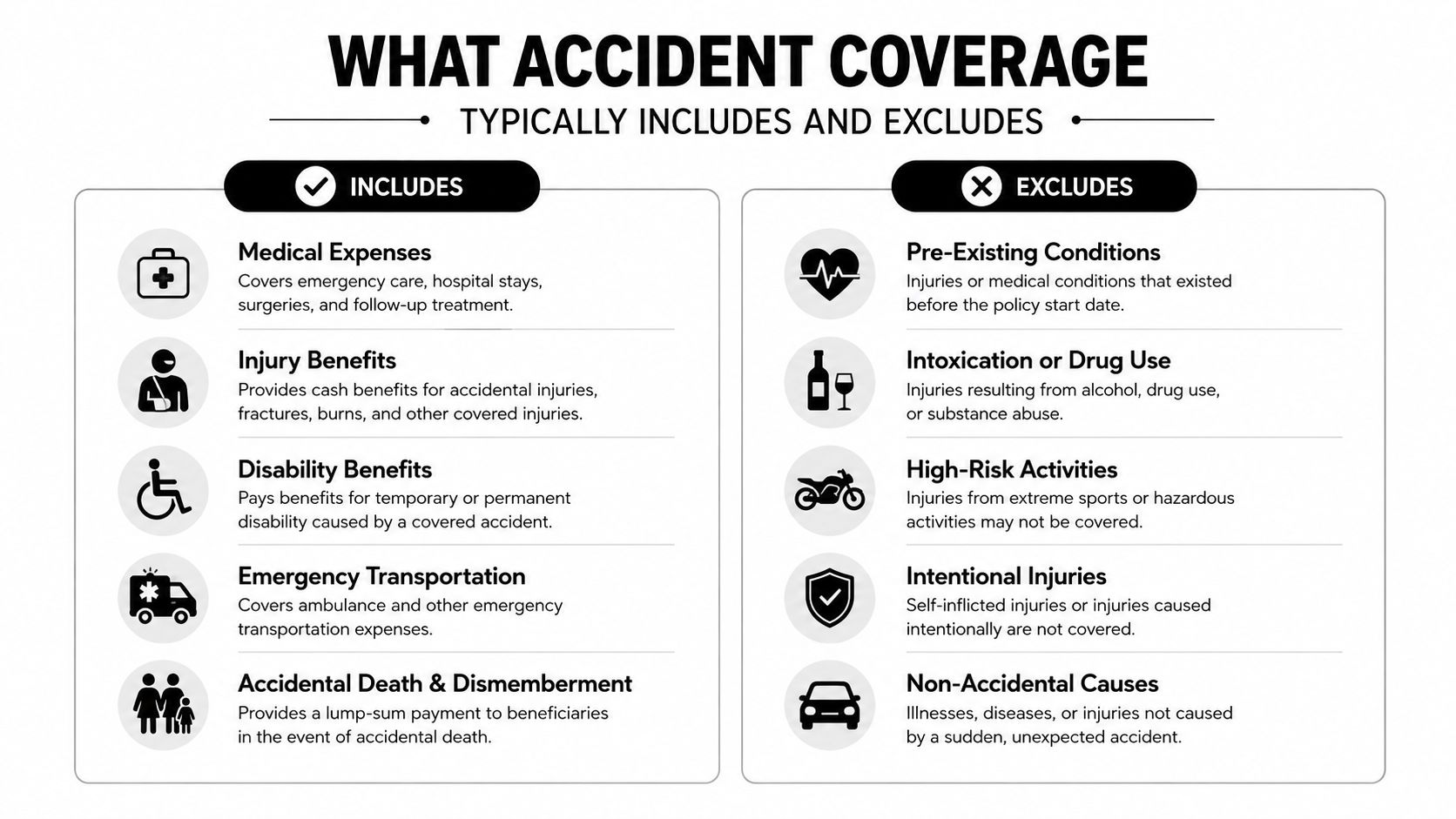
The exclusions that catch expats
- High-risk sports: policies often exclude activities such as paragliding, motor racing, or professional diving.
- Alcohol or drug involvement: if the insurer links the injury to intoxication, the claim can fail.
- Work-related accidents: these can be routed into a separate occupational system.
- Self-harm: normally excluded.
- Pre-existing conditions: if the event is tied to an old musculoskeletal problem, the insurer may argue it wasn't a covered accident.
The grey zone is where the arguments happen. A broken bone is easy. Recovery support is not. If your policy gives you emergency treatment but leaves dental reconstruction, mobility aids, or home adjustments hanging, you've bought a partial answer.
That's why I tell clients to read the Exclusions and Limitations section before they think about price. Many people do the reverse and regret it later. A cheap plan with a sharp exclusion list is not a bargain, it's deferred disappointment.
Filing a Claim and Handling Emergencies in Spain
The first phone call after a serious accident in Spain is 112 if it's an emergency. If you need urgent stabilization, the nearest public hospital can handle that immediately. After that, the insurer's 24-hour line should take over if you're moving into private treatment under a covered plan.
Spanish private insurance usually works in one of two ways. Asistencia sanitaria means the insurer coordinates and pays for treatment directly inside its network. Reembolso means you pay first and claim money back later. If you have the choice, a cuadro médico plan is usually smoother in an accident because it reduces friction at the very moment you don't need it.
Documentation is not optional. You'll usually need the parte de lesiones, the medical report, and sometimes the police report if the circumstances require it. Keep every receipt if you're on a reimbursement policy. Miss one paper and the claim slows down. Miss the right paper and the claim argument starts.
For a practical hospital workflow, this guide on how to use private health insurance at a Spanish hospital is worth having open before you travel or move. The hospital desk doesn't care that you're confused, it cares whether your policy, card, and ID line up cleanly.
Practical rule: after a serious injury, stabilize first, notify the insurer second, and preserve paperwork from the start.
If you've ever dealt with the aftermath of a car claim, you already know the logic. There's a useful explanation of negotiating with insurers for medical bills that captures the same principle, don't throw away evidence and don't assume the first answer is the final answer.
Accident Coverage and Spanish Visa or NIE Compliance
Spanish visa files break because applicants assume an accident policy will do the job of a full health contract. It will not. For residency routes such as the Non-Lucrative Visa and the Digital Nomad Visa, consulates want a medical insurance contract that covers ordinary medical care, not a separate accident indemnity product that only pays under limited circumstances.
The policy wording has to be clean. No co-payments. No waiting periods. Repatriation of remains. If the certificate or policy text adds narrow sub-limits for accident treatment, the file starts to look weaker, even if the brochure sounds generous. Consular staff care about how the cover performs in an emergency, because that is where a weak policy exposes itself.
Accident protection still matters because the health policy has to carry the entire emergency load. Hospitalization, urgent care, and transport need to be covered in a way that does not trigger avoidable questions. Family residency files are even more sensitive when status depends on something like pareja de hecho in Spain, because the paperwork has to line up across the whole file and the insurer's wording cannot create doubt.
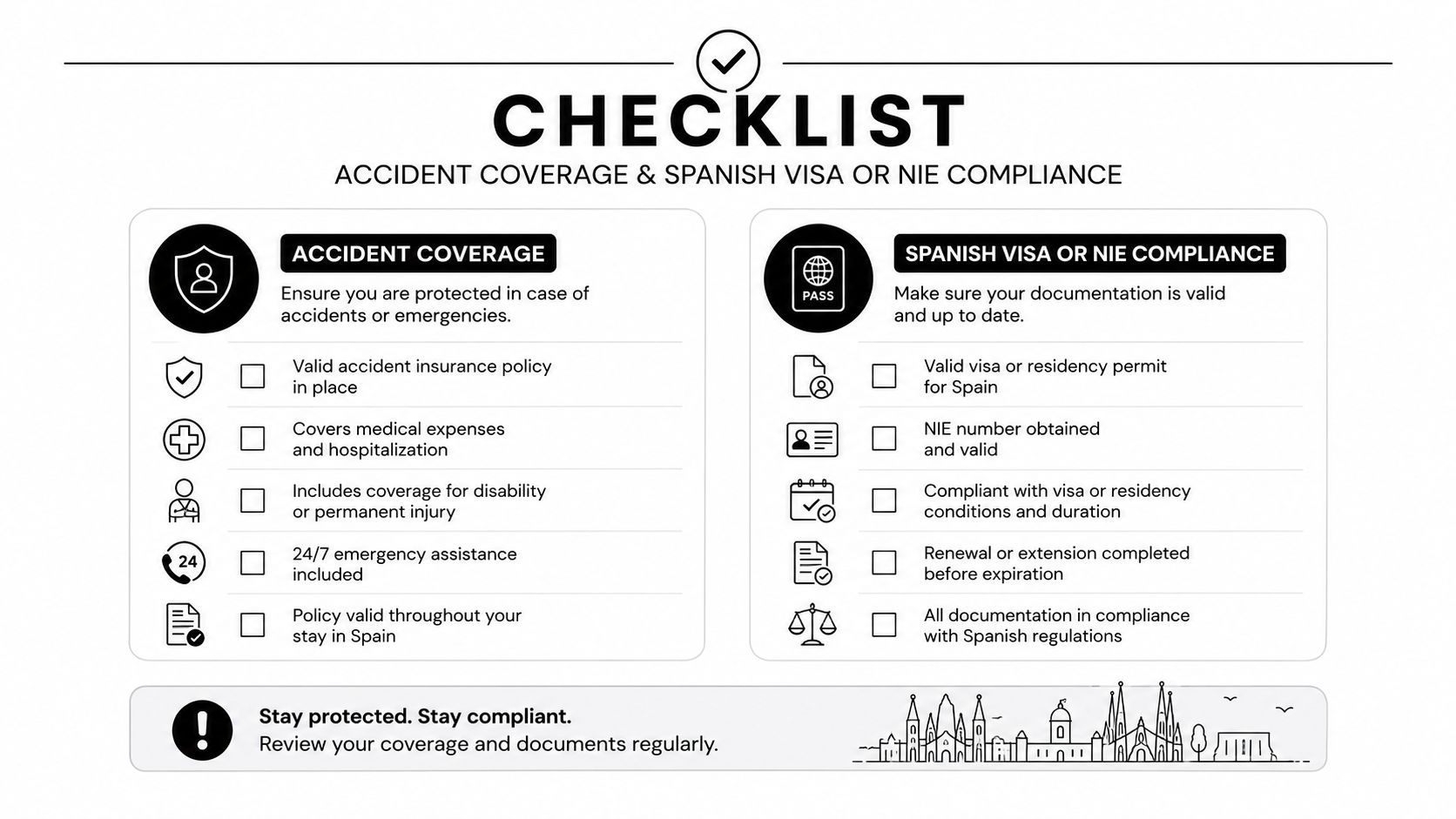
What I'd verify before submitting a visa file
- No co-payment wording appears explicitly in the policy certificate.
- Emergency hospitalization is covered without narrow accident-only language.
- Repatriation is included in writing.
- Waiting periods do not appear in the version you submit.
- Hobby or job risks are disclosed if the insurer asks.
A policy with clear emergency transport, intensive care, and hospitalization wording usually reads better in a visa file. A narrow plan can still be accepted, but it gives the consulate more room to ask questions. That is bad tradecraft when you are trying to get residency paperwork through cleanly.
Use this schengen visa insurance requirements reference as the formal baseline, because it keeps the focus on what the cover must do. If you want the file to stand on its own, the policy needs to satisfy the residency check without relying on optimistic interpretation.
Typical Costs, Choosing Well, and How Bsure Health Brokers Helps
In Spain, the accident piece rarely arrives as a neat separate price tag. For expats, the premium is usually driven more by age, region, and pre-existing conditions than by the accident label itself. That's why comparing policies only by monthly cost is lazy and usually wrong.
The better buying method is blunt and simple. First, check whether accident triggers are broadly defined. Second, confirm your hobbies aren't excluded. Third, look hard at physiotherapy, dental trauma, repatriation, and emergency transport. Fourth, read the exclusions line by line. If the policy only looks good when you ignore the small print, it's the wrong policy.
One practical option is Bsure Health Brokers, an independent brokerage that compares Spanish and international health policies and handles the paperwork, renewals, and support side of the file. Their health insurance premium comparison page is the kind of starting point I'd use if I wanted a market view before choosing a plan. In accident-heavy decisions, clarity beats optimism.
My recommendation: buy the policy that behaves correctly in an emergency, then verify the price.
If you're an expat in Spain and you want this handled properly, send Bsure your passport, NIE or application reference, and a short note about your medical history and activities. A good broker should come back with a clean comparison, explain the accident wording, and tell you which policy won't embarrass you at the hospital desk.
Frequently Asked Questions About Accident Coverage in Spain
Is accident coverage tax-deductible in Spain?
That depends on the policy type and your tax situation. Don't assume a health policy, a rider, or a standalone accident plan gets the same treatment. Ask a tax adviser before you buy.
What happens after a year of residency if I can use the Convenio Especial?
The Convenio Especial changes your access to the public system, but it doesn't magically fix private accident gaps. If you still need private hospital choice, repatriation, or broader emergency handling, keep the private policy.
Can retirees over 65 get full accident cover?
They can often get strong private health cover, but underwriting is tighter and the wording matters more. Don't shop by age alone, shop by what the policy says about injuries, emergencies, and follow-up care.
Can I switch providers without losing accident protection mid-treatment?
Not safely unless the new insurer explicitly accepts the ongoing case. Get written confirmation before you cancel the old policy.
Before you apply, gather your passport, NIE or application reference, and medical history, then ask for a proper comparison from a qualified broker. That saves time, avoids policy gaps, and stops you from finding out the hard way that the wrong accident wording can turn a bad day into a much bigger bill.
If you want a broker who compares Spanish and international plans, checks the accident wording, and handles the visa paperwork without the usual confusion, contact Bsure Health Brokers. They work with expats across Spain, and they can tell you quickly whether your current plan covers the accident scenario you're worried about.